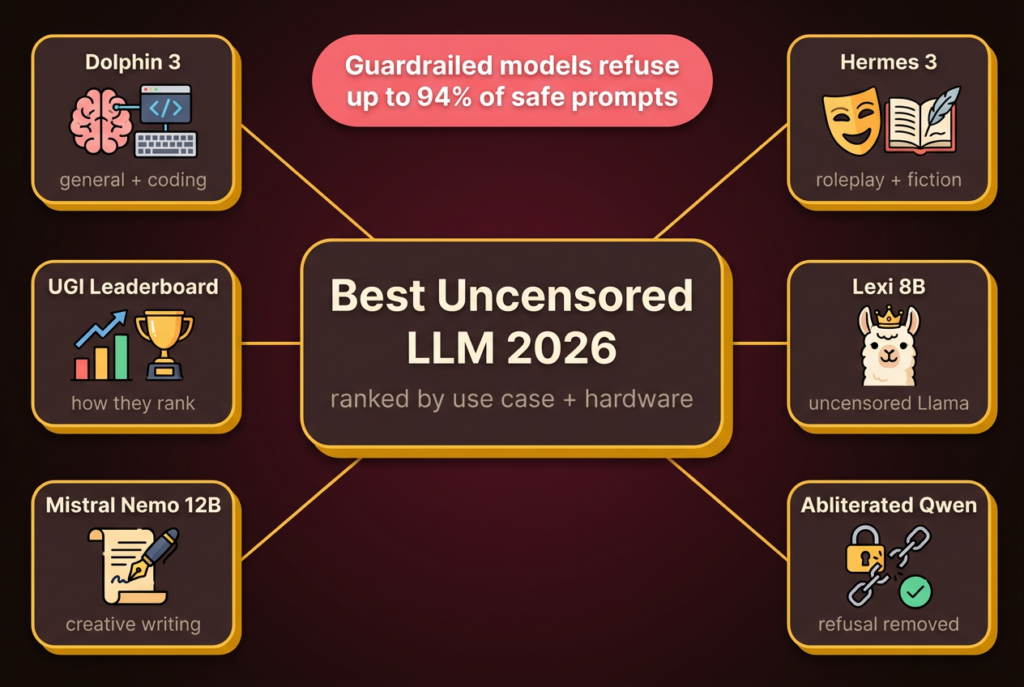
“Uncensored” is a loaded word, so let me start with a number instead. On OR-Bench, a benchmark of 80,000 prompts that look risky but are actually harmless, Claude 3 Sonnet refused 94.4% of the hardest set while GPT-4o refused 6.7% (OR-Bench, Cui et al., ICML 2025). Same safe questions, a fourteen-fold difference in refusals. That gap is the whole reason a sober, non-edgelord slice of the local-LLM community runs uncensored models. Not to do anything illegal, but to stop a guardrail from blocking legitimate work. This guide ranks the best uncensored LLMs in 2026 and explains what “uncensored” actually means, how these models get ranked, which ones to pick by job and by hardware, and the risks you take on once the safety layer is gone.
Key Takeaways
- There’s no single best uncensored LLM. The leaderboard champ (Grok, DeepSeek) and the model you actually run on a laptop (Dolphin, Lexi, a Nemo finetune) are different picks.
- “Uncensored” is a spectrum of four things: base models, fine-tuned models (Dolphin, Hermes), abliterated models (refusal direction surgically removed), and merely permissive instruct models.
- The UGI “Uncensored General Intelligence” leaderboard ranks 765+ models on knowledge plus willingness to answer (UGI Leaderboard, 2026).
- Pick by use case and VRAM: a 7-8B model runs on an 8GB laptop GPU; roleplay and long fiction reward 12B and up if you have the memory.
- You own everything an uncensored model outputs. No platform filter, no liability shield. That is the real trade.
What does “uncensored” actually mean?
Most uncensored models aren’t trained to be dangerous. They’re trained, or surgically edited, to stop refusing. The clearest proof is abliteration: a 2024 method that cancels a single direction in a chat model’s activations dropped Llama-2-7B-Chat’s refusal rate from 100% to roughly 20% while keeping general capability intact (Arditi et al., 2024). Removing refusals turns out to be a small, targeted edit, not a retrain into a different brain.
The four flavors of “uncensored”: (1) Base models never went through safety tuning, so they don’t refuse, but they don’t follow instructions well either. (2) Fine-tuned uncensored models like Eric Hartford’s Dolphin series and Nous Research’s Hermes are retrained on data that doesn’t reinforce refusals. (3) Abliterated models (Qwen, Llama, and Mistral builds carrying the “-abliterated” tag) keep their original training but have the refusal direction ablated out. (4) Permissive instruct models, such as several Mistral releases, are just lightly aligned to begin with. Only the middle two are “uncensored” in the way most people mean it.
There’s a quality cost worth knowing. Fine-tuned models tend to stay coherent because they were retrained as a whole, while abliterated models can get less stable on odd prompts, since the edit is blunt (Atlas Cloud, 2026). And “uncensored” does not mean “aligned with you.” The Lexi model card flat-out tells you to add your own alignment layer before shipping it, because it will comply with almost anything you ask. The term abliteration itself is a portmanteau of “ablate” and “obliterate,” coined by the developer FailSpy who wrote the first tooling for it.
For the runtimes, licenses, and hardware that make any of this run offline, our complete pillar guide to running LLMs locally with Ollama, LM Studio, llama.cpp and vLLM is the place to start.
Why would anyone want an uncensored LLM?
Because safety tuning overshoots, and the cost lands on legitimate work. OR-Bench measured this directly: across major models, refusal rates on benign-but-spiky prompts ranged from 6.7% to 99.8%, with Claude 2.1 refusing 99.8% and the Claude 3 models still over 90% (OR-Bench, Cui et al., ICML 2025). If your job lives anywhere near the gray zone, that’s a wall you hit every day.
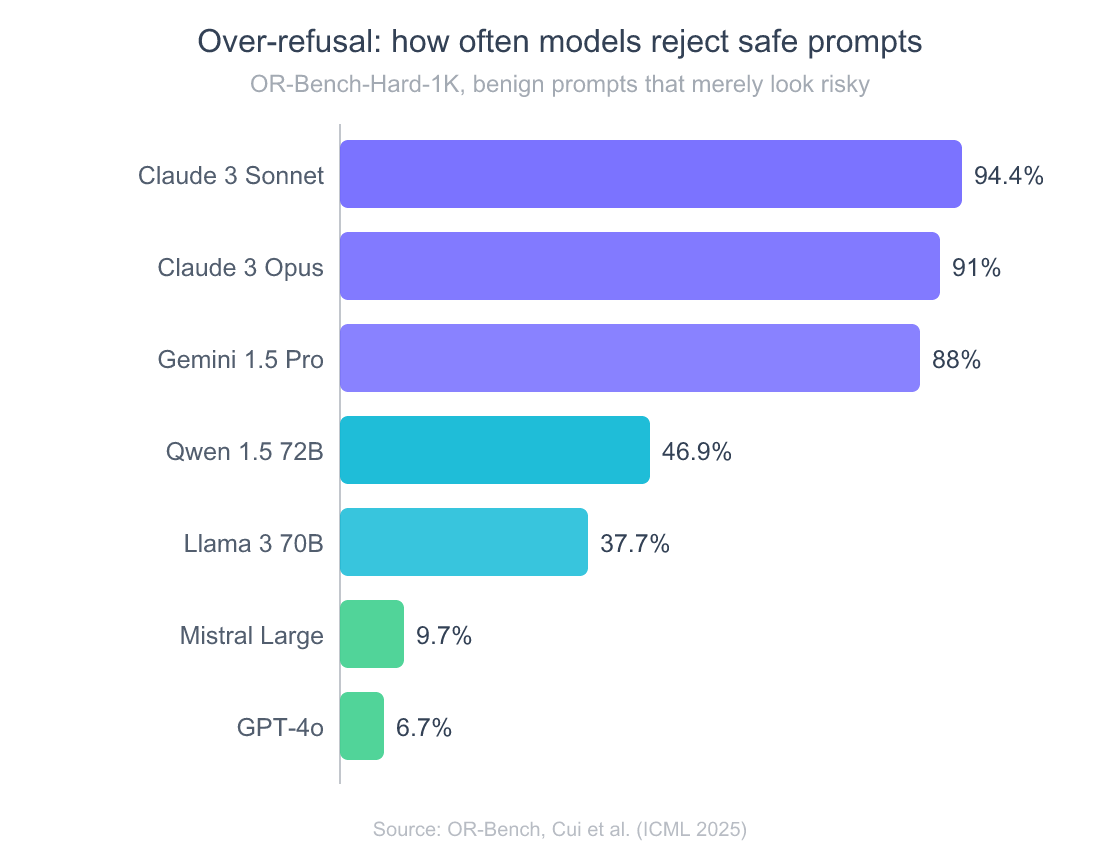
Source: OR-Bench, Cui et al., ICML 2025. Same harmless prompts, wildly different refusal rates.
I hit this constantly. I’ve watched a hosted model refuse to summarize a public security advisory because it named an exploit, refuse to write a villain’s dialogue for a short story, and refuse to explain a SQL injection it had just flagged in my own code. None of that is dangerous. It’s ordinary work for a developer, a novelist, or a security researcher. Running a local uncensored model removes the false positive without me having to argue with a chatbot about whether my own job is allowed.
So who legitimately reaches for these? Four groups, mostly. Privacy-first users who want a model that never phones home. Fiction and roleplay writers who need characters that can be flawed, violent, or morally gray on the page. Security researchers who study malware, exploits, and phishing for defense. And builders who are simply tired of false-positive guardrails on benign requests. The audience is bigger than it looks, and it congregates on Reddit: r/LocalLLaMA threads on “best uncensored model” and “best LLM for roleplay” run for hundreds of comments, which is also why these searches carry heavy Reddit-modifier intent. If you care where AI assistants source their recommendations, that community is the surface they read from, a point I dig into in our guide to GEO and answer-engine optimization.
How are uncensored models ranked?
With a purpose-built leaderboard, because standard benchmarks don’t measure willingness to answer. The UGI (Uncensored General Intelligence) Leaderboard on Hugging Face scores more than 765 models on two axes: a UGI score for breadth of knowledge across sensitive topics, and a W/10 “willingness” score for how readily a model engages (UGI Leaderboard / DontPlanToEnd, 2026). The test questions are kept private so labs can’t train against them.
At the top, the big hosted models actually lead. Grok-4 sat at 69.0 UGI in late 2025, ahead of DeepSeek-V3.2-Speciale at 67.9 and Grok-3 at 63.2, with DeepSeek leading the open-weight field (UGI Leaderboard, 2026). That ordering is a useful reminder: a high UGI score often just means a frontier-scale model with light alignment, not a small local model you can run.
Willingness and intelligence are different axes. A model can be very willing but not very smart (many small uncensored finetunes), or smart but cagey (most aligned flagships). The UGI score and the W/10 score pull apart on purpose. For local use you’re optimizing a third thing the leaderboard doesn’t show: capability per gigabyte of VRAM. The best leaderboard model is rarely the one you keep installed.
Treat the UGI board the way you’d treat any benchmark, as a filter and not a verdict. It tells you which families are permissive and roughly how capable they are. It does not tell you which one fits your GPU or your task. For the underlying capability ranking of the open models these finetunes are built on, our ranked guide to the best open-weight LLMs covers which base to trust.
The best uncensored LLMs in 2026, by use case
The models people actually run are mostly 7-13B finetunes, and Dolphin dominates the catalog. On Ollama, llama2-uncensored leads with about 2.6 million pulls, followed by dolphin-llama3 at 1.9 million and dolphin-mistral at 1.5 million; the Dolphin family alone holds five of the top ten uncensored slots by download (Atlas Cloud, 2026).
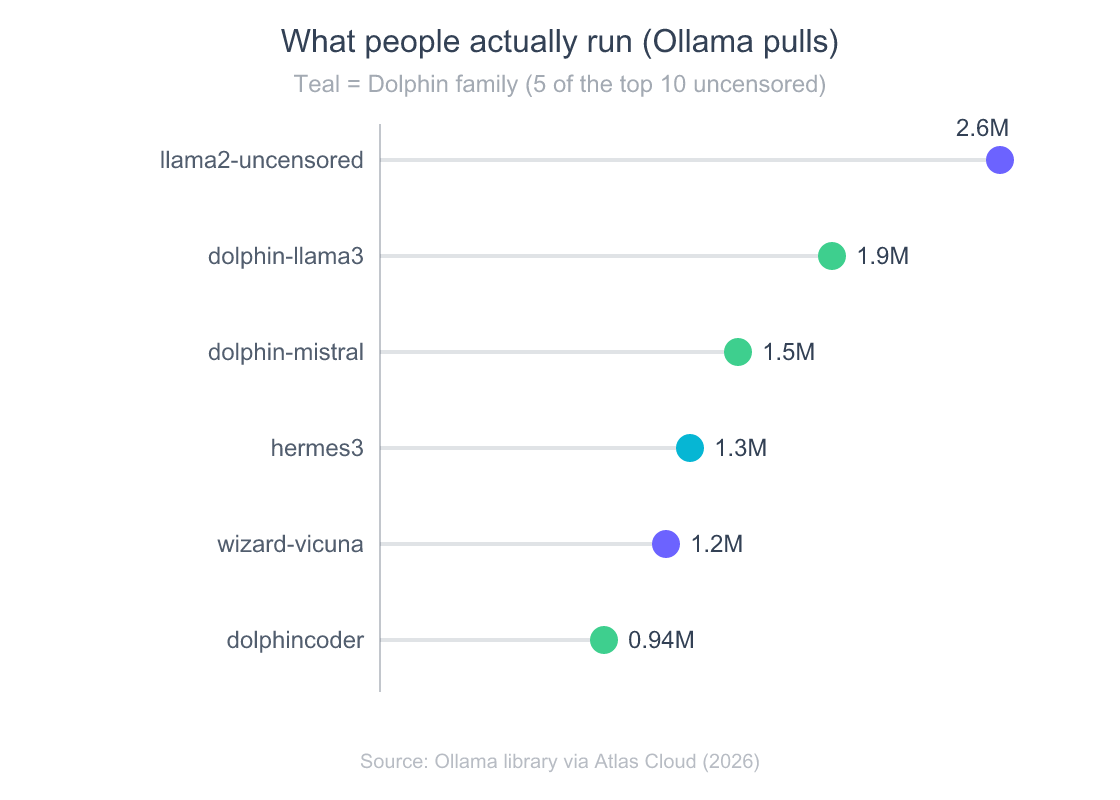
Source: Ollama library via Atlas Cloud, 2026.
Here’s how I’d route the common jobs.
General assistant: Dolphin 3 and Hermes 3
These are the safe all-rounders. Hermes 3 (Nous Research, available from 3B up to 405B) is widely called the best general uncensored model for fiction and structured tool use, and Dolphin 3 (Eric Hartford’s series, usually on Mistral or Llama) is the lighter pick that runs comfortably on a 16-24GB machine (Atlas Cloud, 2026). If you want one uncensored model that does most things without drama, start with one of these two.
Roleplay and creative fiction: the Mistral Nemo finetunes
For roleplay, the Mistral Nemo 12B family is the community default and has been hard to beat at the roughly 10GB VRAM footprint since its 2024 release (Hugging Face, 2026). The finetunes are where the character depth lives: Gryphe’s Pantheon-RP, MarinaraSpaghetti’s NemoRemix, and Lumimaid for persona-driven chat. If you have more VRAM, TheDrummer’s Cydonia 24B (built on Mistral Small) and Sao10K’s Llama 3.3 Euryale 70B are the high-end roleplay picks. On Ollama specifically, the best roleplay model for most people is whichever Nemo-based GGUF fits your card.
Uncensored Llama for LM Studio: Lexi
If you run a GUI, Lexi is the one to know. Orenguteng’s Llama-3.1-8B-Lexi-Uncensored-V2 is an 8B model on the Llama 3.1 Instruct base with a 32K context, and bartowski’s GGUF quants load straight into LM Studio (Hugging Face, 2026). It’s fast, it fits an 8GB card, and it’s about as compliant as an 8B model gets. The model card’s own warning is the catch: it will follow nearly any instruction, so you own the moderation.
Coding without the lectures: abliterated Qwen and Dolphin-Coder
For code, the abliterated Qwen2.5-Coder and DeepSeek-Coder builds, plus dolphincoder (943K pulls on a StarCoder2 base), give you a coding assistant that won’t refuse to write a port scanner or explain a vulnerability you’re patching. The capability ceiling still comes from the base model, so for the raw coding ranking see our ranked comparison of the best coding LLMs by use case.
Tiny and laptop-bound: Dolphin-Phi
When hardware is the constraint, dolphin-phi (2.7B, under 4GB VRAM) is the most accessible uncensored model going. It won’t win benchmarks, but as a fast offline assistant on a thin laptop it’s hard to beat.
What I tell people: don’t chase the leaderboard. Pick the smallest model that clears your task, run it locally, and only size up when the output genuinely falls short. A 7-8B finetune handles most chat, drafting, and “just answer the question” work; you reach for 12B and up only when roleplay coherence or long fiction demands it.
Which uncensored model fits your hardware?
Your GPU decides more than the leaderboard does. An 8GB consumer card runs any 7-8B model at Q4_K_M quantization, which cuts memory roughly 75% versus full precision while keeping output quality high; Mistral 7B needs only about 4.3GB at that setting (SitePoint, 2026). Quantization is the whole game for local models: it’s what lets a “13B” model fit where the raw weights never would.
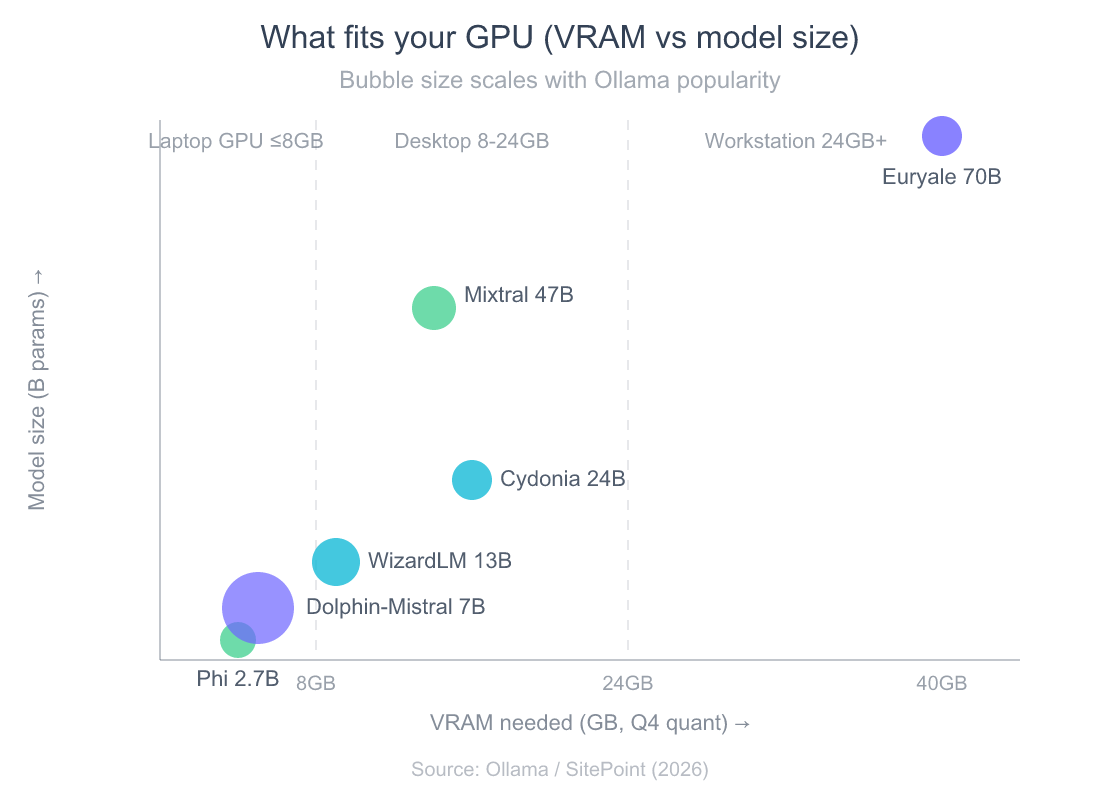
Source: Ollama and SitePoint, 2026. The most-run models cluster in the cheap 4-9GB corner.
The ladder is simple. On an 8GB laptop GPU (an RTX 4060 class card), run any 7-8B uncensored model: Dolphin-Mistral, Lexi, or Hermes 3 8B all fit at Q4_K_M. A 16-24GB desktop card opens the 12-24B tier, where the Nemo roleplay finetunes and Cydonia live, plus Dolphin-Mixtral if you quantize hard. You only need a 40GB-plus workstation, or a Mac with 64GB-plus unified memory, for the 70B tier like Euryale. CPU-only laptops still work for 7B models, just slower. This is also the honest answer to “best 7B LLM” for local use: at that size, a Mistral or Llama 3.1 8B finetune is the sweet spot of speed, quality, and fit.
How do you run an uncensored model locally?
Two tools cover almost everyone: Ollama for the command line, LM Studio for a GUI. To run an uncensored model on Ollama, it’s a single command. ollama run dolphin-mistral pulls and starts the model, and ollama run llama2-uncensored or ollama run hermes3 work the same way. That’s the entire setup; the model lives on your disk and runs offline from then on.
For LM Studio and Lexi, the flow is just as short. Open the model search, type “Lexi,” pick Orenguteng’s Llama-3.1-8B-Lexi-Uncensored-V2, and download a GGUF quant (bartowski’s Q4_K_M is the safe default for an 8GB card). Load it, and you have a local ChatGPT-style window with no refusals and no data leaving your machine. The same path works for any GGUF on Hugging Face, which is how most roleplay finetunes get run.
One caution that applies to every option here: many uncensored model cards, Lexi included, explicitly tell you to add your own alignment layer before exposing the model as a service. That warning exists for a reason, which is the next section. For the deeper tool walkthroughs, see our complete Ollama setup and model guide and LM Studio guide for downloading and running models.
What are the risks, legality, and ethics?
Running an open-weight model on your own hardware is legal in most places; the model is just software, and downloading weights is not the regulated act. What’s regulated is what you generate and what you do with it. Some content is illegal regardless of which tool produced it, and an uncensored model removes the guardrail, not the law. That distinction is the whole ethical core of this topic, so it’s worth being blunt about the trade.
You become the safety layer. A hosted model comes with a moderation system and a company’s liability behind it; a local uncensored model comes with neither. If you deploy one in a product, you are the content filter, the abuse monitor, and the responsible party, which is exactly why Lexi’s model card tells you to build your own alignment before serving it to anyone (Hugging Face, 2026). Never expose an uncensored model as a public endpoint without your own moderation in front of it.
Licensing still applies, too. An abliterated or finetuned model inherits its base model’s license: a Llama derivative carries Meta’s Community License and its acceptable-use terms, even after the refusals are gone. And it helps to understand why guardrails exist in the first place. For a service answering millions of strangers, a high false-refusal rate is a rational price for blocking real harms at scale. A single-user local model is a different risk profile, which is the legitimate case for self-hosting, but the over-refusal you’re escaping was someone’s deliberate, defensible choice. Removing it is yours.
Frequently Asked Questions
What is an uncensored LLM?
An uncensored LLM is a model with its refusal behavior removed or never trained in, so it answers prompts a safety-aligned model would decline. Most are finetunes like Dolphin and Hermes, or abliterated models where a single “refusal direction” is edited out, which dropped refusals from 100% to about 20% on Llama-2-7B (Arditi et al., 2024).
Are uncensored LLMs legal?
Running an open-weight model on your own hardware is legal in most jurisdictions; the model is software. What’s regulated is what you generate and do with it. Illegal content stays illegal regardless of the tool, and Lexi’s own model card warns you to add your own alignment layer before deploying it (Hugging Face, 2026).
What is the best uncensored LLM right now?
There’s no single winner. On the UGI leaderboard, Grok-4 led at 69.0 and DeepSeek-V3.2 topped open weights at 67.9 in late 2025 (UGI Leaderboard, 2026). For a model you can actually run locally, Dolphin 3 and Hermes 3 are the best all-rounders, and Lexi is the popular uncensored Llama for LM Studio.
What is the best uncensored model for roleplay?
For roleplay and creative fiction, the Mistral Nemo 12B family is the community default at the roughly 10GB VRAM tier, where it has been hard to beat for creative writing since its 2024 release (Hugging Face, 2026). Finetunes like Pantheon-RP and TheDrummer’s Cydonia 24B add persona depth; Sao10K’s Euryale 70B is the high-end pick.
Can you run an uncensored LLM on a laptop?
Yes. Any 7-8B uncensored model runs on an 8GB GPU at Q4_K_M quantization, which cuts memory about 75% versus full precision; Mistral 7B needs only around 4.3GB (SitePoint, 2026). On a recent Mac with unified memory you can go larger, and CPU-only laptops still run 7B models, just at slower token speeds.
The bottom line
The best uncensored LLM is whichever one removes a real guardrail problem at a size your hardware can run. There isn’t a single champion, and the leaderboard winner is usually the wrong answer for a laptop. The decision comes down to three things:
- Use case: Dolphin 3 or Hermes 3 for a general assistant, a Mistral Nemo finetune for roleplay, Lexi for an uncensored Llama in LM Studio, abliterated Qwen-Coder for code.
- Hardware: 7-8B on an 8GB laptop GPU, 12-24B on a 16-24GB desktop, 70B only if you have a workstation or a big-memory Mac.
- Responsibility: no platform filter means you own the output, the moderation, and the legal line. That’s the price of removing the over-refusal.
Start small, run it locally, and only size up when the work demands it. To actually stand up the local stack these models need, go to our complete guide to running LLMs locally.