The “Claude Opus 4.1 vs GPT-5” matchup people still search for is two Anthropic releases and one government ban out of date. Opus 4.1 shipped in August 2025 at $75 per million output tokens; by June 2026 the flagship, Opus 4.8, cost $25 and Anthropic’s most capable model above it, Fable 5, had been disabled worldwide by a US export-control order three days after launch, before coming back online on 1 July (Anthropic, 2026). So the real question in mid-2026 wasn’t 4.1 versus the original GPT-5. It was Claude Opus 4.8 versus GPT-5.5, and the answer was closer on price and wider on capability than the old comparisons suggest. I ran both as daily drivers, and here’s where each one won.
October 2026 update: Both labs have shipped a new generation since I ran this test in June. Anthropic’s lineup is now Fable 5.1 (1 September, $10 / $50 per million tokens), Opus 5.5 (22 September, $4 / $20) and Sonnet 5.5 (28 September, $2 / $10), all with a 1M-token context window (Anthropic, 2026). OpenAI’s GPT-5 line has become the GPT-6 family: GPT-6 Astra (3 September, $10 / $50), GPT-6.1 Sol (29 September, $2 / $10) and GPT-6 Luna ($0.10 / $0.50), with a 1.05M context (OpenAI, 2026). So “Claude Opus vs GPT-5” today means Opus 5.5 against the GPT-6 family: Fable 5.1 and GPT-6 Astra face off at an identical top-tier price, Sonnet 5.5 and GPT-6.1 Sol match at $2 / $10, and Opus 5.5 sits between them. The benchmark numbers below are the June 2026 Opus 4.8 versus GPT-5.5 results. I haven’t found a sourced like-for-like head-to-head for the new pairs yet, so I’m not going to invent one.
Key Takeaways
- The matchup I tested in June 2026 is Claude Opus 4.8 (released 28 May 2026) versus GPT-5.5 (released 23 April 2026), not Opus 4.1 versus the first GPT-5. As of October 2026 both have been superseded by Opus 5.5 and the GPT-6 family (see the update above).
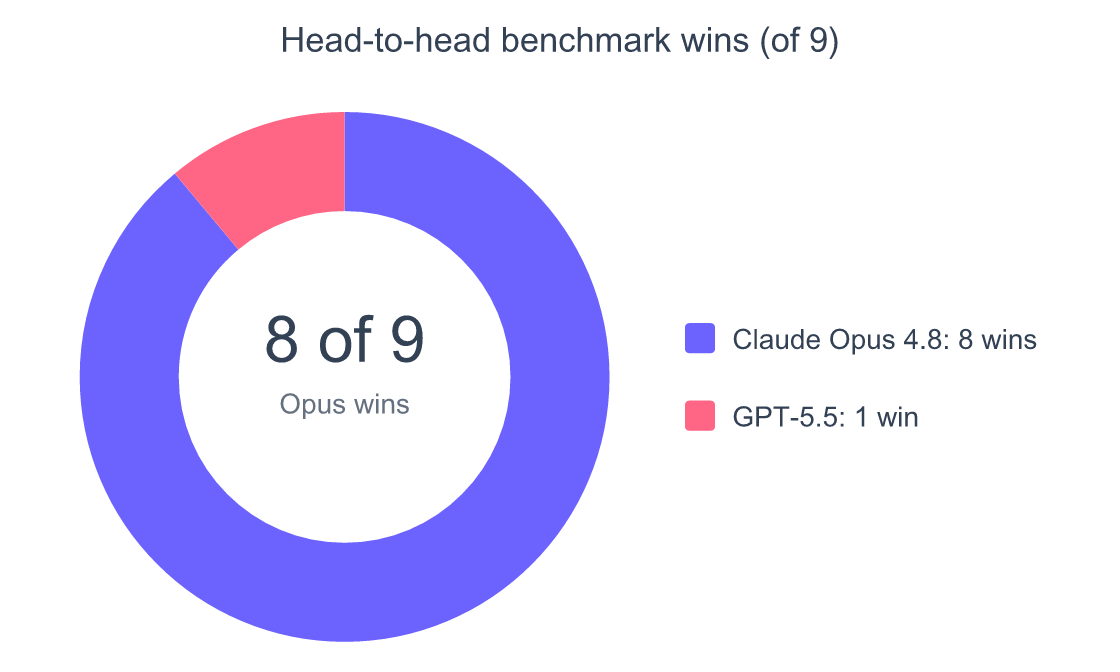
- Opus 4.8 leads on 8 of the 9 head-to-head benchmarks I could source, including reasoning, agentic tool use, and long context. GPT-5.5’s one clean win is Terminal-Bench 2.0 (DataCamp, 2026).
- The “Anthropic is more expensive” rule no longer holds at the top tier: in June, input was identical ($5) and Opus 4.8 output ($25) was actually cheaper than GPT-5.5 ($30). In October 2026, Fable 5.1 and GPT-6 Astra both list at $10 / $50, and Sonnet 5.5 and GPT-6.1 Sol both at $2 / $10.
- For me, the deciding factor is reliability on long agentic runs plus the Claude Code workflow, not a benchmark.
Claude Opus vs GPT-5: the 2026 matchup at a glance
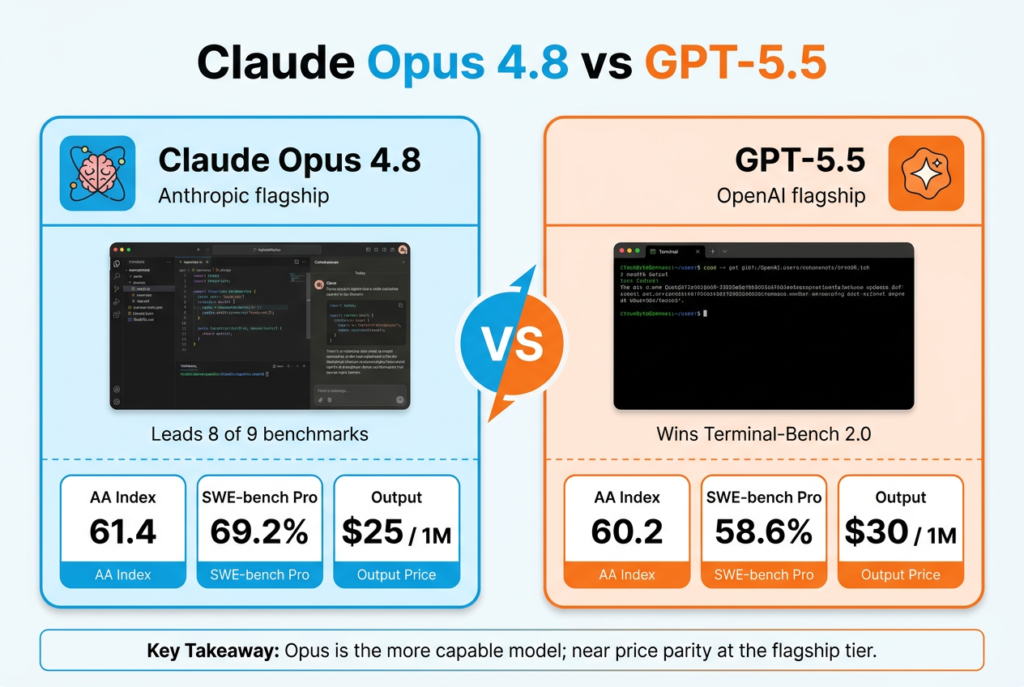
The short version: Claude Opus 4.8 is the more capable model in mid-2026, GPT-5.5 is close behind and competitive on terminal coding, and the two are roughly at price parity at the flagship tier. Opus 4.8 posts a 61.4 on the Artificial Analysis Intelligence Index against 60.2 for GPT-5.5, and leads on the harder agentic and reasoning evals (Artificial Analysis, 2026). Neither is a runaway. This is the tightest the frontier has been.
Here’s the spec sheet for the two flagships as of June 2026, side by side.
| Claude Opus 4.8 | GPT-5.5 | |
|---|---|---|
| Released | 28 May 2026 | 23 April 2026 |
| Context window | 1,000,000 tokens | 1,050,000 tokens |
| Input price (per 1M) | $5 | $5 |
| Output price (per 1M) | $25 | $30 |
| SWE-bench Pro (agentic coding) | 69.2% | 58.6% |
| AA Intelligence Index | 61.4 | 60.2 |
Sources: Anthropic and OpenAI developer docs for pricing and context; DataCamp and Artificial Analysis for benchmarks, 2026.
Put four headline benchmarks next to each other and the pattern is consistent: Opus is ahead, usually by a few points, occasionally by a lot.
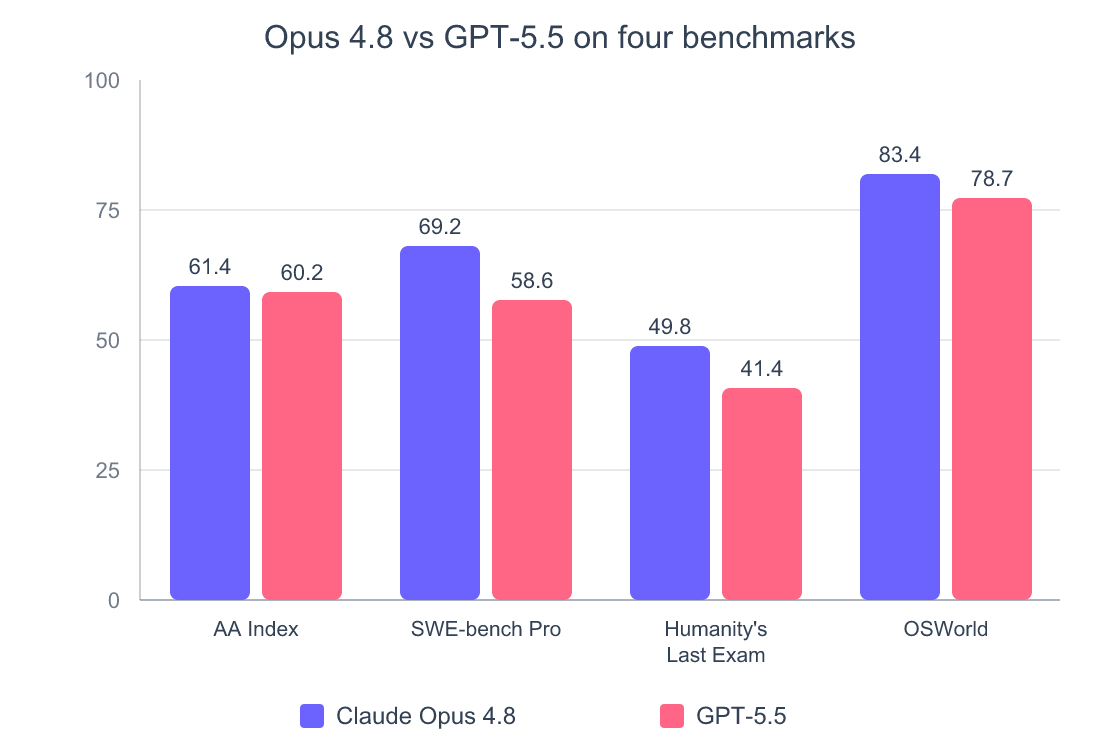
Source: DataCamp and Artificial Analysis head-to-head, 2026. Scores are out of 100.
Which versions are we actually comparing?
If you searched “claude opus 4.1 vs gpt 5” or “claude sonnet 4.5 vs gpt 5,” you were comparing models that have already been replaced. Both labs shipped fast in late 2025 and early 2026, and the version you remember is probably two or three releases behind. Here’s the timeline so you can map any old comparison to the current one.
| Release | Date | What changed |
|---|---|---|
| GPT-5 | 7 Aug 2025 | First unified GPT-5, launched aggressively at $1.25 / $10 |
| Claude Opus 4.1 | 5 Aug 2025 | Drop-in upgrade to Opus 4, priced $15 / $75 |
| Claude Sonnet 4.5 | 29 Sep 2025 | Best speed-to-intelligence balance of the Claude 4 line |
| Claude Opus 4.5 | 24 Nov 2025 | Flagship refresh and the big price cut to $5 / $25 |
| GPT-5.5 | 23 Apr 2026 | OpenAI flagship until GPT-6, $5 / $30, ~1.05M context |
| Claude Opus 4.8 | 28 May 2026 | Claude Opus flagship until Opus 5, $5 / $25 |
| Claude Fable 5 | 9 Jun 2026 | Anthropic’s top tier, $10 / $50 (offline 12 Jun to 1 Jul) |
| Claude Opus 5 | 24 Jul 2026 | Next-generation Opus |
| Claude Fable 5.1 | 1 Sep 2026 | Current Anthropic top tier, $10 / $50, stronger safeguards |
| GPT-6 Astra | 3 Sep 2026 | Current OpenAI flagship, $10 / $50 |
| Claude Opus 5.5 | 22 Sep 2026 | Current Opus, $4 / $20 |
| GPT-6.1 Sol | 29 Sep 2026 | OpenAI’s current mid-tier workhorse, $2 / $10 |
Sources: Anthropic and OpenAI release notes; Anthropic models overview and OpenAI changelog for the September releases, 2026.
The single most useful thing to take from that table: Anthropic’s flagship got cheaper while OpenAI’s got more expensive. Opus dropped from $15 to $5 input between 4.1 and 4.5, and GPT-5 climbed from $1.25 to $5 between the original and 5.5. The old “Claude costs three times more” reflex is from the Opus 4.1 era. It doesn’t describe 2026, and the October releases kept the trend going: Opus 5.5 lists at $4 / $20, below Opus 4.8.
One more thing the version churn hides: the GPT-5 you read about at launch and the GPT-5.5 I tested in June are not the same model with a bigger number. OpenAI folded its separate Codex coding line back into the main model across the 5.x releases, which is part of why GPT-5.5 is so strong in the terminal specifically. If a year-old “GPT-5 is weak at agentic coding” take is shaping your choice, throw it out. That gap closed.
Benchmarks: where Opus 4.8 leads and where GPT-5.5 wins
Across the nine head-to-head benchmarks in DataCamp’s June 2026 side-by-side, Opus 4.8 wins eight and GPT-5.5 wins one (DataCamp, 2026). That sounds lopsided, and on reasoning and tool use it is: Opus leads Humanity’s Last Exam by 8 points without tools, leads the MCP-Atlas tool-use eval 82.2 to 75.3, and stretches its lead on long-context retrieval as the window grows. But a clean sweep would be a red flag, and this isn’t one.
Source: DataCamp Opus 4.8 vs GPT-5.5 head-to-head, 2026.
GPT-5.5’s win is Terminal-Bench 2.0, where it scores 78.2 to Opus 4.8’s 74.6 (DataCamp, 2026). That’s not a footnote. Terminal-Bench measures exactly the kind of shell-driven, run-the-command-and-read-the-output work that fills a real coding session, and GPT-5.5 is genuinely good at it. So the honest read is: Opus is the stronger reasoner and the more reliable agent over long horizons, while GPT-5.5 is right there with it on hands-on terminal coding and ahead on that one eval.
Two cautions on the numbers. First, I’m deliberately not quoting a SWE-bench Verified figure for GPT-5.5, because that benchmark’s scores are contested across leaderboards and OpenAI’s own pages were unreachable when I checked. SWE-bench Pro, the harder contamination-resistant set, is the cleaner comparison. Second, neither lab published a clean GPQA or AIME head-to-head between these two models, so anyone showing you one is reconstructing it. For a deeper look at how coding benchmarks get contaminated and why I read them as ceilings rather than rankings, see my guide to the best LLM for coding, including why SWE-bench Verified broke.
Is Claude Opus more expensive than GPT-5?
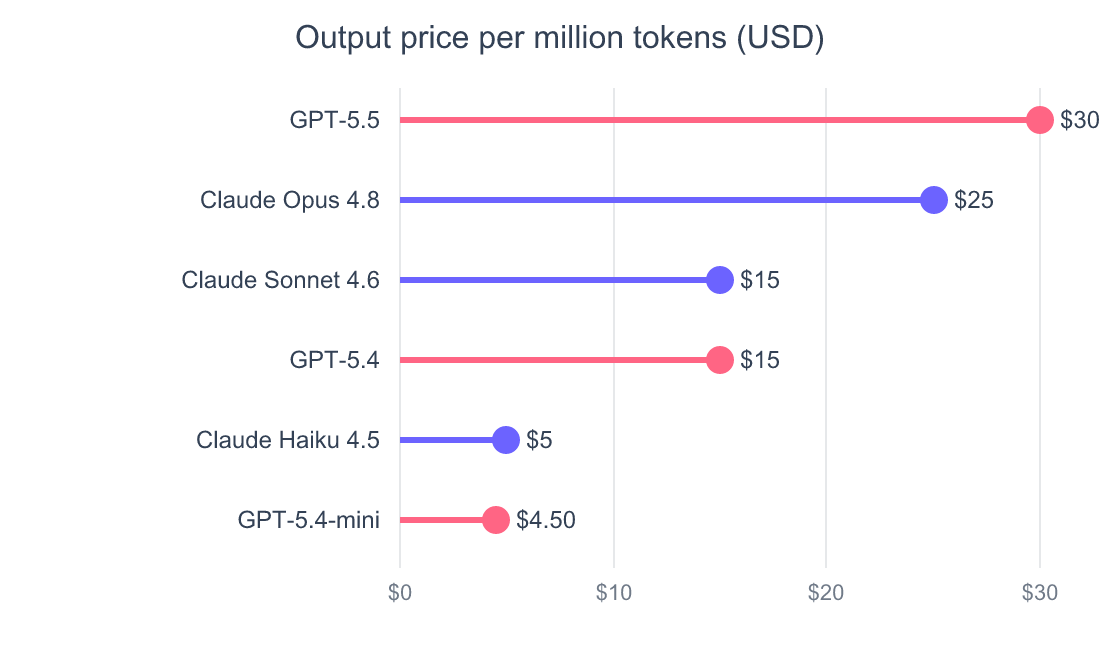
Not at the flagship tier, and this surprises people. In June 2026, Opus 4.8 and GPT-5.5 charged the same $5 per million input tokens, and Opus was actually cheaper on output at $25 versus GPT-5.5’s $30 (Anthropic and OpenAI, 2026). As of October 2026 the parity is even tighter: Fable 5.1 and GPT-6 Astra both cost $10 / $50, and Sonnet 5.5 and GPT-6.1 Sol both cost $2 / $10 (Claude pricing and OpenAI, 2026). The chart below shows the June prices I tested against.
Source: Anthropic and OpenAI pricing pages, June 2026. Indigo is Anthropic, rose is OpenAI.
In June, Anthropic cost more at the extremes. Its mid-tier Sonnet 4.6 ran $3 input against GPT-5.4’s $2.50, and its most capable model, Fable 5, was priced at $10 / $50, well above any Opus tier. OpenAI’s answer at the very top was GPT-5.5 Pro at a steep $30 / $180 (OpenAI, 2026), so “who is more expensive” depended on which rung you were standing on. In October 2026 the mid and top rungs line up exactly, and the real gap is at the small end: GPT-6 Luna lists at $0.10 / $0.50 against Claude Haiku 4.5’s $1 / $5. The fair summary: parity at the top and middle, OpenAI far cheaper at the small end. If cost is your main lever, the more interesting comparison isn’t Claude versus GPT-5 at all, it’s either of them against the open-weight field in my roundup of the best open-source LLMs, or the version question in DeepSeek R1 versus V3 compared.
Where Opus pulls ahead in my testing
Benchmarks get you to the door. What decides it for me is what happens on a real, hour-long agentic task, and in my June testing Opus 4.8 was the model I trusted not to lose the thread.
The difference I notice most isn’t raw smarts, it’s omission. On a long multi-step job, GPT-5.5 is fast and mostly right, but it occasionally drops a detail: a file it was supposed to also update, an edge case from three messages back, a constraint I stated once. Opus 4.8 is the one I catch doing that least often. On the kind of task where a single missed step means a broken build and a debugging session, “rarely forgets” beats “slightly faster,” and that’s the trade I keep making. I’m not claiming Opus is flawless. I’m saying that in my setup it’s the model I hand the work I can’t afford to re-check line by line.
The other half of my answer isn’t the model at all, it’s the harness around it. Opus paired with Claude Code, Anthropic’s own agentic coding tool, is where the model’s long-horizon reliability actually pays off, because the tool is tuned for the exact plan-edit-test-recover loop Opus is good at. GPT-5.5 is strong, and OpenAI’s own coding tooling has caught up a lot, but the Claude Code combination is still the one I reach for on serious work. That’s a tooling comparison, though, not a model one, and it deserves its own treatment: I keep this article on the raw models and send the command-line fight to my Claude Code versus Codex CLI comparison. For what the Claude Code tiers actually cost, the breakdown is in my Claude Code pricing and limits guide.
One boundary worth stating plainly, because the search terms blur it: this is a comparison of the models you call through an API, not the command-line agents built on them. “GPT-5 vs Claude Code” is a different question, because it pits a model against a tool. Keep the two separate and you’ll make a better decision.
The model that was too capable to keep online
Here’s the part of the Anthropic story that has no OpenAI equivalent in 2026, and it’s the clearest signal of where the frontier sits. On 9 June 2026, Anthropic launched Claude Fable 5 and a less-restricted sibling, Claude Mythos 5, as its most capable models yet. Three days later, on 12 June, it disabled both worldwide, for every user including its US customers, after a US government export-control directive (Anthropic, 2026).
The trigger, as reported, was that the government believed Fable 5’s cybersecurity safeguards could be jailbroken, and it moved to restrict the model itself. It’s the first time US export controls were applied to an AI model rather than to chips (TechCrunch, 2026). Anthropic publicly disagreed, calling the jailbreak narrow and already reproducible with other public models, and said it was working to restore access (Tom’s Hardware, 2026). Commerce lifted the order on 30 June, and Anthropic restored Fable 5 worldwide, including inside Claude Code, on 1 July (Anthropic, 2026).
Set the policy fight aside and look at what it tells you about the comparison. Anthropic shipped a model capable enough that a government treated it like a controlled weapons technology, then pulled it within days. That’s not a normal release cadence, and it’s worth weighing if you’re betting on a vendor: it’s a sign of how close to the edge Anthropic is pushing, and also a reminder that its very top tier can be less predictable to rely on than a stable flagship. For everyday work, that’s why the mainstream Opus tier (Opus 4.8 in June, Opus 5.5 today) is the right Anthropic model to compare against OpenAI’s flagship, rather than the headline-grabbing top tier, which is priced for the hardest jobs only.
The top tier has moved on since. Fable 5.1 replaced Fable 5 on 1 September 2026 and is generally available with stronger bio, cyber and anti-distillation safeguards. Its sibling Mythos 5.1 is the same model with different safeguards, limited to vetted cyber and life-science partners (Anthropic, 2026).
Claude Opus vs GPT-5: which should you pick?
There’s no universal winner here, only a better fit per job. After living in both, this is how I’d route the decision, updated for the October 2026 lineup.
- Long, autonomous agentic runs and hard reasoning: the current Opus, which is Opus 5.5 as of October. Opus 4.8 is the version I tested; it was the model I trusted to hold a multi-step task together without dropping a detail.
- Fast terminal coding and shell-heavy loops: GPT-5.5 was genuinely competitive in June and won Terminal-Bench 2.0. Its successor, GPT-6.1 Sol, is now the Codex CLI default. If your day is mostly command-line work, try it head to head before assuming Opus.
- Tightest budget: Sonnet 5.5 and GPT-6.1 Sol both cost $2 / $10, and Opus 5.5 is $4 / $20. At equal prices, capability on your own tasks should decide it.
- Absolute maximum capability, cost no object: Anthropic’s Fable 5.1 and OpenAI’s GPT-6 Astra both list at $10 / $50. For most people the standard tiers are still the smarter buy, but if you want to know when Fable’s premium is worth it, I break it down in my guide to running Fable 5 in Claude Code.
- You mostly write code: don’t pick on a “vs” article alone. Models behave differently across languages and task types, which I break down in my best-LLM-for-coding ranking.
Notice that I don’t route everything to one model, and neither should you. What actually matters in 2026 isn’t finding the single best LLM, it’s matching the model to the task, which is how I work day to day, described in my multi-model workflow across Claude, ChatGPT, and Gemini.
Frequently asked questions
Is Claude Opus better than GPT-5 in 2026?
On the June 2026 data, yes in most respects. Claude Opus 4.8 led GPT-5.5 on 8 of 9 head-to-head benchmarks, including reasoning and agentic tool use, and posted a 61.4 to 60.2 on the Artificial Analysis Intelligence Index (Artificial Analysis, 2026). GPT-5.5 won on Terminal-Bench 2.0. As of October 2026 the matchup is Opus 5.5 and Fable 5.1 against the GPT-6 family, and I haven’t seen a sourced like-for-like benchmark for those pairs yet.
Claude Opus 4.1 vs GPT-5: which is newer?
Both are outdated labels. Opus 4.1 shipped in August 2025 and has been replaced by Opus 4.5 through 4.8, then Opus 5 (July 2026) and now Opus 5.5 (22 September 2026). The original GPT-5 from August 2025 was superseded by the 5.x line up to GPT-5.5 and then the GPT-6 family (GPT-6 Astra on 3 September, GPT-6.1 Sol on 29 September 2026). Compare Opus 5.5 against GPT-6.1 Sol or GPT-6 Astra instead.
Is GPT-5 cheaper than Claude Opus?
It depends on the tier. As of October 2026, Fable 5.1 and GPT-6 Astra both cost $10 / $50 per million tokens, Sonnet 5.5 and GPT-6.1 Sol both cost $2 / $10, and Opus 5.5 sits at $4 / $20 (OpenAI, 2026). OpenAI is much cheaper at the small-model tier, where GPT-6 Luna is $0.10 / $0.50 against Haiku 4.5’s $1 / $5. In June, GPT-5.5 and Opus 4.8 both cost $5 input, and Opus was cheaper on output at $25 versus $30.
Claude Sonnet 4.5 vs GPT-5: how do they compare?
Sonnet 4.5 was Anthropic’s speed-to-intelligence pick from the Claude 4 line. It has since been replaced by Sonnet 4.6, Sonnet 5 and now Sonnet 5.5, and Anthropic deprecated it on 30 September 2026 with retirement set for 30 November 2026 (Anthropic, 2026). The current mid-tier matchup is Sonnet 5.5 against GPT-6.1 Sol, both at $2 / $10.
Which is better for coding, Claude Opus or GPT-5?
It split in June 2026. Opus 4.8 led on hard, multi-file agentic coding (SWE-bench Pro 69.2% versus 58.6%), while GPT-5.5 edged ahead on terminal workflows. The current pair is Opus 5.5 and GPT-6.1 Sol, so pick by the shape of your work and test on your own repo rather than trusting a single benchmark.
What happened to Claude Fable 5?
Anthropic launched Fable 5 and Mythos 5 on 9 June 2026 and disabled both worldwide on 12 June after a US export-control directive over the model’s cybersecurity capabilities, the first export control applied to an AI model itself (Anthropic, 2026). Commerce lifted the order on 30 June, and Fable 5 returned to Claude.ai, the API, and Claude Code on 1 July (Anthropic, 2026). Fable 5.1 replaced it on 1 September 2026.
The verdict
Claude Opus 4.8 is the model I’d pick over GPT-5.5 in mid-2026, and the reason isn’t a benchmark, it’s that on long, high-stakes work it forgets less and holds the thread better, and the Claude Code workflow turns that reliability into finished output. But this is the closest the gap has ever been. GPT-5.5 matched Opus on price at the flagship tier and beat it on Terminal-Bench. In October 2026 the names are Opus 5.5 and the GPT-6 family, and prices now match tier for tier, so the same advice applies with new labels. If you mostly live in the terminal, test GPT-6.1 Sol against Opus 5.5 on your own work for a week before you assume Opus wins. If you want one model for hard agentic runs and you value rarely-wrong over slightly-faster, the current Opus is where I’d start. And if your real question is which to run for cost or privacy, start one tier down with my complete guide to running LLMs locally before paying for either frontier API.