Most indie hackers don’t have a marketing problem. They have a priorities problem.
They spend 90% of their time building and 10% telling anyone the thing exists. Then they wonder why nobody signs up. CB Insights’ March 2026 analysis of 431 VC-backed startups that shut down since 2023 found 70% ran out of capital, but the report is blunt that cash is where the story ends, not why. The real causes underneath were poor product-market fit (43%), bad timing (29%), and unsustainable unit economics (19%) (CB Insights, 2026). Poor product-market fit isn’t usually a building failure. It’s a listening and communicating failure.
Here’s the uncomfortable truth: the product you’re pouring weekends into probably works fine. What’s broken is the connection between what you’ve built and the people who need it. Marketing isn’t a dirty word. It’s the bridge. And most solo founders never build it.
complete guide to building a marketing strategy as a solo founder with no budget
TL;DR: Most indie hacker products fail not from bad code but from invisible marketing. Poor product-market fit showed up in 43% of the 431 startup shutdowns CB Insights analyzed (CB Insights, 2026), and Failory ties 56% of the failures in its founder interviews to marketing problems. The fix isn’t spending money on ads: it’s defining your audience, picking two channels, and showing up consistently for 90 days.
What’s the Conventional Wisdom About Marketing for Indie Hackers?
The startup ecosystem has sold founders a comforting lie for over a decade. Even among well-funded startups, 70% of recent shutdowns ended with the money running out before traction showed up (CB Insights, 2026). If funded teams with sales hires run dry, a solo founder waiting for word of mouth has even less runway. Despite that, the “build it and they’ll come” myth persists in every indie hacker forum and Twitter thread.
The conventional view goes something like this: if your product is good enough, word-of-mouth will do the work. Just ship fast, iterate on feedback, and growth happens organically. Marketing? That’s what funded companies with $50k/month ad budgets do. Real hackers just build.
There’s a second myth lurking underneath. Many solo founders equate marketing with paid advertising. They see “marketing strategy” and imagine Facebook ad dashboards, Google Ads keyword bidding, and retargeting pixel setups. Since they can’t afford any of that, they conclude marketing isn’t for them, at least not yet.
And there’s a third flavor: random acts of marketing. A Product Hunt launch one week. A couple of tweets the next. Maybe a Reddit post that gets downvoted. No plan, no consistency, no feedback loop. Just isolated bursts of energy that fizzle out.
I’ve watched dozens of indie hackers in communities like Indie Hackers and WIP build genuinely impressive products, then abandon them after 3 months of zero traction. Not because the product was bad, but because nobody knew it existed.
Sound familiar? If any of these describe your approach, you’re not alone. But you are making a mistake that’s fixable.
Why Do Indie Hackers Actually Fail at Marketing?
Failory interviewed the founders of 80+ failed startup projects and grouped why they died. Marketing problems came first at 56%, ahead of team (18%), finance (16%), and tech (6%) combined, and the biggest marketing problem “by far” was lack of product-market fit (Failory, updated January 2026). Tech problems, the thing indie hackers obsess over, accounted for just 6%. The failure isn’t that founders don’t try marketing. It’s that they skip the foundations.
Here’s where it breaks down, based on patterns I’ve seen across hundreds of bootstrapped projects.
They Skip Defining Their Ideal Customer
This is the silent killer. You can’t write compelling copy, pick the right channel, or craft an offer if you don’t know exactly who you’re talking to. Yet most indie hackers describe their audience as “developers” or “small businesses”, categories so broad they’re meaningless.
Without a defined ICP (ideal customer profile), every marketing effort becomes a coin flip. Your messaging doesn’t resonate because it’s trying to speak to everyone. Your content doesn’t rank because it targets keywords that are too competitive. Your landing page doesn’t convert because it addresses problems your actual users don’t have.
If you haven’t done this work yet, stop everything else and define your ICP first, even with zero customers. It’s the single highest-ROI marketing task you’ll ever do.
They Think Marketing Requires Money
Here’s a stat that should reframe your thinking: organic search delivered about 16% of all web visits across 50,000+ sites in 2025, second only to direct traffic and more than 30x paid search (Semrush, 2026). Content, SEO, community participation, building in public, none of these cost money. They cost time.
The misconception that marketing equals advertising keeps bootstrapped founders on the sidelines when they should be in the game. There’s an entire zero-dollar marketing stack built for exactly this situation: free tools, free channels, zero excuses.
They Execute Random Tactics Without a Strategy
A Product Hunt launch is a tactic. A Twitter thread is a tactic. A blog post is a tactic. Without a strategy connecting them, each one fires into the void. You generate a traffic spike that dies in 48 hours, learn nothing, and burn out.
The Content Marketing Institute’s 2026 B2B trends research (1,015 marketers, fielded June to August 2025) found that 74% of marketers whose content got more effective pointed to strategy refinement as the driver. Their one-line summary: “Strategy beats scale. The biggest driver of improvement wasn’t more budget; it was refining the plan” (Content Marketing Institute, 2026). Strategy isn’t optional. It’s the difference between compounding growth and random noise.
If you don’t have a documented marketing strategy, here’s how to create one as a solo founder with no budget.
Citation Capsule: Indie hackers fail at marketing primarily because they skip ICP definition, assume marketing requires ad spend, and execute random tactics without strategy. Failory’s founder interviews tie 56% of startup failures to marketing problems, and CMI’s 2026 research found 74% of marketers who improved credited refining their strategy, not bigger budgets (Content Marketing Institute, 2026).
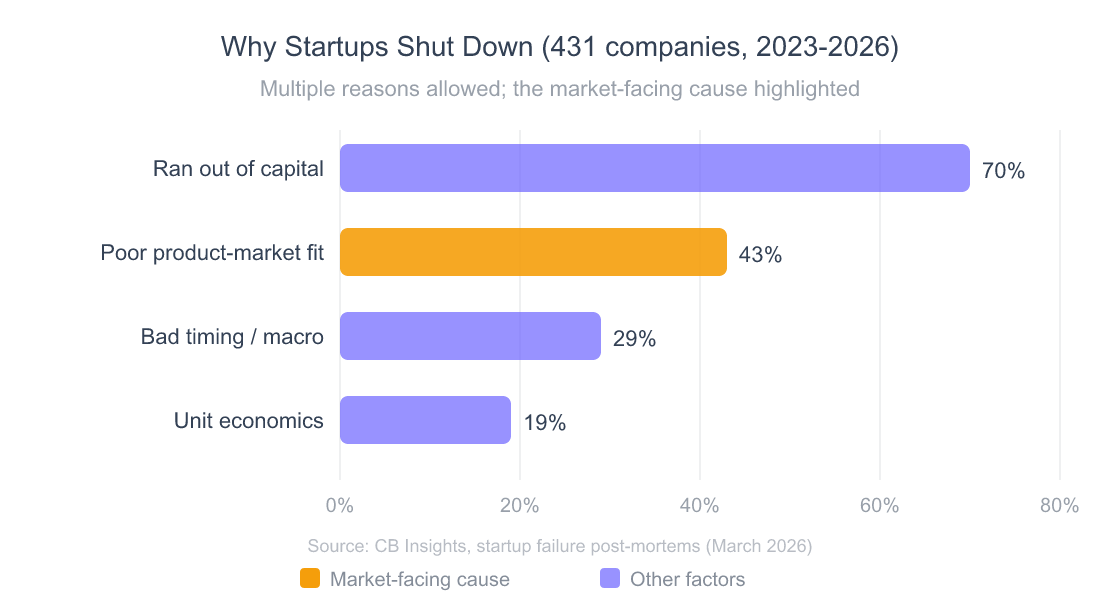
Running out of capital is where most shutdowns end. Poor product-market fit, a market-facing failure, is the most common cause underneath it.
What Does the Data Actually Show About Indie Hacker Marketing?
Research paints a clear picture: consistency beats brilliance, and strategy beats hustle. HubSpot’s 2026 State of Marketing data ranks blog posts among the five highest-ROI content formats, and says small businesses are 23% more likely than average to see ROI from blog posts (HubSpot, 2026). That’s the indie hacker’s home turf. You don’t need to publish daily. But you need to show up regularly.
In my observations across indie hacker communities (tracking product launches on Indie Hackers, Product Hunt, and Twitter) the founders who gain traction almost always share one trait: they marketed consistently for at least 90 days before evaluating results. Those who quit after 2-3 weeks almost universally concluded “marketing doesn’t work for my product.”
The consistency gap is real. Most founders give up right before compound growth kicks in. Blogging compounds over time, a post written today keeps generating traffic for months. But the first 60-90 days feel like shouting into the void. That’s normal. That’s not failure. That’s the warmup.
Here’s what else the data shows. CB Insights found that two-thirds of the product-market fit failures in its 2026 dataset were early-stage companies “that never found a market” (CB Insights, 2026). For an indie hacker, “finding a market” mostly means picking a narrow segment and talking to it specifically. That’s what an ICP is for.
And what about the money objection? Look at where web traffic actually came from. Semrush’s 2025 channel study of 50,000+ websites found paid search drove just 0.49% of visits, while organic search drove 16.04% and referrals 9.60% (Semrush, 2026). The channels that cost time instead of money (content, SEO, community, building in public) carry most of the load.
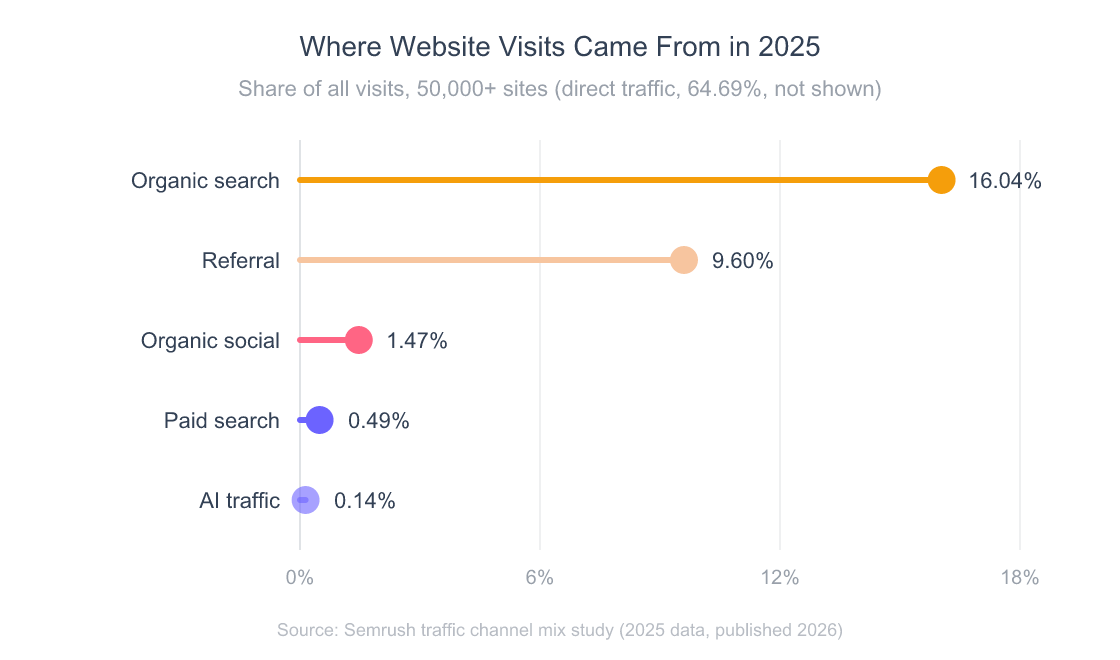
Organic search sent roughly 33x more visits than paid search in 2025. The free channels do the heavy lifting.
So why does the “marketing costs money” myth survive? Because the people writing about marketing are often agencies selling expensive services. The indie hacker’s path looks completely different.
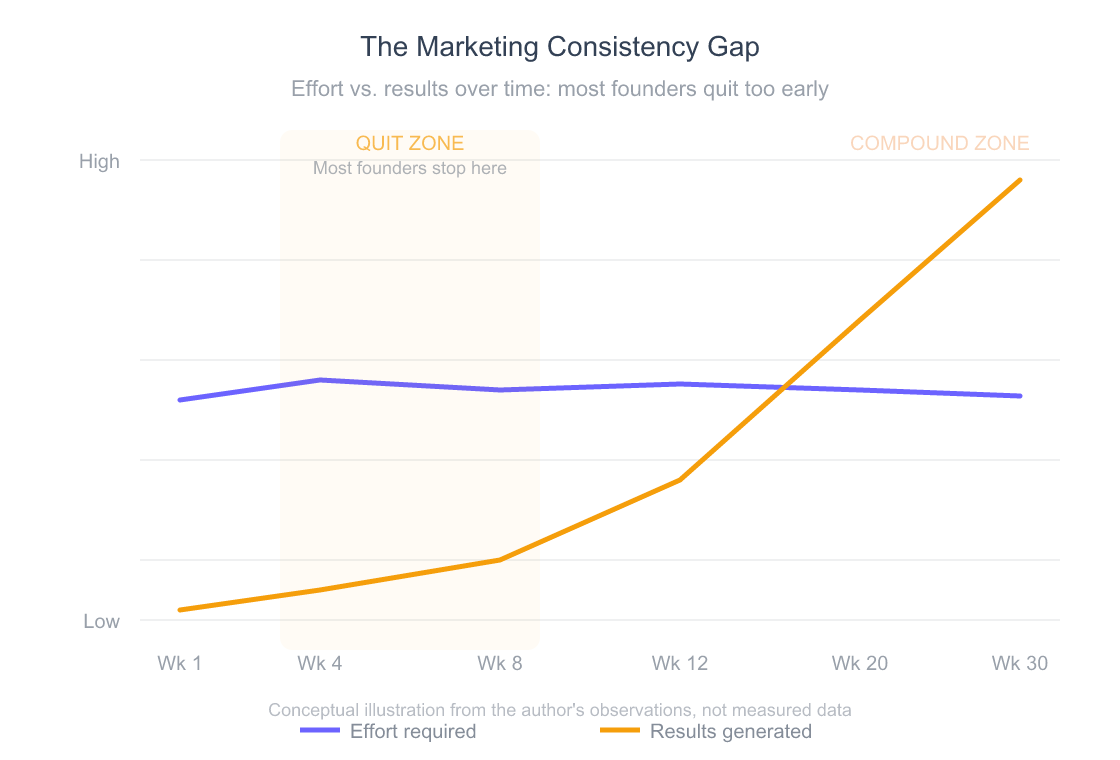
Most indie hackers quit marketing during weeks 4-12, right before results begin to compound.
Citation Capsule: Marketing consistency, not brilliance, drives indie hacker growth. HubSpot’s 2026 State of Marketing data puts blog posts among the five highest-ROI content formats and finds small businesses 23% more likely than average to see ROI from them (HubSpot, 2026). Organic search, meanwhile, drove 16.04% of visits across 50,000+ sites in 2025 versus 0.49% for paid search (Semrush, 2026).
What’s the Better Approach to Indie Hacker Marketing?
Failory’s advice after 80+ founder interviews is simple: “Don’t invest a lot of time and resources before you are confident people want what you are offering. Validate your assumptions quickly and cheaply, and if needed – pivot” (Failory). Validation is marketing. Marketing isn’t something you bolt on after building. It happens alongside building.
Here’s a framework that actually works for bootstrapped founders. I call it the ICS framework: Identity, Channel, System.
Identity first. Before you write a single tweet or blog post, nail down who you’re talking to. One specific person. Not a demographic, a real human with a real problem. What do they Google at 11 PM when the problem’s driving them crazy? What subreddit do they lurk in? Here’s how to define that ICP even with zero customers.
Channel second. Pick exactly two channels. Not five. Not ten. Two. One for long-form content (blog, YouTube, or a newsletter). One for community engagement (Twitter/X, Reddit, or an indie hacker community). That’s it. Master those before adding more.
System third. Create a repeatable weekly cadence. Something like: write one article, share three times on your community channel, engage genuinely with 10 people in your space. Put it in your calendar. Treat it like a standup meeting, non-negotiable.
Most marketing advice tells founders to “be everywhere.” For indie hackers, this is the fastest path to burnout and mediocrity. Two channels done well will outperform six channels done poorly every single time. The constraint is a feature, not a bug.
This isn’t glamorous. It won’t go viral overnight. But it compounds. And compounding is the only growth model that works without a marketing budget.
step-by-step guide to writing articles that actually perform
How Do You Actually Apply This Week by Week?
My rule of thumb: in the first six months, roughly a third of your working hours should go to marketing-related work (writing, talking to users, community). That’s my own heuristic from watching launches, not a study. The founders I’ve seen stall usually spent far less. Here’s what a practical weekly schedule looks like.
Week 1-2: Foundation.
Define your ICP. Write your positioning statement in one sentence: “I help [specific person] solve [specific problem] with [your product].” If you can’t fill in those blanks, you’re not ready to market anything yet.
Week 3-4: First content.
Write two articles targeting problems your ICP Googles. Not product announcements, actual helpful content. Use a zero-dollar marketing stack so tool costs don’t become an excuse.
Week 5-8: Build the rhythm.
One article per week. Daily engagement in your chosen community (15-20 minutes, set a timer). Share what you’re building, what you’re learning, what’s not working. Building in public isn’t bragging. It’s documenting.
Week 9-12: Evaluate and adjust.
Look at what’s getting traction. Double down on topics that resonate. Drop what doesn’t. This is the phase where most founders quit. Don’t.
AI tools can accelerate every step of this process. If you want to generate your positioning, ICP documents, and marketing assets without hiring a marketer, tools like Growth Engine exist specifically for this, an AI marketing kit generator built for indie hackers building in public.
Citation Capsule: A 12-week plan for indie hacker marketing: define the ICP and one-sentence positioning (weeks 1-2), publish two problem-focused articles (weeks 3-4), ship one article a week plus daily community engagement (weeks 5-8), then evaluate and double down (weeks 9-12). Failory’s founder interviews show why the early validation steps matter: 56% of failures traced back to marketing problems, led by lack of product-market fit (Failory).
When Does This Advice Not Apply?
Not every product benefits from content-driven marketing. If you’re building for a highly technical niche with fewer than 1,000 potential customers worldwide, direct outreach and partnerships will outperform blog posts. Gartner’s latest buyer survey (fielded August to September 2025) found 67% of B2B buyers prefer a rep-free experience (Gartner, 2026). Read that the other way round, though: a third still want a human in the loop, and for a complex, high-ticket product with a tiny buyer pool, you are that human.
If you already have strong distribution (say, an audience of 10,000+ on Twitter or a popular open source project) your marketing problem is different. You don’t need awareness. You need conversion optimization.
And if you’re pre-idea, doing marketing research before building is even better than building first and marketing second. Talk to potential customers before you write a line of code. That’s not marketing after the fact, it’s market validation, and it’s the smartest move in the playbook.
Be honest about where you actually are. The framework above is designed for founders who’ve built something and need to get it in front of the right people.
Frequently Asked Questions
How much time should an indie hacker spend on marketing each week?
My rule of thumb is 30-40% of your working hours. If you work 40 hours, that’s 12-16 hours on marketing. That’s a heuristic, not a law: if you only have nights and weekends, start with 5-10 hours a week and protect them like a standup. Adjust based on traction, not on how you feel about marketing that week.
Can you do effective marketing with zero budget?
Absolutely. Organic search was still the biggest traffic channel after direct visits in 2025 (Semrush, 2026). Content marketing, community engagement, SEO, and building in public are all free. The only cost is your time. Check out the zero-dollar marketing stack for indie hackers for specific tools and workflows.
What’s the single most important marketing step for a new indie hacker?
Define your ICP. Everything else, copy, channels, content, positioning, flows from knowing exactly who you serve. Poor product-market fit was behind 43% of the startup shutdowns in CB Insights’ 2026 analysis (CB Insights, 2026), and a sharp ICP is the cheapest way to test fit. Start there, even if you have zero customers.
How long before I see results from content marketing?
Plan on 90-120 days of consistent publishing before organic traffic starts to compound. That’s my experience across my own sites, not a universal law: new domains need time for search engines to crawl, index and trust them, and a brand-new site can take longer. The founders who persist past the “consistency gap” are the only ones who find out whether it works.
Should indie hackers use AI tools for marketing?
Yes, strategically. AI tools are especially useful for generating first drafts, ICP documents, positioning statements, and content outlines. They cut the time cost significantly. The key is to use AI as an accelerator for your strategy, not a replacement for understanding your customer.
how to use an AI marketing kit generator while building in public
The Industry Needs to Stop Lying to Founders
Poor product-market fit showed up in 43% of recent startup shutdowns, and two-thirds of those were early-stage companies that never found a market (CB Insights, 2026). A lot of that is a marketing and positioning failure dressed up as a market failure. We need to stop telling indie hackers to “just build” and start telling them to build and market from day one.
The path isn’t complicated. Define who you serve. Pick two channels. Show up every week for 90 days. Measure. Adjust. Repeat. That’s it.
If you want a head start on the marketing foundations (your ICP, positioning, and first marketing assets) Growth Engine generates an entire marketing kit in minutes, purpose-built for solo founders who’d rather spend their time building.
The product you’ve already built might be exactly what someone needs. They just don’t know it exists yet. That’s not their problem to solve. It’s yours.
full guide to creating a marketing strategy as a solo founder
How to Define Your ICP When You Have Zero Customers
$0 Marketing Stack for Indie Hackers: 9 Free Tools for 2026
From 0 to $1K MRR: The Complete Playbook for Indian Solo Founders