Most small businesses don’t have a marketing team. They have one person, sometimes the founder, sometimes a part-timer, sometimes a freelancer on a 10-hour retainer, wearing the marketing hat between everything else.
The pitch you keep hearing is that AI fixes this. Open ChatGPT, paste your audience and product, and out comes a marketing team in a chat window. That’s the part that’s wrong, and it’s why most AI marketing setups quietly stall by week three. ChatGPT isn’t an AI marketing team. A marketing team understands your business. ChatGPT forgets it every conversation.
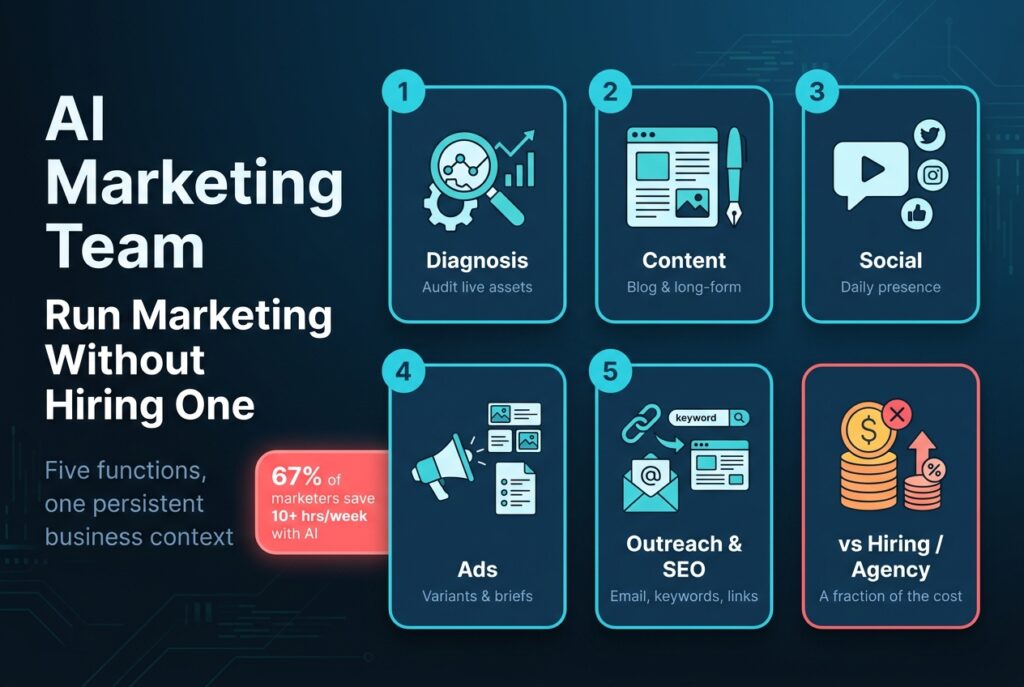
According to HubSpot’s 2026 generative AI survey of 1,500+ U.S. professionals, 67% of marketing teams report AI saves them 10 or more hours per week (HubSpot, 2026). The hours are real. What most teams don’t realize is what’s actually doing the saving, and what an AI marketing team has to look like before it can save anything for a small business that doesn’t already have a head of marketing scoping the prompts.
Key Takeaways
- An AI marketing team is a system with persistent business context that runs strategy, content, social, ads, and outreach across channels, not a chat window with a saved prompt.
- The moat is persistent business context. ChatGPT generates well; it forgets between sessions, which is why founders re-explain their product, ICP, tone, and positioning every time (OpenAI, 2025).
- In Gartner’s 2025 CMO Spend Survey, 39% of CMOs planned to reduce labor costs and 39% planned to cut agency budgets (Chief Marketer, 2025); 22% said generative AI had already reduced their reliance on external agencies (Gartner, 2025).
- A real AI marketing stack runs $200–$500/month, versus a $166,790/yr median marketing manager (BLS, May 2025) or a roughly $42,000/yr agency retainer.
- AI can’t read a room, develop original positioning from nothing, or build trust on your behalf. Name the limits before buying the stack.
What Is an AI Marketing Team?
An AI marketing team is a system that holds persistent business context (your positioning, ICP, tone, and offer) and applies it across the five core marketing functions: diagnosis, content, social, ads, and outreach/SEO. It runs operations on a cadence, ships channel-shaped artifacts, and costs a fraction of a hire. It’s not one prompt. It’s a function.
That definition matters because the SERP is full of “AI marketing tools” listicles that conflate two very different things. An AI writer takes a brief and produces words. An AI marketing team holds your business in memory, decides what to work on, runs the work across roles, and delivers in the formats each channel actually takes. The difference shows up the moment a small business tries to run a real campaign instead of a one-off task.
Citation capsule: An AI marketing team is a system with persistent business context that runs the five core marketing functions, diagnosis, content, social, ads, and outreach, and ships channel-shaped artifacts on a cadence. It is not a chat window with a saved prompt; per HubSpot, 67% of marketing teams already report 10+ hours/week saved with AI (HubSpot, 2026).
Why ChatGPT Isn’t an AI Marketing Team
ChatGPT now has 900 million weekly active users (TechCrunch, 2026). It’s a remarkable tool, and a small business owner with a sharp prompt can get a passable blog post out of it in five minutes. So why does the same owner come back two weeks later and quietly stop using it for marketing?
Because a chat window has no memory of the business between conversations. That’s the context decay problem, and it’s the difference between an AI assistant and an AI marketing team.
Here’s what the failure mode looks like in practice. Monday: you open ChatGPT, paste your value proposition, your ICP, your tone of voice, and ask for five LinkedIn posts. Output is decent. Tuesday: you want a cold email sequence. You re-paste the value prop, the ICP, the tone, plus the new context (the segment you’re emailing). Output is decent. Wednesday: a landing page section. Re-paste again. By Friday you’ve spent 45 minutes per session re-explaining your business to a model that doesn’t remember it, and the prompts have started drifting because nobody enjoys typing the same context six times.
ChatGPT Projects, Custom GPTs, and Gemini Gems patched the worst of this: you can pin reference docs, and OpenAI reported weekly users of Custom GPTs and Projects grew roughly 19x over 2025 inside its enterprise accounts (OpenAI, 2025). Persistent context inside one window is now the floor. But a window holds one conversation. Marketing isn’t a conversation. It’s a set of specialized roles (researcher, strategist, copywriter, social manager, paid media operator, SEO lead) that hand off work to each other on a weekly cadence.
Citation capsule: A chat window has persistent context but no orchestration. It can hold your brand voice; it can’t run research → strategy → channel work as a pipeline with handoffs. That’s why generation has gotten cheap and operations have not, and why Gartner expects 40%+ of agentic AI projects to be canceled by the end of 2027 (Gartner, 2025).
For a deeper read on why ChatGPT Projects specifically don’t replace the function, see the companion piece: why a ChatGPT Project still won’t replace your marketing team.
What 5 Functions Must an AI Marketing Team Cover?
A marketing team isn’t defined by tool count. It’s defined by the functions that have to run every week regardless of who’s running them. There are five of them, and any AI setup that calls itself a “team” needs a credible answer for each.

1. Diagnosis. What’s broken? What’s the homepage missing? Where’s the angle thin? Which page leaks the most pipeline? For the marketing-of-few operator, diagnosis is the work and generation is the easy part. A real AI marketing team audits what already exists and surfaces the gap before you have to ask. A chat window can’t do this on its own, it generates from a brief; it doesn’t audit live assets.
2. Content. Blog, long-form, lead magnets, newsletters. The “produce words” function. This is the one ChatGPT genuinely solves, and also the one where generation alone proves least. Orbit Media’s 2026 blogger survey found 92% of marketers now use AI, yet AI users are no more likely to report “strong results” than the 8% who don’t (Orbit Media, 2026). Cheap words aren’t the bottleneck. Knowing which words to ship is.
3. Social. Daily presence on LinkedIn, X, Instagram, or wherever your ICP scrolls. Different artifact shape than long-form. Different voice register. Different rhythm, five posts a week is a different operation than one blog post a week. If X is one of your channels, I break down a working cadence in my build-in-public strategy for X.
4. Ads. Headline variants, audience descriptions, creative briefs, ad-set structures, A/B test setups. Ads are paid distribution, which means the artifact is structured and the feedback loop is fast.
5. Outreach and SEO. Cold email sequences, partnership pitches, on-page optimization, keyword clustering, competitor analysis, link-building outreach. The lowest-glamour function and often the highest-leverage one. Search itself now splits three ways, which I cover in SEO vs GEO vs AEO.
Citation capsule: The five marketing functions, diagnosis, content, social, ads, and outreach/SEO, are what define a “team.” A tool that covers one (Jasper for content, Surfer for SEO) is a specialist. A team covers all five with the same persistent business context running through them. Marketing and sales is already one of the functions where organizations use gen AI most often, according to McKinsey’s March 2025 State of AI survey (McKinsey, 2025).
If your AI setup ships strong work on two functions and silence on the other three, you don’t have an AI marketing team. You have an AI writer with a focus area.
How Does an AI Marketing Team Compare to Hiring or an Agency?
The cost gap between a marketing hire, an agency retainer, and an AI marketing stack is the part most evaluation guides skip. The U.S. Bureau of Labor Statistics puts the median annual wage for marketing managers at $166,790 as of May 2025 (BLS, 2025). HawkSEM puts the average agency retainer around $3,500 per month, with most minimums in the $1,000–$1,500 range (HawkSEM, 2025). A mature AI marketing stack runs $200–$500 per month, all-in. The numbers aren’t close.

A small business owner can run a year of AI-driven marketing for less than two weeks of a marketing manager’s salary.
The cost story isn’t the whole story, though. Speed, context retention, and scalability are where the comparison gets interesting:
| Dimension | Marketing manager ($167K/yr) | Agency retainer ($42K/yr) | AI marketing stack ($3.6K/yr) |
|---|---|---|---|
| Time to first productive output | 60–90 days (onboarding + ramp) | 30–45 days (kickoff + brand immersion) | Hours to days |
| Context retention | Excellent, internalizes the business | Strong on retainer; lost when contract ends | Persistent if the system holds a brand profile |
| Output volume per week | 1–2 major artifacts + ops | 4–6 deliverables across 1–2 channels | 10+ across all 5 functions |
| Channel coverage | All 5 if senior; usually 2–3 in practice | 1–3 (agencies specialize) | All 5 with the right stack |
| Strategic judgment | Strong, reads the room | Variable, depends on the team | Weak, needs a human to set direction |
| Replaceable when they leave | Painful, institutional knowledge walks out | Painful, onboarding restarts | Trivial, context lives in the system |
My read: a marketing manager wins on judgment and reading the room. An agency wins on senior craft and external perspective. An AI marketing stack wins on cost, speed, channel coverage, and context permanence. The right answer depends on which of those constraints is binding for you. For most SMBs under $5M in revenue, the binding constraint is cost, which is exactly why, in Gartner’s 2025 survey, 39% of CMOs planned to reduce labor costs and 39% planned to cut agency budgets (Chief Marketer / Gartner, 2025).

Cost is the headline; ramp time is the underrated story.
How Do You Set Up an AI Marketing Team in 2026?
Setting up an AI marketing team is four steps in a fixed order. Skipping the first step (which is what most founders do) is what produces the “AI is mid” experience six weeks in.

Step 1: Build the persistent business context (the brand profile). Before any AI runs marketing for you, it needs to know your business better than your last hire did. That means a structured profile: positioning statement, ICP with firmographic and psychographic detail, jobs-to-be-done, top three competitors with battle-card-level detail, tone of voice with do/don’t examples, and offer architecture. This is the foundation an AI marketing team needs to operate without re-prompting. Without it, every output is generic. With it, every output is yours.
Step 2: Run a diagnosis pass. Before generating anything new, audit what exists. Homepage positioning, pricing page objection handling, blog content gaps versus the SERP, social cadence and angle drift, ad copy claims versus messaging hierarchy. The diagnosis tells you the work order: what to fix first, what to build next, what to retire. Skipping this is why most AI marketing setups produce a lot of work that doesn’t move the metric.
Step 3: Activate the five engines. With business context loaded and diagnosis run, switch on the five function engines: content, social, ads, outreach, SEO. Each consumes the same brand profile. Each produces channel-shaped artifacts (calendar entries, post drafts, ad sets, email sequences, optimization briefs), not chat transcripts.
Step 4: Set the cadence. Decide what lands when. Weekly content brief on Mondays. Daily social drafts queued by 9am. Ad creative refresh every two weeks. SEO audit monthly. Outreach campaigns by quarter. The cadence is what turns AI marketing from a tool you summon into a function that runs.
Our finding: Teams that run all four steps see compounding output by week three. Teams that skip step one, the persistent business context, re-prompt every session and quit by week six. It rhymes with Gartner’s projection that 40%+ of agentic AI projects will be canceled by the end of 2027, mostly over unclear value and rising costs (Gartner, 2025).
The trap most small businesses fall into is starting at step three. They open Jasper or Copy.ai, generate a week of social posts, notice the posts sound like everyone else’s posts, and conclude AI marketing doesn’t work. The output is generic because the input is generic. Steps one and two are what make step three’s output yours.
The AI Marketing Stack: Tools by Function
The comparison most SERP results avoid: which tools cover which functions, and where the gaps are. Five tools come up most often when small businesses ask about an AI marketing stack: ChatGPT, Jasper, Copy.ai, Surfer SEO, and the newer “AI marketing platform” category (Growth Engine, Averi, FounderPal, Holo AI). Here’s how they actually compare on the dimensions that matter for a marketing function.
| Tool | Persistent business context | Multi-channel coverage | Diagnosis (audits existing assets) | Channel-shaped artifacts |
|---|---|---|---|---|
| ChatGPT (Projects) | Yes (per Project) | Manual, you run each channel | No | Transcripts; you reformat |
| Jasper | Limited, brand voice profiles | Content-focused | No | Templates per output type |
| Copy.ai | Limited, workflows | Content + sales outreach | No | Templates per output type |
| Surfer SEO | No (page-level only) | SEO only | Yes, for on-page SEO | SEO briefs |
| Growth Engine / similar | Yes (brand profile) | All 5 functions | Yes, site + competitor audit | Native (calendars, ad sets, sequences) |
Laid out like this, the pattern is obvious. ChatGPT and the writing-first tools (Jasper, Copy.ai) are excellent generators. They are not marketing teams: they don’t audit, they don’t run multiple channels with the same context, and most ship transcripts you reformat. Surfer is a strong specialist for one function. The newer “AI marketing platform” category is the only one trying to clear all four columns at once, and the category is young, expect more entrants and shake-out over the next 18 months.
The buying mistake to avoid: paying for three writing tools (ChatGPT Pro + Jasper + Copy.ai) and calling it a stack. It’s not a stack. It’s three windows that each forget your business between sessions. The stack is one persistent-context layer feeding all five function engines.
Citation capsule: Most AI marketing tools clear one or two of the four columns: persistent business context, multi-channel coverage, diagnosis, and channel-shaped artifacts. The “AI marketing platform” category that clears all four is what makes a system function as a team rather than as an AI writer. The global AI-in-marketing market reached $25.83B in 2025 and is projected to hit $217.33B by 2034 (Precedence Research, 2025).
What Can’t an AI Marketing Team Do Yet?
AI can’t read the room. When a customer pulls you aside at a conference and tells you the real reason they almost didn’t buy, that’s not in any prompt. The unspoken objection, the one that surfaces in a 30-minute call but never in a survey, is human reconnaissance work. AI can summarize what you tell it. It can’t be in the room.
AI can’t develop original positioning from nothing. It can rephrase, recombine, and stress-test positioning you give it. It can’t invent a category or coin the language a market hasn’t heard yet. McKinsey’s November 2025 State of AI report found that only about 6% of organizations qualify as AI high performers (5%+ of EBIT attributed to AI, plus significant value), and those high performers are nearly 3x as likely as everyone else to have fundamentally redesigned individual workflows (McKinsey, 2025). Translation: original strategy still comes from a human; AI accelerates execution against it.
AI can’t build trust on your behalf. Personal brand, founder voice, customer relationships, the LinkedIn comment you leave at 11pm because you actually care, none of that scales through a generation pipeline. If your category competes on trust (high-ticket B2B, regulated industries, professional services), the human layer is non-negotiable.
I’ve watched founders try to outsource the trust layer to AI and lose the deal. Not because the AI-generated email was bad. Because the prospect could tell. AI is the leverage layer underneath you, not the layer that meets the customer.
AI also can’t take responsibility. When a campaign claim crosses a regulatory line or a tone choice lands wrong with a community, the system that generated it isn’t accountable. You are. That’s an argument for review queues, not for keeping AI out, but it’s an argument every small business owner needs to internalize before turning AI loose on customer-facing channels.
Real Workflows: Weekly Marketing Operations With AI
What does a week actually look like running marketing through an AI marketing team? Three concrete patterns by company shape.

Pattern A: The solo founder / one-person marketing function.
Monday morning the system delivers a diagnosis report: homepage positioning gap, two SEO opportunities, one competitor angle to address. The founder picks one to act on. Tuesday: AI drafts five LinkedIn posts in the founder’s voice from the chosen angle; founder edits the two strongest and queues them. Wednesday: AI runs an SEO audit on a target page and produces an optimization brief; founder ships the changes in 20 minutes. Thursday: AI generates three ad creative variants for the new angle; founder picks one and launches a $50/day test. Friday: AI compiles a weekly performance summary across channels. Total founder time on marketing: 4–6 hours instead of the 15+ it would take without AI.
Pattern B: The in-house marketer at a 6-person SMB.
The marketing person inherits a brand profile their predecessor never wrote. Step one is filling it out (positioning, ICP, tone, offer) so the AI system has institutional memory. From week two onward, the marketer becomes the editor and strategist. AI handles drafts across the five functions; the marketer reviews, redirects, and ships. The shift is from “I’m doing all the work” to “I’m the conductor.” Output goes up without a headcount change.
Pattern C: The 5-person agency owner.
Agency owners use AI as the leverage layer on top of human craft. Each client gets their own brand profile inside the system. Junior staff shift most of their time from first drafts to review and senior craft, so each person can carry more clients. The senior partner stops being the bottleneck on every deliverable because the diagnosis layer has already triaged the week’s work order.
The common thread across all three patterns: the human shifts from producer to editor and strategist. That’s the actual job redesign McKinsey identifies as separating the roughly 6% of AI high performers from everyone else. Layering AI on top of existing workflows produces marginal gains. Redesigning the workflow around persistent context and AI execution produces compounding ones.
Frequently Asked Questions
Can AI replace a marketing manager?
It can take over most of the execution work a marketing manager does: drafting, channel ops, briefs, performance summaries, but not the strategic judgment, customer reconnaissance, or stakeholder navigation parts. For a small business that can’t afford a $167K marketing manager (BLS, May 2025), an AI marketing team plus 5–10 hours/week of founder strategic input replaces the role for under $500/month.
How much does an AI marketing team cost?
A mature AI marketing stack runs $200–$500 per month all-in. That typically includes a persistent-context platform, content tooling, scheduling, analytics, and possibly a paid ChatGPT or Claude subscription for one-off work. For comparison, the average agency retainer is around $3,500/month (HawkSEM, 2025) and the median marketing manager earns $166,790/year (BLS, May 2025).
What’s the difference between an AI writer and an AI marketing team?
An AI writer takes a brief and produces words. An AI marketing team holds your business in persistent memory, decides what to work on (diagnosis), runs five marketing functions across channels, and ships in channel-shaped artifacts, not transcripts you reformat. Jasper and Copy.ai are AI writers. Platforms that cover all five functions from one brand profile (Growth Engine is one example) are the AI marketing team category.
Do I still need a human marketer if I have an AI marketing team?
Yes, as a strategist and editor, not a producer. The roughly 6% of organizations McKinsey counts as AI high performers redesign workflows around AI; they don’t eliminate the human layer (McKinsey, 2025). For a 1–10 person company, that human is usually the founder for 5–10 hours a week.
Will AI marketing work for B2B vs. B2C?
Both, with different limits. B2C is easier: high volume, structured channels, tolerable variance. B2B is harder because the trust layer matters more and ICPs are narrower. AI is excellent for B2B research, content, and outreach scaffolding; the relationship work still belongs to the human.
How long until an AI marketing team produces results?
Realistic horizon: 30 days to ship channel-shaped output, 60–90 days to see the first content/SEO results compound, 90–180 days for paid channels to settle into stable CAC. Faster than a human hire (60–90 days just to onboard) but slower than the marketing-software pitch deck implies. The first 14 days are setup: brand profile, diagnosis, engine activation.
What if I’ve already invested in ChatGPT Plus or Jasper?
Keep them. They’re the writing layer, strong at one of the five functions. Layer the persistent-context, diagnosis, and orchestration capabilities on top. Run the four-column comparison from the stack section against what you have, and address the empty columns first.
Can I trust an AI marketing team with brand voice?
Only if you’ve defined it. The persistent business context layer is where brand voice lives: tone, do/don’t examples, vocabulary, register. Without that layer, output sounds like everyone else’s. With it, output sounds like you. Consistency has to be defined before it can be enforced.
Is AI marketing the same as marketing automation?
No. Marketing automation (HubSpot Workflows, Mailchimp sequences, ActiveCampaign) is rules-based, “if X then send Y.” AI marketing is generative and judgment-based, “given the business context, decide what to send and write it.” They stack. Automation handles the delivery rails; AI handles the content and decision layer running on top.
What’s the biggest mistake small businesses make setting up an AI marketing team?
Skipping the persistent business context step and going straight to generation. Output ends up generic, the small business owner concludes “AI is mid,” and the experiment dies by week six. The order matters: brand profile first, diagnosis second, engines third, cadence fourth. Reverse it and you’ll quit before the system has had a chance to produce anything that’s actually yours.
Stop Re-Explaining Your Business to ChatGPT
The pattern in every quietly-stalled AI marketing experiment is the same. The owner opens ChatGPT on Monday, pastes the value prop, the ICP, the tone, the offer. Asks for a week of content. Gets something usable. Closes the tab. Opens it Wednesday. Re-pastes everything. By week three, they’ve spent four hours typing the same context to a model that doesn’t remember it, and they’ve quietly stopped opening the tab.
That’s the gap an AI marketing team closes. Persistent business context as the floor. Diagnosis as the second layer. Five function engines as the third. Cadence on top. None of this is exotic. It’s choosing the right structure instead of asking a chat window to do work it was never built for.
If you want to see what that structure looks like running on your own business, start with the four steps in this article: write the brand profile, then run one diagnosis pass with your own site as the input. Either you’ll see why the function category is different from the writing category, or you’ll learn enough about your own marketing gaps to fix them with whatever stack you already have. Both outcomes are useful.
The decade where every small business needed a marketing hire to run real marketing is closing. The decade where every small business runs marketing through a system that holds their business in memory, runs the five functions on a cadence, and ships in channel shape is starting. The setup work is small. The compounding is not.