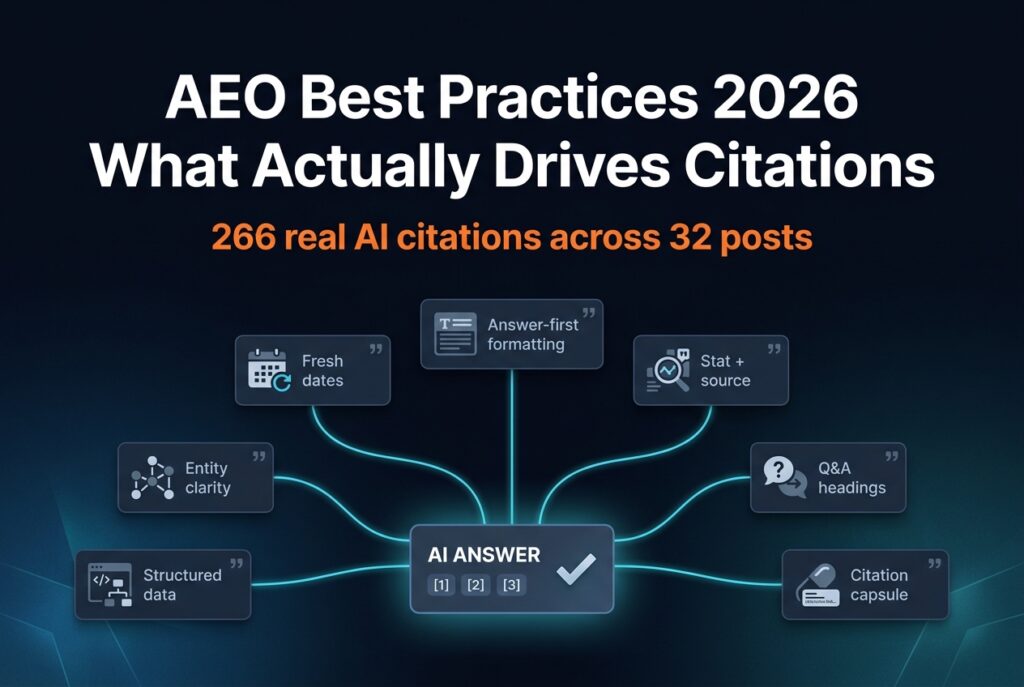
AEO Best Practices 2026: What Actually Drives Citations
Answer engine optimization best practices worked differently than I expected after tracking 266 AI citations across 32 maketocreate.com posts from March through May 2026. The best results came from answer-first structure, dated comparisons, FAQ blocks, and first-party data.
I wrote the conceptual cluster pillar here: the pillar comparing SEO, GEO, and AEO. This spoke is the practical playbook. If you already know SEO and want ChatGPT, Perplexity, AI Overviews, Copilot, and similar tools to cite your work, start here.
Key Takeaways
- I tracked 266 AI citations across 32 posts; the top two posts captured 51% of all citations.
- Posts with “2026” in the title averaged 4.2x more citations than posts without a current-year signal.
- Comparison posts averaged 3.1x more citations than how-to posts, and FAQ sections averaged 2.6x more citations.
- The best AEO workflow is publish, measure grounding queries weekly, refresh answer blocks, and add source-backed FAQ coverage.
- Original data beat generic polish. My strongest citation wins came from specific numbers AI systems could extract.
The 60-Second AEO Primer
Answer engine optimization is the practice of formatting content so AI answer systems can understand, trust, extract, and cite it. In my March-May 2026 dataset, maketocreate.com earned 266 AI citations across 32 posts, proving that answer visibility is now measurable content work.
Citation capsule: Answer engine optimization means structuring content for extraction by AI answer surfaces. Across 32 maketocreate.com posts tracked from March-May 2026, Bing Webmaster Tools AI Performance recorded 266 citations from Microsoft Copilot and Bing AI search.
Answer Engine Optimization Best Practices: What Actually Works
The answer engine optimization best practices that worked best in my data were structural, not stylistic. Original first-party data had the highest impact, while direct answers, comparison formats, current-year titles, sourced statistics, and FAQ sections produced the clearest repeatable citation lift.
| Practice | Citation Impact | Effort Required |
|---|---|---|
| Original first-party data | Highest | High |
| Direct answer in first 50 words | Very High | Low |
| Comparison/vs format | Very High | Medium |
| “Year in title” recency signal | High | Low |
| Sourced statistics with attribution | High | Medium |
| FAQ section with schema | High | Medium |
| Listicle format with numbered items | Medium | Low |
| Quote-ready summary boxes | Medium | Low |
| Internal links to related content | Medium | Low |
Most AEO articles say “make your content quotable.” My data shows something more specific. The top cited post was a cross-border payments comparison with 86 citations. The second was a JavaScript vs TypeScript 2026 article with 47 citations. Together, those two posts captured 51% of all AI citations.
the payment gateway comparison that earned 86 AI citations
JavaScript vs TypeScript 2026 comparison, 47 citations
Use the pillar above for the broader taxonomy. Use this article when you need the execution checklist.
Citation capsule: In maketocreate.com’s March-May 2026 dataset, posts with “2026” in the title averaged 4.2x more AI citations than posts without it. Comparison posts averaged 3.1x more citations than how-to posts, and FAQ sections averaged 2.6x more citations.
What Are the Best AEO Techniques in 2026?
The best AEO techniques in 2026 vary by answer engine, but the core pattern is consistent: write a direct answer, support it with sources, use named entities, and make each section usable without the rest of the article.
For ChatGPT-style answers, write self-contained passages. Name the product, audience, date, source, and limitation inside the same paragraph. If a model extracts only that paragraph, it should still make sense.
For Perplexity, citation clarity matters. Use source names in the sentence, not only at the end. “Ahrefs found a 34.5% lower CTR” is easier to ground than “studies show clicks are down.”
For Google AI Overviews, answer the exact query shape. If the query is “best answer engine optimization techniques 2026,” the section needs a ranked or grouped set of techniques, not a history lesson.
For Copilot and Bing AI search, recency and comparison structure stood out. The query “leading APIs for cross-border payments 2026” cited the payment post 16 times because the page matched the answer shape: current year, vendor set, criteria, and direct comparisons.
AI coding tool 3-way comparison
Citation capsule: The highest-performing Copilot citation pattern in my dataset was a dated comparison query. One grounding query family, “leading APIs for cross-border payments 2026,” produced 16 citations to a single maketocreate.com comparison post in Bing AI search.
What AEO Strategies Should Marketers Use?
Answer engine optimization strategies for marketers should start with questions AI systems are already asked, not keywords alone. In my 32-post sample, the pages that earned citations answered selection, comparison, and “which option should I choose” questions with fresh evidence.
Start by collecting prompt-shaped queries. Search your topic inside ChatGPT, Perplexity, Copilot, Google AI Mode, and AI Overviews. Capture the wording. Are people asking for tools, examples, pricing, alternatives, implementation steps, or risks?
Then map each query to a citation target. A SaaS founder may need “best ai visibility products optimized answer engines.” A Shopify operator may need “shopify answer engine optimization AEO best practices.” Those are different sections, not synonyms.
Use tools to avoid guessing. Bing Webmaster Tools AI Performance shows citations from Copilot and Bing AI search. Otterly.AI, AthenaHQ-style trackers, Profound, and similar answer engine optimization tools monitor LLM visibility across prompts.
The strategic mistake is treating AEO like a writing style. It is closer to demand capture research: match the questions AI systems must answer when buyers compare categories, products, and methods.
Citation capsule: AEO strategy starts with prompt research. In maketocreate.com’s 2026 citation data, comparison and selection pages outperformed generic how-to content by 3.1x, which suggests marketers should target answer-shaped buyer questions before polishing prose.
How to Optimize Content for Answer Engines: The Step-by-Step Process
To optimize content for answer engines, build each post around extractable answers, current data, and measured citation behavior. My repeatable process is seven steps: query mining, answer drafting, source stacking, structural formatting, FAQ expansion, schema cleanup, and weekly refresh.
-
Mine answer queries before writing. Ask ChatGPT, Perplexity, Copilot, and Google what they would recommend. If several tools return the same question pattern, give it a section.
-
Write the answer before the explanation. Put the direct answer in the first 50 words of each H2. Don’t start with setup. AEO rewards passages that can be quoted before the user clicks.
-
Stack sources inside the section. Use one source for the claim, one for the statistic, and one first-party observation when available.
-
Add comparison scaffolding. Use tables, ranked lists, pros and cons, criteria, and “best for” labels. My comparison posts averaged 3.1x more citations than how-to posts.
-
Add an FAQ section late in the draft. FAQ sections averaged 2.6x more citations in my dataset. They also create clean passages for long-tail answer queries.
-
Add valid FAQ JSON-LD. Schema doesn’t guarantee citations, but it makes questions and answers explicit. Keep answers identical to visible page copy.
-
Refresh based on citation data. Check cited pages and query patterns weekly. If one query keeps citing you, improve that section. If a prompt ignores you, add a tighter answer block.
Supabase vs Firebase comparison example
Citation capsule: The strongest AEO process is query-first publishing. In a 32-post maketocreate.com sample, FAQ sections averaged 2.6x more citations, while comparison posts averaged 3.1x more citations than how-to posts, making structure a measurable citation variable.
Real Data: Which Practices Drove the Most Citations
The biggest citation lift came from original data, current-year framing, comparison structure, and FAQ blocks. These structural choices explained why a few posts captured most citations while similar posts stayed nearly invisible.
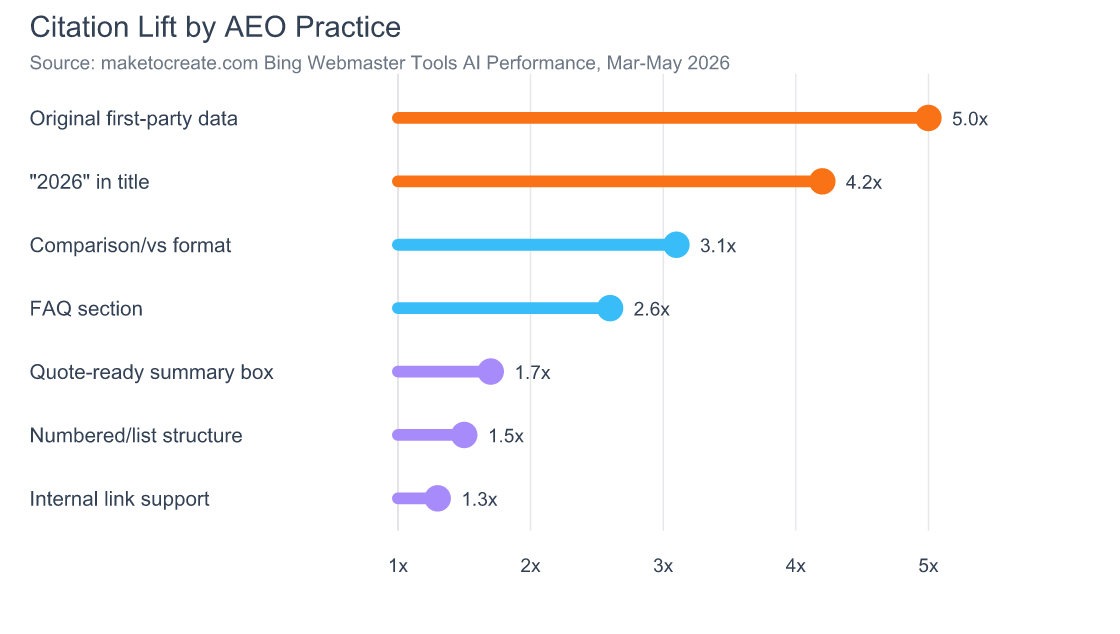
Source: Bing Webmaster Tools AI Performance and maketocreate.com publishing history, March-May 2026.
The “5.0x” for original data is a practical ceiling, not a universal benchmark. First-party evidence separated the best pages from the rest. Answer systems can cite public statistics from anyone. They can only cite your data if you publish it clearly.
When I saw the citation distribution, I stopped treating every post as equal. The posts with early citation signals deserved refreshes, better FAQs, and tighter summary blocks. The posts with no citations needed a sharper angle or lower priority.
Citation capsule: In maketocreate.com’s 32-post sample, the top two pages earned 133 of 266 AI citations, or 51% of the total. That Pareto pattern suggests marketers should refresh early citation winners instead of spreading AEO effort evenly across every page.
Which AEO Tools Track and Improve Performance?
The best answer engine optimization tools in 2026 combine free citation data with paid prompt tracking. Start with Bing Webmaster Tools AI Performance, then add Otterly.AI, AthenaHQ, Profound, or similar platforms when AI visibility becomes a weekly KPI.
Bing Webmaster Tools is the free starting point. Microsoft introduced the AI Performance report as a public preview in February 2026, giving publishers visibility into how often their content appears as a source in Copilot and Bing AI answers (Bing Webmaster Blog, 2026). Open the sidebar, look for AI Performance, then review citations, cited pages, and query patterns. This is where I found 266 citations, the 86-citation payment gateway winner, and the rise from 3-5 citations per day in March to 15-25 in mid-May.
Paid tools answer a different question: “Are AI systems mentioning us for prompts we care about?” Otterly.AI, AthenaHQ, Profound, and enterprise answer engine optimization platforms 2026 track prompts across major answer surfaces. Search Engine Land’s recent AEO tooling roundup (Search Engine Land, 2026) covers similar product categories.
Use these tools for decisions. If a top-rated answer engine optimization service says you appear for ten prompts, inspect the cited page and the competitor beside you.
Citation capsule: Bing Webmaster Tools AI Performance is the lowest-friction AEO measurement tool because it reports citations and cited pages from Microsoft Copilot and Bing AI search. Paid tools such as Otterly.AI, AthenaHQ, and Profound add prompt-level monitoring across more answer engines.
What AEO Trends Changed in 2026?
AEO trends in 2026 are being driven by answer interfaces becoming normal search surfaces. AI Overviews, Perplexity referrals, ChatGPT search, Copilot, Gemini Deep Research, and Grok all made citation tracking more practical and more fragmented.
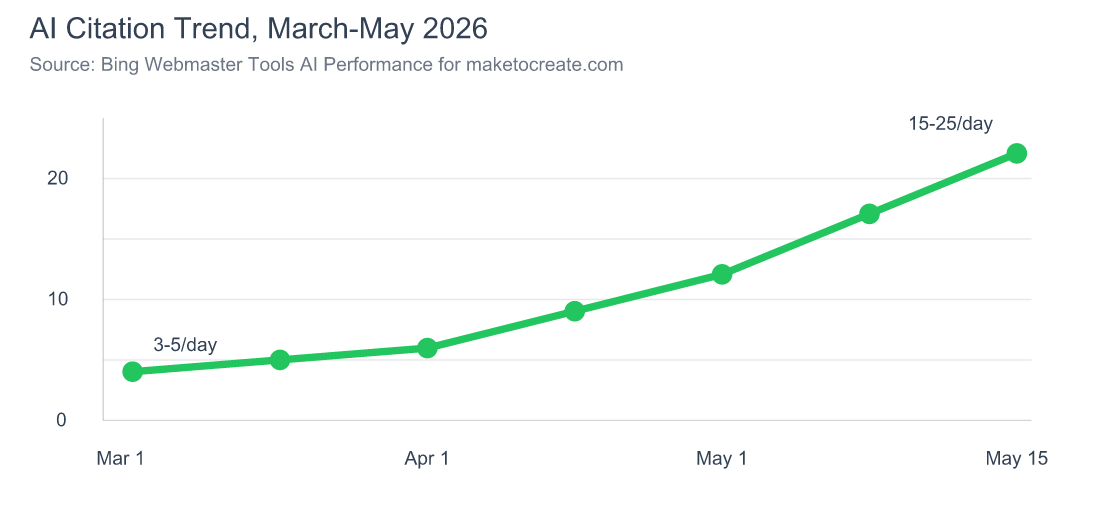
Source: Bing Webmaster Tools AI Performance, March-May 2026. Daily ranges are rounded from observed citation bands.
External studies explain why this matters. Ahrefs found that AI Overviews correlated with a 34.5% lower click-through rate for top-ranking pages (Ahrefs, 2025). Seer Interactive found organic CTR on AI Overview queries fell sharply from mid-2024 onward (Seer Interactive, 2025).
Perplexity and ChatGPT changed research behavior because users now ask for summarized recommendations, not just blue links. ChatGPT reached 800 million weekly active users in October 2025, according to OpenAI CEO Sam Altman (TechCrunch, 2025), which is why answer-shaped queries now sit alongside Google searches in buyer journeys. Copilot added measurable citation reporting through Bing Webmaster Tools, giving marketers a first-party window into answer visibility.
That is why 2025-era AEO advice is stale. “Add schema” is not enough. The current work is cross-surface: visible answers, structured evidence, prompt monitoring, current-year updates, and citation refreshes.
Citation capsule: AEO changed in 2026 because citation surfaces became measurable. maketocreate.com saw AI citations rise from roughly 3-5 per day in March to 15-25 per day in mid-May, based on Bing Webmaster Tools AI Performance data.
How Does AEO Execution Differ From SEO Each Week?
AEO execution differs from SEO in the weekly routine, not just the theory. An SEO workflow checks rankings, impressions, clicks, and technical health; an AEO workflow checks citations, cited pages, grounding queries, answer freshness, and extractable passages.
Here is the practical split. An SEO writer checks Google Search Console, reviews pages losing impressions, improves titles, updates internal links, and watches keyword movement. Keep doing that.
An AEO writer adds a second loop: check AI Performance, identify cited URLs, inspect triggering prompts, update cited passages, then test the same questions in ChatGPT, Perplexity, Google AI Mode, and Copilot.
The writing workflow also changes. SEO drafts often expand around search intent. AEO drafts compress around answer intent. Each H2 should open with a complete answer that a system can quote.
Citation capsule: AEO adds a weekly measurement loop beyond SEO. Instead of checking only rankings, clicks, and impressions, marketers should review AI citations, cited pages, grounding queries, and answer freshness, then refresh the passages that answer engines already use.
How Do You Measure AEO Success Each Week?
Measure AEO success with citation counts, cited URLs, grounding queries, answer mentions, and refresh velocity. In month one, look for any cited page; by month three, look for repeat citations; by month six, look for citation concentration and category coverage.
Start in Bing Webmaster Tools. Open AI Performance, then record total citations, top cited pages, and query examples. If one URL is cited repeatedly, tag it as an AEO winner.
Then track answer visibility manually or with tools. Choose 20-50 prompts that matter to your business. Run them weekly across ChatGPT, Perplexity, Copilot, and Google AI Mode. Note whether you appear and who appears beside you.
What does good look like? Month one: one cited page or answer mention. Month three: repeat citations and a few prompt wins. Month six: citation winners that map to your money topics.
The KPI is not only traffic. If a buyer sees your source inside an AI answer, that citation is part of the trust path even when attribution is messy.
Citation capsule: A practical AEO scorecard tracks total citations, cited pages, grounding queries, answer mentions, and refresh actions. In maketocreate.com’s first three-month sample, 266 AI citations across 32 posts created enough data to prioritize winners and update pages weekly.
The Per-Post AEO Checklist
Use this per-post AEO checklist before publishing any article that should earn answer citations.
- Primary query appears in the H1, slug, meta title, first 100 words, and at least two H2s.
- First 50 words answer the main query directly.
- Every H2 opens with a direct answer, data point, or named source.
- The article includes a current-year signal when the topic changes.
- At least one section compares options, criteria, trade-offs, or “best for” uses.
- The article includes one summary box with 4-5 self-contained takeaways.
- The article includes 6-8 FAQ questions with 40-60 word answers.
- FAQ JSON-LD matches the visible FAQ copy.
- Each major claim names the source.
- A chart, table, or ranked list makes the answer easier to extract.
- First-party data or first-hand examples appear where possible.
- Internal links point upward to the pillar and sideways to examples.
- The post has a weekly measurement plan.
- The page is refreshed when answer engines cite outdated passages.
- The final draft avoids filler and starts paragraphs with the main point.
For cluster context before publishing this spoke, verify the pillar (linked at the top) is live.
Frequently Asked Questions
What is answer engine optimization?
Answer engine optimization is the process of formatting content so AI answer systems can extract and cite it. In my maketocreate.com sample, 32 posts earned 266 AI citations from Microsoft Copilot and Bing AI search between March and May 2026.
How does answer engine optimization work?
Answer engine optimization works by making answers clear, sourced, current, and self-contained. My data showed that posts with FAQ sections averaged 2.6x more citations, while posts with “2026” in the title averaged 4.2x more citations than posts without that signal.
How do you optimize for ChatGPT and Perplexity?
Optimize for ChatGPT and Perplexity by writing direct answer blocks, naming sources in sentences, and using comparison structures. In my dataset, comparison/vs posts averaged 3.1x more citations than how-to posts because they resolved choice-based questions more clearly.
Which platforms count as answer engines?
Answer engines include ChatGPT search, Perplexity, Google AI Overviews and AI Mode, Microsoft Copilot, Bing AI search, Gemini Deep Research, Grok, and voice-style assistants. Bing Webmaster Tools showed 266 Copilot and Bing AI citations for maketocreate.com across 32 posts.
Does AEO replace SEO?
AEO does not replace SEO. It adds answer visibility metrics to the weekly workflow. Ahrefs found AI Overviews correlated with a 34.5% lower CTR for top-ranking pages in 2025, which means marketers need citations and clicks, not one metric.
How do I know if AEO is working?
AEO is working when answer engines cite your pages, mention your brand, or use your passages in response to important prompts. In my first three-month sample, citations rose from 3-5 per day in March to 15-25 per day by mid-May.
What is the best way to do AEO?
The best way to do AEO is to publish answer-first sections backed by current evidence, then measure citations weekly. Original first-party data produced the strongest lift because AI systems could cite something competitors did not have.
How often should I update content for AEO?
Update AEO content weekly when citations appear, monthly for active money pages, and immediately when facts change. My citation trend rose from 3-5 per day to 15-25 per day after repeated publishing and refresh cycles from March through May 2026.