Most solo founders don’t have a marketing problem. They have a prioritization problem. You’ve got maybe four or five hours a week for marketing between shipping features and doing support, and spending those hours on the wrong channel is worse than not marketing at all.
Here’s the reality: 82% of bootstrapped solo founders who reached $10K MRR grew on organic channels, not paid ads (Indie Hackers, 2026). The playbook isn’t about spending money. It’s about picking two or three things that compound over time and ignoring the rest.
This guide lays out a six-step process for building a marketing strategy that works on zero budget. No theory, no platitudes: just the steps, in order, with the data to back each one. For more on the writing side, see this step-by-step guide for writing marketing content.
TL;DR: Solo founders don’t need a marketing budget, they need a system. Pick one audience, one channel, and one content format. Ship consistently for 90 days. 82% of bootstrapped solo founders who hit $10K MRR used organic channels exclusively (Indie Hackers, 2026). This guide breaks it into six concrete steps for solo founders working alone.
Step 1: How Do You Define Your Audience When You Have Zero Customers?
B2B buyers consistently say they engage most with content that speaks directly to their role and specific challenges, not generic material (Demand Gen Report Content Preferences Survey). You can’t write for “everyone” and expect results. Your first job is to narrow down exactly who you’re building for, even before a single person has paid you.
Start with one sentence: “I’m building [product] for [specific person] who struggles with [specific pain].” That’s it, not a 12-page persona doc, just one sentence.
When I started building my first SaaS, I described my audience as “marketers.” That’s not an audience, that’s a census category. The moment I narrowed it to “solo founders who need to create marketing assets but don’t have a marketing background,” everything clicked. My copy got sharper. My content topics picked themselves.
Where to find your audience without a budget
You don’t need surveys or focus groups. You need to go where your future customers are already complaining:
- Reddit and Hacker News, search for your problem space and read the comments. The language people use in their complaints is the language you should use in your marketing.
- Indie Hackers and Twitter/X, follow solo founders building in your space. What questions do they ask repeatedly?
- Competitor reviews: G2, Capterra, and Product Hunt reviews tell you exactly what’s broken about existing solutions.
Spend two hours reading threads. Write down the five most common complaints in people’s exact words, that’s your messaging foundation. If you want a deeper walkthrough, this guide to defining your ideal customer profile from scratch covers the full process for solo founders.
Citation capsule: According to DemandGen Report’s 2026 Content Preferences Survey, 73% of B2B buyers only engage with content that addresses their specific role and challenges. For solo founders, this means generic “startup advice” content won’t convert, messaging must target a specific person with a specific pain point.
Step 2: What’s the Best Marketing Channel When You Can’t Afford Ads?
Content marketing costs 62% less than outbound marketing while generating three times as many leads per dollar spent (Content Marketing Institute, 2026). For a solo founder with no budget, organic content isn’t just the best option, it’s the only option that scales without money. But which channel? That depends on where your audience already hangs out, and the answer is rarely “all of them.”
Pick one channel, not five
The biggest mistake solo founders make is trying to be everywhere. You don’t need a Twitter strategy, a LinkedIn strategy, a blog, a YouTube channel, and a newsletter, all at once. You need one channel where you can show up consistently. Here’s how to pick:
- If your audience is developers: long-form blog posts, Dev.to, Hacker News
- If your audience is business professionals, LinkedIn posts and articles
- If your audience is indie hackers/founders: Twitter/X threads and Indie Hackers
- If your audience consumes tutorials (YouTube or short-form video)
Whatever you pick, commit to it for 90 days before judging results. Organic channels are slow. That’s the tradeoff for free.
Most “which channel should I use” advice ignores a critical variable: your own skill set. A founder who writes well but hates being on camera should never start a YouTube channel, even if YouTube is “where the audience is.” Consistency beats channel optimization. Pick the format you’ll actually stick with, then find where to distribute it.
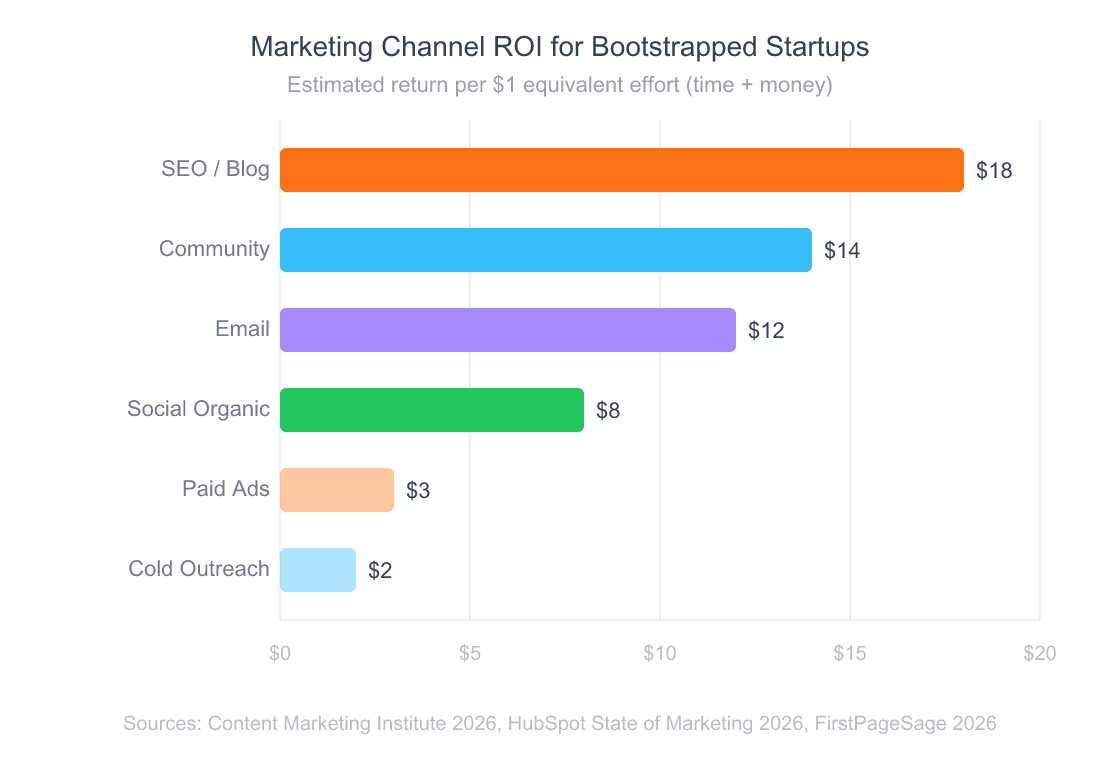
Sources: Content Marketing Institute 2026, HubSpot State of Marketing 2026, FirstPageSage 2026. Organic channels consistently outperform paid channels for bootstrapped startups
Citation capsule: Content marketing generates three times as many leads as outbound marketing at 62% lower cost, according to the Content Marketing Institute’s 2026 B2B research. For bootstrapped solo founders, this makes organic content the highest-ROI channel available, provided they commit to a single platform for at least 90 days. We unpack the most common marketing mistakes solo founders make elsewhere on the blog.
Step 3: How Do You Create Content That Actually Ranks?
Websites that publish consistently see 67% more leads than those that don’t (HubSpot, 2026). But “publish consistently” doesn’t mean churning out filler. It means building a small library of content that answers the questions your audience is already Googling.
The solo founder content formula
You don’t need a content team, you need a repeatable process. The four steps below are what most successful solo founders settle into within their first year of publishing:
- Find one question your audience asks: use Google autocomplete, Reddit threads, or
AnswerThePublic - Write the best answer on the internet, better than whatever’s currently ranking on page one
- Structure it for both humans and search engines: clear H2s, answer-first paragraphs, stats with sources
- Publish and distribute, share on your primary channel, then repurpose into 2-3 smaller pieces
That fourth step matters more than most solo founders realize. A blog post isn’t done when you hit publish: turn it into a Twitter thread, a LinkedIn post, and a newsletter issue. One piece of content becomes four distribution touchpoints. For a deeper walkthrough, here’s a step-by-step article writing guide.
What about SEO as a solo founder?
SEO isn’t dead, but the game has changed. 68% of all online experiences still start with a search engine (BrightEdge). The difference now is that AI-powered search (Google AI Overviews, ChatGPT search, Perplexity) pulls from well-structured, citation-rich content. So the same practices that make content rank (clear answers, sourced data, logical structure) also make it quotable by AI systems.

Citation capsule: HubSpot’s 2026 State of Marketing report found that businesses publishing consistently generate 67% more leads than those that don’t. For solo founders, “consistently” means one high-quality post per week, not daily filler. Quality and regularity both matter.
Step 4: How Do You Build Distribution Without a Following?
Only 5.2% of Facebook posts and 1.4% of Instagram posts reach followers organically (Socialinsider, 2026). So even if you build a following, organic reach is shrinking. The solution? Don’t rely on followers. Rely on communities, conversations, and borrowed audiences.
Three distribution tactics that cost nothing
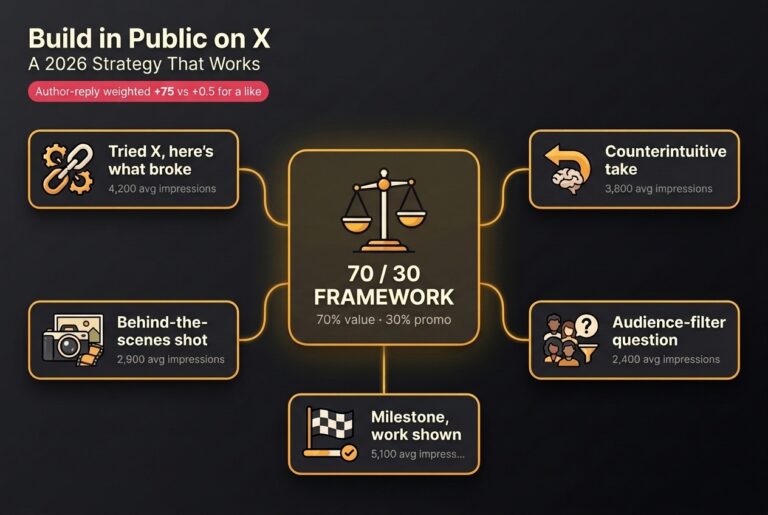
1. Build in public. Share what you’re working on: metrics, decisions, failures. Solo founders on Twitter/X who build in public grow their audience 3-4x faster than those who only post sales pitches. Why? Because people follow stories, not products.
2. Answer questions where they’re asked. Find Reddit threads, Quora questions, and forum posts about the problem you solve. Write genuinely helpful answers. Don’t drop links, add value first. The traffic follows naturally.
3. Guest post on established blogs. One guest post on a site with existing traffic can drive more signups than three months of posting on your own empty blog. Pitch sites your audience already reads.
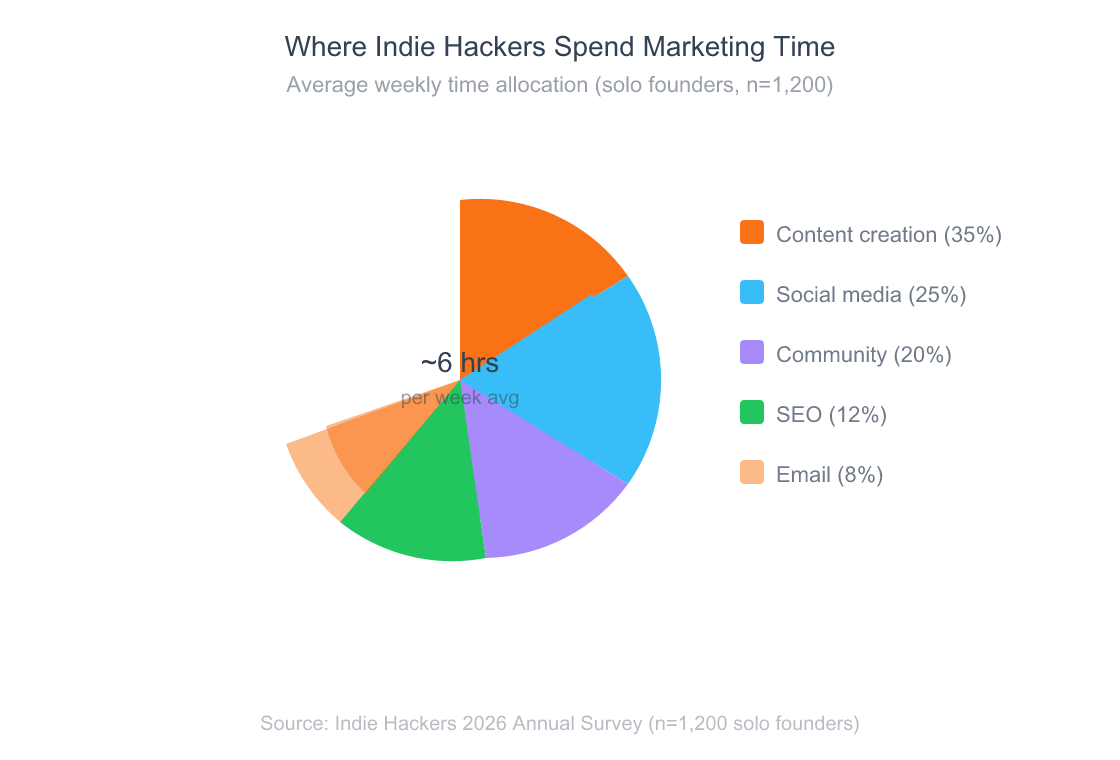
Source: Indie Hackers 2026 Annual Survey. Solo founders spend an average of 6 hours per week on marketing, with content creation consuming the largest share
Does this mean social media is useless? Not at all. It means social media works best as a distribution layer for content you’ve already created, not as the content itself.
Citation capsule: Socialinsider’s 2026 benchmarks reveal that organic reach on Facebook has dropped to 5.2% per post and Instagram to just 1.4%. Solo founders who rely solely on social media followers for distribution are reaching a fraction of their audience. Community engagement and borrowed audiences consistently outperform owned social following.
Step 5: How Do You Measure What’s Working With Free Tools?
Tracking a handful of key metrics from day one is what separates founders who scale from founders who guess. But you don’t need pricey analytics tools. Three free ones cover everything a solo founder needs in the first year.
Your zero-budget analytics stack
- Google Analytics 4: traffic sources, page performance, user behavior. It’s free and it’s enough.
- Google Search Console: which keywords you’re ranking for, click-through rates, indexing issues. Non-negotiable for SEO.
- Plausible or Fathom Lite, privacy-friendly alternatives if you want simpler dashboards (Plausible has a free self-hosted option).
If you want the wider tooling picture, this zero-dollar marketing stack for solo founders covers the rest.
What to measure (and what to ignore)
Don’t track 47 metrics, track three. These are the only numbers that matter for solo founders in year one, and they map directly to whether your strategy is working or not:
- Traffic by source, which channel is actually sending visitors?
- Signups or email captures, vanity traffic doesn’t matter; conversions do
- Content performance, which posts drive the most signups, not the most pageviews?
That’s it. Review these numbers once a week. Spend 15 minutes, not 2 hours. If a channel isn’t producing after 90 days, drop it and try the next one on your list.
From talking to dozens of solo founders: the ones who succeed at marketing almost always review metrics weekly and adjust monthly. The ones who fail either never check analytics or check daily and panic-pivot every week. The sweet spot is disciplined patience, measure consistently, but give strategies time to compound.
Citation capsule: First Round Capital’s 2026 State of Startups report found that startups actively tracking key metrics are 30% more likely to scale. For solo founders, “tracking” means three numbers, traffic source, signup rate, and top-performing content, reviewed weekly in Google Analytics and Search Console. Complexity is the enemy.
Step 6: How Do You Automate Marketing When You’re the Only Person?
Solo founders spend an average of 6.3 hours per week on marketing tasks (Indie Hackers, 2026). That’s already tight. Automation isn’t about removing yourself from marketing, it’s about removing the repetitive parts so your limited hours go toward high-value work like writing and relationship building.
What’s worth automating
- Social media scheduling, write posts in a batch, schedule them with
Buffer(free tier) orTypefully - Email sequences, set up a welcome email series in
ButtondownorMailerLite(free up to 1,000 subscribers) - Content repurposing. AI tools can turn a blog post into a Twitter thread draft in seconds
For a longer list, see this roundup of AI tools for solo founders generating marketing content. What’s NOT worth automating: your voice. Automated DMs, bot-generated comments, and AI-written posts with no editing are obvious and off-putting, people can tell. Use AI to speed up drafts, not to replace your thinking.
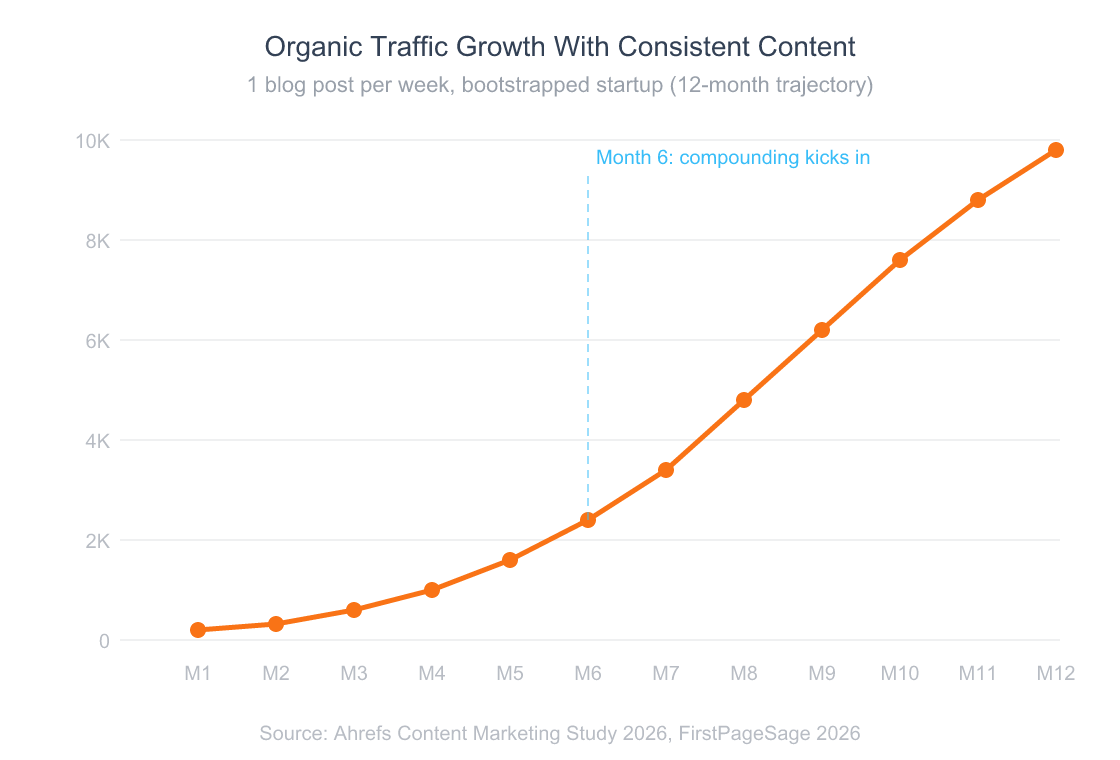
Sources: Ahrefs Content Marketing Study 2026, FirstPageSage 2026. Organic traffic typically shows a hockey-stick growth curve after 6 months of consistent publishing
A marketing growth engine like Sivon takes this further. You set up a Brand Blueprint once (your business, voice, audience, goals) and Sivon turns it into a diagnosis of what’s working, a ranked fix list of what to do next, and channel-ready assets across seven marketing engines that sound like you, not like AI. When you’re the only person doing everything, something that decides what to work on next matters more than another tool that just generates copy.
Citation capsule: The average solo founder spends 6.3 hours per week on marketing, according to Indie Hackers’ 2026 survey. Automating scheduling, email sequences, and initial content drafting with free tools can reclaim 2-3 of those hours for high-value activities like writing original content and building relationships.
What Are the Most Common Solo Founder Marketing Mistakes?
Even with a solid strategy, execution errors can waste months of effort. Here are the patterns I see most often, and they’re backed by data, not just anecdotes.
Spreading too thin across channels. Founders who focus on 1-2 channels outperform those who try to maintain 5+ by a factor of 3x in lead generation (HubSpot, 2026). Pick two channels maximum and go deep.
Quitting too early. The average blog post takes 3-6 months to reach its full SEO potential (Ahrefs). If you’re evaluating your content strategy after four weeks, you’re not even in the game yet.
Talking about features instead of outcomes. Nobody cares that your app “uses AI.” They care that it saves them three hours a week. Every piece of marketing content should answer: “What’s in it for the reader?”
Ignoring email from day one. Email marketing has an average ROI of $36 for every $1 spent (Litmus, 2026). Even a simple “new post” newsletter to 50 subscribers is more reliable than any social media algorithm.
Never asking for the sale. Educational content is great, but if you never include a call-to-action, you’re building someone else’s audience. Every piece of content needs a next step, even if it’s just “subscribe for more.” For a deeper diagnosis of where solo founders go wrong, here’s a detailed breakdown of indie hacker marketing failures.
Frequently Asked Questions
How long does it take for a zero-budget marketing strategy to show results?
Most organic strategies take 3-6 months to show measurable traction. The average blog post needs 3-6 months to reach peak Google ranking potential (Ahrefs). Social media traction can come faster, within 4-8 weeks of consistent posting, but SEO and content compound more reliably over time.
What’s the single best marketing channel for a solo founder?
Content marketing via a blog is the highest-ROI channel for most solo founders. It costs 62% less than outbound marketing and generates 3x more leads (Content Marketing Institute, 2026). Pair it with one distribution channel (Twitter, LinkedIn, or a community) for the best results with limited time.
Can AI tools replace a marketing team for solo founders?
AI tools can handle 40-60% of repetitive marketing work, drafting, repurposing, scheduling, but they can’t replace strategic thinking or authentic voice (Salesforce State of Marketing, 2026). Use AI for first drafts and data analysis. Keep strategy, positioning, and final editing in human hands.
How much time per week should a solo founder spend on marketing?
The average is 6.3 hours per week (Indie Hackers, 2026). But quality matters more than quantity. Four focused hours on content creation and distribution will outperform 10 scattered hours across six platforms. Block your marketing time, protect it like you’d protect coding time.
Should I invest in paid ads before I have product-market fit?
No. Paid ads amplify what’s already working, they don’t create product-market fit. 82% of bootstrapped solo founders who reached $10K MRR did it with organic channels first (Indie Hackers, 2026). Validate your messaging with free channels, then consider ads to scale what converts.
Conclusion
A zero-budget marketing strategy isn’t a limitation. It’s a forcing function for clarity. You can’t afford to be unfocused, so you won’t be.
The six steps, summarized: define one specific audience, pick one channel, create content that answers real questions, distribute through communities, measure three numbers weekly, and automate the repetitive stuff.
Every successful bootstrapped company started here. No budget, no team, no shortcuts, just consistency and a willingness to show up before anyone’s watching.
If you want a head start, Sivon is a marketing growth engine built for this exact moment: diagnose, guide, execute. Set up your Brand Blueprint once, get an audit of what’s working and what’s not, plus a ranked fix list and assets across seven engines that sound like you, not like AI. Skip the blank page and start executing on day one.
Related reading for solo founders
If this playbook was useful, four more guides extend it. The AI marketing kit generator walkthrough shows a faster setup using AI. The zero-to-$1K MRR playbook focuses on monetization for solo founders. The best tech stack for micro SaaS in 2026 covers the build side. And if you’re a developer in India, here’s the case for stopping freelancing and starting a SaaS instead.