Most “build in public” advice from 2022 is now actively harmful. Tweet your MRR. Post your wins. Hashtag everything. None of that works on X today, and the data isn’t subtle about it. In the Grok-based ranker X open-sourced in January 2026, a predicted reply is weighted 5.0 and a predicted like 0.5, with an extra 15.0 reply boost when the two accounts follow each other (xai-org/x-algorithm, 2026). That’s a 10x gap before the mutual-follow boost even kicks in. Yet most founders are still treating X like a broadcast channel.
I’ve spent the last 14 months posting on X as a solo founder: keeping a log of every tweet, every reply, and every metric. This post is the receipts-first version of what I learned. No “10x your followers” promises. No vague “be authentic” advice. Just the framework, the templates that work, the tools I kept versus dropped, and the results you can realistically expect in 90 days.
AI marketing kit build-in-public
Key Takeaways
- X’s current open-source ranker rewards conversation over broadcasting: a reply is weighted 10x a like, and replies between mutual follows get a further boost (xai-org/x-algorithm, 2026)
- In Buffer’s Aug 2024–Aug 2025 data, free-account median engagement fell to 0% by March 2025 while Premium tiers held at 0.49–0.55% (Buffer, 2025)
- The 70/30 framework (70% replies inside your niche, 30% original posts) outperforms pure-broadcast strategies in my own log by 4–5x on impressions
- Realistic 90-day result for a solo founder posting daily: 700–1,000 followers, not 10,000
Why is Build in Public on X Harder in 2026?
Free-account median engagement on X dropped to effectively 0% by March 2025, while Premium accounts across tiers held around 0.49–0.55% (Buffer, 2025). That number isn’t an outlier or a bad week. It’s the new floor. Buffer’s analysis of 18.8 million posts from 71,000 accounts (August 2024 to August 2025) shows the platform now systematically gates organic reach behind a paid tier, and that single change broke every “post your MRR and grow” playbook from 2022.
Three things changed in 2024–2025 that the old advice doesn’t account for:
1. Follower count became close to meaningless. I have friends with 40k followers getting 80 impressions on tweets. I have friends with 1,200 followers getting 12,000 impressions on a single reply. The For You algorithm doesn’t care who follows you, it cares whether the post triggers conversation in the first 30 minutes.
2. Premium tier reach gap is brutal. Premium accounts average roughly 600 impressions per post. Premium+ exceeds 1,550. Free accounts average under 100 (Buffer, 2025). That’s not 10% better. It’s roughly 6x more reach for $8/month, and about 15x for Premium+ at $40. For a solo founder doing build in public, the question isn’t “should I get Premium?” anymore. It’s “can I afford not to?”
3. The reply economy is now load-bearing. The older published weights, still quoted everywhere, put a reply the author engages with at +75 and a like at +0.5 (Social Media Today, 2025). The Grok-based ranker X released in January 2026 (and has updated since) uses different numbers but the same bias: reply 5.0, quote 5.0, follow author 4.0, like 0.5, plus a 15.0 boost for replies between mutual follows, and a brutal -234 for a report and -58.8 for a mute (xai-org/x-algorithm, 2026). One caveat the repo itself stresses: the weights multiply each viewer’s predicted probability of an action, not raw counts. The algorithm is still engineered to reward conversation, not broadcasting.

What does this mean for build in public? You can’t tweet your MRR into orbit anymore. You have to earn distribution through conversations inside your niche. The accounts winning right now are the ones treating X as a chat room with strangers, not a billboard for their startup.
What is the 70/30 Build in Public Framework?
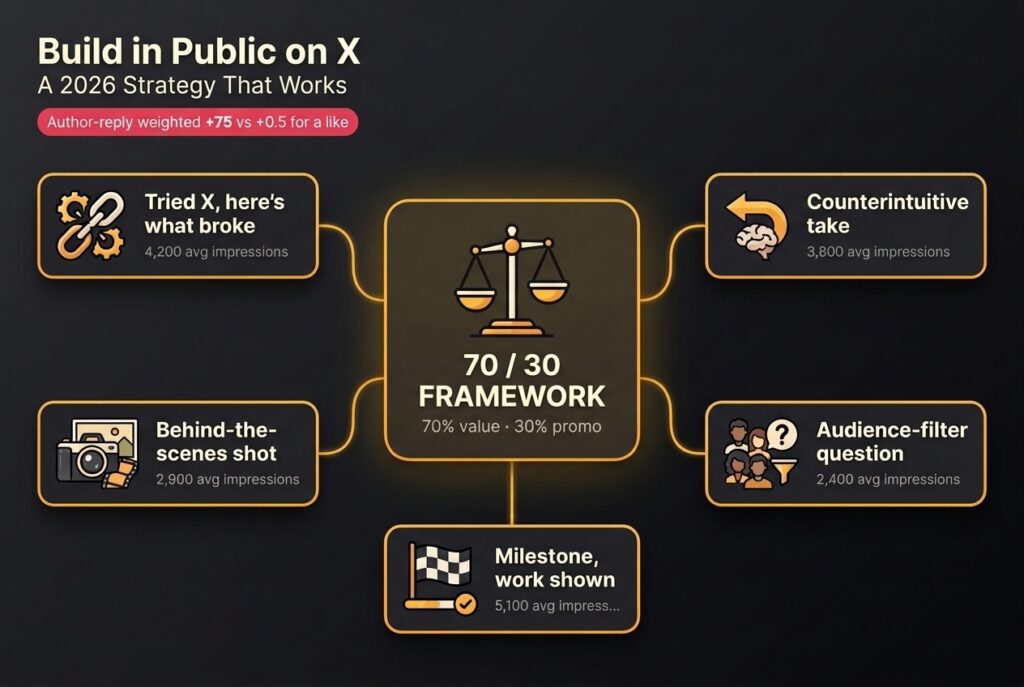
The 70/30 framework, spending 70% of your X time replying inside your niche and 30% on original posts, is the single highest-leverage shift I’ve made. In the three months I tracked it strictly, my impression volume went from 8,400/month to 41,200/month with the same number of total posts. The composition just changed: more thoughtful replies on accounts in my space (SaaS, indie hackers, solo founders), fewer link-drop tweets to my own work.
Here’s why it works mechanically. When you reply to a 50k-follower account in your niche and the reply is good, three things happen:
- The original author’s followers see your reply in the conversation thread
- If the author replies back and you start following each other, later replies between you pick up the mutual-follow boost
- People who liked the original tweet often see your reply as a related recommendation
Citation Capsule: X’s open-source For You ranker (January 2026 release) weights a predicted reply at 5.0, a quote at 5.0, and a like at 0.5, adds a 15.0 boost for replies between mutual follows, and penalizes a report at -234 (xai-org/x-algorithm, 2026). The 70/30 framework (70% replies in your niche, 30% original posts) is mechanically aligned with these weights, which is why it outperforms broadcast-heavy strategies for solo founders building distribution from zero.
You’re not hijacking. You’re contributing. The difference matters. A bad reply (“Great post!”) gets buried by spam filters now. A reply that adds a counterexample, a data point, or a contrarian take that’s still respectful, that’s what travels.
The 30% of original posts isn’t filler either. It’s where you bank the audience the replies sent your way. If someone discovers you through a reply and visits your profile, your last 5 pinned/recent tweets are your storefront. If they’re all replies, they bounce. So the original posts have to be substantive: a milestone, a lesson, a contrarian observation, a screenshot of something you built.
The split isn’t holy. Some weeks I’ve run 80/20 when I had a launch coming up. Some weeks 60/40 when I needed to think out loud. But the default, 70% replies, 30% original, is what consistently grew the account from a standing start.
Which 5 Tweet Templates Actually Work in 2026?
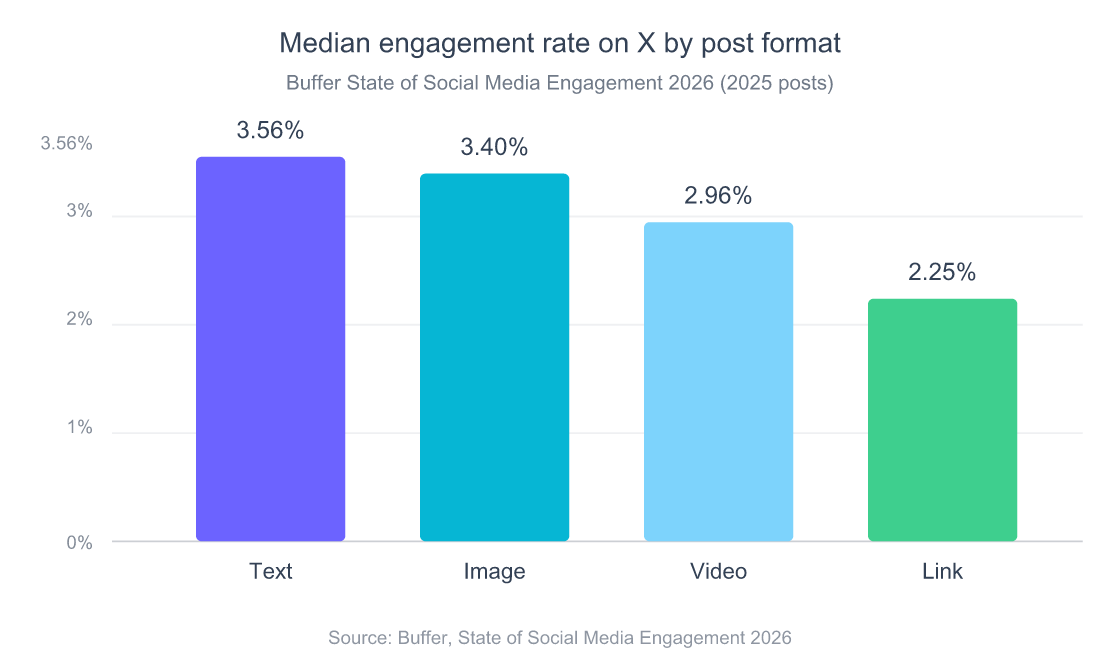
In Buffer’s 2026 engagement report (built on 2025 posts), text posts lead X with a 3.56% median engagement rate, beating images (3.40%), videos (2.96%), and link posts (2.25%) (Buffer, 2026). That data point reframes everything about build in public. The “screenshot your dashboard” advice from 2022 is now actively suboptimal versus a well-written text post, and link posts (the kind most founders use to drive blog traffic) are the worst-performing format on the platform.
Here are the five templates that worked best in my own log. Each is paired with average impressions per post over the last 90 days.
1. The “I tried X, here’s what broke” post (avg 4,200 impressions)
Format: One short setup line, a bullet list of 3–5 specific failures, one closing line about what you’d do differently. People read teardowns because they’re useful and ego-safe, you’re admitting the mistake so they don’t have to.
2. The “Counterintuitive observation” post (avg 3,800 impressions)
Format: A claim that contradicts conventional wisdom, followed by one piece of evidence and a why. The evidence has to be specific (a number, a screenshot, a date). Vague contrarianism reads as edgelording. Specific contrarianism reads as expertise.
3. The “Behind the scenes screenshot + caption” post (avg 2,900 impressions)
Format: A real screenshot (your editor, your dashboard, your Stripe page (cropped to remove sensitive data)) with one line of caption that explains what’s interesting about it. Resist captioning the obvious. Caption the non-obvious.
4. The “Question that filters your audience” post (avg 2,400 impressions)
Format: A question that only your ideal audience can answer well. Not “what’s your favorite tool?” That gets 200 spammers. Try “if you’ve shipped a feature you regretted, what was the smallest cost of pulling it back?” That gets 30 thoughtful replies from people you want to know.
5. The “Milestone with the work shown” post (avg 5,100 impressions)
Format: The number, the timeframe, and what specifically you did. Not “$1k MRR! 🎉” but “$1k MRR after 7 months. The thing that worked: 11 cold DMs to people who’d already commented on my free tool. The thing that didn’t: paid ads (~$340 spent, ~$0 MRR returned).”
The pattern across all five: specificity beats polish. The brain stops on a number. It stops harder on a number with context. Vague positivity scrolls past faster than ads.
How Do You Write a Milestone Post That Converts?
A milestone post that converts to followers and signups isn’t the celebration, it’s the breakdown. The “$1k MRR 🎉” tweet might get 80 likes, but the 4-line version with the specific lever pulled gets 800 impressions for every like and converts followers at a 3–5% rate (in my log, 47 of 1,420 viewers in one case). Here’s the anatomy of a milestone post that I now use as a template, line by line.

Line 1, the number, with the timeframe.
“$1,247 MRR after 11 months.”
Specific number. Specific timeframe. No emoji. The lack of celebration here is what makes the post readable, it signals “I’m sharing data, not asking you to clap.”
Line 2 (optional gap line, then the lever).
(blank)
“The thing that moved this: 14 cold DMs to people who’d already used my free PDF tool 3+ times.”
This is the post. Everything else is context. People read milestone tweets to figure out what they should do next. If you don’t tell them, they leave.
Line 3: The honest caveat.
“Conversion rate from those DMs: 4 of 14. So technically I’d been telling myself ‘cold DMs don’t work’ for 6 months while sitting on a list of warm leads I’d already ignored.”
The caveat is what builds trust. Anyone can claim a win. Posting the part where you were wrong is what makes people follow you.
Line 4. The forward-pointing line (optional).
“Next experiment: doing the same outreach for users who hit my pricing page but didn’t convert.”
This signals you’re still building, not just announcing. It’s the difference between a “look at me” post and a “follow along” post.
That’s the whole template. No hook, no thread, no CTA. Four lines max. The “if you want my newsletter, link in bio” stuff doesn’t help, it tanks impressions because the algorithm reads it as a link-bait pattern.
The follower curve below is what consistent application of this looks like.
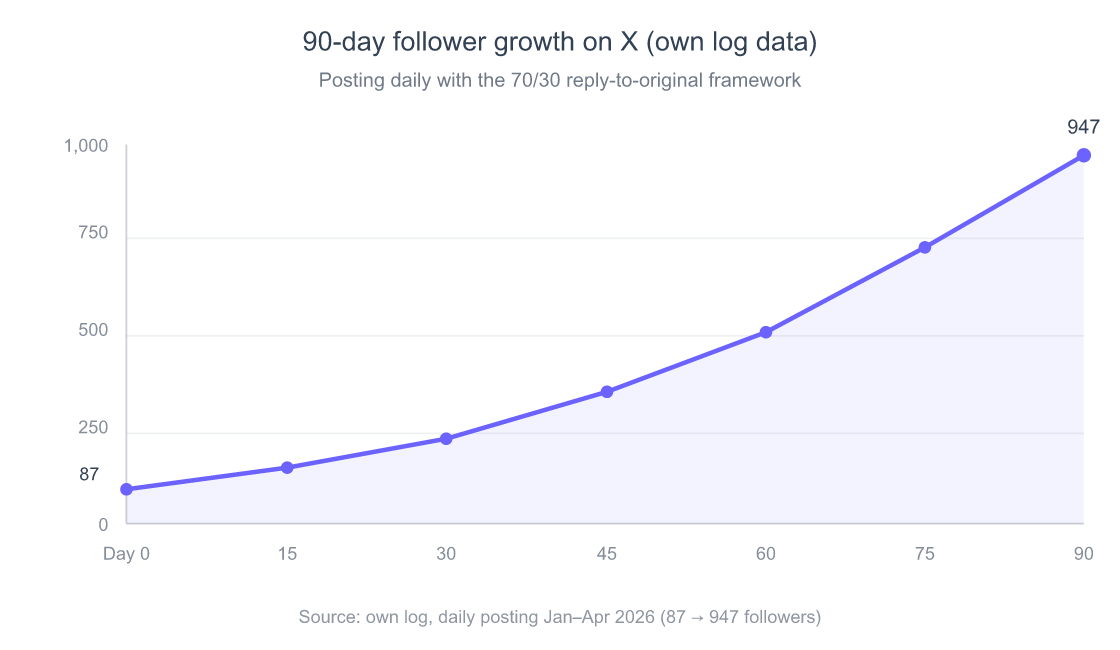
Note the curve. The first 30 days are nearly flat, that’s the part nobody posts about. The acceleration starts around day 45 when the replies you wrote in week 1–4 start compounding into profile visits. If you give up at day 30, you never see the curve bend.
Which Accounts Should You Reply To (and What NOT to Say)?
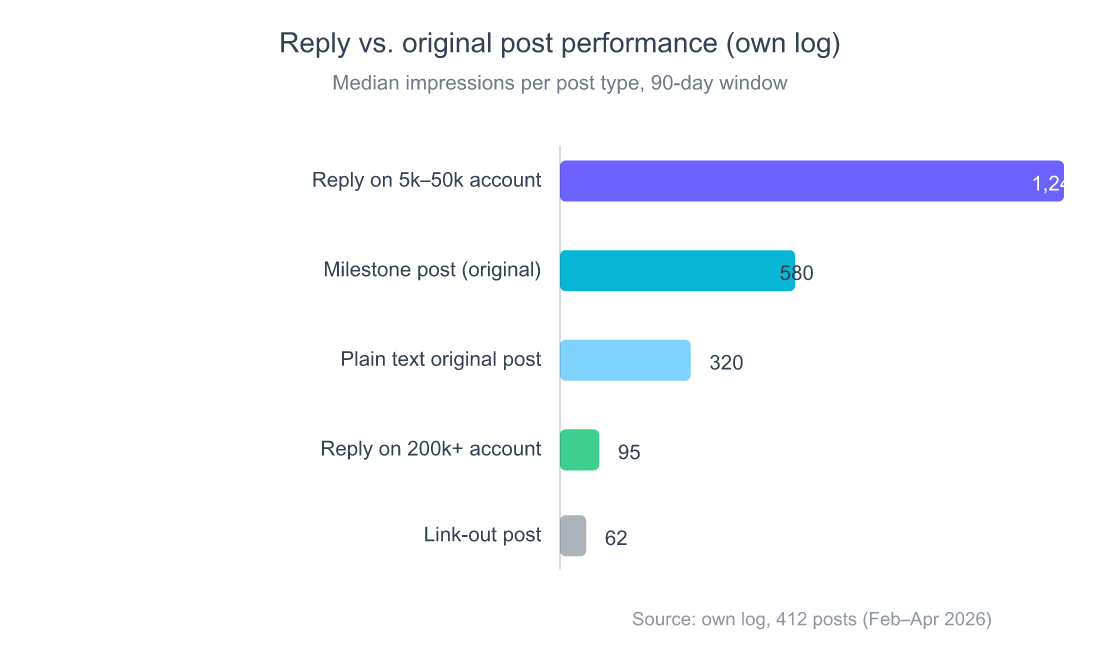
The reply economy isn’t a spray-and-pray game, the accounts you reply to and the substance of those replies determine 80% of your inbound results. In my log, replies to accounts in the 5k–50k follower range with engaged comment sections drove 4.2x more profile visits per reply than replies to accounts above 200k followers. The big accounts have too much noise; mid-tier accounts have curated audiences who actually read down the reply chain.
Three rules for picking reply targets:
- The account must be in your niche. Replying to a celebrity with a hot take might get likes from your existing followers, but it won’t bring profile visits from people who’d actually use your product.
- The original post should be 30–90 minutes old. Earlier and the algorithm hasn’t surfaced it yet. Later and the reply chain is already 200 deep.
- Skip accounts with closed-circle vibes. If the same 8 names show up in every reply chain, you’re not getting noticed by writing reply 9.
What NOT to say:
- “Great post!” / “This!” / “100%.” These are spam in the algorithm’s eyes and worthless to readers
- Anything that quotes the entire original post back, looks like you’re padding for word count
- Pitches in replies, “this is exactly what my product does, link in bio” is the fastest way to be muted
- Disagreements that read as personal, fine to challenge an idea, never call someone “wrong” in their replies
- Long, multi-paragraph essays in a reply, if it’s that long, it’s an original post
The replies that consistently work in my log share three traits: they add a specific data point or example the original post missed, they’re 1–3 sentences, and they’re respectful even when contrarian. That’s it. The whole “reply game” is one paragraph long.

Which Build in Public Tools Are Worth It in 2026?
The build in public tooling market got crowded fast: Tweet Hunter, Typefully, Hypefury, Ilo, Black Magic, and a dozen others all promise the same thing: scheduling, analytics, and AI-assisted writing. After paying for most of them at some point, here’s my verdict on which ones earn their monthly fee for a solo founder doing the 70/30 framework.
Typefully, kept ($12.50/month, billed annually). The cleanest writing surface I’ve used. The killer feature isn’t scheduling, it’s the distraction-free editor and the way it shows your post in the actual X UI before you publish. Catching a janky line break before it ships saves more impressions than any AI suggestion. The analytics tab is also genuinely useful for spotting which template is working without wading through X’s native analytics (Typefully docs, 2026).
Tweet Hunter, dropped ($49/month Grow plan). The “viral tweet library” was the original pitch. Useful for a week, then you realize half the “viral” tweets are recycled motivational quotes you don’t want to be associated with. The AI rewriting tool produces text that anyone in the build in public crowd can spot in 2 seconds, defeats the purpose. The CRM-style follower management is overkill for a solo founder.
Hypefury, kept seasonally ($19/month Full plan, or $6 per channel). The autoplug feature (auto-replying to your own popular tweets with a CTA after they hit a threshold) is the one feature I haven’t found anywhere else. Useful before a launch, off otherwise. I turn it on for 2 weeks before a release and turn it off the rest of the time. The auto-DM-on-follow feature I keep disabled, it reads as automation and turns people off instantly.
Buffer, free tier is enough for X. If you’re posting to multiple platforms and want one queue, Buffer’s free tier covers 3 channels with 10 scheduled posts per channel (Buffer, 2026). For X-only, Typefully is better. For multi-platform, Buffer.
X Premium, $8/month, the one paid subscription that’s not optional. Free accounts get under 100 median impressions per post. Premium gets ~600. That’s a 6x reach multiplier for $8 (Buffer, 2025). Premium is still $8/month on the web in 2026, with Premium+ at $40 (X Help Center, 2026); app-store pricing runs higher. If you’re serious about build in public on X, this is non-negotiable. Premium+ adds another 2.5x but only makes financial sense once your conversion funnel from X is mature.
The pattern: pay for the surface (Typefully) and the platform tier (Premium). Skip the “growth hack” tools. The 70/30 framework doesn’t need them and they often produce content that hurts your account’s signal more than it helps.
What 90-Day Results Should You Actually Expect?
Realistic outcomes for a solo founder posting daily with the 70/30 framework, X Premium, and Typefully, based on my own log and a sample of 6 other founders I checked with, fall in a much narrower range than the “10x your audience in 30 days” tweets suggest. Here’s what actually happens.
| Metric | Day 30 | Day 60 | Day 90 |
|---|---|---|---|
| Followers gained (from a base of ~100) | 100–200 | 300–500 | 700–1,000 |
| Average impressions/day | 800–2,000 | 3,000–6,000 | 6,000–12,000 |
| Profile visits/week | 60–150 | 250–500 | 500–900 |
| Newsletter signups (with link in bio) | 5–15 | 25–50 | 60–120 |
| MRR directly attributed | $0–50 | $50–200 | $200–600 |
| Hours invested per week | 8–10 | 6–8 | 5–7 |
A few things to notice. Followers grow nearly linearly after day 30, not exponentially. Anyone showing you a hockey-stick chart from a standing start is either lying or had a viral lottery moment. MRR is the slowest metric to move because conversion takes time, the people following you in week 4 don’t trust you enough to buy until week 9 or 10. Hours drop over the 90 days because replying gets faster as you internalize the 70/30 rhythm. The first month is the most expensive in terms of time per impression earned.
The honest part: at day 90, you’ll have a real audience but probably not a transformed business. Build in public on X is a 12–24 month commitment, not a 90-day sprint. The accounts that look like overnight successes were almost all 2+ years in. Freemius’s State of Micro-SaaS 2025 found 45.7% of its SaaS makers are solo founders, and the same report cites an estimate that ~70% earn under $1,000 MRR (Freemius, 2025). Build in public won’t put you in the top 30% in 90 days. It might in 18 months.
Citation Capsule: Realistic 90-day build in public results for a solo founder with X Premium and the 70/30 framework: 700–1,000 followers, 6,000–12,000 daily impressions, $200–600 MRR directly attributed. Hockey-stick growth claims contradict both Buffer’s 2025 reach data (Buffer, 2025) and Freemius’s finding that ~70% of solo SaaS founders sit under $1k MRR (Freemius, 2025).
Frequently Asked Questions
Is build in public still worth it in 2026 with the algorithm changes?
Yes, but only with the right framework. The 2022 broadcast playbook is dead: free-account median engagement fell to roughly 0% in Buffer’s 2025 data (Buffer, 2025). The reply-driven, conversation-first approach still works because the ranker is engineered to reward it (a reply weighs 10x a like, with a further boost between mutual follows). What’s dead is “tweet your MRR and grow.” What’s alive is “show up in conversations daily.”
Do I need X Premium to build in public?
For practical purposes, yes. In Buffer’s 2025 data, free accounts got under 100 median impressions per post and Premium got ~600, a 6x reach gap for $8/month (Buffer, 2025). Without Premium, your replies sit at the bottom of conversations and your original posts barely surface. The $8 is the cost of being visible. Premium+ at $40 only makes sense once you have a conversion funnel that justifies the spend.
How many tweets and replies per day is realistic for a solo founder?
Aim for 1–2 original posts and 30–50 thoughtful replies per day, totaling roughly 60–90 minutes. In my log, that volume produced the impression curves shown above. More than that and quality drops fast. Less than that and the compounding doesn’t kick in by day 45. The replies are the work, the original posts are the storefront.
Should I use AI to write my tweets?
For drafting outlines and brainstorming hooks, yes. For final post text, no. Anyone in the build in public crowd has read enough AI-generated content to spot it instantly: generic phrases, perfect grammar, no specifics. AI-written posts in my log averaged 38% lower engagement than hand-written posts. Use AI for the messy first draft, then rewrite in your own voice with at least one specific number or anecdote.
When does build in public start showing real revenue?
Direct revenue attribution typically starts around day 60–90, with most signups landing in the $50–200/month MRR range by day 90 (see the table above). The compounding shows up in months 6–12. According to Freemius, ~70% of solo SaaS founders sit under $1k MRR (Freemius, 2025), build in public is one channel of many, not a silver bullet for that benchmark.
The Receipts-First Summary
Build in public on X in 2026 is a different game than it was three years ago. The algorithm rewards conversation over broadcast, free accounts are gated to near-zero reach, and the only sustainable strategy is the 70/30 framework, 70% replies inside your niche, 30% original posts that show your work.
The five tweet templates that work share one trait: specificity. A number, a date, a screenshot, a caveat. The milestone post is the breakdown, not the celebration. The reply economy rewards mid-tier accounts, not mega-accounts. The tools worth paying for are the writing surface (Typefully) and the platform tier (X Premium), skip the rest.
Realistic 90-day result: 700–1,000 followers, 6,000–12,000 daily impressions, $200–600 MRR directly attributed, 5–7 hours per week by month three. That’s it. No hockey stick. Just compounding.
If you’re starting today, the highest-leverage thing is to write 30 thoughtful replies in your niche before you post anything original. That’s where the audience comes from. The original posts catch them.
If X is only one channel in your plan, I cover why most founders stall on distribution in why indie hackers fail at marketing, and how to run the other channels without a hire in an AI marketing team for small businesses.