Gemini CLI vs Claude Code, After Months of Daily Use
October 2026 update: The shutdown has happened. Since June 18, 2026, Gemini CLI no longer serves free personal, Google AI Pro, or Google AI Ultra accounts. It still runs on paid Gemini API keys and for organizations on Gemini Code Assist Standard or Enterprise licences (Google Developers Blog, 2026). Google’s replacement for everyone else is the closed-source, Go-based Antigravity CLI. I’ve updated the pricing, model names, and recommendations below for October 2026. On the Claude side, the current lineup is Fable 5.1, Opus 5.5, and Sonnet 5.5, and Opus 5.5 is available in Claude Code on every paid plan, Pro included (Anthropic, 2026). Google’s flagship is still Gemini 3.1 Pro, which is still a preview model (Google AI for Developers, 2026). Benchmarks and hands-on results stay as I measured them, with dates attached.
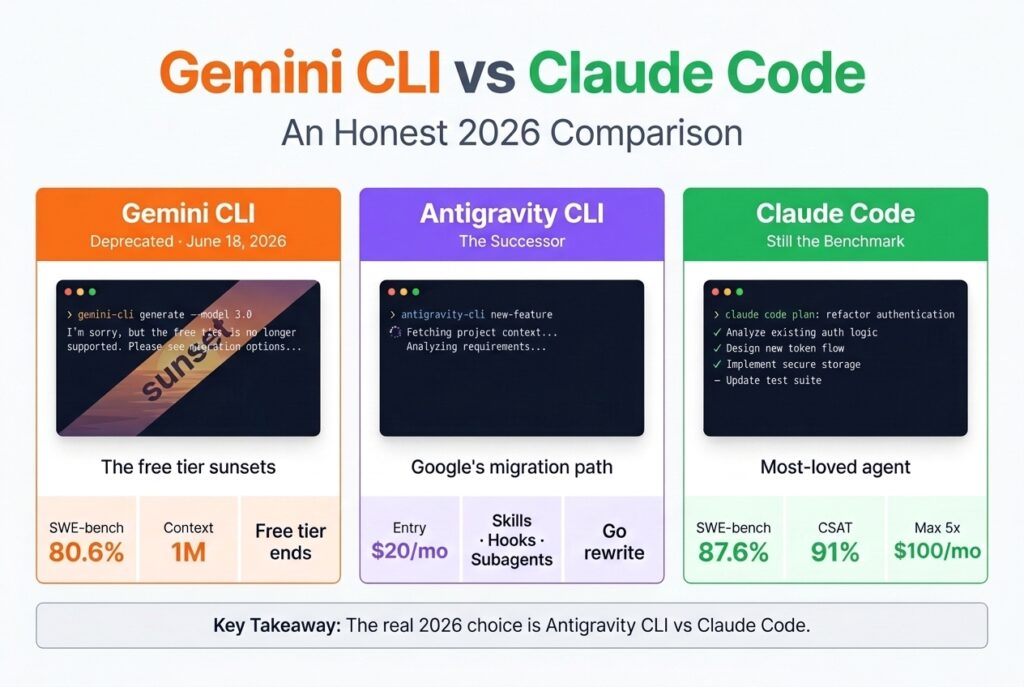
Update (May 24, 2026): Google has deprecated the original Gemini CLI. Starting June 18, 2026, it stops serving requests for free personal, Google AI Pro, and Google AI Ultra accounts, and points users to the new Antigravity CLI instead (Google Developers Blog, 2026). This rewrite accounts for that. Short version: the free tier that made Gemini CLI a no-brainer is going away, but the successor is cheaper than Claude Code and now ships Skills, Hooks, and Subagents too. The choice got more interesting, not simpler.
Two terminal agents. One slot in your shell. I’ve been driving both Gemini CLI and Claude Code in real work (different repos, different stakes, different budgets) for the better part of a year. Most comparison posts you’ll find online are either feature-checklist exercises or thinly veiled marketing for one side. This one is neither, and since June it also has to cover the product Google replaced Gemini CLI with.
The honest take, before I show my work: until June 18, 2026, Gemini CLI’s free tier was the most generous deal in the agent space: 1,000 free model requests per day with a 1M token context window on a personal Google account (Gemini CLI Docs, 2026). Since that date, free, Pro, and Ultra users have either moved to Antigravity CLI or kept Gemini CLI alive with a paid API key. Claude Code charges $20 to $200 a month for a more refined product, and its footing hasn’t moved. Which one belongs in your daily shell now depends on that transition, so this post prices it in.
if you’re comparing Claude Code against Codex CLI instead
Key Takeaways
- Google deprecated the original Gemini CLI on May 19, 2026. It stopped serving free, Pro, and Ultra accounts on June 18, 2026, replaced by the closed-source Antigravity CLI (Google Developers Blog, 2026). The Apache 2.0 repo stays public, but the hosted free quota does not.
- Antigravity CLI is a Go rewrite that now ships Skills, Hooks, and async Subagents, the extensibility features that were Claude Code’s clearest moat (Agentpedia, 2026). Entry pricing is Google AI Pro at about $20/month, the same entry price as Claude Pro, which includes Claude Code.
- Claude Code starts at $20/month Pro (serious use realistically $100 Max 5x) and holds a 91% CSAT and 54 NPS in JetBrains’ April 2026 survey, the highest of any coding tool tracked (JetBrains Research, 2026).
- The honest split for 2026: Claude still wins on raw agentic quality (Opus 4.7 hit 87.6% SWE-bench Verified in May; Claude Code now runs Opus 5.5). Gemini’s successor wins on price and now matches the feature checklist. Most serious daily-driver users I know still run both.
Why Are Gemini CLI and Claude Code Even Comparable?
Both products start from the same bet: the IDE is a deeply customized editor, and an agent does not need to live inside it to do useful work. 95% of engineers in The Pragmatic Engineer’s 2026 survey use AI tools weekly, and 75% report AI handles at least half of their engineering work (The Pragmatic Engineer, 2026). When the agent is doing half the work, the right question stops being “which editor extension” and starts being “which process owns my repo.”
That’s the philosophical convergence. Both CLIs run as long-lived processes that read files, run shell commands, watch output, and propose diffs. Claude Code shipped this paradigm in May 2025. Google launched Gemini CLI on June 25, 2025 as an open-source Apache 2.0 project (Google Blog, 2025). Inside a year, the Gemini CLI repo grew to roughly 104,000 GitHub stars and 13,700 forks by May 2026 (Gemini CLI GitHub, 2026). That’s not a minor side project; at the time it was the largest agent CLI codebase by community footprint.
The daily ritual is genuinely similar. Open terminal, point at repo, type a goal, watch a plan appear, approve tool calls, accept the diff. If you blindfolded me and dropped me into a session mid-refactor, I’d need a minute to identify which CLI I was driving. The differences only surface when the agent gets confused, when something fails, or when you need to push past the happy path, and that’s where this comparison actually lives.

Is Gemini CLI Being Shut Down?
Yes, and it already happened. Google announced on May 19, 2026 that starting June 18, 2026, Gemini CLI and the Gemini Code Assist IDE extensions would stop serving requests for Gemini Code Assist for individuals, Google AI Pro, and Google AI Ultra accounts, and that cutoff is now in effect (Google Developers Blog, 2026). It wasn’t wiped off anyone’s machine. The free hosted quota that made it worth installing is what got switched off for personal accounts.
The headlines flattened this into “Gemini CLI is dead,” and that’s not quite right. Here’s who is actually affected:
- Free, Pro, and Ultra users (most readers of this post): Since June 18, your personal login no longer authorizes the legacy CLI. You either migrate to Antigravity CLI or keep Gemini CLI running on a paid Gemini API key (Google Developers Blog, 2026).
- Gemini Code Assist Standard and Enterprise orgs: Nothing changed. Google keeps supporting Gemini CLI and the IDE extensions with the latest models for licensed organizations and for Gemini Code Assist for GitHub (Google Developers Blog, 2026).
- The open-source repo: The Gemini CLI codebase stays public under Apache 2.0 with its ~104K GitHub stars intact. What ended is the hosted serving for free tiers, not the project (The Register, 2026).
I ran the migration the week it was announced. The good news: Google published migration docs at antigravity.google/docs/gcli-migration, and my GEMINI.md, MCP configs, and most extensions carried over with minor edits. The annoying news: if you leaned on the free tier across a few machines like I did, June 18 was a hard deadline, not a soft nudge. If a personal-account Gemini CLI is still wired into your scripts, it has stopped answering, and that migration guide is the fastest way back.
What’s the Best Gemini CLI Alternative?
If you’re looking for a Gemini CLI alternative, there are three honest options, ordered from least to most disruption. Antigravity CLI is Google’s own successor and the lowest-friction move if you want to stay in the Gemini ecosystem. Claude Code is the alternative most former Gemini CLI users I know are actually testing right now, because it’s the most mature paid agent, and it’s what the rest of this post compares head to head. Keeping Gemini CLI on a paid Gemini API key works if you specifically need the open-source binary or air-gapped guarantees and don’t mind metered billing. What no longer exists is the old 1,000-requests-a-day deal on the legacy CLI, but Antigravity itself keeps a genuinely generous free allotment (gated by your Google account tier), which remains its clearest edge over Claude Code’s no-free-tier model.
if Claude Code is your likely landing spot, here’s its full pricing and limits breakdown
How Does the Pricing Reality Actually Compare?
Here is where the two products were most obviously different, and the gap narrowed when the free tier ended. Until June 18, 2026, Gemini CLI gave you a 1M token context window and 1,000 free model requests per day at 60 requests per minute on a personal Google account, no credit card required (Gemini CLI Docs, 2026). Since then, as covered above, free personal access runs through Antigravity CLI or a paid API key. Claude Code has no free tier. It starts at Claude Pro ($20/month), which includes Claude Code with tighter limits, and scales through Max 5x ($100/month) and Max 20x ($200/month) for serious daily-driver use (Anthropic Pricing, 2026).
When I first wrote this in May, Gemini 2.5 Pro cost $1.25 per million input tokens and $10 per million output under 200K context, while Claude Opus 4.7 was $5/$25 and Sonnet 4.6 was $3/$15. That’s the chart below, and back then Gemini was meaningfully cheaper per token. The October 2026 picture is tighter. Google’s flagship, Gemini 3.1 Pro, costs $2 input and $12 output per million tokens for prompts up to 200K, rising to $4 and $18 above that (Google AI Pricing, 2026). Claude Opus 5.5 sits at $4 and $20, and Sonnet 5.5 at $2 and $10 (Anthropic Pricing, 2026). So Sonnet 5.5 is now slightly cheaper than Gemini 3.1 Pro on output, and only Opus still carries a clear premium: about 2x Gemini’s flagship on input and 1.7x on output.
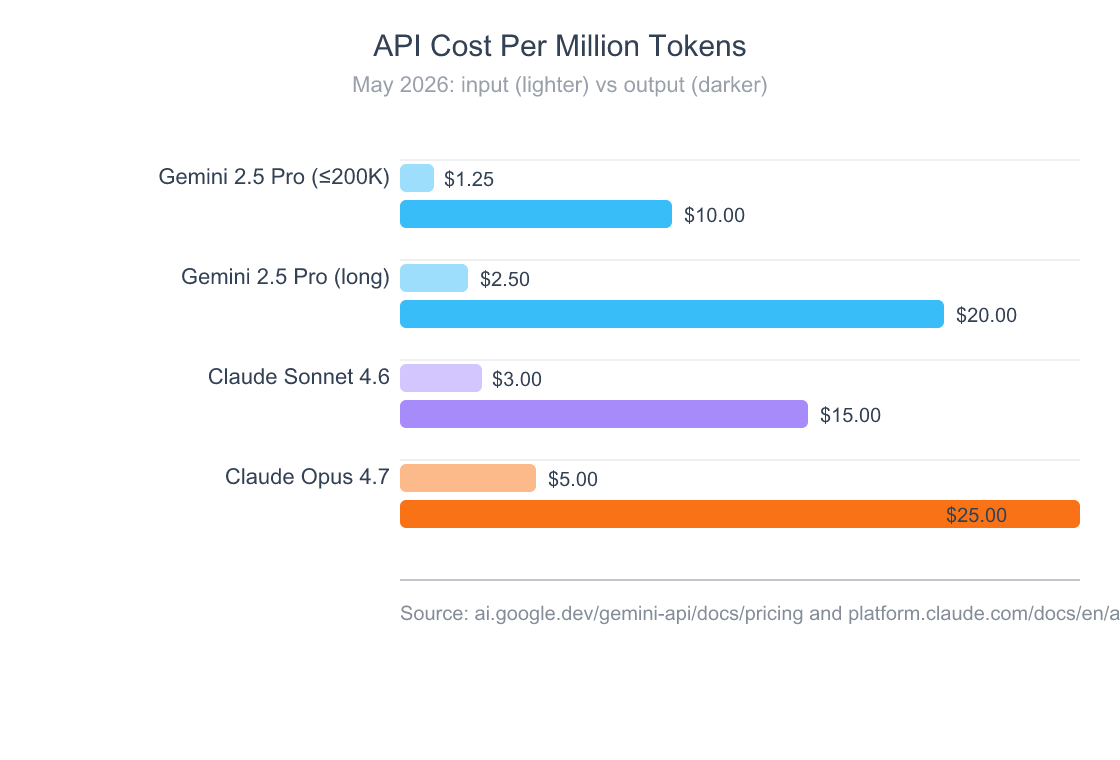
But raw per-token pricing isn’t what most people actually pay. Here’s the real shape of it from my own usage over the last six months:
- Free Gemini CLI (ended June 18, 2026): For students, side projects, and one-off scripts, it was genuinely free. The 1,000 daily requests covered a surprising amount of work if you avoided burning them on chitchat, and the 1M context window came with no upcharge. This is the exact tier that was switched off for personal accounts. The paid entry point now is $19.99/month Google AI Pro on Antigravity CLI.
- Google AI Pro ($19.99/month): Lifts daily limits and gives priority access, and post-transition it’s the tier that unlocks the full Antigravity platform: desktop app, CLI, and SDK (9to5Google, 2026). I burn through it in maybe four hours of heavy agentic work, fine for moderate use, tight for a serious daily driver.
- Google AI Ultra ($100 or $200/month): Google split Ultra into a $100 tier with 5x Pro limits and a $200 tier with 20x Pro limits, cut from $249.99, and limits now refresh every 5 hours (Google Blog, 2026). The tiers now line up with Claude Max 5x and Max 20x price for price.
- Claude Max 5x ($100/month): Comfortable for one developer doing 6–8 hours of agent-heavy work a day. I rarely hit limits.
- Claude Max 20x ($200/month): Same price as ChatGPT’s $200 Pro tier and gives effectively unlimited Claude Code for solo work, in my experience.
My finding: Over a 30-day window where I logged session token usage on a single mid-size Laravel + Next.js project, Gemini CLI used roughly 40% more tokens than Claude Code on the same task set, partly because the 1M context tempts you into including everything, and partly because Gemini’s responses are more verbose. The free tier still came out ahead on cost, but the “cheaper per token” gap narrows once you account for behavior.
The crossover point is around three hours per day of active agent driving. Below that, Gemini CLI’s free tier was unbeatable until June 18. Now the cost-conscious entry point is Antigravity’s free allotment or the $19.99 AI Pro tier, which puts it level with Claude Pro at $20. Above three hours, Claude Max 5x is the better deal for sustained throughput. There’s also a hidden cost on the Claude side: on April 21, 2026, Anthropic briefly removed Claude Code from the $20 Pro tier and then reversed the decision within 24 hours (Simon Willison, 2026). The episode reminded a lot of people that the pricing model isn’t fully settled.
One more thing worth naming: API access economics differ in ways that aren’t obvious from the price list. Anthropic offers cache hits at 10% of the base input price and a 50% Batch API discount (Anthropic API Docs, 2026). Google offered a 50% batch discount on Gemini 2.5 Pro through Vertex AI when I checked in May (Vertex AI Pricing, 2026). If your workload is batch-heavy or repeats similar prompts, the real cost can be half the headline number on both sides. For interactive agent use, the cache hit pricing is what actually drives Claude Code’s daily economics down, that’s a real piece of why Max 5x works at $100/month.
complete guide to Claude Code pricing and rate limits
Does Gemini’s 1M Context Window Actually Matter in Daily Work?
On paper, this was the most decisive Gemini advantage. The 1M token context window was standard across the Gemini 2.5 Pro lineup, including the old free tier (Google AI for Developers, 2026). Claude caught up: Anthropic shipped 1M context windows for Sonnet 4.6 and Opus 4.6 to general availability on March 13, 2026 at standard per-token pricing (Anthropic Context Windows, 2026), and today Fable 5.1, Opus 5.5, and Sonnet 5.5 all ship with 1M context (Anthropic Models, 2026). The experience still differs in my use: Gemini leans on long context by default, while Claude Code compacts more deliberately.
In practice, three things actually change when you have 1M tokens:
- Whole-repo reasoning. I can dump a 200-file mid-size codebase into a single Gemini CLI session without thinking about it. Claude Code with extended context can do this too, but the model attention degrades faster on truly enormous contexts in my testing, the lift-and-shift refactor work where Claude shines tends to live in the 50K–200K context band.
- Long-running session memory. Gemini CLI maintains context across long sessions more gracefully. Claude Code is more aggressive about compaction. The trade-off is that Gemini’s “remembers everything” mode sometimes drags in stale context that biases the next response, where Claude’s tighter context is more deliberate.
- Document-heavy work. When the task is “read these 30 PDFs and summarize the differences,” Gemini wins outright, both because of context size and because Google’s multimodal handling is more native.
Where the 1M context matters less than the marketing suggests: most coding work doesn’t actually fit nicely into a 1M context shaped reasoning task. Real refactors live across 5–30 files. Real bug hunts involve targeted reading, not exhaustive ingestion. The 1M token marketing claim is impressive, but the median useful session for both tools uses 30K–80K tokens. That’s not a knock on Gemini, it’s a reminder that “biggest context” is a noisy proxy for “best agent.”

how the underlying memory architectures differ across major AI assistants
How Do the Models Actually Behave on Real Codebases?
Benchmarks first, then experience. In May 2026, Claude Opus 4.7 led SWE-bench Verified at 87.6% (Anthropic News, 2026). Gemini 3.1 Pro, released on February 19, 2026, sits at 80.6% on the same benchmark and 54.2% on the harder SWE-Bench Pro (DeepMind Gemini 3.1 Pro Model Card, 2026). Claude Opus 4.7’s SWE-Bench Pro score is 64.3%, a meaningful 10-point gap on the harder evaluation (Vellum, 2026).
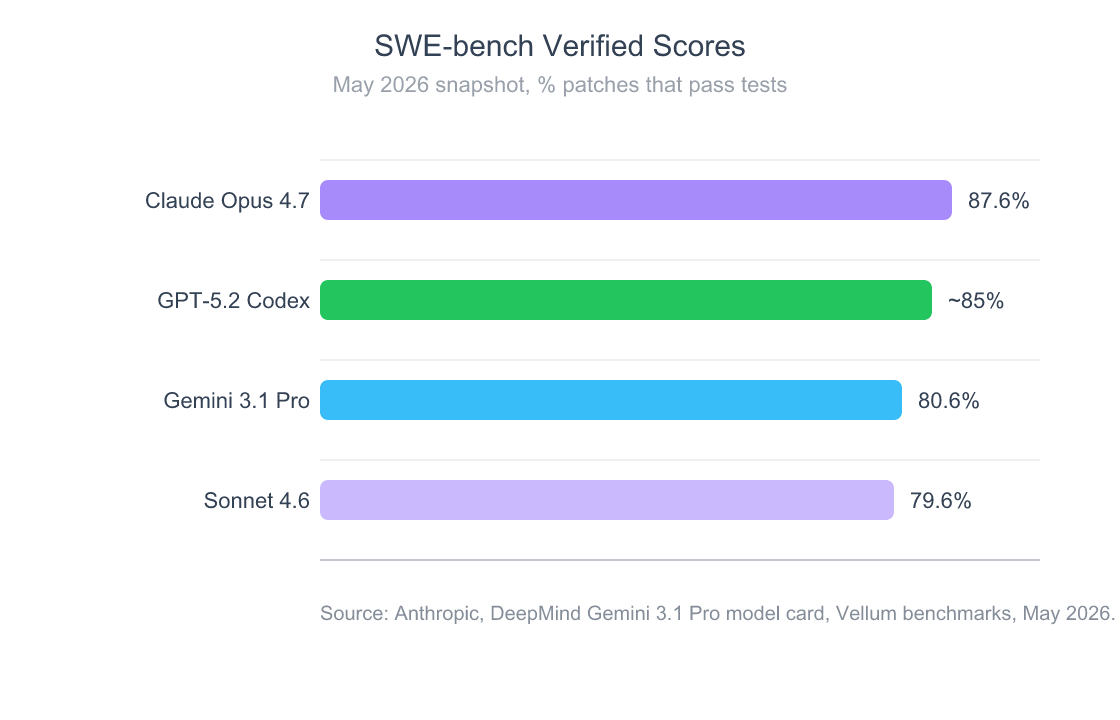
October 2026 note: These are May 2026 scores. Since then Anthropic has shipped the Claude 5 family (Opus 5.5 on Sep 22, Sonnet 5.5 on Sep 28), and OpenAI’s Codex CLI now defaults to GPT-6.1 Sol. I haven’t re-run these comparisons, and I won’t quote numbers for the new models until I’ve checked them against a source I trust. Gemini 3.1 Pro is still Google’s flagship, so its row is the one that hasn’t aged.
Benchmarks are a noisy signal, both Anthropic and Google have spent real engineering on these specific evaluations. The pattern I see in actual repos is what matters more. Claude is more cautious and more aligned with “ask before doing.” When it’s wrong, it backs out cleanly. Gemini is more confident, sometimes overconfident, it will happily generate 200 lines of code that look right and aren’t, and the recovery loop costs more than the original task would have on Claude.
On a 20-file refactor I ran on the same Laravel codebase three different ways, first with Claude Code, then a fresh session with Gemini CLI on the free tier, then Gemini CLI with Gemini 2.5 Pro paid, Claude got it right in three prompts with four confirmation stops. Free-tier Gemini got 80% there in one prompt but missed a service-binding update that caused two test failures. Paid Gemini did better, but still introduced one stale type import that I caught in review. None of these are disqualifying. They’re a consistent pattern: Claude is conservative-by-default, Gemini is aggressive-by-default.
There’s a meta-pattern worth naming. Pragmatic Engineer’s 2026 survey of ~906 engineers showed Claude Code at 46% “most loved” tool: vs Cursor at 19%, GitHub Copilot at 9%, and Codex at 6% (The Pragmatic Engineer, 2026). JetBrains’ April 2026 report tracks 24% Claude Code adoption at work in the US and Canada (18% globally), up from roughly 3% in mid-2025: a 6x increase in nine months, with a 91% CSAT and NPS of 54 (JetBrains Research, 2026). Gemini CLI adoption is harder to measure but sits around 10% in the same Pragmatic survey. As of spring 2026, the emotional pull was decisively with Claude. That’s not destiny, it’s a snapshot.
One pattern that doesn’t show up in benchmarks but matters in daily use: codebase reasoning across multiple files. When I ask either tool to “find where the user authentication flow connects to the billing webhook,” Claude tends to do less searching but more careful synthesis. Gemini casts a wider net (it reads more files thanks to the bigger context) but the summary it produces is sometimes diluted by including irrelevant matches. On Terminal-Bench 2.0 (early-2026 leaderboard), the gap was visible at the system level: Codex CLI with GPT-5.2 led at 63%, Claude Opus 4.5 with Terminus 2 sits at 58%, and Gemini 3 Pro with Terminus 2 at 57% (Terminal-Bench Leaderboard, 2026). The Aider polyglot leaderboard tells a similar story: Claude Opus 4.5 at 89.4% vs GPT-5 at 88% with Gemini further back (Aider Leaderboards, 2026). The benchmarks aren’t the whole story, but they’re consistent with what I see when I drive both tools through the same task.
broader landscape including Cursor, Codex, and Windsurf
What About Tool Use, MCP, and the Extensibility Story?
This is where the comparison gets more interesting and where the older “Claude wins extensibility” narrative needs an update. Both products now support the Model Context Protocol. Gemini CLI has full MCP server support via stdio and HTTP transports, configured through ~/.gemini/settings.json (Gemini CLI MCP Docs, 2026). Google also shipped Hooks as a default capability in Gemini CLI v0.26.0: they cover pre/post tool execution, session events, and prompt submission (Google Developers Blog, 2026).
What Gemini CLI doesn’t have, and Claude Code does:
- Skills. Reusable prompt + tool bundles that bundle workflows into named, invokable units. Anthropic shipped them in October 2025 and the ecosystem (skills.sh and others) has grown around them. The full documentation lives at code.claude.com/docs/en/skills.
- Subagents. Model-launched workers with their own context windows. You spawn one for research, code review, or exploration, and the parent agent continues without polluting its context.
- Plugins. A first-class extension surface for community-authored tooling.
Gemini CLI has Extensions, which are conceptually similar to Skills + Plugins combined: they package prompts, MCP servers, and slash commands together. The implementation is younger and the ecosystem thinner. If you’re starting from zero today, both surfaces are usable. If you’re inheriting a setup with a dozen carefully tuned workflows, Claude Code’s ecosystem has more depth.
Here’s the twist that reframes this whole section, though: the gap I just described is a snapshot of the legacy Gemini CLI. Its successor, Antigravity CLI, ships first-class Skills, Hooks, and async Subagents (Agentpedia, 2026). So “Claude Code wins extensibility” was true of the legacy CLI and is largely false now that Antigravity is the default path for Gemini users. I dig into what that means in the dedicated Antigravity section below.
Here’s the part that doesn’t get said often enough: the extensibility surface is also the attack surface. Anthropic patched four CVEs against Claude Code in early 2026: RCE via untrusted project config, path bypass, command injection, and DNS exfiltration (Check Point Research, 2026). Three of those exploited the hook/MCP/skill layer. Gemini CLI being newer and Apache 2.0 means more eyes are on it, but it also means the attack surface is younger and less battle-tested. Neither is a reason to avoid either tool, but it’s a reminder that running an agent on a freshly cloned untrusted repo is not as safe as the UX makes it feel.

deterministic hook gates Claude Code can’t reason its way past
when to reach for Skills vs MCP servers
How Does the Terminal UX Actually Compare?
This is the part that almost never shows up in feature checklists, and it’s the thing that drives my daily preference more than benchmarks do. Both CLIs render a similar visual surface: a chat pane, a tool-call list, a diff preview, an approval prompt. But the small details are different in ways that compound across a working day.
Claude Code’s interactive panel is denser and more interruption-friendly. I can hit a slash command mid-stream, switch from auto-accept to plan mode in one keystroke, fork a session, or push a Subagent off to do a side task while the main thread keeps going. The keyboard ergonomics feel deliberate. There’s a permission UI tier that lets me allow a specific tool for the rest of the session without granting blanket access, small, but I lean on it constantly.
Gemini CLI’s UX is closer to a chat-first design with tools bolted on. The diffs render cleanly, the tool calls are explicit, and the VS Code Companion extension gives you in-editor diff previews (Google Blog, 2025). What’s missing for me is the in-session flexibility: switching between modes, gating specific tool classes, and recovering from a derailed plan takes more keystrokes. None of these are dealbreakers. They’re the kind of papercuts you notice on hour six of a long day.
Two specific things I keep running into:
- Plan mode. Claude Code’s plan mode, where the agent proposes a written plan you approve before any tool use, is the single biggest UX feature I rely on. Gemini CLI doesn’t have a direct equivalent. You can prompt it into “show me a plan first” behavior, but it’s not enforced, and on long tasks the agent will drift back to “do then show” without you noticing.
- Session forking. Claude Code lets me fork a session at any point and try a different approach in parallel without losing my place. Gemini CLI requires me to open a separate terminal and re-instantiate context, which negates some of the 1M-context advantage.
On the other hand, Gemini CLI’s GitHub Actions integration (in beta when I tested it) is genuinely useful for running Gemini against pull requests at scale (Google Blog, 2025). Claude Code has agentic CI patterns through hooks and headless mode, but the out-of-the-box CI story is less polished. If a meaningful chunk of your agent use is “run on every PR” rather than “drive interactively in a terminal,” Gemini wins that lane.

Antigravity CLI vs Claude Code: The Comparison That Now Matters
For most readers, the real 2026 decision isn’t Gemini CLI vs Claude Code anymore, it’s Antigravity CLI vs Claude Code, because Antigravity is what your Gemini login has pointed to since June 18. Google unveiled Antigravity at I/O 2026 on May 19 as a standalone, agent-first platform: a Go-based CLI, an SDK, a desktop app, managed execution, and enterprise support, all on a shared runtime (MarkTechPost, 2026). It isn’t a Gemini CLI point release. It’s a different product wearing the migration path.
What changes for this comparison, concretely:
- The feature checklist now matches. Antigravity CLI ships Skills, Hooks, and async Subagents, the exact extensibility trio that was Claude Code’s clearest moat (Agentpedia, 2026). Its async subagents run long refactors or parallel research in the background without blocking your prompt, which is arguably ahead of where Claude’s subagents sit today. Extensions get rebranded to Plugins, and MCP support carries over.
- It’s faster, and it’s closed-source. The Go rewrite is noticeably snappier than the old Node-based CLI, and the CLI shares a runtime with the desktop app so updates land everywhere at once. The catch: Antigravity is not open source. The binary is free to install and the repo is public, but the source isn’t (The Register, 2026). The open-governance argument that favored Gemini CLI does not transfer to its successor.
- Pricing undercuts Claude. Antigravity access is gated by your Google account tier, and $20/month Google AI Pro unlocks the full platform: desktop, CLI, and SDK (Agentpedia, 2026). That’s the same entry price as Claude Pro but a more complete bundle, and a fifth of Claude Max 5x.
So where does that leave Antigravity CLI vs Claude Code? Closer than legacy Gemini CLI ever was. Claude Code still holds the two advantages that are hardest to copy: raw model quality (in May, Opus 4.7 scored 87.6% on SWE-bench Verified vs Gemini 3.1 Pro at 80.6%, and Claude Code has since moved to Opus 5.5) and a year-deep, battle-tested extension ecosystem with a 91% CSAT behind it. Antigravity counters with price, background multi-agent orchestration, and a desktop-plus-CLI-plus-SDK surface Claude doesn’t match in a single bundle. The cleanest framing: Antigravity is the stronger platform play and the obvious migration for Gemini loyalists, while Claude Code is still the more reliable agent on hard, trust-sensitive work. If you were picking Gemini CLI for the free tier and the open license, neither reason survives the transition, which is exactly why this comparison is worth re-running for yourself.
My Take After Testing Antigravity CLI
I put Antigravity CLI through real work alongside Claude Code and the other terminal agents in late May, and I’ll be blunt about where I landed. The single biggest problem for me: there was still no real plan mode, the one Gemini CLI gap I flagged above that the rewrite didn’t fix. Claude Code’s plan mode (propose a written plan, I approve it, then it touches anything) is the feature I lean on hardest, and Antigravity inherited Gemini CLI’s lack of a true equivalent. For the kind of careful, multi-step work I do, that alone is a deal-breaker.
Stability is the other gap. Head to head in that round of testing, Claude Code felt mature and stable in a way Antigravity didn’t yet. Antigravity reads like exactly what it is: a freshly launched rewrite. I hit rough edges, inconsistent behavior, and the general sense that it needs a few more release cycles to settle. It’ll get there, Google’s cadence is fast, but “will get there” isn’t “is there.”
Then there’s the model gap, which the benchmarks flag and daily use confirms: Claude still wins by a meaningful margin on hard, careful work. The one thing Antigravity genuinely has on Claude Code is generous free usage. Even after the legacy Gemini CLI free tier sunsets, Antigravity’s free allotment is real, and Claude Code has no free tier at all. If budget is your binding constraint, that’s a legitimate reason to keep Antigravity in the rotation. For everything else, I’m still reaching for Claude Code.
how Claude Code stacks up against Cursor if you’re weighing more than two agents
Feature Matrix: Where Each Tool Genuinely Wins
| Capability | Gemini CLI | Claude Code |
|---|---|---|
| Status (Oct 2026) | Discontinued for free/Pro/Ultra since June 18, 2026; paid API keys and Code Assist Standard/Enterprise only; succeeded by Antigravity CLI | Active |
| Underlying model (Oct 2026) | Gemini 3.1 Pro (preview) | Claude Opus 5.5 / Sonnet 5.5 |
| SWE-bench Verified (May 2026) | 80.6% (Gemini 3.1 Pro) | 87.6% (Opus 4.7) |
| SWE-Bench Pro (May 2026) | 54.2% (Gemini 3.1 Pro) | 64.3% (Opus 4.7) |
| License | Apache 2.0 (open source) | Closed-source (npm) |
| GitHub stars (May 2026) | 104K, 13.7K forks | n/a (closed) |
| Default context window | 1M tokens (standard) | 1M tokens (Opus 5.5, Sonnet 5.5) |
| Free tier | Ended June 18, 2026 (was 1,000 req/day); Antigravity has a free allotment | None |
| MCP support | Yes (stdio + HTTP) | Yes (original implementation) |
| Hooks | Yes (default since v0.26.0) | Yes (mature, 9+ lifecycle events) |
| Skills | Legacy: no (Extensions closest). Antigravity: yes | Yes (Oct 2025+) |
| Subagents | Legacy: no. Antigravity: yes (async) | Yes |
| Plugins | Extensions (Plugins on Antigravity) | Plugins |
| IDE integration | VS Code Companion | VS Code, JetBrains |
| Entry pricing | $19.99/mo Google AI Pro (Antigravity) | $20/mo Claude Pro (includes Claude Code) |
| Paid mid-tier | $100/mo Google AI Ultra (5x Pro limits) | $100/mo Max 5x |
| Top pricing | $200/mo Google AI Ultra (20x Pro limits) | $200/mo Max 20x |
| API input/output (per 1M, Oct 2026) | $2 / $12 (Gemini 3.1 Pro ≤200K) | $4 / $20 (Opus 5.5); $2 / $10 (Sonnet 5.5) |
| Open governance | Gemini CLI: yes (Apache 2.0). Antigravity: no | No |
| CSAT / NPS | Not publicly reported | 91% / 54 (JetBrains, 2026) |
| Recent CVEs | None publicly disclosed | 4 patched in early 2026 |
The matrix tells you what. It doesn’t tell you what to actually do. The next section does.
Which One Should Be Your Daily Driver in 2026?
Use this framework. The decision isn’t “which is better”, it’s “which fits the work you do most.”
Pick Gemini CLI (or its Antigravity successor) as your daily driver if: with the caveat that since June 18, “Gemini CLI” effectively means Antigravity CLI for free, Pro, and Ultra accounts:
- You’re cost-sensitive or just starting out: the old Gemini CLI free tier is gone, so Antigravity’s free allotment or the $19.99/mo AI Pro tier is the cost-sensitive pick.
- You work on document-heavy or whole-repo reasoning tasks where 1M context is load-bearing.
- You need open-source guarantees for legal, audit, or air-gapped reasons, but note this holds for the legacy Gemini CLI, not its closed-source Antigravity successor. If open governance is a hard requirement, that’s now a reason to look elsewhere, not toward Antigravity.
- You’re already inside the Google Cloud ecosystem and Vertex AI billing makes sense.
- You want background multi-agent orchestration. Antigravity’s async subagents are a genuine reason to move, not just a forced migration.
Pick Claude Code as your daily driver if:
- You spend most of your time in repos you trust, doing focused refactor and debug work.
- You’ll actually use Skills, Subagents, and Hooks (otherwise you’re paying $100+/mo for a CLI that’s roughly comparable on the surface).
- You value model recovery behavior on hard tasks more than raw context size.
- You can start on Pro at $20 and afford Max 5x or Max 20x once you’re driving it daily.
- You want the highest reported developer satisfaction (91% CSAT) and don’t mind paying for it.
Run both if:
- You’re doing 6+ hours of agent-heavy work daily.
- You want a second opinion on hard tasks, one agent’s stuck plan often unblocks fast in the other.
- You work across language ecosystems where the models diverge. I find Claude stronger on PHP, Ruby, and complex TypeScript refactors. Gemini is stronger on Python, data work, and anything multimodal.
Pragmatic Engineer’s survey reflects how the market is actually behaving: 70% of engineers run 2–4 AI tools simultaneously, and 15% run five or more (The Pragmatic Engineer, 2026). Treating this as a one-winner question is the wrong frame. The cost of running both (especially when Antigravity’s free allotment is one of them) is rounding error for any working developer.

My current setup, in case it’s useful: Claude Max 20x is the daily driver. Antigravity CLI took over the second-opinion slot from the Gemini CLI free tier after the June 18 cutoff. When Claude gets confused on a long task, usually around the 45-minute mark on something architecturally tangled, I’ll fork the conversation, paste the state into a fresh Antigravity session, and let the 1M context chew on the whole repo. The disagreement between them is more useful than either single answer.
the full multi-model workflow including ChatGPT and Grok
Frequently Asked Questions
Is Gemini CLI really free, or does the free tier have hidden costs?
Not anymore. Until June 18, 2026, the free tier was genuinely free for personal Google account holders: 1,000 model requests per day at 60 per minute, with the full 1M context window, no credit card required (Gemini CLI Docs, 2026). Google collected data to improve models on the free tier, which was the trade-off. Since June 18, that free serving has ended for personal accounts; you move to Antigravity CLI or keep Gemini CLI on a paid API key. For commercial work where data privacy matters, you’ll want a paid Google AI Pro plan or Vertex AI billing either way.
Does Claude Code have a free tier I can try first?
No. Claude Code requires at least a Claude Pro subscription at $20/month, which includes Claude Code, and serious daily-driver use realistically starts at Max 5x ($100/month) (Anthropic Pricing, 2026). There’s no free tier in 2026. You can use pay-per-token API access without a subscription, but it adds up fast for agent-heavy work.
Can Gemini CLI use MCP servers, or is that Claude Code only?
Both products support MCP. Gemini CLI shipped MCP support with stdio and HTTP transports, configured through ~/.gemini/settings.json (Gemini CLI MCP Docs, 2026). The MCP ecosystem now has roughly 2,300 public servers, and most run in both tools without modification. Against the legacy Gemini CLI, Claude’s extras were Skills and Subagents; Antigravity CLI now has both. MCP is fully shared territory.
Is Gemini 3.1 Pro actually competitive with Claude for coding?
Close, but not at parity as of the last numbers I checked. In May 2026, Gemini 3.1 Pro scored 80.6% on SWE-bench Verified vs 87.6% for Claude Opus 4.7 (DeepMind, 2026; Anthropic, 2026). The gap was roughly 7 points on the easier benchmark and 10 points on SWE-Bench Pro. Claude Code has since moved to Opus 5.5, while Gemini 3.1 Pro is still Google’s flagship and still in preview. In daily use, Claude feels noticeably more careful on hard refactors. Gemini is faster on greenfield work where caution isn’t load-bearing.
Is Gemini CLI being shut down?
It already has been, for personal accounts. Since June 18, 2026, the original Gemini CLI no longer serves requests for free personal, Google AI Pro, or Google AI Ultra accounts (Google Developers Blog, 2026). Standard and Enterprise organizations keep full access, paid API keys still work, and the Apache 2.0 source stays public. For most individual developers, though, the practical answer is yes: your free Gemini CLI stopped working that day.
What replaces Gemini CLI?
Antigravity CLI replaces it. Announced at Google I/O 2026 on May 19, it’s a Go-based rewrite that ships as part of a standalone agent platform: CLI, SDK, and desktop app on a shared runtime (MarkTechPost, 2026). It carries over MCP support and adds first-class Skills, Hooks, and async Subagents. Google’s migration guide lives at antigravity.google/docs/gcli-migration.
Is Antigravity CLI better than Claude Code?
It depends on what you weight. Antigravity CLI wins on value (about $20/mo Google AI Pro unlocks the full desktop, CLI, and SDK platform, while Claude Pro’s $20 includes Claude Code with tighter limits and heavy use pushes you to $100 Max 5x) and on background multi-agent orchestration. Claude Code still leads on raw model quality (in May, Opus 4.7 scored 87.6% on SWE-bench Verified vs Gemini 3.1 Pro at 80.6%; Claude Code now runs Opus 5.5) and a more mature, battle-tested extension ecosystem (Anthropic, 2026). For hard, trust-sensitive refactors I still reach for Claude; for cost and async background work, Antigravity is compelling.
Should I switch from Gemini CLI now, or wait?
There’s nothing left to wait for. If you’re on a free, Pro, or Ultra account, the legacy CLI stopped serving you on June 18, 2026. The migration is straightforward: your GEMINI.md, MCP configs, and most extensions carry over to Antigravity CLI with minor edits (Google Developers Blog, 2026). If open-source governance was your reason for choosing Gemini CLI, this is the moment to evaluate alternatives, because Antigravity is closed-source and that requirement no longer points to Google’s tooling.
Conclusion
If you only have one slot in your shell, here’s the honest verdict: Claude Code is the daily driver I’d still recommend for most professional engineers working in trusted repos with budget for $100+/month. The 91% CSAT and the depth of the Skills + Subagents ecosystem aren’t accidents. But the comparison just shifted under everyone’s feet. The reason most people reached for Gemini CLI (a genuinely free, generous tier) stopped being an option for personal accounts on June 18, 2026, and the open-source argument doesn’t survive the move to closed-source Antigravity CLI.
So the real 2026 choice for most readers is Antigravity CLI vs Claude Code, and there it’s closer than the legacy matchup ever was: Antigravity matches the feature checklist and undercuts the price, while Claude holds the edge on model quality and ecosystem maturity. If you were a free-tier Gemini CLI user and haven’t moved yet, the cleanest path is to migrate to Antigravity now, then re-run this comparison against Claude with fresh eyes.
The smart move for anyone doing serious work is still to run both. Claude Code as primary, Antigravity CLI as second opinion, or vice versa, depending on your budget and the shape of your repos. The terminal-agent paradigm is the new default for AI-assisted coding. Pick the one that fits the work you do most, swap out any personal-account Gemini CLI still sitting in your scripts, and don’t agonize over the rest. The only mistake is staying on the sidelines while everyone else ships faster than you.