Why I Gave Up on Being a One-Model Person
For about eighteen months I tried to be a one-model person. ChatGPT first, then a long Claude phase, then a brief Gemini detour when the 1M-token context dropped. Each switch felt like a religious conversion, and each one was wrong. The honest answer, the one nobody selling you a subscription wants to admit, is that no single model wins every task in 2026. The leaderboard has a leader again, but a reasoning lead doesn’t make one model right for every job, the bills are real, and the tax on standardizing is a quiet drag on output you only notice when you stop paying it.
So I gave up. I built a multi-model AI workflow with four vendors, one router in my head, and a per-task cost rule for each. This piece is the actual stack, the math behind it, and the one place where switching saved me eight hours of work a week. It’s a manifesto, but the kind backed by a spreadsheet.
context on how solo operators are running multi-tool AI stacks instead of hiring
Key Takeaways
- In 2025, 37% of enterprises used five or more models, up from 29% in 2024: multi-model is the default, not the edge case (Andreessen Horowitz, 2025).
- Claude Opus 5.5 tops the Artificial Analysis Intelligence Index at 58, with GPT-6 Astra at 53, but a reasoning score doesn’t tell you who writes your emails best (Artificial Analysis, 2026).
- Output prices span 100x across today’s lineups: GPT-6 Luna costs $0.50 per million output tokens, GPT-6 Astra costs $50 (OpenAI, 2026).
- Anthropic held the top of the coding leaderboards for 18 months by late 2025 (Menlo Ventures, 2025), and in October 2026 it holds seven of the SWE-bench Verified top ten (LLM-Stats, 2026).
Why Has One Model Stopped Being Enough?
Anthropic’s share of enterprise LLM API spend climbed from 12% in 2023 to 40% in 2025, while OpenAI’s dropped from 50% to 27% (Menlo Ventures, 2025). That isn’t a vendor swap. It’s a regime change: enterprises stopped picking a winner and started routing tasks. The same survey put total enterprise gen AI spend at $37 billion in 2025, up 3.2x year over year, with the top three vendors capturing 88% of usage between them.
The leaderboards tell the same story from the other side. In October 2026, Claude Opus 5.5 leads the Artificial Analysis Intelligence Index at 58, Sonnet 5.5 sits at 56 (Artificial Analysis, 2026), and GPT-6 Astra scores 53 (Artificial Analysis, 2026). A five-point lead is real. It also says nothing about which model writes a cold email that doesn’t sound machine-made, or which one sees a tweet posted ten minutes ago. Once you’re past “is this model smart enough,” the differentiator stops being the leaderboard. It becomes the use case.
I noticed this when I started timing myself. The same prompt, rewrite this product page in plain English, no fluff, produced output I shipped without edits from ChatGPT, output I rewrote heavily from Claude, and output I almost shipped from Gemini. Same prompt, same data, three voices. I wasn’t being scientific. I was being honest about which tool fit which job, and the answer was different for marketing copy than it was for a refactor or a research summary. That’s when the multi-model AI workflow stopped being a thought experiment and started being a habit.
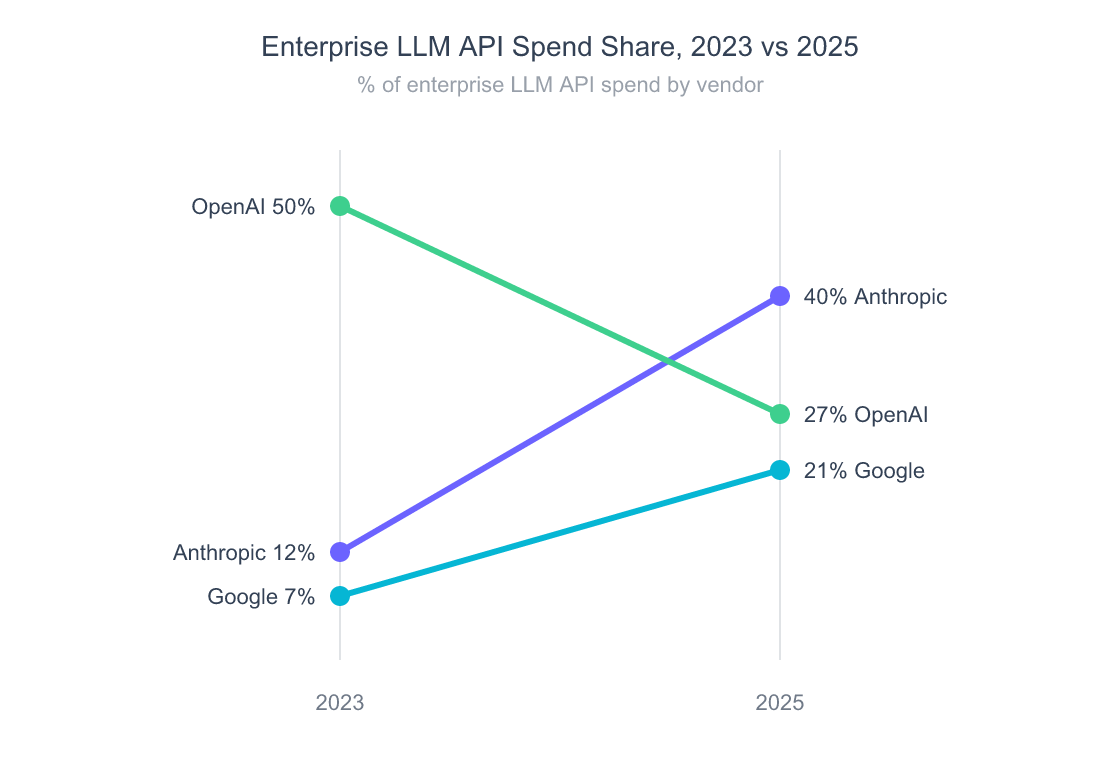
Source: Menlo Ventures, 2025: The State of Generative AI in the Enterprise.
why architecture, not features, separates the AI tools that win this era
What Does My Actual Stack Look Like?
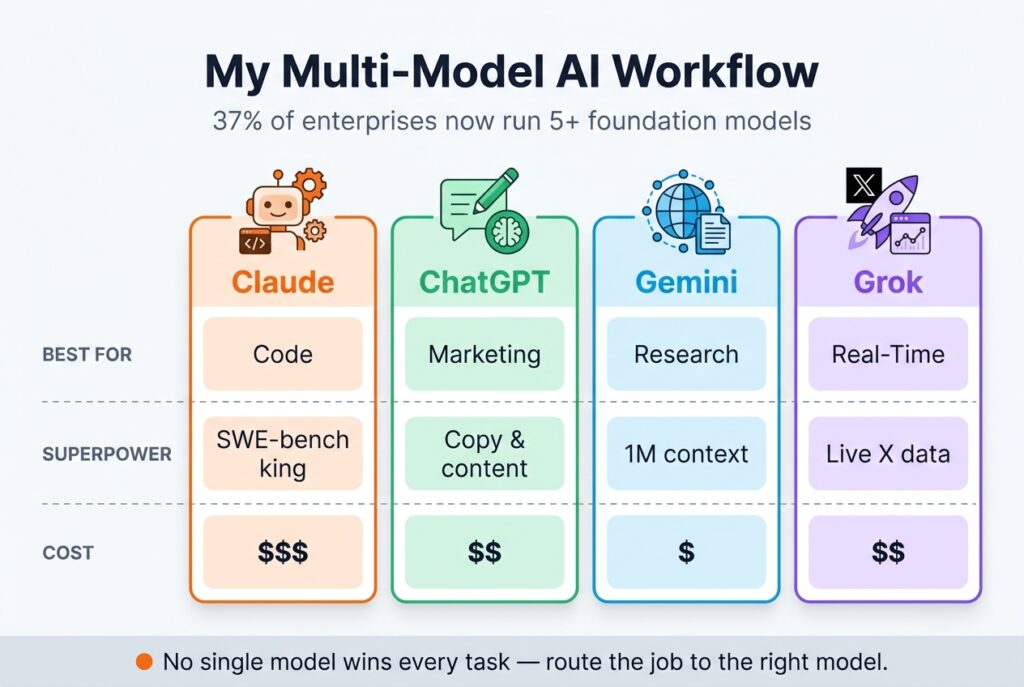
Four vendors, four jobs. As of October 2026, Claude Opus 5.5 and Sonnet 5.5 handle code. ChatGPT (GPT-6.1 Sol mostly, GPT-6 Astra when the stakes are real) handles marketing and customer-facing copy. Gemini 3.1 Pro handles research, anything where the input is a stack of PDFs or a long document. grok-4.7 handles real-time queries that need fresh signal from X or the web. Each has a fallback in the same family: Sonnet 5.5 for cheap code, GPT-6 Luna for cheap copy, Gemini 3.8 Flash for cheap reads, grok-4.3 for cheap real-time.
The reason isn’t taste. It’s that each vendor has a measurable lead on the axis I care about for that work, and the leads are different.
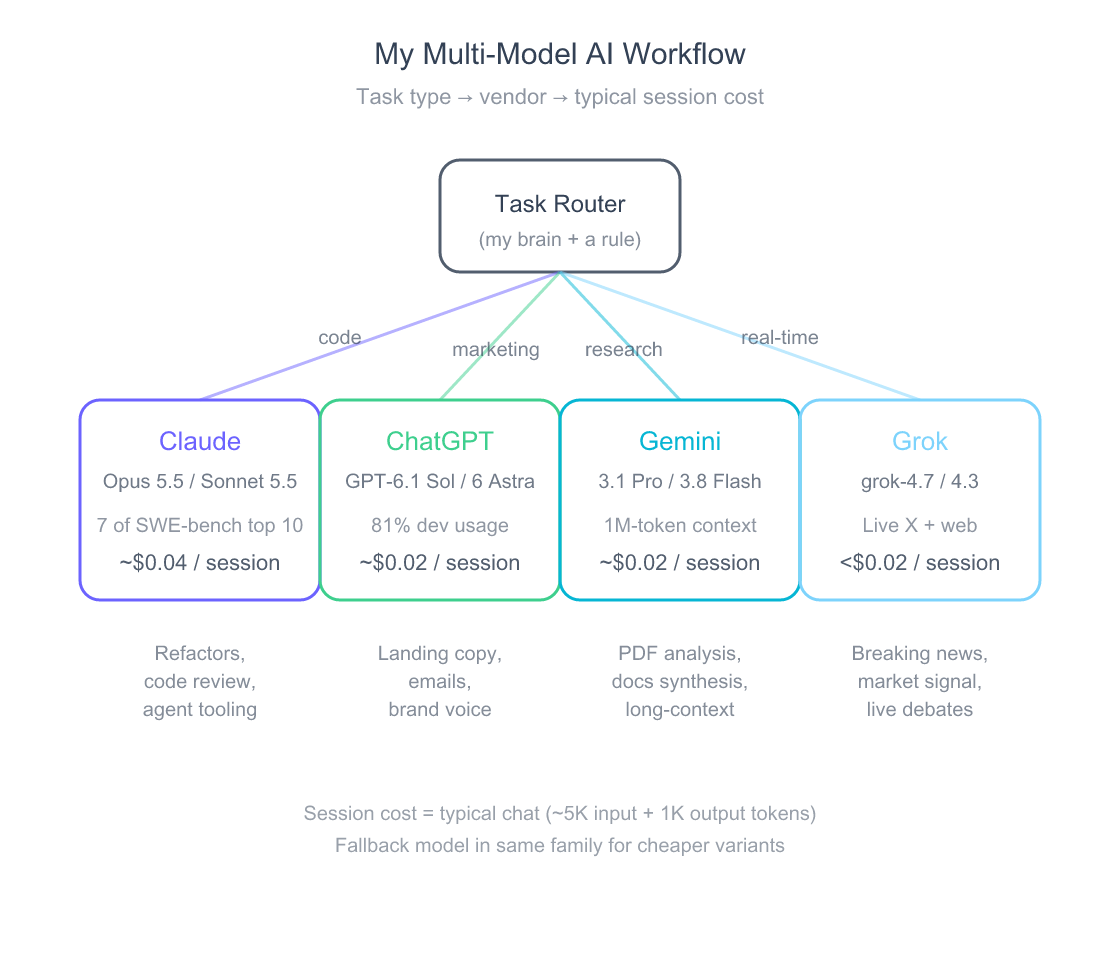
Workflow diagram: how I route tasks across four AI vendors with per-task cost estimates.
Claude for Code
Claude wins coding because the data says it does. On the SWE-bench Verified leaderboard I checked in October 2026, Anthropic holds seven of the top ten slots, led by Claude Fable 5 at 95.0%, with the best non-Anthropic entries (DeepSeek-V4-Pro-Max and Gemini 3.1 Pro) at 80.6% (LLM-Stats, 2026). Opus 5.5 and Sonnet 5.5 weren’t in that top ten when I checked. Menlo Ventures counted 18 months of Anthropic atop the coding leaderboards by late 2025, and an estimated 54% share of enterprise coding spend (Menlo Ventures, 2025). I felt this before I read it. Back in 2025, refactors that took two prompts in Claude took five in GPT-5 and ten in Gemini. I use Fable 5.1 only for the rare gnarly problem, since at $10/$50 per million tokens it costs 2.5x what Opus 5.5 does (Anthropic, 2026).
ChatGPT for Marketing
ChatGPT wins marketing because of voice. There’s no benchmark for “this email doesn’t sound like an LLM wrote it,” but there’s a market signal: in Stack Overflow’s 2025 survey, 81% of developers who used AI models reported using OpenAI’s GPT models, more than any other family (Stack Overflow, 2025). I draft landing copy, cold emails, and onboarding sequences in GPT-6.1 Sol because the contractions land, the rhythm is human, and the tone holds across a 6-email sequence without me re-priming voice every time.
Gemini for Research
Gemini won research on context window alone when I set this stack up. Gemini 3.1 Pro still accepts 1,048,576 input tokens in a single call: roughly 750,000 words (Google, 2026). I drop a 200-page PDF, a quarterly earnings transcript, and three competitor whitepapers into one chat and ask for a synthesis. No model-specific PDF chunking. No retrieval pipeline. Input costs $2 per million tokens for prompts up to 200K and $4 above that (Google, 2026), versus $4 flat for Claude Opus 5.5.
I’ll be straight about what changed, though. The window isn’t a moat anymore. Opus 5.5 and Sonnet 5.5 now take 1M tokens too, and the GPT-6 family takes 1.05M (OpenAI, 2026). Gemini keeps the research job in my stack because the workflow already lives there and the price is fair, not because nobody else can hold the documents.
Grok for Real-Time
Grok wins real-time because it sees X and the live web in the same query. When something breaks (a Fed announcement, a competitor’s product launch tweet, a viral thread) Grok returns context that Claude and ChatGPT either hallucinate or refuse. I don’t use it daily. I use it the way you’d use a Bloomberg terminal: when fresh signal beats deep reasoning. xAI’s top model, grok-4.7, runs $2 input and $6 output per million tokens, and grok-4.3 at $1.25 and $2.50 is one of the cheapest capable options for that narrow job (xAI Docs, 2026).
how I run a one-person marketing team using ChatGPT Projects and a content stack
How Does the Per-Task Cost Math Actually Work?
The cost spread is wider than most pricing pages let on, and in 2026 it lives between tiers more than between vendors. Per million output tokens, Gemini 3.8 Flash runs $3.75 (promo pricing through December 31, 2026) while GPT-6 Astra runs $50: a 13x gap on the same unit (Google, 2026; OpenAI, 2026). Standardizing on a premium model means you’re paying that gap on every token, including the ones where you didn’t need premium reasoning. The savings from routing show up monthly, not per call.
I track session cost as roughly 5,000 input tokens and 1,000 output tokens, a fair average for chat-style work. At those numbers, a Claude Opus 5.5 session is about $0.04, a GPT-6 Astra session is $0.10, a GPT-6.1 Sol session is $0.02, a Gemini 3.1 Pro session is about $0.02, and a grok-4.7 session is under $0.02. The math is small per call. It’s not small at scale. A hundred sessions a day on Astra when Sol would have done the job is about a $240 monthly difference per person, and you won’t feel it until you check the API dashboard with one eye closed.
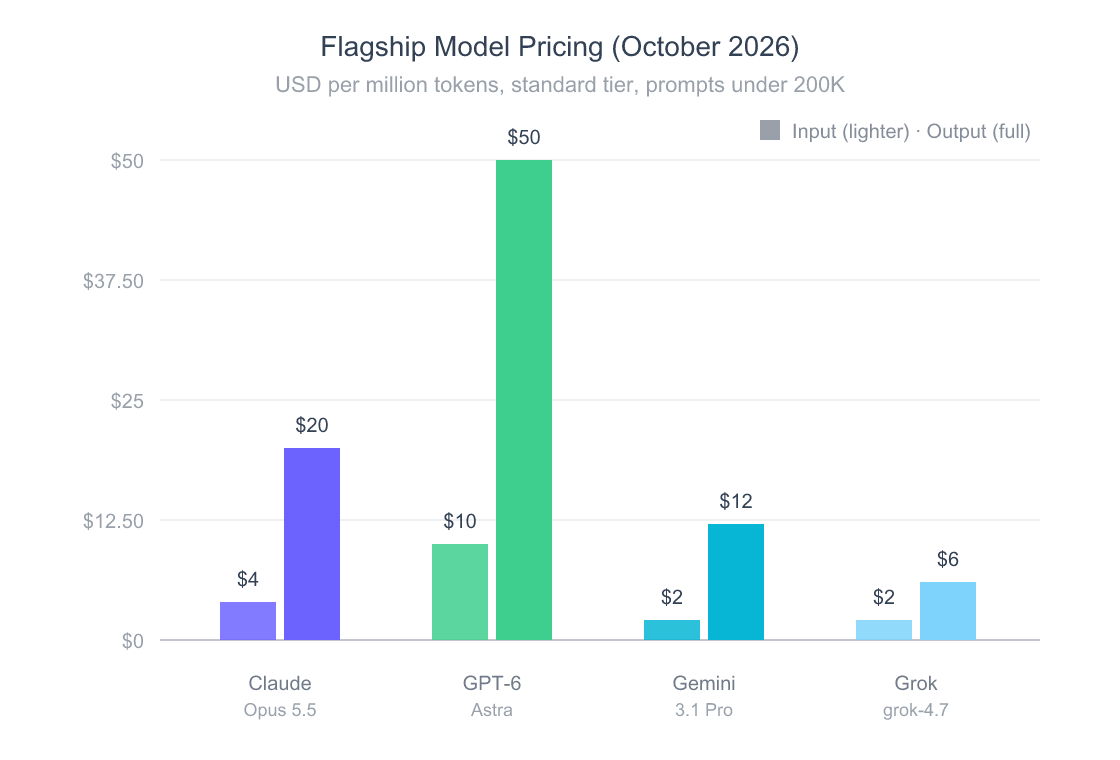
Source: Anthropic, OpenAI, Google AI for Developers, and xAI pricing pages (accessed October 2026).
The per-task rule writes itself once you stare at this chart. If the work is short, conversational, and high-stakes, write a code review for a senior engineer, pay the premium. If the work is bulk reading, pay Gemini. If the work is brand voice, pay GPT-6.1 Sol, not Astra: Sol costs $2/$10 per million tokens against Astra’s $10/$50, and the marginal quality bump rarely justifies a 5x bill. If the work is real-time, pay grok-4.3 for routine checks and grok-4.7 when the reasoning matters; the output price is $2.50 versus $6. None of this is theoretical. It’s what shows up on the bill.
Where Does Each Model Actually Lead?
No single model leads on every axis, and that’s the whole argument. Anthropic owns coding and, for now, the top reasoning score. OpenAI owns developer mindshare and the deepest pricing ladder. xAI owns real-time signal. Google used to own context length outright; in 2026 it shares that axis with Anthropic and OpenAI. The radar below is my own 0-10 rating of each flagship on four axes, informed by SWE-bench Verified (coding), the Artificial Analysis Index (reasoning), published max context (long context), and live X/web access (real-time). The shapes still don’t match, which is exactly the point.
According to Menlo Ventures’ 2025 enterprise survey, Anthropic captured 40% of enterprise LLM spend in 2025, helped by an estimated 54% share of coding spend, while Google climbed from 7% to 21% in two years (Menlo Ventures, 2025). Enterprise behavior is the leading indicator, the buyers with the largest bills route by use case, and the rest of us are catching up.
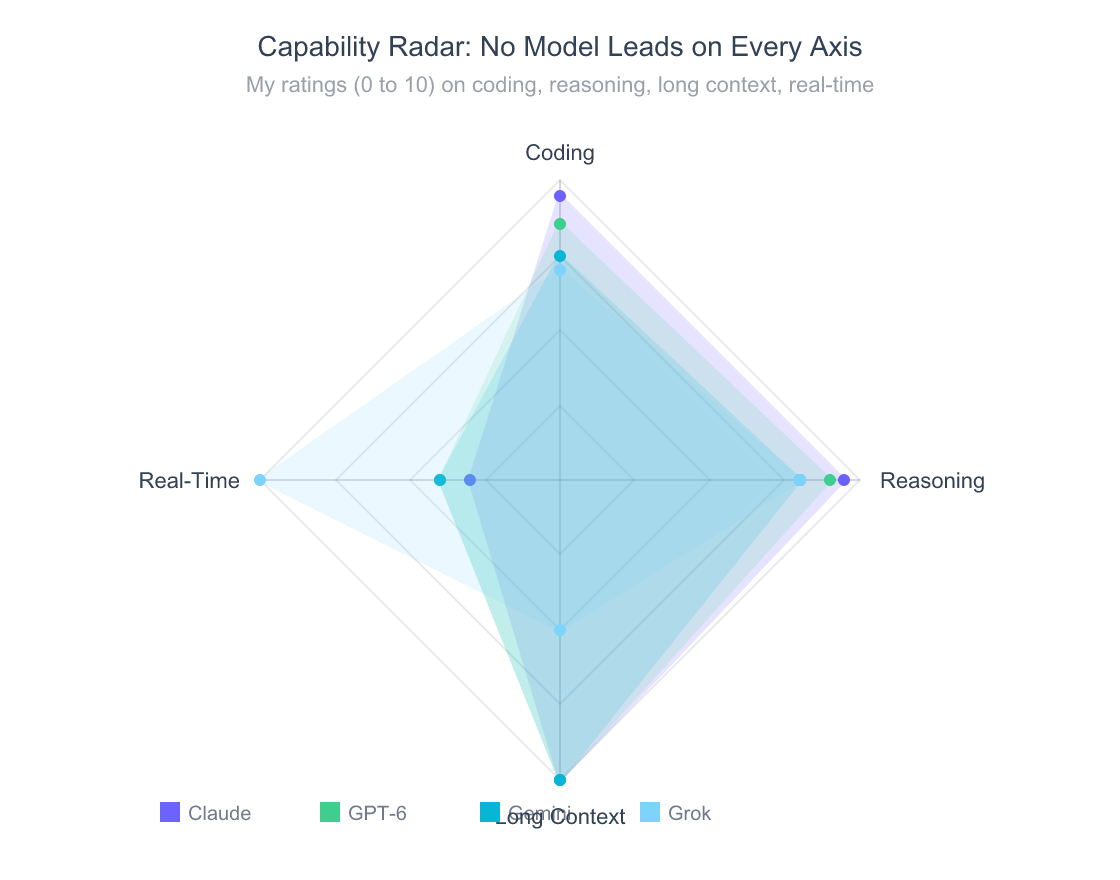
Author’s ratings, informed by SWE-bench Verified via LLM-Stats, the Artificial Analysis Intelligence Index, and vendor model docs (October 2026).
Reading the radar: Claude has the deepest coding spike and edges the reasoning axis. Long context is now a three-way tie at roughly a million tokens, with Grok’s 500K window the outlier. GPT-6 is balanced, the closest thing to “good at everything,” which is exactly why standardizing on it costs you on the axes where it isn’t the leader. Grok is a single-axis specialist on real-time, and that’s fine. Specialists are useful when you know what you’re hiring them for.
Where Did Switching Save Me Eight Hours a Week?
The real case study is research, and it dates from 2025. I write 2–3 long-form pieces a week, each one synthesized from 5–15 sources. For a year I did this in Claude with manual chunking and a retrieval scratchpad, because I was working inside Claude’s standard 200K window at the time. Each piece took 4–6 hours of reading and prompt-shaping. When I moved that one workflow to Gemini 2.5 Pro and started loading every source (PDFs, transcripts, blog posts, supporting research) into a single 600,000-token chat, the per-piece time dropped to 90 minutes. Eight hours a week, recovered, on one swap.
What this saved (2025 pricing): Roughly 8 hours per week of source reading and synthesis, and about $40/month in API spend (Gemini 2.5 Pro at $1.25/MTok input ran cheaper than the Claude Opus equivalent for this volume). In October 2026 the gap is smaller: Gemini 3.1 Pro charges $2/MTok input, Opus 5.5 charges $4.
The reason it worked isn’t that Gemini’s reasoning is better than Claude’s. It isn’t. Claude wins reasoning benchmarks more often than not. The reason is that Gemini’s context window, back when it was the only million-token option I trusted, made the workflow architecturally different. I stopped asking “what should I retrieve?” and started asking “what should I conclude?” That’s a different cognitive job, and it’s the one I actually wanted to do.
This is the real argument for the multi-model AI workflow. It isn’t that one model is better. It’s that the right model removes a constraint you didn’t realize was costing you hours. Standardizing makes you blind to those constraints, because the model you’re using sets the ceiling on what work feels possible. The flip side: constraints move. Now that Opus 5.5 also reads a million tokens, the original reason for this swap is gone, and I re-run the comparison every quarter instead of assuming last year’s winner still wins.
the marketing-side equivalent, using ChatGPT Projects to compress an entire content pipeline
When Does Standardizing Actually Win?
There’s a real cost to multi-vendor: context-shifting between models is mental tax. Different system prompts, different memory behaviors, different rate limits, different tool-calling syntax. If your work is uniform, say you ship code 90% of the time and rarely touch marketing or research, Claude alone is the cleaner answer. In Stack Overflow’s 2025 survey, 45% of professional developers said they’d used Claude Sonnet, versus 30% of people learning to code (Stack Overflow, 2025), and plenty of them never touch another model. They don’t need to.
how ChatGPT, Claude, Gemini, and Grok each handle memory, and why it matters when you switch
The framework I use is task entropy. If your work week looks like one task type, standardize. If it looks like four (code, copy, research, market signal) route. The break-even is roughly 25% of your time on a non-primary task. Below that, the context-shift cost wins. Above it, the model-fit gain dominates. I run somewhere around 45/30/20/5 across code, marketing, research, and real-time. That entropy is too high to standardize, and routing everything through Opus 5.5 or GPT-6 Astra would cost me more every month for outputs that are worse on at least two of the four axes.
There’s also the team question. LangChain’s State of Agent Engineering survey (1,340 responses, collected in late 2025) found that 57% of respondents had agents in production and over three-quarters were using multiple models in production or development (LangChain, 2025). If you’re building anything agentic, you’re already multi-model whether you wanted to be or not. The orchestration layer routes for you. The only question is whether you’re choosing the routing or letting your framework default it.
Frequently Asked Questions
Should I subscribe to all four model providers if I want a multi-model AI workflow?
Not necessarily. Pay-per-use API access through one gateway (OpenRouter, LiteLLM) covers Claude, GPT, Gemini, and Grok, and light solo usage on mid-tier models can stay in the tens of dollars a month. Four consumer subscriptions add up fast: ChatGPT Plus and Claude Pro are $20/month each before you add Google and xAI plans (OpenAI, 2026; Anthropic, 2026). The aggregator route also makes per-task cost visible.
Which AI model is best for coding in 2026?
Claude, by a wide margin on public benchmarks. On the SWE-bench Verified leaderboard in October 2026, Claude Fable 5 leads at 95.0% and Anthropic holds seven of the top ten slots; the best non-Anthropic scores, from DeepSeek and Gemini 3.1 Pro, sit at 80.6% (LLM-Stats, 2026). Day to day I use Opus 5.5 and Sonnet 5.5, and Claude Code is included from the $20 Pro plan, so you don’t need Max to start.
Is Gemini’s 1M-token context actually useful, or is it a marketing number?
It’s useful when you have the inputs to fill it. Gemini 3.1 Pro accepts 1,048,576 input tokens, about 750,000 words (Google, 2026). For document research, legal review, and codebase-wide questions, it removes the chunking step entirely. It’s no longer unique, though: Claude Opus 5.5 and the GPT-6 family also take about a million tokens. For short conversational queries, the window is overkill.
Why use Grok at all when Claude and ChatGPT also have web search?
Grok’s edge is X-native real-time access. For breaking news, market sentiment, and live debate context, it returns specific posts and timestamps that web-search-augmented Claude and ChatGPT either miss or hallucinate. grok-4.3 at $1.25/$2.50 per million tokens is the cost-effective tier for this narrow use case, with grok-4.7 at $2/$6 when you need more reasoning (xAI Docs, 2026).
How much does a multi-model AI workflow actually cost per month?
At my session size (about 5K input and 1K output tokens), 100 sessions a day on mid-tier models like GPT-6.1 Sol, Gemini 3.1 Pro, and grok-4.7 works out to roughly $50–$70/month in API charges, more if you lean on Opus 5.5 or Astra. That’s in the same range as two $20 subscriptions plus some API use, while delivering better task-fit on every axis except brand-voice consistency, which a single primary model handles slightly better.
Conclusion
The case for a multi-model AI workflow isn’t a religious one. It’s arithmetic. Each flagship leads on a different axis. Output prices span 100x from the cheapest tier to the most expensive. Switching tasks to the right model recovers hours that one-model standardization quietly bleeds. Thirty-seven percent of enterprises were already running five or more models in 2025, up from 29% a year earlier. The pattern that wins is simple: pick the right tool for the right task, build a router (even if it’s just a rule in your head), and stop arguing about which model is “best.” None of them is. All of them are, somewhere.
If you’re still on one vendor, run the audit for a week. Track every prompt, label the task type, and compare what you’d have used at the right model. The gap is the cost of standardization, and once you see it, you don’t unsee it.