Why Feature Spreadsheets Fail as an Agent Framework Comparison
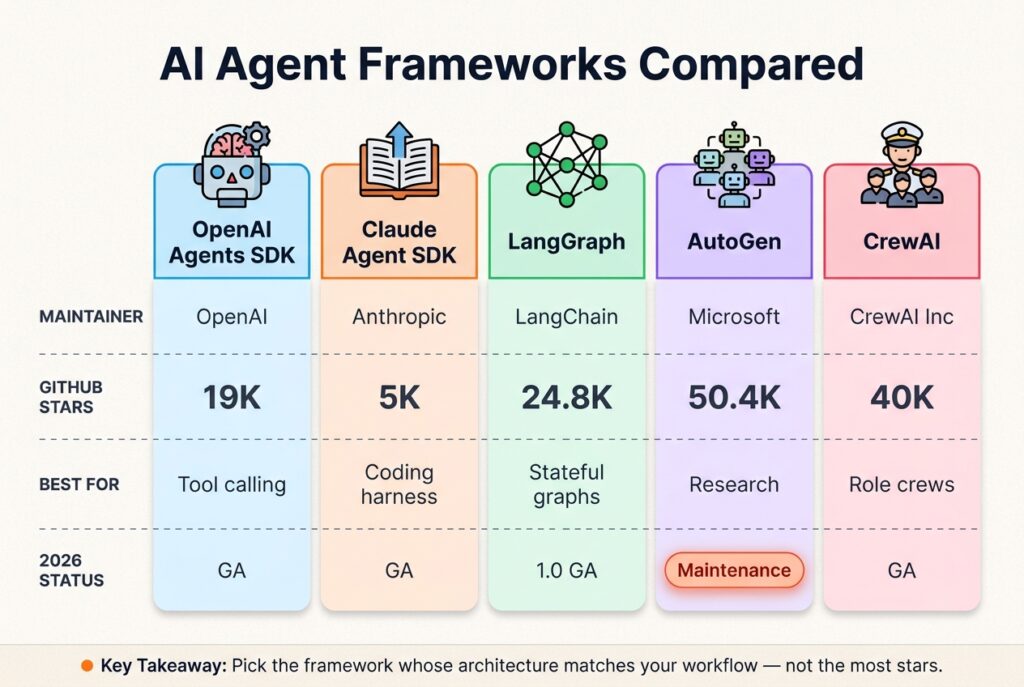
Five SDKs dominate the AI agent framework conversation, and most comparison posts treat them like a feature spreadsheet. That’s the wrong lens. In August 2025, Gartner predicted that up to 40% of enterprise apps will include task-specific AI agents by the end of 2026, up from less than 5% in 2025 (Gartner, 2025). Picking your SDK isn’t a checkbox exercise anymore. It’s an architecture decision.
I’ve spent the last year shipping agent systems on three of these frameworks and reading the source code of the other two. The interesting question isn’t “which has more features.” It’s: who built it, what does it actually own in production, and where does it quietly fall apart? This guide answers those questions for each SDK, then ends with a single decision matrix you can paste into a design doc. It’s updated for October 2026, which matters: AutoGen’s successor shipped 1.0, and both the OpenAI and Claude SDKs grew sandboxed and hosted options this year.
If you want the deeper failure-mode anatomy that explains why so many agent projects collapse, that’s covered in companion piece on the 14 documented failure modes from the Berkeley MAST study and how production teams hit them. This piece is about which framework to start with.
Key Takeaways
- LangGraph hit 1.0 GA on October 22, 2025, and it’s the framework behind Klarna’s support assistant (work equivalent to 700 full-time staff) and LinkedIn’s SQL Bot (LangChain, 2025).
- Microsoft put AutoGen into maintenance mode on October 2, 2025, and its successor, Microsoft Agent Framework, reached 1.0 GA for Python and .NET on April 3, 2026 (Microsoft, 2026).
- The Claude Agent SDK, renamed from “Claude Code SDK” on September 29, 2025, is the same harness that powers Claude Code. Its Python package pulled about 29.8M PyPI downloads in the 30 days to October 6, 2026, more than double the OpenAI Agents SDK’s 12.4M (PyPI Stats, 2026).
- CrewAI says it’s used by more than 60% of the Fortune 500 and has powered 1.4 billion agentic automations (Insight Partners, 2025).
- The right choice isn’t the framework with the most features. It’s the one whose architectural opinions match the workflow shape you’re actually building.
What’s the Right Way to Compare AI Agent Frameworks?
Berkeley’s MAST study analyzed 1,642 execution traces from seven multi-agent frameworks and identified 14 failure modes in three categories: system design issues (43.9% of failures), inter-agent misalignment (32.3%), and task verification problems (23.9%) (Cemri et al., 2025). Inter-annotator agreement on those labels hit kappa = 0.88, which is unusually high for qualitative AI research. Translation: the failure modes are real, repeatable, and tied to architectural choices each framework makes.
That’s the lens I’ll use. For each SDK below, I’m answering four questions:
- Who built it, and what’s the maintenance signal in 2026?
- What it actually owns, the production scenario where it’s the obvious pick.
- Where it falls apart, the failure mode it tends to hit.
- Who shouldn’t pick it, the workload that will fight the framework.
This isn’t a feature audit. It’s a “what breaks at 3 AM” audit. The frameworks that look identical in a feature matrix diverge sharply once you put real traffic through them.
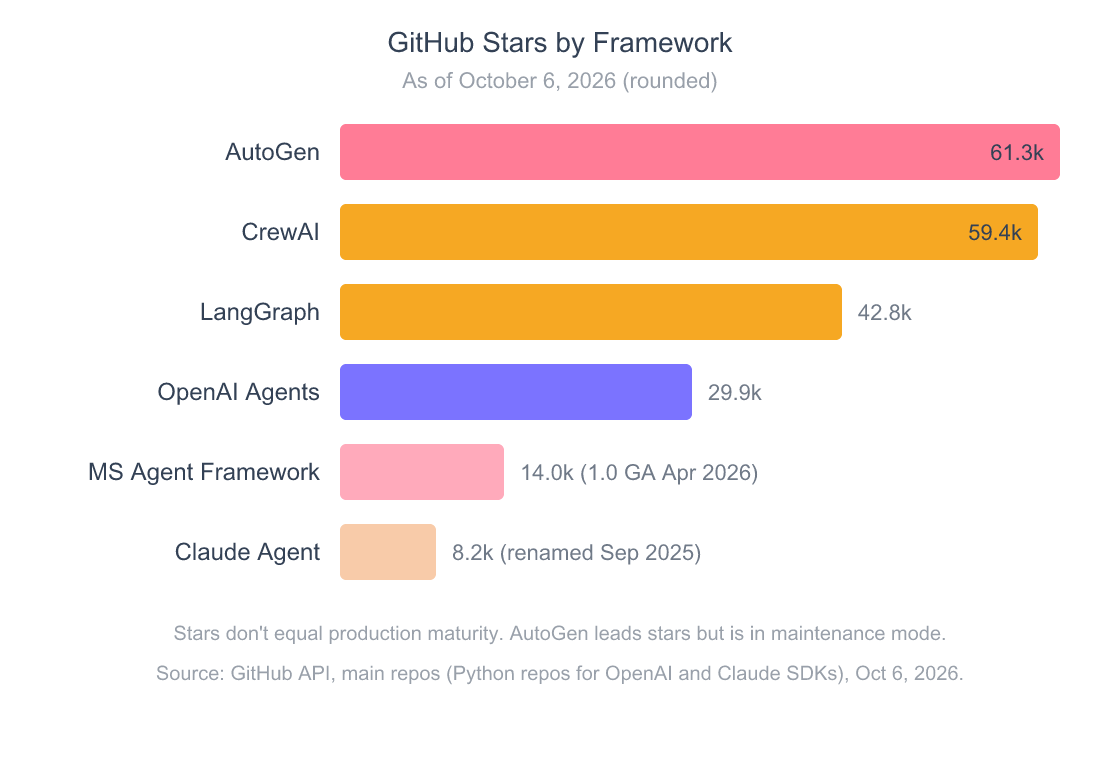
Source: GitHub API, October 6, 2026. Star counts are a popularity proxy, not a quality signal.
Stars are misleading on their own. AutoGen leads on stars, yet its repo hadn’t seen a push since April 2026 when I pulled these numbers. Downloads tell a different story. Here are the 30-day package downloads as of October 6, 2026:
| Package | Downloads, last 30 days | Registry |
|---|---|---|
langgraph |
44.8M | PyPI |
@anthropic-ai/claude-agent-sdk |
47.8M | npm |
claude-agent-sdk |
29.8M | PyPI |
openai-agents |
12.4M | PyPI |
@openai/agents |
7.9M | npm |
crewai |
2.4M | PyPI |
autogen-agentchat |
0.38M | PyPI |
agent-framework (Microsoft) |
0.19M | PyPI |
Sources: PyPI Stats and the npm downloads API, both accessed October 6, 2026. Downloads include CI runs and transitive installs, so treat them as an activity signal, not a user count. Still, the gap between CrewAI’s stars and its downloads, and the reverse for the Claude Agent SDK, is worth noticing. The signal that matters most is “is this thing being shipped in production this quarter?” That’s where I’ll spend the rest of the comparison.
OpenAI Agents SDK: The Minimalist Successor to Swarm
OpenAI launched the Agents SDK on March 11, 2025, as the production-ready upgrade of its experimental Swarm project (OpenAI, 2025). The original design rested on a few primitives: agents, handoffs, guardrails, and built-in tracing that pipes into the OpenAI platform dashboard. In April 2026 OpenAI added sandbox agents that inspect files, run commands, and edit code inside controlled workspaces, plus sessions for persistent memory (OpenAI Agents SDK docs, 2026).
Who built it: OpenAI, evolving Swarm (which was always positioned as educational, not production-grade). The SDK is actively maintained and ships in both Python and TypeScript, with the openai-agents-js package treating realtime voice agents as a first-class concept. OpenAI also now offers a hosted Agents API in public beta if you’d rather not run the harness yourself.
What it actually owns: Voice agents, and any production stack already tied to OpenAI’s Responses API. If you’re building a customer-facing voice assistant on OpenAI’s realtime models, this SDK is the path of least resistance. Handoffs are clean, the tracing dashboard works out of the box, and the small core means a junior engineer can read the code and follow what’s happening.
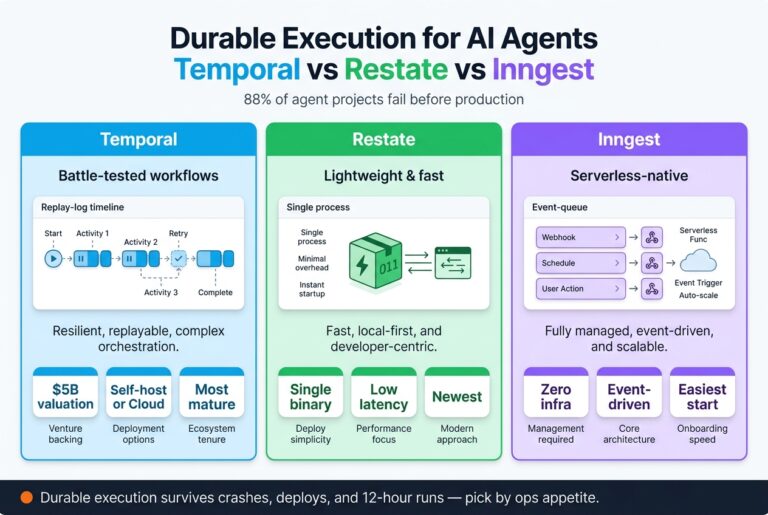
Where it falls apart: The minimalism stops paying off past five or six agents. The handoff abstraction assumes a flat topology, so when you need a hierarchical orchestrator with shared state, you start writing scaffolding the framework doesn’t give you. Tracing is OpenAI-platform tied, which means migrating to a vendor-agnostic observability stack later is non-trivial. Sandbox sessions are resumable, but durable workflow execution across server restarts still isn’t the core concern. For that you’re building it yourself or on top of durable execution platforms like Temporal, Restate, and Inngest.
Who shouldn’t pick it: Teams that already see GPT vendor lock-in as a strategic risk. The SDK supports other providers through LiteLLM and Any-LLM adapters, but most examples, docs, and integrations assume you’re staying in the OpenAI ecosystem.
Claude Agent SDK: The Agentic Loop Made Portable
On September 29, 2025, alongside the Sonnet 4.5 launch, Anthropic renamed the Claude Code SDK to the Claude Agent SDK (Anthropic, 2025). The name change isn’t cosmetic. It’s a bet: the harness Anthropic built to make Claude Code work is the right pattern for agents in general.
Who built it: Anthropic. Available in Python and TypeScript. It’s the same loop, tools, and context management powering Claude Code, which means every improvement Anthropic ships to its flagship coding agent flows into the SDK (Claude Code docs, 2026). That’s a meaningful maintenance signal. Anthropic now also offers Managed Agents, a hosted version of the harness with cloud or self-hosted sandboxes, for teams that don’t want to operate the process.
What it actually owns: Coding agents and computer-use agents. The SDK formalizes what Anthropic calls the agentic loop: gather context, take action, verify work, repeat. It treats the file system as agent memory, gives Claude shell access through permissioned tools, and assumes the agent will iterate on its own output. Hooks, subagents, sessions, skills, and MCP all come built in. If you’re building anything that needs to read code, write code, run code, and check whether the code worked, this is the SDK whose primitives match the problem.
There’s also a strong tooling story here. Anthropic’s “Code Execution with MCP” pattern, published November 4, 2025, treats MCP servers as code-level APIs the agent imports and calls programmatically rather than as a tool list loaded upfront. In Anthropic’s example, that cut one workflow from 150,000 tokens to 2,000, a 98.7% reduction (Anthropic, 2025). The pattern is documented but not framework-locked, so you can apply it from any MCP server architecture and the related A2A protocol regardless of SDK.
Where it falls apart: The agentic loop is built for Claude, full stop. It’s designed around Claude models, and the verification step leans on Claude’s ability to self-critique. If you’re building a multi-model environment where you want to swap providers based on cost or task fit, this isn’t your abstraction layer. The TypeScript repo is also far less starred than the Python one, though its npm download count suggests it’s the more heavily used of the two.
Who shouldn’t pick it: Multi-vendor shops who need provider-agnostic abstractions. And teams not building anything code-adjacent. The SDK’s primitives are tuned for “agent edits files and runs commands.” If your agent’s job is “answer customer support questions,” you’re using a hammer for a screw.
LangGraph: The Graph for Stateful, Durable Agents
LangGraph reached 1.0 GA on October 22, 2025, with durable execution, built-in persistence, and human-in-the-loop as first-class features (LangChain, 2025). It has the strongest production track record in this list. Nearly 400 companies used LangGraph Platform to deploy agents into production during its beta, including Klarna, Replit, LinkedIn, and Qualtrics (LangChain, 2025).
Who built it: Harrison Chase and the LangChain team. Version 1.0 wasn’t a marketing rebrand. They explicitly committed to API stability, which had been the running joke about LangChain for years.
What it actually owns: Long-running, stateful workflows that need to survive a server restart mid-conversation. Klarna’s AI assistant, built on LangGraph with LangSmith for observability, has handled 2.5 million conversations, does work equivalent to 700 full-time staff, and cut average query resolution time by 80% (LangChain, 2025). LinkedIn’s SQL Bot, a multi-agent system built on LangChain and LangGraph, is used by hundreds of employees, and about 95% of surveyed users rated its query accuracy “Passes” or better (LinkedIn Engineering, 2025). These aren’t demos. They’re load-bearing systems at large companies.
The graph abstraction is what makes this work. Nodes are functions. Edges are typed state transitions. State is checkpointed at every step. If a node fails, you replay from the last checkpoint instead of starting the whole agent over. That’s the production property nothing else in this list gives you as cleanly out of the box.
The one I personally use the most is LangGraph, and the reason is simple: I’ve never lost work to a crashed agent run on it. Every other framework on this list has cost me at least one full re-run when something blew up at minute 12 of a 15-minute job. With LangGraph, the checkpoint system caught it.
Where it falls apart: The learning curve is real. Reviewers on Gartner Peer Insights call it very flexible but very complex, and say it takes strong technical expertise to configure and optimize (Gartner Reviews, 2026). The framework expects you to bring state-machine and distributed-systems intuition. For a simple linear ReAct agent, LangGraph is overkill. Debugging a misbehaving graph node is also harder than reading a stack trace; you need LangSmith (paid) or solid observability discipline.
Who shouldn’t pick it: Teams shipping a single-step ReAct agent. Solo developers who want to stand something up in an afternoon. Anyone who finds the LangChain ecosystem’s churn off-putting; LangGraph stabilized that, but the surrounding tools still move fast.
AutoGen: The Research Framework That Became Microsoft Agent Framework
Microsoft Research released AutoGen v0.4 on January 14, 2025, as a ground-up rewrite with an asynchronous, event-driven architecture split into Core, AgentChat, and Extensions layers (Microsoft Research, 2025). It was, briefly, the most impressive piece of agent infrastructure in the open ecosystem. Then on October 2, 2025, Microsoft announced that AutoGen would get only critical bug fixes and security patches, with no significant new features, because it had been merged with Semantic Kernel into the Microsoft Agent Framework (GitHub Discussion #7066, 2025).
Who built it: Microsoft Research. The team’s capability work now goes into Microsoft Agent Framework, which hit 1.0 GA for Python and .NET on April 3, 2026, with stable APIs, a long-term support commitment, and an official AutoGen migration guide (Microsoft, 2026). The AutoGen repo still holds about 61,300 GitHub stars, the most of any framework here, which makes the maintenance-mode reality confusing for anyone reading older comparison posts.
What it actually owns: Research and rapid prototyping of conversational multi-agent patterns. Magentic-One, Microsoft’s generalist multi-agent system built on AutoGen, showed what an Orchestrator plus WebSurfer, FileSurfer, Coder, and ComputerTerminal architecture looks like in practice (arXiv 2411.04468, 2024). Those patterns survived the transition: Microsoft Agent Framework 1.0 ships sequential, concurrent, handoff, group chat, and Magentic-One orchestrations, all with checkpointing and human-in-the-loop support.
Where it falls apart: Production reliability. Berkeley’s MAST study included AG2 (the AutoGen fork) and Magentic-One among the seven systems it traced, and inter-agent misalignment accounted for about a third of all failures (Cemri et al., 2025). Free-form group chat sits squarely in that risk zone. Non-determinism in conversation order destroys reproducibility, which destroys tests, which destroys the eval-driven development loop you need to keep agents working under change. And maintenance mode means you’re building on a codebase whose roadmap now lives somewhere else.
Who shouldn’t pick it: Anyone starting net-new in 2026. If you’re in the Microsoft and Azure ecosystem, start on Microsoft Agent Framework directly; it’s GA now, so there’s no reason to wait. Existing AutoGen users with running systems can keep them, but plan the migration rather than adding new investment.
CrewAI: Role-Based Crews for Sequential Workflows
CrewAI is used by more than 60% of the Fortune 500 and has powered 1.4 billion agentic automations through customers including PwC, IBM, Capgemini, and NVIDIA, according to its lead investor (Insight Partners, 2025). The company raised $18 million in October 2024, including a Series A led by Insight Partners. Its main repo sits at about 59,400 GitHub stars as of October 2026. The framework is built from scratch (no LangChain dependency), and that independence is part of its pitch.
Who built it: João Moura, who started CrewAI as an open-source project in November 2023 and turned it into a venture-backed company. Active development, well-funded, growing enterprise customer base.
What it actually owns: Role-based, sequential team workflows. The mental model is a small team: a researcher hands findings to a writer who hands a draft to an editor. CrewAI’s Agent, Task, and Crew primitives map onto that workflow shape almost too cleanly. If you can describe the work as a sequence of role-defined steps, CrewAI is the SDK that turns that description into running code in the smallest number of lines.
That simplicity is the moat. I’ve onboarded a non-engineering colleague onto CrewAI in less than an hour. The same person stared at a LangGraph state machine for two days before giving up. For workflows that genuinely are sequential (content pipelines, structured research tasks, compliance reviews), CrewAI’s opinionated structure is a feature, not a limitation.
Where it falls apart: The opinionated structure constrains non-linear and dynamic workflows. The moment you need an agent to loop back, branch conditionally on intermediate state, or hand off to a peer mid-task, you’re either fighting CrewAI or rewriting parts of it. In my experience, streaming-heavy UIs and fine-grained checkpointing are also weaker than what LangGraph offers.
Who shouldn’t pick it: Teams building cyclical agent loops, dynamic handoff swarms, or anything where the workflow shape can’t be predicted upfront. Also teams that need durable execution as a first-class property; CrewAI’s checkpointing is workable but not in the same league as LangGraph’s.
Which AI Agent Framework Should You Pick for What?
Here’s the decision matrix. Match your workflow shape to the SDK whose architectural opinion fits, not the one with the most stars.
| Scenario | Pick | Why |
|---|---|---|
| Voice agent on OpenAI’s realtime models | OpenAI Agents SDK | First-class realtime and voice agents, minimal boilerplate, Responses API alignment |
| Coding agent that reads, writes, runs code | Claude Agent SDK | Agentic loop is built for gather → act → verify; file system as memory is native |
| Customer-facing assistant that must survive restarts | LangGraph | Durable execution and checkpoints are first-class; Klarna and LinkedIn proved it at scale |
| Sequential content or research pipeline | CrewAI | Role-based crews map directly onto the workflow; smallest learning curve |
| Multi-agent debate or critique loop | LangGraph or Microsoft Agent Framework | Both support cyclical, checkpointed group patterns; avoid starting new work on AutoGen |
| Vendor-agnostic enterprise agent platform | LangGraph | Broad production deployments, model-neutral by design, strongest observability story |
| Internal automation, single agent, ship in a day | CrewAI or OpenAI Agents SDK | Both let a small team ship in hours, not weeks |
| Hierarchical orchestrator with shared state | LangGraph | The graph abstraction handles arbitrary topology; others fight it past 5 agents |
| Net-new project in a Microsoft/.NET shop | Microsoft Agent Framework | AutoGen’s GA successor, with Python and .NET support and a migration guide |
| Computer-use agent (browser, shell, files) | Claude Agent SDK | Anthropic’s own primitive; tooling and verification are tuned for this loop |
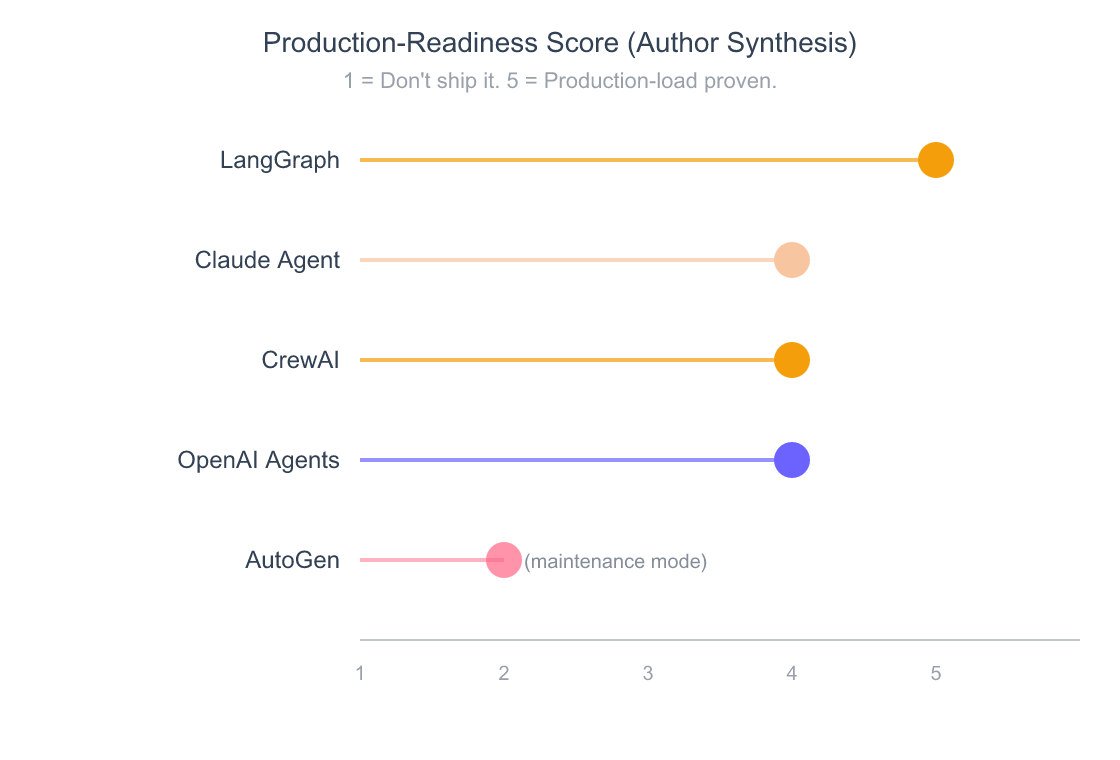
Author’s synthesis from cited sources, October 2026. Scoring weighs production deployments, durable execution, vendor neutrality, and maintenance signals. Microsoft Agent Framework is too new in GA for me to score fairly.
The framework’s architectural opinion is the actual product. Picking by stars or feature count is how teams end up six months in, fighting their SDK instead of building product.
If I Were Starting Today, What Would I Pick?
For a single-step or two-step agent shipped in a week: CrewAI. The role-based primitive matches how product managers describe the work. You’ll get to “running in production” faster than with anything else on this list, and you can migrate later if the workflow shape changes.
For a coding or computer-use agent: Claude Agent SDK. The agentic loop is the right primitive, the Anthropic engineering team is investing heavily, and the same harness powers Claude Code. Don’t fight a known-good design.
For a customer-facing assistant or any workflow that has to survive restarts and serve thousands of concurrent users: LangGraph, every time. The Klarna deployment alone is worth more than every feature comparison you’ll read this year. Durable execution isn’t a nice-to-have once you’re past pilot. It’s the difference between an agent that fails gracefully and one that loses customer state.
For a voice agent on OpenAI infrastructure: OpenAI Agents SDK. Voice is a meaningful gap in every other framework. Don’t paper over it.
For AutoGen: I wouldn’t start there. If you’ve already invested, ship what you have and move to Microsoft Agent Framework or LangGraph on your next major release. The successor is GA, so the “wait and see” excuse is gone.
The straight meta-point: most teams over-index on framework choice. In the MAST data, 43.9% of multi-agent failures came from system design issues, problems your framework choice doesn’t fix (Cemri et al., 2025). Pick the SDK whose opinion fits your workflow, then put your real engineering effort into evals, observability, and the boring infrastructure work that actually keeps agents running.
LangChain’s State of Agent Engineering survey (1,340 responses, collected November-December 2025) found that 57.3% of respondents had agents in production, up from 51% a year earlier, with another 30.4% actively developing agents with concrete deployment plans. Quality was the top blocker, cited by a third of respondents (LangChain, 2025). The teams winning aren’t the ones with the cleverest framework choice. They’re the ones who picked one, stopped re-evaluating, and shipped.
Frequently Asked Questions
Is LangGraph the same as LangChain?
No. LangGraph is a separate library built by the LangChain team. LangChain is the broader ecosystem of LLM integrations and chains; LangGraph is a focused, low-level agent orchestration framework with state, durability, and graph-based control flow. Both reached 1.0 in October 2025, and you can use LangGraph on its own (LangChain, 2025).
What replaced AutoGen at Microsoft?
Microsoft Agent Framework. Microsoft put AutoGen into maintenance mode on October 2, 2025, merging it with Semantic Kernel into the new framework (GitHub, 2025). Agent Framework reached 1.0 GA for Python and .NET on April 3, 2026, with an official AutoGen migration guide. Existing AutoGen projects keep working with security fixes, but new investment should go to the successor.
Is the Claude Agent SDK only for Anthropic models?
Yes, in practice. The SDK runs the Claude Code harness and its built-in tools, permissions, sessions, and hooks, and it’s designed around Claude models (Claude Code docs, 2026). If you need to swap model vendors per task, use a model-neutral framework like LangGraph and call Claude through it.
Which framework has the strongest observability story?
LangGraph paired with LangSmith is the most mature combination, and it’s the stack behind Klarna’s assistant (LangChain, 2025). OpenAI Agents SDK has solid built-in tracing if you stay in the OpenAI ecosystem. CrewAI and Claude Agent SDK lean more on third-party or hook-based observability.
Can I use MCP with all these frameworks?
Yes, and increasingly that’s the right pattern. Anthropic’s “Code Execution with MCP” approach treats MCP servers as code-level APIs the agent imports rather than tool lists loaded upfront, which cut one example workflow’s token use by 98.7% (Anthropic, 2025). Claude Agent SDK and OpenAI Agents SDK have first-class MCP support, and Microsoft Agent Framework 1.0 supports both MCP and A2A.
The Bottom Line on AI Agent Frameworks
The five SDKs in this guide aren’t interchangeable, and treating them as a feature spreadsheet is the fastest way to pick the wrong one. Each framework has an architectural opinion: CrewAI thinks in roles, LangGraph thinks in graphs, Claude Agent SDK thinks in agentic loops, OpenAI Agents SDK thinks in handoffs, and AutoGen thought in conversations before handing that idea to Microsoft Agent Framework.
Pick the SDK whose opinion matches your workflow shape, ignore the ones whose opinions don’t. Then spend the time you saved on evals, observability, and the production hardening that actually determines whether your agent ships.
If you want the deeper foundation under all of this, start with the three-grader system production teams use to keep agents working under change and durable execution patterns that keep long-running agents from losing state. Frameworks change. Those primitives don’t.