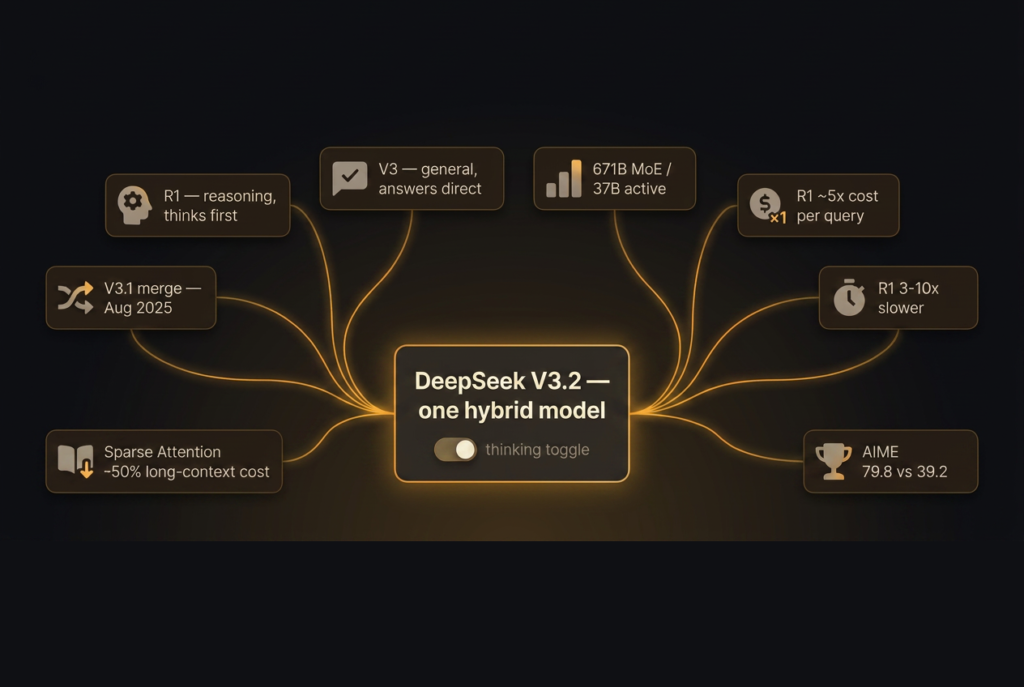
Here is the trap most “DeepSeek R1 vs V3” comparisons fall into: they treat the two as a permanent fork in the road. They aren’t. R1 is the reasoning model that thinks before it answers. V3 is the fast general model that answers directly. On AIME 2024, R1 scores 79.8% to V3’s 39.2% (DeepSeek R1 paper, 2025). That gap looks decisive until you see the bill: R1 costs several times more per answer and runs much slower. And by mid-2026, DeepSeek itself has been quietly folding the two into a single model. So the real question isn’t “R1 or V3.” It’s “when do I pay the reasoning tax, and on which model.”
Key Takeaways
- Same engine, different behavior: R1 and V3 share a 671B-parameter MoE backbone (37B active). R1 is V3 trained with reinforcement learning to emit a chain of thought before answering (DeepSeek R1 paper, 2025).
- R1 wins big on verifiable reasoning (AIME, competition math, hard logic) but costs roughly 5x more per query and runs 3-10x slower (TokenMix, 2026).
- Default to V3 for 80-90% of work. Reach for R1 only when the problem is genuinely multi-step and checkable.
- The fork is closing: V3.1 (August 2025) merged reasoning into one hybrid model with a thinking toggle, and V3.2 (December 2025) is now the general-purpose default (Sebastian Raschka, 2026).
What’s the actual difference between DeepSeek R1 and V3?
The difference is one behavior, not two architectures. R1 and V3 run the same 671B-parameter Mixture-of-Experts backbone with 37B parameters active per token and a 128K context window (BentoML, 2026). DeepSeek built R1 by taking V3 as the base and training it with reinforcement learning so it writes out a long chain of thought before giving you an answer. V3 skips that and replies directly.
You can see this in the API names. V3 is deepseek-chat. R1 is deepseek-reasoner. Same family, same weights underneath, one extra habit. When I send R1 a tricky prompt, it can spend several minutes “thinking” out loud before the real answer appears (DataCamp, 2025). V3 just answers. That single difference drives everything else: the accuracy gains, the latency, and the cost.
According to DeepSeek’s R1 paper, R1 was built from V3 using Reinforcement Learning with Verifiable Rewards, the GRPO method, which rewards the model for answers that can be checked symbolically or programmatically, like math and code (DeepSeek R1 paper, 2025). That training target is why the gap between the two is widest exactly where answers are verifiable, and nearly flat where they aren’t.
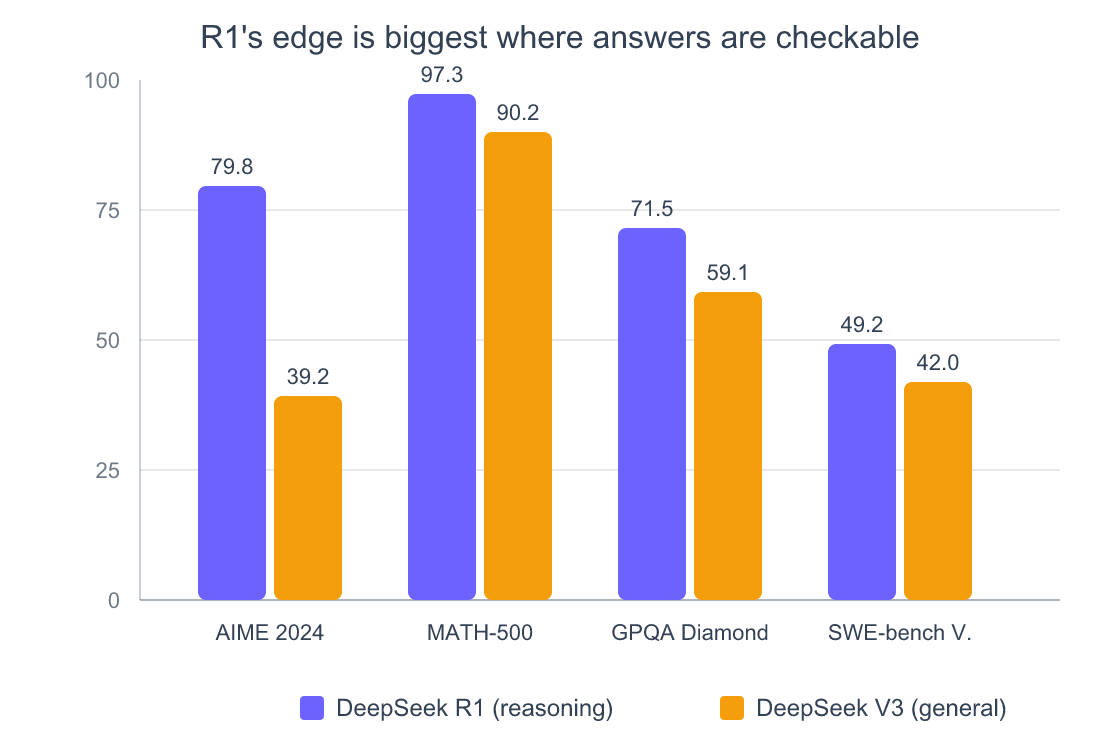
Source: DeepSeek-R1 technical report, 2025.
For the deeper story on how DeepSeek’s lineup prices against Claude, GPT-5 and Gemini for day-to-day building, see my companion article on coding with DeepSeek, Cursor and Cline setup, and real per-feature costs.
How much smarter is R1, and what does the reasoning cost you?
R1’s reasoning is real but narrow, and it isn’t free. On AIME 2024 it scores 40.6 points higher than V3. On general knowledge (MMLU) the gap shrinks to 2.3 points (DeepSeek R1 paper, 2025). That shape matters more than any single number. R1 doesn’t make the model broadly smarter. It buys you accuracy on a specific class of problem: multi-step, logical, and checkable.
The cost side is where teams get surprised. Independent 2026 comparisons put R1 at roughly 5x the cost per query and 3-10x the latency of V3 (TokenMix, 2026). The reason is mechanical, not pricing trickery. R1 generates a long hidden chain of thought, and you pay for every one of those tokens even though you never read them. Tokens spent thinking are still tokens.
Here is the part the benchmark tables hide. The reasoning premium only converts to value when the task has a verifiable answer. Run R1 on a Codeforces-style problem and the chain of thought genuinely helps. Run it on “rewrite this marketing email,” and you’ve paid 5x to watch a model deliberate over something with no right answer. R1’s advantage and R1’s waste come from the same feature.
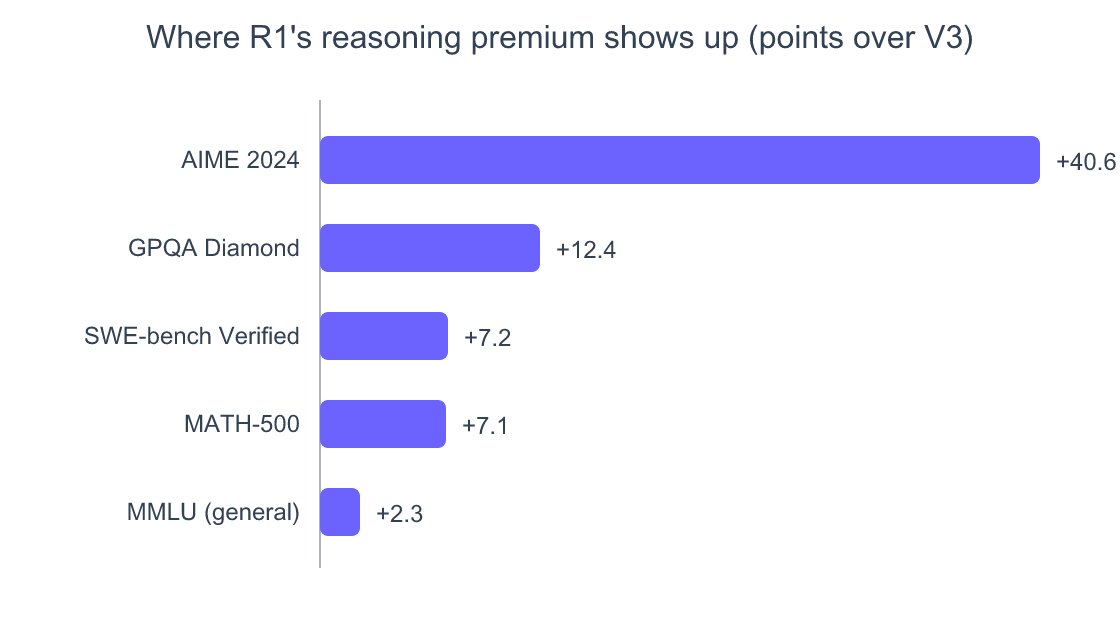
Source: DeepSeek-R1 technical report, 2025. Point gap = R1 score minus V3 score.
On the headline reasoning benchmarks, R1 reaches 97.3% on MATH-500 and a 2,029 Codeforces rating, putting it in the same tier as the strongest proprietary reasoning models at its release (DeepSeek R1 paper, 2025). For a young open-weight model, that was the headline. For your budget, the takeaway is narrower: pay for it only when the problem rewards it.
When should you use V3 instead of R1?
V3 is the right default for most work, and it isn’t close. The standard guidance across 2026 comparisons is to route 80-90% of tasks to V3 and switch to R1 only when the problem actually needs deeper reasoning (emergent.sh, 2026). V3 is faster, cheaper, and on everyday tasks the quality difference is small enough that the reasoning tax rarely pays off.
Use V3 for general chat, drafting, summarization, classification, data extraction, and the bulk of coding. It answers in one pass, so it feels responsive in interactive tools and stays cheap at scale. The current V3.2 generation prices around $0.28 per million input tokens and $0.42 per million output, with cached input dropping below 3 cents per million (VentureBeat, 2025). At those rates, V3 is one of the cheapest capable models you can call.
In my own testing, the pattern that holds up is boring but reliable: if I can’t state the “right answer” a verifier would check, V3 is the pick. Code generation, refactors, content, ordinary Q&A all land on V3. If you’re specifically weighing models for day-to-day engineering, I rank the full field in my ranked coding models by use case and budget, where V3 takes the value slot.
When does R1 (reasoning mode) actually earn its keep?
R1 earns its cost on problems with a checkable answer and real multi-step structure. That means competition math, algorithmic and leetcode-style logic, query optimization, parsing gnarly formats, formal proofs, and the kind of “trace through the cases” problem where one wrong step ruins the result. On those, R1’s 40-point AIME edge over V3 is the difference between a correct answer and a confident wrong one (DeepSeek R1 paper, 2025).
R1 also helps when you want the reasoning itself, not just the answer. Debugging a subtle logic error, auditing a calculation, or working through a decision with explicit tradeoffs all benefit from seeing the chain of thought. The rule I use: if a human expert would need scratch paper, R1 is worth it. If they’d answer off the top of their head, you’re overpaying.
What R1 is not is a general upgrade button. Reach for it on the 10-20% of tasks that are genuinely hard and verifiable, and leave the rest on V3. That single routing habit is most of what separates a sane DeepSeek bill from a wasteful one.
Why “R1 vs V3” is becoming the wrong question in 2026
This is the part most comparisons miss: DeepSeek has spent a year erasing the choice. The two-model split was a January 2025 reality. By 2026, it’s mostly history, because DeepSeek merged reasoning and direct answering into one hybrid model you toggle with a setting (Sebastian Raschka, 2026).
The timeline tells the story. V3 shipped in December 2024 as the fast general model. R1 followed in January 2025 as the separate reasoning model, peer-reviewed in Nature that September. Then V3.1, in August 2025, stopped maintaining two models and merged reasoning and instruction into one system you switch with a chat template, the same move Qwen made with its thinking tags. V3.2, on 1 December 2025, kept the hybrid design and added DeepSeek Sparse Attention, which drops long-context compute from quadratic to near-linear (Sebastian Raschka, 2026). The “reasoning model” became a mode, not a model.
So if you’re starting fresh in 2026, you don’t really pick “R1 or V3.” You pick the current general model (V3.2) and decide, per request, whether to turn thinking on. The R1-vs-V3 mental model still matters because it explains the tradeoff you’re toggling. But the artifact, two separate endpoints, is fading. Running any of these yourself is its own decision, which I cover in the pillar page on running local models with Ollama, LM Studio, llama.cpp and vLLM.
DeepSeek vs o1, Qwen, Grok, GPT-5 and Gemini: how does it stack up?
DeepSeek’s whole reputation rests on matching far pricier models for a fraction of the cost. At R1’s launch, it traded blows with OpenAI’s o1, the model it was explicitly chasing: 79.8% vs 79.2% on AIME 2024, 97.3% vs 96.4% on MATH-500, and a 2,029 vs 2,061 Codeforces rating (DeepSeek R1 paper, 2025). For an open-weight model you could download, landing within a point or two of the leading closed reasoning model was the story of early 2025.
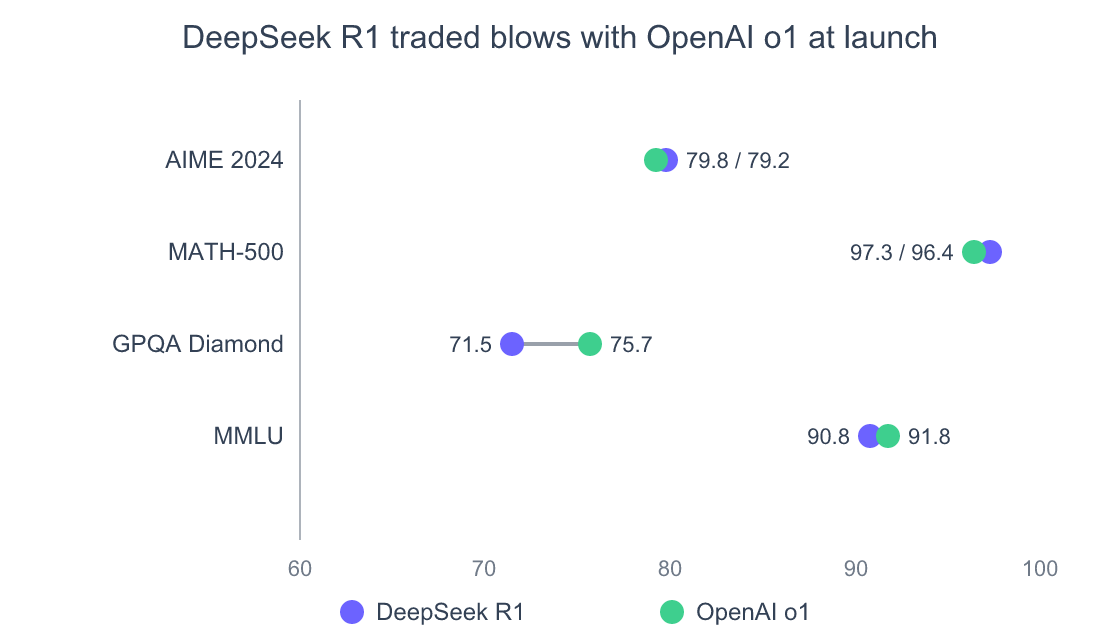
Source: DeepSeek-R1 technical report, 2025.
Against the open-weight field, the deepseek vs qwen matchup is the real fight. Qwen pioneered the same hybrid thinking-toggle design DeepSeek later adopted, and the two now trade the open-weight reasoning lead back and forth release to release. I treat them as siblings: both open-weight, both strong on reasoning, with Qwen often edging ahead on coding-specific tasks and DeepSeek holding the cost advantage on long context after its sparse-attention update.
Against the frontier, the framing is value, not crown. DeepSeek’s V3.2 delivers GPT-5-class coding performance while its API runs roughly 4x cheaper on input and more than 20x cheaper on output ($0.28 vs $1.25 per million input, $0.42 vs $10 output) (Introl, 2026). It won’t top GPT-5.2, Gemini 3.1 Pro, or Grok 4 on the hardest frontier reasoning benchmarks. But “90% of the capability at a tenth of the price” is exactly the trade that makes deepseek vs chatgpt and deepseek vs gemini worth running for cost-sensitive teams.
What Reddit gets right (and wrong) about DeepSeek
If you search deepseek vs chatgpt reddit or deepseek vs gemini reddit, the recurring verdict is consistent: people love DeepSeek’s price and open weights, and they’re wary of the hosted API’s data policy. Both reactions are fair. The cost story is real, as the benchmarks above show. The privacy caveat is also real, because the official API runs on DeepSeek’s servers. The fix the threads usually land on is the right one: if data residency matters, run an open-weight DeepSeek model yourself instead of calling the hosted endpoint.
Can you run DeepSeek R1 or V3 on your own machine?
Mostly no for the full models, and that surprises people. The full R1 and V3 weights are 671B-parameter models, far beyond a single consumer GPU even though only 37B parameters are active per token (BentoML, 2026). The active-parameter count helps inference speed, not the memory you need to load the whole thing.
What you can run locally are the distilled versions. DeepSeek released R1 distills into smaller Qwen and Llama models (1.5B, 7B, 8B, 14B, 32B and 70B), which keep much of the reasoning behavior at sizes that fit real hardware. A 32B distill runs on a single high-memory GPU or a well-specced Mac. For the full picture on which runtime and how much VRAM you actually need, the pillar page on local runtimes and hardware requirements walks through it.
Frequently asked questions
What is the difference between DeepSeek R1 and V3?
R1 and V3 share the same 671B-parameter MoE base, but R1 is trained to write a chain of thought before answering, while V3 answers directly. R1 wins on verifiable reasoning like math and logic; V3 is faster and cheaper for general tasks (DeepSeek R1 paper, 2025).
Is R1 better than V3?
Only on reasoning-heavy, checkable problems. R1 scores 79.8% on AIME 2024 to V3’s 39.2%, but costs roughly 5x more per query and runs several times slower (TokenMix, 2026). For everyday work, V3 is the better and cheaper default.
Is DeepSeek R1 better than OpenAI o1?
At launch they were neck and neck: R1 hit 79.8% on AIME 2024 to o1’s 79.2%, and 97.3% vs 96.4% on MATH-500 (DeepSeek R1 paper, 2025). R1’s edge was price and open weights, not a clear capability lead.
Should I still pick R1 in 2026?
The R1-vs-V3 split is fading. DeepSeek merged reasoning into a hybrid model with V3.1 (August 2025), so on current versions you toggle thinking mode rather than choosing a separate reasoning model (Sebastian Raschka, 2026). The tradeoff is the same; the two endpoints are not.
DeepSeek vs Qwen, which is better?
They’re close siblings. Both are open-weight with hybrid reasoning, and they trade the open-weight reasoning lead back and forth from release to release. Qwen often edges coding tasks; DeepSeek holds a long-context cost advantage after its sparse-attention update.
The verdict
Treat R1 and V3 as one model with a switch, not two products. V3 is your default for nearly everything: fast, cheap, and good enough that the reasoning premium rarely pays for itself. Turn on R1-style reasoning only when the problem is multi-step and has an answer a verifier could check, which is the 10-20% of work where the 40-point AIME gap actually shows up.
And read the version number before you read the comparison. The clean R1-vs-V3 fork was a 2025 artifact. On V3.1 and V3.2, the choice is a thinking toggle on a single hybrid model, priced low enough that DeepSeek’s real pitch in 2026 is unchanged: frontier-adjacent reasoning at open-weight cost. If you’re deciding what to actually build with, start from V3, reach for reasoning deliberately, and check whether you should be running a distill yourself before you ever send your data to the hosted API.