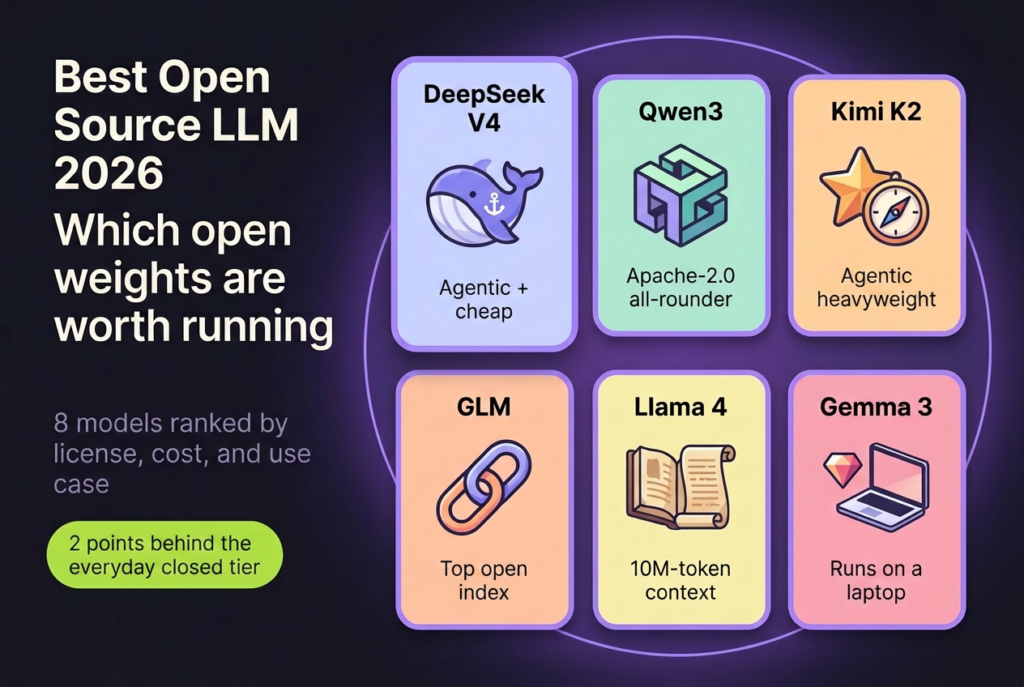
The best open-source model now trades blows with the everyday closed flagships. On the Artificial Analysis Intelligence Index, GLM-5.2 leads open weights at 51, two points behind Claude Sonnet 5 at 53, even as the frontier tier (Claude Fable 5, at 60) pulled further ahead (Artificial Analysis, 2026). So why do open weights still run only about 13% of production AI workloads? Because “best” stopped being a leaderboard answer. It is a license, cost, and hardware answer now. This guide ranks the open models that matter and tells you which one fits your actual job.
Key Takeaways
- There is no single best open-source LLM. The benchmark leaders (GLM, DeepSeek, Kimi) and the download leader (Qwen) are different models for different jobs.
- GLM-5.2 leads open weights at 51 on the Artificial Analysis Intelligence Index, within 2 points of Claude Sonnet 5, though the frontier flagship (Claude Fable 5, at 60) is further out (Artificial Analysis, 2026).
- “Open” mostly means open-weight, not OSI open-source. The license is the part that decides whether you can ship.
- Pick by license and use case: Apache-2.0 Qwen or Mistral for clean commercial use, MIT DeepSeek for reasoning on a budget, Gemma or Phi for a laptop.
What counts as an open-source LLM in 2026 (and why ChatGPT isn’t one)?
Most models people call open source are open-weight, not open-source by the strict definition. Open-weight means you get the trained weights to download and run. Fully open source, by the Open Source Initiative test, also means the training data and pipeline are public. Almost none of the popular releases clear that bar (Hugging Face, 2026).
That distinction matters more than the benchmark you read. Llama, Qwen, DeepSeek, Kimi, GLM, and Gemma are all open-weight. You can run them offline, fine-tune them, and keep your data on your own hardware. You usually cannot see exactly what they were trained on. For most builders that is fine. For a regulated audit trail, it is not.
The part nobody ranks: the license decides whether a model is usable, and the licenses are not equal. Qwen and Mistral ship under Apache 2.0 with no user cap. DeepSeek and Phi use MIT. Llama 4 uses Meta’s Community License, which adds an extra-terms clause for products above 700 million monthly users. Same “open” label, very different rights.
And ChatGPT? It is a large language model, but it is not open in any sense. The GPT-5 weights behind it are closed, as are Claude and Gemini. If a list tells you ChatGPT is the best open-source LLM, close the tab. The open field is Llama, Qwen, DeepSeek, Mistral, Gemma, and the newer Chinese labs, not the hosted closed assistants.
For the underlying runtimes, licenses, and hardware to actually run these, see our complete pillar guide to running LLMs locally with Ollama, LM Studio, llama.cpp and vLLM.
How close are open models to GPT-5 and Claude now?
Two points from the everyday tier, about nine from the absolute frontier. GLM-5.2, the current open leader, scores 51 on the Artificial Analysis Intelligence Index versus 53 for Claude Sonnet 5, while the frontier flagship, Claude Fable 5, sits at 60 (Artificial Analysis, 2026). LMArena’s human-preference rankings tell a similar story: the strongest open models sit close behind the leaders.
The index (v4.1) blends nine evaluations spanning agentic work, coding, and scientific reasoning, so a score near the top means broad competence, not one cherry-picked test. The open field behind GLM-5.2 steps down quickly: DeepSeek V4 Pro and MiniMax-M3 at 44, Kimi K2.6 at 43.
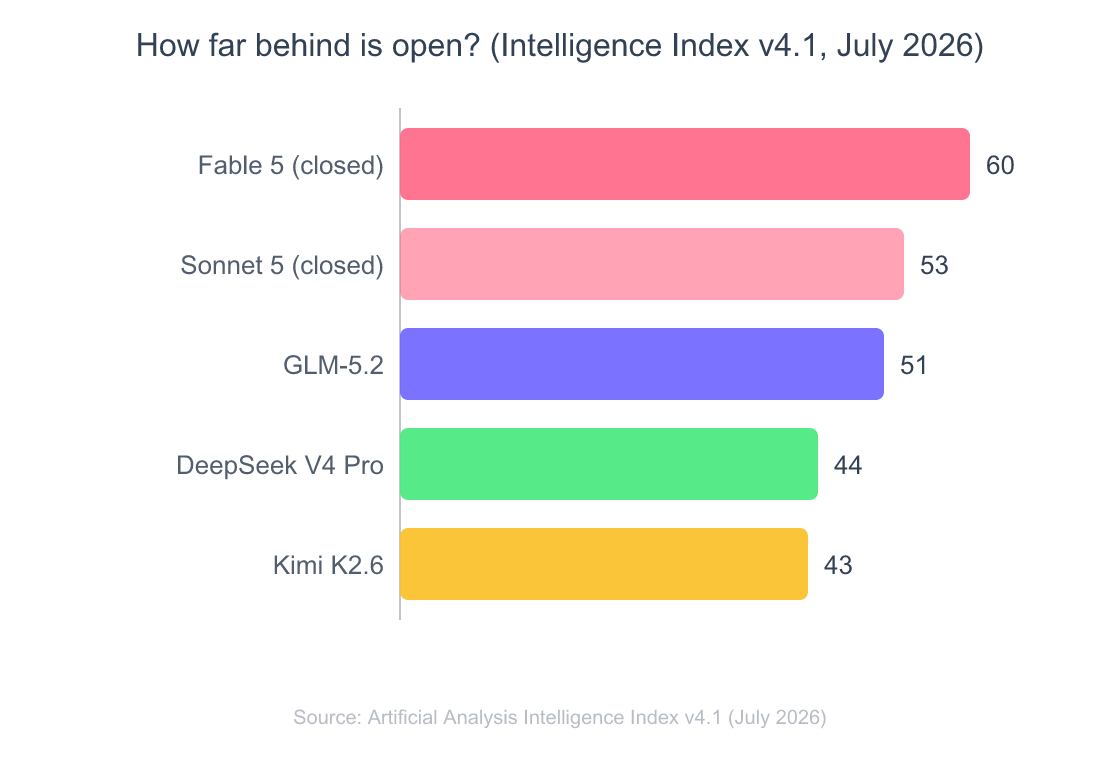
Source: Artificial Analysis, July 2026.
That chart is the whole dynamic in one image: open weights caught the everyday closed tier, and then a new frontier release stretched the lead again. Open releases still lag the proprietary frontier by six to eighteen months, and every Chinese-lab launch closes part of that window before the next flagship resets it.
The headline you should take from this: capability is no longer the reason to avoid open weights. For the closed side of that comparison, our detailed Claude Opus versus GPT-5 breakdown goes deeper on the frontier itself.
The best open-source LLMs in 2026, ranked
The benchmark leaders and the popularity leaders are not the same models, and that tension is the whole story. DeepSeek, Kimi, and GLM top the neutral index. Qwen owns the download charts: it holds eleven of the twenty most-downloaded text models on Hugging Face, around 100 million downloads, with Llama a distant second (Presenc AI, 2026).
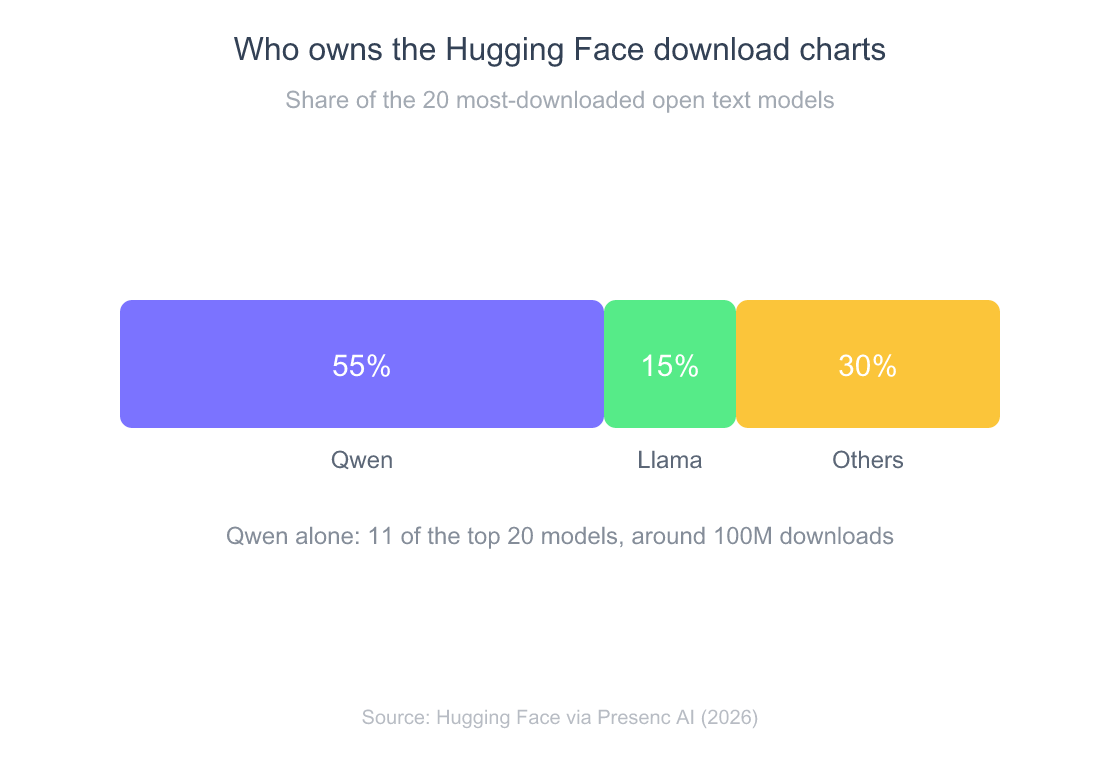
Source: Hugging Face via Presenc AI, 2026.
Here is what I keep coming back to after running most of these locally. The “best” model on a chart is rarely the one I actually leave installed. The one I keep is the one that fits my GPU, ships under a license I can use, and answers fast enough to stay in flow. With that lens, here is the field.
DeepSeek (V4 / R1)
The reasoning-per-dollar champion. DeepSeek V4 Pro sits within a few benchmark points of the closed flagships on coding while costing a fraction per token, and the MIT license means no commercial strings. R1 remains the go-to for transparent step-by-step reasoning on math and debugging. If you want frontier-class output on a budget, start here. Our DeepSeek R1 versus V3 comparison covers which variant to run.
Qwen3
The safe default. Qwen3 235B (a 235B mixture-of-experts with 22B active) ships under Apache 2.0, leads the Hugging Face download charts, and is genuinely strong across reasoning, coding, and multilingual work (Hugging Face, 2026). If you need one open model to standardize on for a commercial product, Qwen is the lowest-regret pick.
Kimi K2
The agentic heavyweight. Moonshot’s Kimi K2 line (K2.6 on the current index, at 43) has slipped behind GLM and DeepSeek on the neutral leaderboard, but its agentic, tool-use, and coding behavior remains among the strongest in the open field. It is large, so it is more of a served-model choice than a laptop one.
GLM (5.x)
The new open leader. Zhipu’s GLM-5.2 tops open weights on the Artificial Analysis Intelligence Index at 51 (Artificial Analysis, 2026), and the line is built for long-horizon execution, function calling, and MCP-style tool use, which makes it a strong backbone for autonomous coding agents. It undercuts closed models on price by a wide margin.
Llama 4
The context king. Meta’s Llama 4 Scout (109B total, 17B active) carries a 10-million-token context window, which no closed model matches, and it is multimodal. It has slipped behind the leading Chinese labs on pure benchmarks, but for whole-codebase review or very long documents it is still the obvious tool. Watch the Community License if you operate at large scale.
Mistral
The European option. Mistral’s Apache-2.0 models trail the very top tier on the neutral index, but they are clean to license, efficient to serve, and a common choice for teams that want EU-based options and predictable deployment over leaderboard position.
Gemma 3
The laptop pick. Google’s Gemma 3 offers one of the best capability-to-hardware ratios going, with a 128K context (Google, 2025) and a small active footprint that runs comfortably on a single consumer GPU or a recent Mac. For local-first privacy work, it punches well above its size.
Phi-4
The tiny reasoner. Microsoft’s Phi-4 is a 14B MIT-licensed model with reasoning quality that embarrasses its parameter count. It will not win general benchmarks, but as a small local assistant or an edge reasoner it is hard to beat on efficiency.
Which open-source LLM is best for your use case?
The honest answer is to match the model to the workload, not the leaderboard. A 235B all-rounder is overkill for autocomplete, and a 14B reasoner will not carry a 40-file refactor. Here is how I route the common jobs.
- Coding: DeepSeek V4 for value, Qwen3-Coder for local work, Kimi K2 for agentic multi-step tasks. The full breakdown lives in our ranked coding-model comparison by use case and budget, with a hard line between models and the agents that wrap them.
- Writing and long-form: Qwen3 and Llama 4 handle tone and length well; Llama’s huge context helps when you feed it a whole brief or manuscript.
- Research and translation: Qwen3 is the multilingual leader of the open field, which makes it the default for translation and cross-language research.
- Data analysis and math: DeepSeek R1’s visible reasoning makes its work auditable, which matters when a wrong number is expensive.
- Agentic / tool use: GLM and Kimi K2 are built for function calling and long-horizon execution.
- Laptop and privacy-first: Gemma 3 or Phi-4, which run offline on modest hardware.
What I tell people: pick two, not one. Run a small local model (Gemma or Phi) for the private, fast, offline work, and keep one bigger served model (DeepSeek or Qwen) for the hard jobs. That split beats hunting for a single model that does everything, because no open model does.
For the leaderboards behind these picks: treat the Artificial Analysis Intelligence Index and LMArena ELO as the credible neutral sources, and treat single-benchmark “beats GPT-5” headlines with suspicion. Benchmarks leak into training data, which inflates scores until a contamination-resistant test resets them. The download charts (Hugging Face) tell you what people actually keep, which is a different and useful signal.
Should you run an open model or just pay for a closed one?
For most production traffic, closed still wins on operations, not capability. Open-weight models account for only about 13% of deployed AI workloads, down from 19% six months earlier, while closed providers hold roughly 87% (Menlo Ventures, 2025). Capability caught up; support, compliance, and reliability did not, and that is what production teams buy.
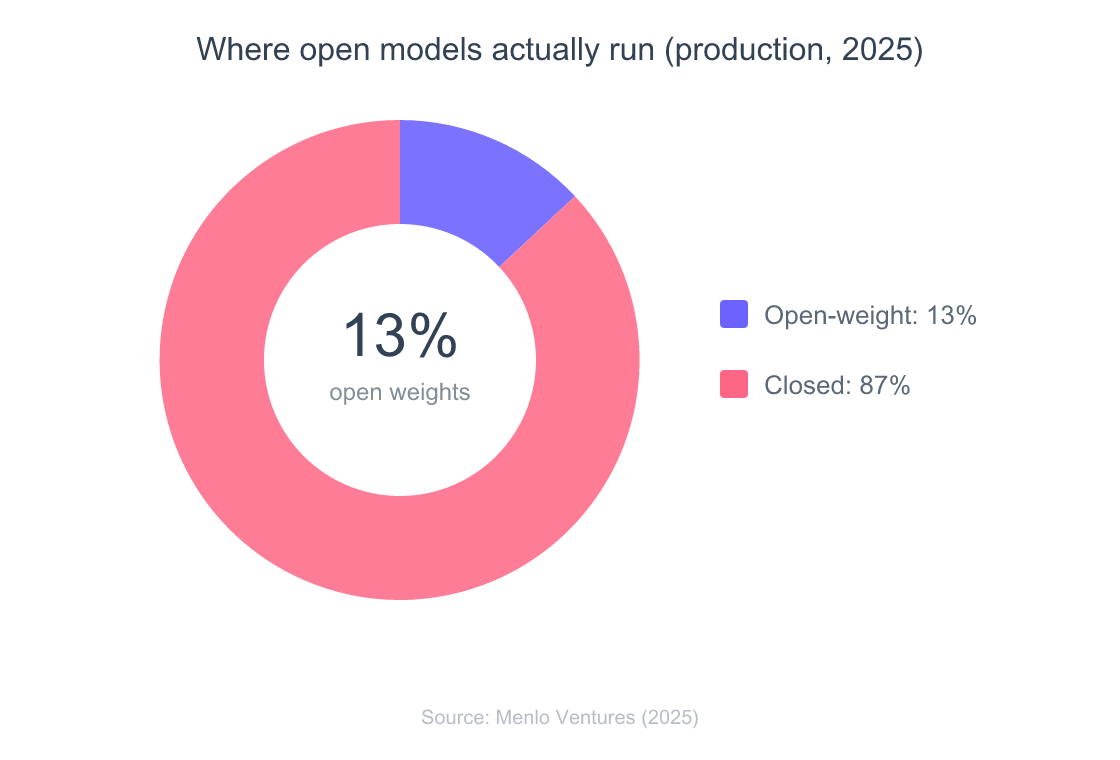
Source: Menlo Ventures, 2025.
So when does open win? Three cases. When data cannot leave your network, an open model on your own hardware is the only real option. When token cost dominates, a model like DeepSeek can cut your bill by an order of magnitude. And when you need to fine-tune or fully control behavior, weights you own beat an API you rent. Everywhere else, the reliability and support of a closed API is worth paying for, and McKinsey’s 2025 research backs the hybrid reality: 88% of organizations use AI somewhere (McKinsey, 2025), and more than half already use open-source AI solutions in part of their stack (McKinsey, 2025).
The practical move is rarely all-or-nothing. Run open models locally for the private and cheap work, then route the hard or customer-facing calls to a closed API. When that routing gets complex, our guide to AI gateway architecture covers how to put a control layer in front of both.
Try this: download Gemma 3 or Qwen3 through Ollama or LM Studio this week, point your editor at it, and run a real task you would normally send to a paid API. You will learn more about whether open works for you in an hour than from any leaderboard.
Frequently Asked Questions
Is ChatGPT an open-source LLM?
No. ChatGPT is a large language model, but the GPT-5 weights behind it are closed, like Claude and Gemini. None of the major hosted assistants are open. The open field is Llama, Qwen, DeepSeek, Mistral, and Gemma, which you can download and run yourself (Hugging Face, 2026).
What is the best open-source LLM right now?
There is no single winner. On the neutral Artificial Analysis index, GLM-5.2 leads open weights at 51, with DeepSeek V4 Pro and Kimi K2.6 in the mid-40s (Artificial Analysis, 2026). For commercial use, Apache-2.0 Qwen3 is the lowest-regret default. For value, MIT-licensed DeepSeek wins.
Which open-source LLM should I start with?
Qwen3 or Gemma 3. Qwen3 is the most downloaded open model on Hugging Face and ships under Apache 2.0, so it is both capable and safe to use commercially (Presenc AI, 2026). Gemma 3 is smaller and runs on a laptop, which makes it the easiest first install.
Are open-source LLMs free?
The weights are free to download and run, but compute is not. You pay in GPU, electricity, or hosting instead of per-token API fees. That trade favors open models at high volume and favors closed APIs at low volume, where you avoid fixed infrastructure cost entirely.
Can open-source LLMs beat GPT-5 and Claude?
On specific benchmarks, sometimes. On the broad neutral index, the best open model sits 2 points behind Claude Sonnet 5 but about 9 behind the frontier flagship, Claude Fable 5 (Artificial Analysis, 2026). They match or beat closed models on individual coding and reasoning tests, but the closed flagships still lead on overall capability.
The bottom line
Open weights are no longer the compromise pick. The capability gap to GPT-5 and Claude is down to a few points, and for coding, reasoning, and privacy-first work the open field is genuinely competitive. The decision now turns on three things, not benchmark bragging rights:
- License: Apache-2.0 (Qwen, Mistral) and MIT (DeepSeek, Phi) are the cleanest to ship; check Llama’s user-cap clause at scale.
- Use case: DeepSeek for value, Qwen for a commercial default, Gemma or Phi for a laptop, Kimi or GLM for agents.
- Where it runs: open wins on privacy, cost at volume, and control; closed still wins on support and reliability for customer-facing traffic.
Pick the smallest model that does your job, run it locally first, and only reach for a closed API when the work demands it. Next, see exactly how to host these with our complete guide to running LLMs locally.