The GST question every Indian SaaS founder hits
A 2022 Chiratae-Zinnov study projected Indian SaaS revenue would pass $100 billion by 2026 (IBEF, April 2022), and a growing slice of that comes from one-person companies billing global B2B customers in USD. Most of those founders are engineers, not GST experts, with one question their CA can’t answer in a WhatsApp reply: what does the Indian tax system actually want from me?
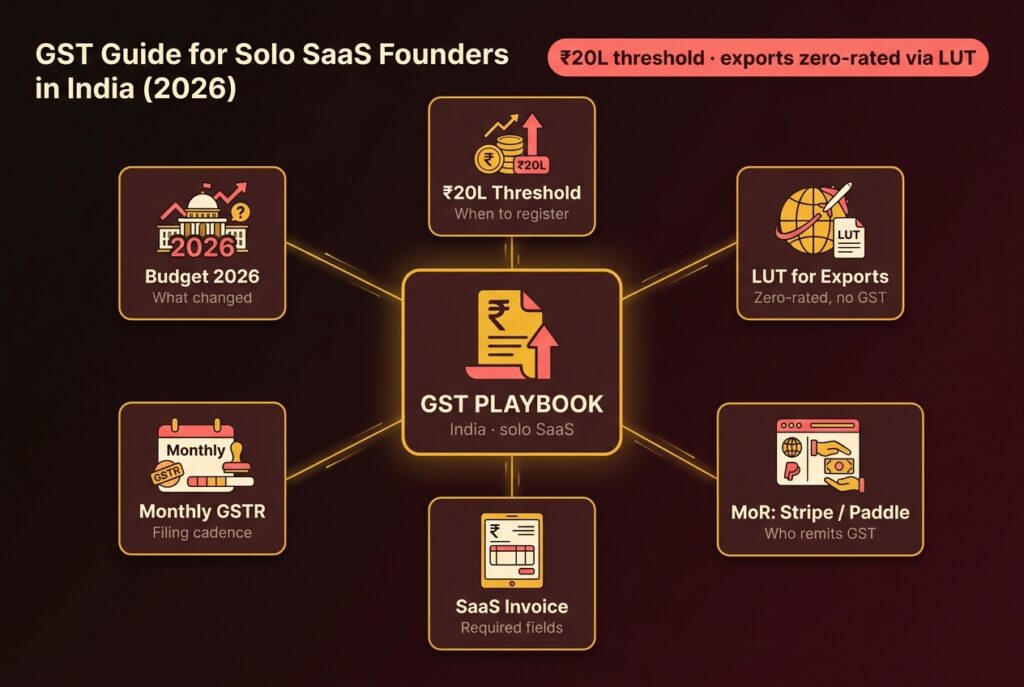
This guide is the answer I wish someone had handed me when I registered for GSTIN: a founder-first walkthrough of what actually matters when you run a global SaaS from a flat in Pune, Bengaluru, or Bhopal.
Disclaimer: This is not legal or tax advice. Rules change, edge cases exist, and your situation may differ. Consult a qualified Chartered Accountant before filing anything with the GST portal or making structural decisions about how you bill customers.
Key Takeaways
- GST registration becomes mandatory once your aggregate turnover crosses ₹20 lakh in services (₹10 lakh in special-category states), per Section 22 of the CGST Act (CBIC, 2017, in force 2026).
- Software exports qualify as zero-rated supplies under Section 16 of the IGST Act if you file an LUT (Form RFD-11); that single form removes 18% IGST from your global invoices.
- SaaS stays at 18% GST after the September 2025 rate rationalisation, which moved India to two main slabs: a 5% merit rate and an 18% standard rate (PIB, September 2025).
- Stripe leaves you as the seller of record (you file GST). Paddle and LemonSqueezy operate as Merchant of Record; Paddle’s 5% + 50¢ covers tax compliance across 240+ countries and regions (Paddle pricing, 2026).
- The Finance Act 2026 omitted Section 13(8)(b) of the IGST Act, removing a place-of-supply rule that denied export status to Indian intermediary services (TaxGuru, 2026).
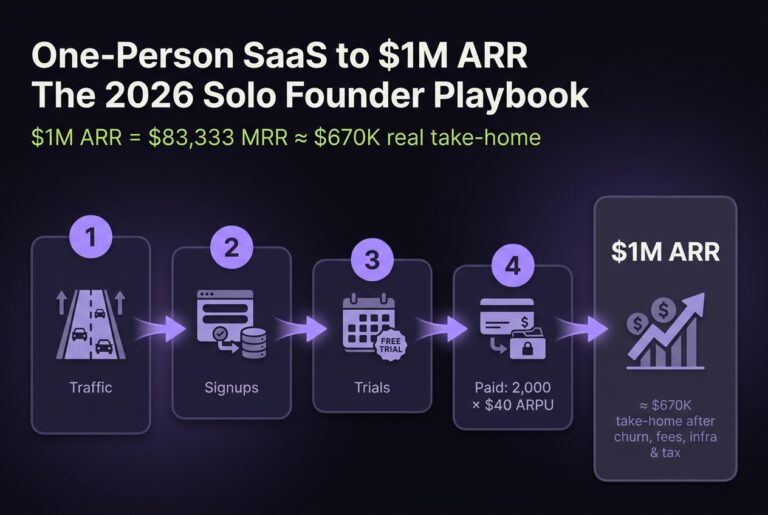
revenue ramp playbook for Indian solo founders
Do You Even Need to Register for GST?
If your aggregate turnover for services stays under ₹20 lakh in a financial year (₹10 lakh in special-category states like Manipur, Mizoram, Nagaland, and Tripura), you are not legally required to register for GST under Section 22 of the CGST Act (CBIC, 2017). At roughly ₹95 to the dollar (the mid-2026 rate), that’s about $1,750 MRR, so below that you can run lean without a GSTIN. But the moment you cross that line, registration is mandatory within 30 days.
What Counts Toward the ₹20 Lakh Threshold
Aggregate turnover is not just your SaaS revenue. It includes:
- All taxable supplies (your subscriptions, one-time fees).
- Exempt supplies (rare for SaaS, but possible for educational tools).
- Exports of services (zero-rated, but they still count toward turnover).
- Inter-state supplies.
So if you bill $1,500 MRR globally, that is roughly ₹17.1 lakh a year at ~₹95 to the dollar. You are still under the threshold. At $2,000 MRR (about ₹22.8 lakh a year), you cross it in roughly ten and a half months. Plan ahead.
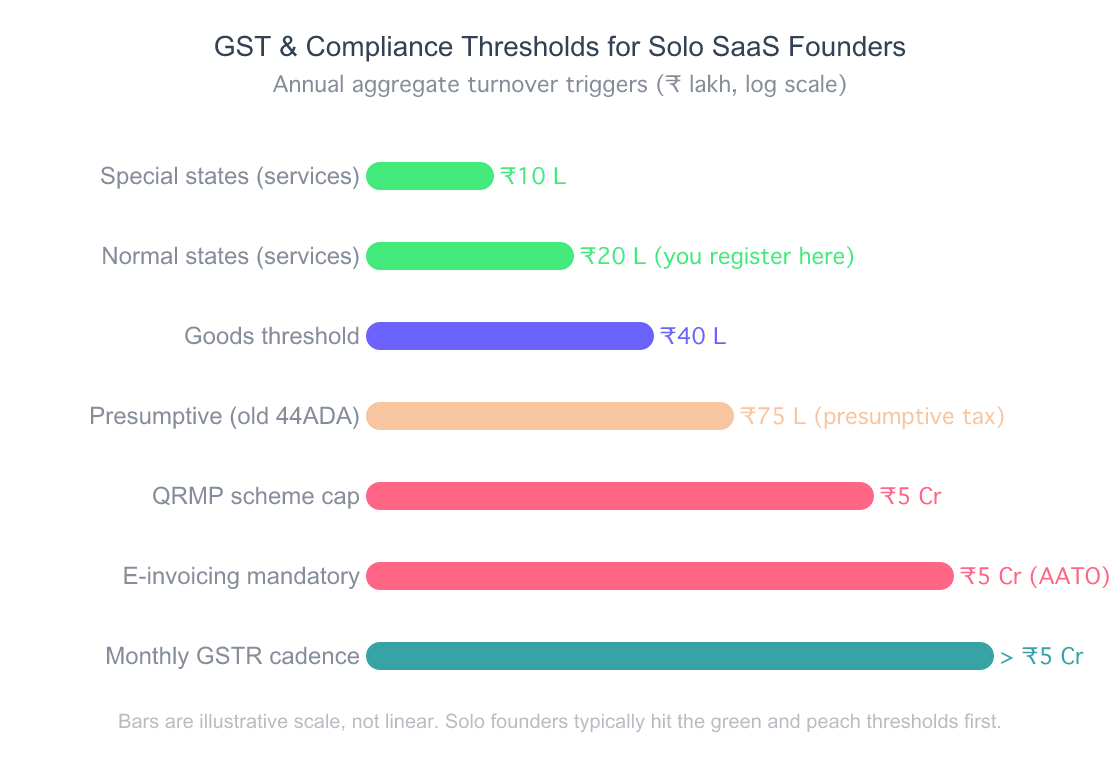
Source: CGST Act Section 22; CBIC Notification 10/2023-CT (e-invoicing); presumptive limit from the old Section 44ADA, carried into Section 58 of the Income-tax Act, 2025. Compiled October 2026.
The “But I Sell to Foreigners” Trap
Here is the part that surprises founders. Even if every customer you have lives in California or Berlin, exports of services count as zero-rated supplies, not exempt ones. They count toward your aggregate turnover. So you can absolutely cross ₹20 lakh selling only to non-Indian customers, and you still need a GSTIN.
There is also a school of thought that says register voluntarily from day one if you are exporting. The reasoning: claiming input tax credit on your business spend (laptop, AWS bills, Notion subscription, Stripe fees with GST loaded) is only possible with a GSTIN. In my view, for most solo founders past ~$300 MRR, voluntary registration is worth the compliance cost.
From experience: I sat on the registration question for almost four months because the GST portal looked terrifying. The actual application took ninety minutes once I had my PAN, Aadhaar, electricity bill, and rental agreement scanned. The harder part was deciding which SAC code to use, and we will get to that. Don’t do what I did. If you are above ₹15 lakh annualised and growing, just register.
why SaaS beats freelancing for Indian devs
Citation Capsule: Section 22 of the CGST Act sets the GST registration threshold for service providers at ₹20 lakh aggregate turnover (₹10 lakh for special-category states like Manipur, Mizoram, Nagaland, and Tripura) (CBIC, 2017, in force 2026). Export turnover counts toward it, since exports are zero-rated, not exempt.
How Does GST Treat Software Exports?
Indian SaaS sold to a customer outside India is an “export of services” under Section 2(6) of the IGST Act, and it qualifies as a zero-rated supply under Section 16. Translation: you charge zero GST on those invoices. You do not pocket the 18%. You do not pay it to the government. The transaction is taxed at 0%, but it remains a taxable supply, which is what makes input tax credit recoverable (CBIC, 2017).
The Five Conditions of Export of Services
Section 2(6) lists five conditions, and you need all five to qualify as an exporter:
- The supplier of service (you) is in India.
- The recipient of service is located outside India.
- The place of supply is outside India.
- Payment is received in convertible foreign exchange (or in INR where permitted by the RBI).
- The supplier and recipient are not merely establishments of a single person.
Most solo SaaS founders comfortably satisfy all five. The one that trips people up is #4, and we will untangle the FIRC question shortly.
LUT: The 15-Minute Form That Saves You 18%
The Letter of Undertaking, filed online via gst.gov.in as Form GST RFD-11, lets you export services without paying IGST upfront. Without an LUT, the default rule is that you pay 18% IGST on every export and then claim it back as a refund, months of paperwork for money that is yours. With an LUT in place, you simply do not charge or pay IGST on export invoices. It is the single highest-leverage compliance action for any Indian SaaS exporter (GSTN tutorial, 2026).
LUT validity is one financial year; the portal marks it expired at year-end. Re-file before the new FY begins on 1 April and set a calendar reminder, because the rule is that the LUT must be in place before you make the zero-rated supply.
Receiving in INR via Stripe: Does It Still Count?
Here is the question every founder asks. When Stripe accepts $99 from a US customer, converts it, and deposits rupees in your ICICI account, does that count as “convertible foreign exchange”?
In practice, yes. Stripe’s partner bank, Standard Chartered, sends Indian users a payment advice that serves as evidence the payment originated outside India, and your own authorised bank issues the FIRC (Foreign Inward Remittance Certificate) (Stripe Support, 2026). The money lands in INR, but the paper trail shows the foreign-currency inflow that Section 2(6)(iv) cares about. One caveat: Stripe went invite-only for new Indian businesses in 2024 (Inc42), and its India pricing page still asks you to request an invite.
Hoard those payment advice emails. You will need them at filing time.
Citation Capsule: Filing Form GST RFD-11 (LUT) under Rule 96A allows Indian SaaS exporters to invoice global customers at zero IGST instead of paying 18% upfront and claiming a refund later (GSTN tutorial, 2026). The LUT is valid for one financial year, so re-file it before each 1 April.
Stripe vs Paddle vs LemonSqueezy: Which Is the Right Choice for GST?
The most consequential GST decision a solo SaaS founder makes is in the billing stack, not on the GST portal. With Stripe you remain the seller of record and handle GST, FIRC, RCM, and global VAT yourself. Paddle and LemonSqueezy operate as Merchant of Record: they are the legal seller to your customer and handle VAT, GST and sales tax on your behalf (Paddle, 2026; Stripe, 2025).
Why MoR Status Matters for Indian Founders
If Paddle is your Merchant of Record, the legal supply chain looks like this:
- Paddle sells a subscription to a customer in Germany (Paddle handles EU VAT).
- Paddle, in turn, “buys” the underlying software service from you.
For GST purposes, you are no longer exporting to thousands of customers in fifty countries. You are exporting one stream of service to a Paddle entity outside India. One customer for invoicing purposes, no EU VAT registration, no US sales tax nexus tracking.
With Stripe, the picture is the inverse. You sit at the centre of every transaction. Sell to EU or UK consumers and their VAT rules apply to you; cross a US state’s economic-nexus threshold and sales tax does too. None of that is GST, but it is the compliance burden that comes with Stripe’s lower fees.
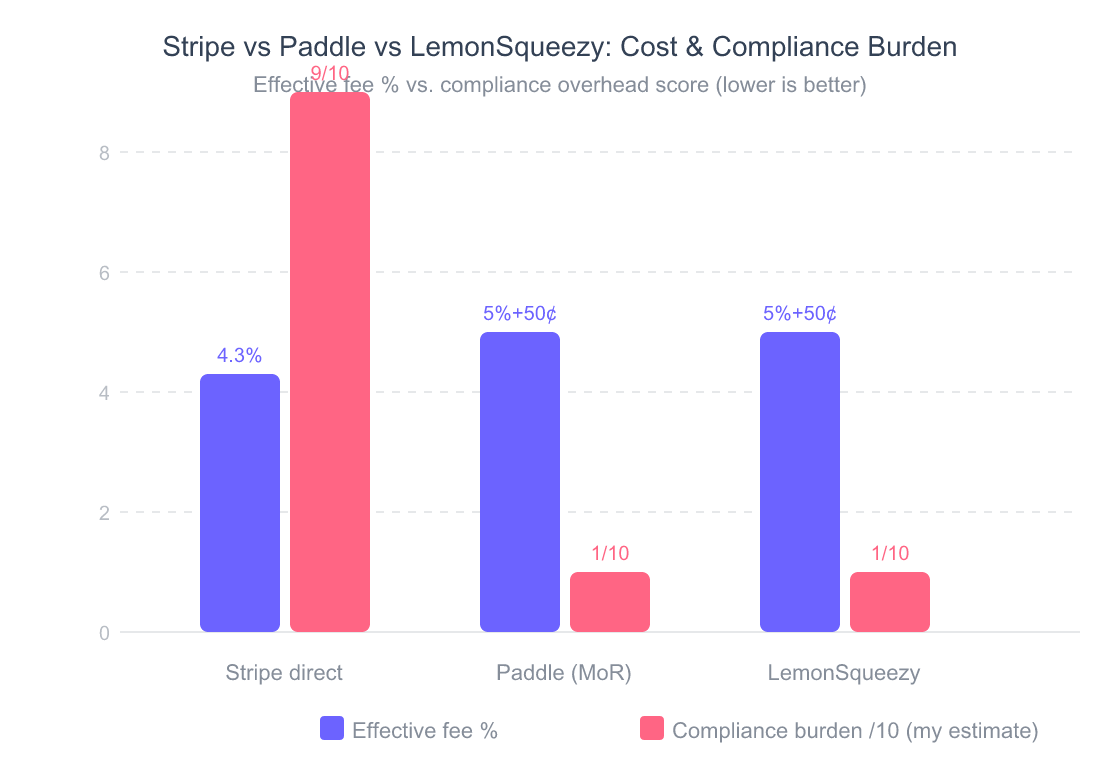
Source: Stripe India pricing (3% for international Visa/Mastercard, 4.3% with USD presentment, plus 2% if currency conversion applies), Paddle pricing and LemonSqueezy pricing, October 2026. The compliance burden score is my own estimate covering GST, FIRC, EU VAT, US sales tax and chargebacks. Lower is better.
When Each One Wins
There is no universal answer. The right choice depends on where you bill from and how complex your customer geography is.
- Stripe wins if you already have an Indian Stripe account (new ones are invite-only) and a CA who actively manages your global tax footprint. The fees are lower and the FIRC pathway is mature.
- Paddle wins if you are mostly global and do not want to think about EU VAT, US sales tax, or chargeback paperwork. You pay 5% + 50¢ and outsource the global tax problem.
- LemonSqueezy suits indie hackers in the validation phase, with the same 5% + 50¢ headline. Stripe bought it in 2024, and its successor product, Stripe Managed Payments, doesn’t list India as a supported business location as of October 2026 (Stripe docs), so check the migration path before you commit.
The arbitrage: Paddle’s 5% + 50¢ looks more expensive than Stripe’s 3-4.3% (plus conversion), but it includes EU VAT collection, US sales tax filing, chargeback management, and dunning. My rough estimate is that covering the same surface yourself on Stripe costs several hours and a few hundred dollars of tooling a month. For a one-person SaaS, that matters more than the headline percentage.
micro-SaaS stack guide with billing options
What Goes on an Indian SaaS Invoice in 2026?
Every invoice you raise from a registered GSTIN must contain specific fields prescribed by Rule 46 of the CGST Rules, and yes, this applies to your zero-rated export invoices too. The mandatory fields are: your name, address, and GSTIN; a unique sequential invoice number; the invoice date; the recipient’s name, address, and GSTIN (if registered); the recipient’s place of supply; the SAC code; the description of services; the value; the GST rate; and a line stating “supply meant for export under LUT, payment of integrated tax not required.”
Picking the Right SAC Code
For SaaS, the three commonly used SAC codes are:
- 998314: Information Technology design and development services. The most common code for SaaS where you have built and host your own product.
- 998313: Information Technology consulting and support services. Better fit for products that include heavy onboarding or implementation services.
- 997331: Licensing services for the right to use computer software. Used when the legal contract is structured as a software licence rather than a hosted service.
Most solo SaaS founders use 998314, and that is what your CA will likely default to. It carries 18% GST on domestic supply and 0% on exports under LUT (IndiaFilings, 2026). The September 2025 rate overhaul cut GST on gyms, salons and budget hotels, but IT services weren’t among the cuts, so 18% still applies.
The 30-Day Rule and E-Invoicing
If your aggregate turnover exceeds ₹5 crore in any financial year from 2017-18 onward, e-invoicing becomes mandatory for your B2B invoices (CBIC Notification 10/2023-CT, effective 1 August 2023, per ClearTax). You generate invoices through your accounting tool, the data goes to the IRP (Invoice Registration Portal), and an IRN (Invoice Reference Number) plus QR code comes back. Since 1 April 2025, businesses above ₹10 crore must report invoices to the IRP within 30 days of the invoice date.
For solo founders below ₹5 crore, e-invoicing is not mandatory as of October 2026. The threshold has dropped repeatedly since the system launched in 2020, though, so pick an invoicing tool that supports e-invoice generation now. Switching later is more painful than configuring it once.
B2B vs B2C: Two Different Invoice Behaviours
For exports under LUT, your invoice shows the value in foreign currency (e.g., USD 99) and an INR equivalent at the exchange rate on the invoice date (ask your CA which reference rate they use). GST line is 0%. For domestic B2B, you charge 18% IGST (inter-state) or 9% CGST + 9% SGST (intra-state). For low-value domestic B2C invoices, Rule 46 relaxes some recipient details; a GST-aware billing tool handles the cut-offs for you.
From experience: I once raised an export invoice in USD without the SAC code, the LUT reference, or the INR equivalent. My CA caught it three months later, and fixing the invoices and GSTR-1 records cost me a day. Use a billing tool that knows about Indian GST: Zoho Invoice, ClearTax, or a properly configured Stripe Invoicing template.
When Does Reverse Charge Hit You as the Buyer?
The Reverse Charge Mechanism flips the normal GST flow: you, the buyer, pay the GST instead of the seller. For Indian SaaS founders, it bites when you import services from foreign vendors like Vercel, Notion, Linear, Figma or OpenAI. Under Notification No. 10/2017 – IT(R), the recipient of imported services must pay IGST under reverse charge (ICAI Handbook on RCM, 2025).
A Concrete Example
Let us say in a month you spend $480 on AWS, $200 on Vercel, $100 on Linear, and $80 on OpenAI, all billed from outside India. Total: $860, roughly ₹81,700 at ₹95/USD. Under RCM, you self-assess 18% IGST on this, about ₹14,700, and pay it through your GSTR-3B. You also claim it back as input tax credit in the same return, assuming the spend is for business use. Net cash impact: zero. But the bookkeeping has to happen.
Skip RCM and you’re sitting on a notice waiting to happen. The cash effect is neutral; the compliance isn’t optional.
What RCM Does Not Cover
Since 1 October 2023, a foreign seller of online services (OIDAR) must register in India and charge 18% GST to any unregistered Indian buyer, whatever the purpose; registered buyers pay it themselves under reverse charge instead (TaxGuru). That’s why Notion or OpenAI add GST to your card bill before you have a GSTIN. Once you register, add your GSTIN to each vendor’s billing settings so they stop charging it, and self-assess under RCM.
If a foreign-vendor invoice still carries Indian GST after you’ve registered, don’t pay RCM on top of it without checking with your CA. Read invoices carefully.
The Hidden Tax on Unregistered Founders
An unregistered solo founder spending ₹50,000 a month (before tax) on tools, gateway fees, coworking and internet pays ₹9,000 a month (₹1.08 lakh a year) in 18% GST that it can never recover. Register, and that becomes recoverable input tax credit. It’s the strongest case for registering voluntarily before you cross ₹20 lakh.
Citation Capsule: Reverse Charge Mechanism under Section 9(3) of the CGST Act and Section 5(3) of the IGST Act requires Indian businesses to self-pay 18% IGST on imported services like AWS, Vercel, Notion, and OpenAI (ICAI Handbook on RCM, 2025). Registered founders recover it as input tax credit.
What Is the Monthly GST Cadence?
If your aggregate annual turnover is up to ₹5 crore, you can opt into the QRMP (Quarterly Return Monthly Payment) scheme. GSTR-1 is filed quarterly by the 13th of the month after the quarter ends, GSTR-3B quarterly by the 22nd or 24th depending on your state group, and tax for the first two months of each quarter is paid via Form PMT-06 by the 25th. Above ₹5 crore, GSTR-1 is monthly (due 11th) and GSTR-3B is monthly (due 20th) (ClearTax GST calendar, 2026-27).
The Year in the Life of a Solo Founder
For a solo SaaS founder under ₹5 crore, the GST year looks like this:
- 31 March: File LUT renewal (Form RFD-11) for the next FY.
- 13th of every quarter-end + 1 month: GSTR-1 filing (April, July, October, January).
- 22nd or 24th of the same month: GSTR-3B filing.
- 25th of the first two months of each quarter: PMT-06 challan if you have any net liability.
- 31 December (or as extended): GSTR-9 annual return.
- 15 March: final advance-tax instalment. Income tax runs under the new Income-tax Act, 2025 from 1 April 2026, which folds the old Section 44ADA presumptive scheme (50% deemed profit, ₹75 lakh limit when cash receipts are 5% or less) into Section 58 (TaxGuru). Whether SaaS revenue counts as professional or business income is a call for your CA.
In my experience, GST compliance takes 3-5 hours a quarter with a decent tool, and the CA quotes I got for handholding ran ₹2,500-₹6,000 a month. Tools that reduce the burden: ClearTax (full GSTR pipeline plus LUT and IFF), Zoho Books (if you also want full accounting), TallyPrime (the legacy choice your CA may insist on).
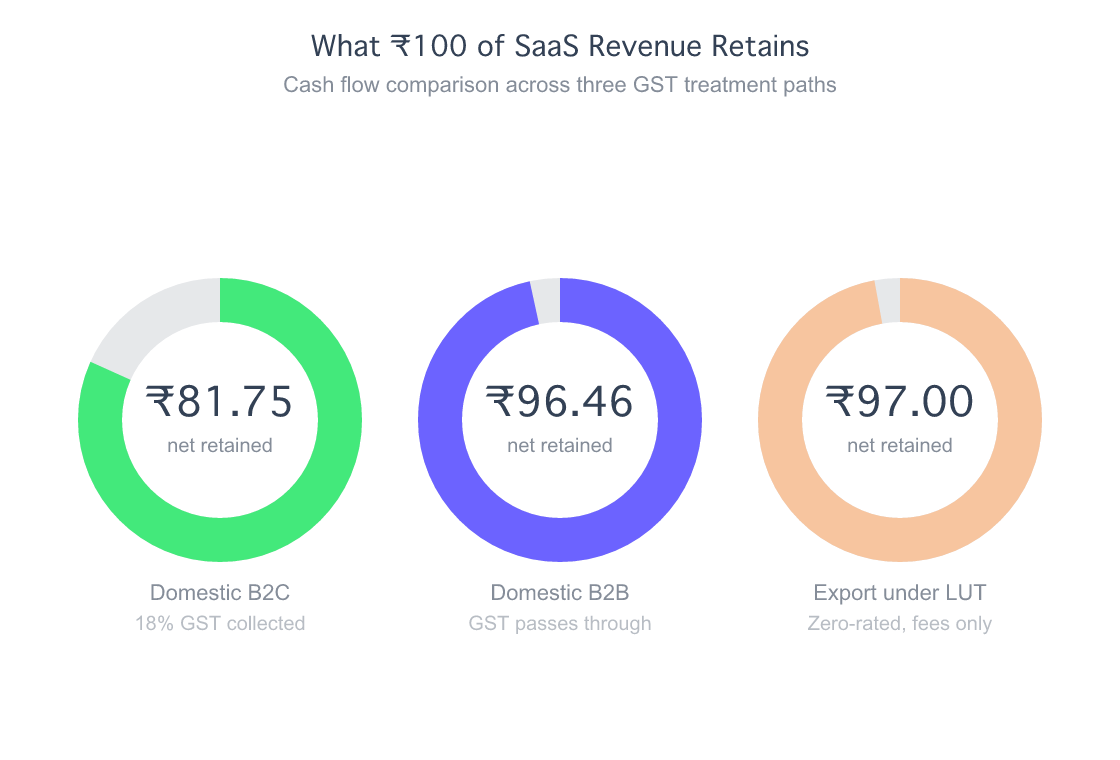
Source: Author calculation at the 18% GST rate, an assumed 3% gateway fee, and Section 16 IGST Act zero-rating. B2C assumes a ₹100 GST-inclusive price; B2B assumes ₹100 plus 18% GST billed. Indicative; actual numbers vary by gateway and ITC position.
The Cash-Flow Trap of Late LUT Filing
Imagine you forget to renew your LUT before 1 April. That day, you raise an invoice for $1,000 to a US customer. Under the default rule, it attracts 18% IGST, about ₹17,100 at ₹95/USD, payable with your April liability. You can claim it back as a refund, which the law gives the department 60 days to process. Effectively, you have lent the government ₹17,100 interest-free for at least two months, on a single invoice.
There is a safety net: CBIC Circular 37/2018 says a delay in furnishing the LUT may be condoned and export under LUT allowed after the fact, case by case (TaxGuru). Don’t plan around it. Make the LUT renewal a fixed March task.
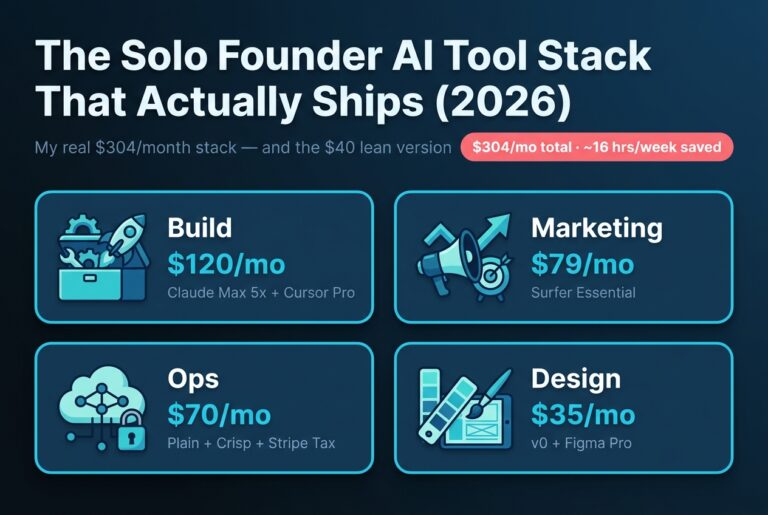
the solo founder tool stack these imported-service bills come from
What Changed in 2026 You Should Know About?
Two sets of changes matter in 2026. First, the GST 2.0 rate rationalisation took effect on 22 September 2025, collapsing four slabs into a standard rate of 18%, a merit rate of 5% and a 40% de-merit rate for a few goods and services (PIB). SaaS and IT services stayed at 18%, so your invoices don’t change.
Second, the Finance Act 2026, which received Presidential assent on 30 March 2026, amended the GST law. The headline for exporters: Section 13(8)(b) of the IGST Act, which deemed “intermediary services” to be supplied in India even when the recipient was abroad, has been omitted, effective from the date of assent (Grant Thornton Bharat). Place of supply now follows the recipient’s location, so these services can qualify as exports if the Section 2(6) conditions are met. For pure SaaS the impact is small; for marketplaces, affiliate platforms and other brokers, it matters.
Other Finance Act 2026 Changes Worth Noting
Per TaxGuru’s summary:
- Provisional refunds for inverted duty structure. Up to 90% of such refund claims can now be sanctioned provisionally (Section 54(6)). Rare for SaaS, but possible if you carry heavy domestic infrastructure costs.
- ₹1,000 refund floor removed for exports made with payment of tax (Section 54(14)). Small refund claims are no longer blocked by the minimum.
- Post-sale discounts. Discounts agreed after the supply can now reduce the taxable value (Section 15(3)), with credit notes allowed under Section 34.
What Did Not Change
The e-invoicing threshold is still ₹5 crore of aggregate turnover as of October 2026. It has been cut before, so check each year rather than assuming.
Citation Capsule: The Finance Act 2026 omitted Section 13(8)(b) of the IGST Act with effect from 30 March 2026, ending the long-running rule that treated intermediary services as supplied in India even when the recipient was abroad (Grant Thornton Bharat, 2026). Separately, the September 2025 rate rationalisation kept IT and SaaS services at the 18% standard rate, and the e-invoicing threshold remains ₹5 crore.
From experience: The single best decision I made in my first GST year was paying ₹4,000/month to a CA who handles three other Indian SaaS founders. He files everything, flags edge cases, answers WhatsApp queries within a few hours, and freed me to ship. The compliance burden is real, but it is also extremely outsourceable. Your job is to ship product. Don’t become an amateur tax accountant.
Frequently Asked Questions
Do I need to register for GST if I only sell to non-Indian customers?
Yes, once your aggregate turnover crosses ₹20 lakh in services (₹10 lakh for special-category states). Exports of services are zero-rated, not exempt, they still count toward your turnover (CBIC Section 22, 2017). Below that threshold, registration is voluntary, but most founders past ~$300 MRR benefit from registering early to claim input tax credit on imported services.
What SAC code should I use for my SaaS?
Most Indian SaaS founders use SAC 998314 (Information Technology design and development services), which carries an 18% GST rate domestically and 0% for exports under LUT (IndiaFilings, 2026). If your product is licensed rather than hosted, 997331 may apply. For consulting-heavy SaaS, 998313 is sometimes used. Confirm with your CA before printing it on invoices.
How often must I renew my LUT?
Once every financial year. The LUT (Form GST RFD-11) expires at the end of the FY, and it must be in place before you make zero-rated supplies, so re-file before 1 April (GSTN tutorial, 2026). A late LUT can be condoned under Circular 37/2018, but don’t count on it.
Should I use Stripe or Paddle for my Indian SaaS in 2026?
Use Stripe if you can get an Indian account (it’s invite-only for new businesses), have a CA, and accept handling global tax compliance yourself (3-4.3% on international cards, plus 2% if currency conversion applies, per Stripe India pricing). Use Paddle as Merchant of Record if you want to outsource EU VAT, US sales tax, and chargeback handling for 5% + 50¢. For solo founders under about $5K MRR, I think the MoR route usually saves more time than the fee gap costs.
What happens if I miss a GSTR-3B filing deadline?
You pay a late fee of ₹50 a day (₹20 for nil returns), capped per return at ₹500 for nil returns, ₹2,000 if your turnover is up to ₹1.5 crore, and ₹5,000 between ₹1.5 crore and ₹5 crore (Notification 19/2021-CT, per IRIS GST). Interest at 18% a year runs on unpaid tax. Persistent non-filing can lead to GSTIN suspension.
Closing: The 80/20 of GST for Solo SaaS Founders
Remember three things. Register once you cross ₹20 lakh, or earlier if your imported-service spend is meaningful. Renew your LUT before every 1 April. Pick a billing stack based on whether you want to handle global tax yourself or outsource it. The rest is execution detail your CA can handle.
The rest of the Indian tax surface (presumptive tax under Section 58, OPC vs sole proprietorship, FEMA reporting, a US LLC on top) deserves its own guide. Start with GST, make it boring, then get back to building product.
Disclaimer (repeated): None of this is legal or tax advice, and GST rules change. Work with a Chartered Accountant who has handled Indian SaaS exporters before you file anything important; that fee is the highest-ROI line in a founder budget.