Most AI startups aren’t building products. They’re renting someone else’s intelligence and adding a user interface. That’s not a business. It’s a feature waiting to be absorbed.
Thousands of AI-powered SaaS products launched between 2023 and 2025. A large share are already dead, stuck in zombie mode, or quietly losing users to the very model providers they were built on. The thin ones won’t make it: in February 2026 a Google Cloud VP warned that startups wrapping “very thin intellectual property around Gemini or GPT-5” should expect little patience from the market (TechCrunch, 2026). OpenAI ships a feature, and overnight a dozen startups lose their reason to exist. Anthropic adds tool use, and another batch becomes redundant. This isn’t a theoretical risk, it’s happening every month.
I’ve watched this pattern play out as a builder in this space. The brutal truth is that most AI SaaS companies never had a moat. They had a head start. And head starts expire.
This piece introduces the “Wrapper Tax” (the hidden cost of building on someone else’s model) and lays out the only three moat types that actually survive in AI SaaS. If you’re building in this space, this framework might save you from building on sand.
TL;DR: Most AI SaaS startups are dead or dying because they never had a real moat, just a head start. Industry leaders now warn openly that thin “wrapper” startups built on someone else’s model won’t survive (TechCrunch, 2026). Only three moat types survive: data flywheels, workflow lock-in, and regulatory compliance. Everything else is a feature, not a business.
What Exactly Is the “Wrapper Tax”? And Why Is It Killing AI Startups?
The wrapper tax is the hidden cost every AI startup pays when it builds its core value on top of someone else’s foundation model. Every time the model provider ships a new capability, the wrapper’s unique value proposition shrinks. And the cadence is relentless: OpenAI’s steady run of GPT Store, Canvas, Search, Tasks, and Operator launches has chewed through whole categories of wrapper startups, the same way native file upload in late 2023 made dozens of “ChatGPT for PDF” tools redundant almost overnight (OpenAI changelog, 2026).
Here’s how the wrapper tax works in practice. You build an AI writing assistant. It takes GPT-4 output and adds templates, tone controls, and team collaboration. Your value is the layer between the raw model and the user. Then ChatGPT adds custom instructions. Your tone control becomes redundant. ChatGPT adds shared workspaces. Your collaboration feature is now a worse version of the native one. ChatGPT adds memory. Your template system looks quaint.
Each update doesn’t kill you. It taxes you. A 5% reduction in unique value here, a 10% reduction there. But the tax compounds. After twelve months of model provider updates, many wrapper companies find that 40-60% of their original feature set now exists natively in ChatGPT, Claude, or Gemini.
The Math Behind the Wrapper Tax
Consider a typical AI SaaS wrapper that launched in early 2024 with ten differentiated features on top of GPT-4. By the end of 2024, ChatGPT had absorbed three of those features. By mid-2025, five. Within a year or two of launch, the median wrapper finds that a large chunk of what made it special now ships natively in ChatGPT, Claude, or Gemini, the exact “thin IP” problem investors now warn founders about (TechCrunch, 2026).
The compounding effect is what kills you. It’s not one update. It’s the relentless cadence. OpenAI now ships weekly. Anthropic releases major updates monthly. Google pushes Gemini updates almost daily. You’re paying the wrapper tax every single cycle, and your engineering team can’t rebuild differentiation as fast as model providers absorb it.
Why “Move Faster” Isn’t the Answer
Some founders respond to the wrapper tax by trying to out-ship the model providers. This is a losing strategy. OpenAI crossed roughly $20 billion in annualized revenue by the end of 2025 (Reuters, 2025) and employs an estimated 7,800-plus people. Anthropic raised a single $13 billion round in late 2025 at a $183 billion valuation (Anthropic, 2025). You cannot out-build these organizations feature-for-feature. The moment you try, you’ve already lost. The only winning move is to build value that model providers can’t absorb, and most startups aren’t doing that.
Citation Capsule: The “Wrapper Tax” erodes AI startup differentiation at a compounding rate. Each model-provider release, ChatGPT’s Canvas and Search, Claude’s tool use, Gemini’s native image generation, quietly absorbs another slice of a wrapper’s value, and wrapper teams can’t rebuild differentiation faster than the foundation labs ship it. Google Cloud’s Darren Mowry put it bluntly: the market no longer has patience for startups built on “very thin intellectual property around Gemini or GPT-5” (TechCrunch, 2026).
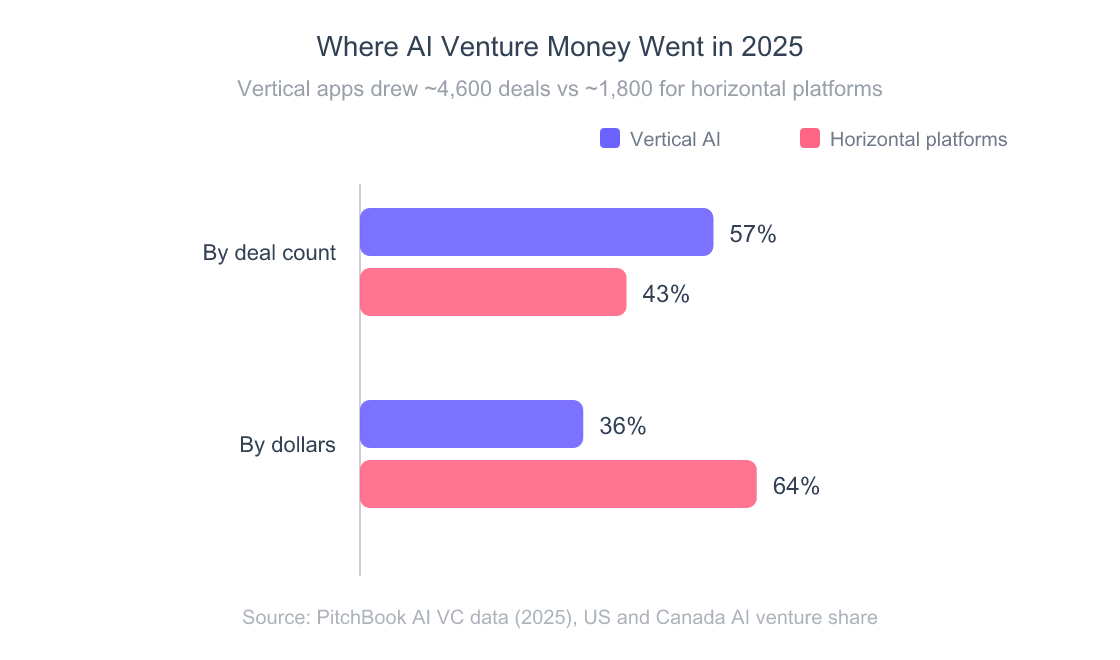
Investors are piling into defensible vertical AI by deal count, while the giant dollar rounds still flow to horizontal platforms. The market is already repricing the wrapper layer.
Which AI SaaS Companies Already Died, and What Killed Them?
The AI startup graveyard is filling fast, and 2025 was the first real reckoning. The shutdowns are concentrated in the “wrapper” category, products that added a UI layer on top of foundation-model APIs without building proprietary technology. As one Google Cloud VP framed it, anything that just “white-labels” a frontier model is now squeezed the way AWS resellers were once squeezed out once Amazon shipped its own enterprise tools (TechCrunch, 2026).
The pattern repeats with eerie consistency. A startup finds a gap in a foundation model’s capabilities, builds a product around that gap, raises funding, and then watches the gap close when the model provider ships an update.
The Casualties
AI writing assistants were the first wave of casualties. When ChatGPT added Custom GPTs, persistent memory, and canvas editing in 2024-2025, dozens of AI writing tools saw massive user drops. Jasper, which raised at a $1.5 billion valuation in late 2022 (TechCrunch, 2022), watched revenue slide from roughly $120 million in 2023 to about $55 million in 2024 and cut its internal valuation as customers moved to native ChatGPT Team and Enterprise tiers. The product still exists, but it’s fighting a war it can’t win.
AI search wrappers suffered a similar fate. When Google integrated AI Overviews directly into search results and scaled the feature to roughly 2 billion monthly users by mid-2025 (TechCrunch, 2025), dozens of smaller “search with AI” startups became obsolete overnight. Why use a third-party AI search tool when Google does it natively?
Code generation wrappers that simply piped prompts to Codex or GPT-4 and displayed results in a basic IDE collapsed when GitHub Copilot expanded its capabilities and when Cursor proved that only deep architectural integration could compete. Replit’s AI features, Codeium, and others found themselves squeezed between the model providers going down-market and architecturally superior competitors like Cursor going up-market.
What They Had in Common
Every dead wrapper shared the same fatal flaw: their value lived in a layer the model provider could replicate in a single sprint. They weren’t building on proprietary data. They weren’t embedded in workflows. They weren’t solving compliance problems. They were building prettier front-ends for someone else’s brain. And prettier front-ends are trivially replicable.
Citation Capsule: 2025 brought the first real wave of AI startup shutdowns, concentrated among wrapper companies that bolted a UI onto a foundation model without proprietary technology. The pattern is consistent: startups build around a model capability gap, then die when the model provider closes it. Jasper’s revenue slide from roughly $120M (2023) to about $55M (2024) and the collapse of AI search wrappers after Google AI Overviews scaled to ~2 billion monthly users (TechCrunch, 2025) illustrate the dynamic.
What Are the Only 3 Moats That Actually Survive in AI SaaS?
Only three types of defensibility survive the wrapper tax. The companies still standing almost all share a trait the dead ones lacked: at least one structural moat a model provider can’t ship its way around. The moats aren’t new concepts, but their relative importance has shifted dramatically in the AI era.
Here’s the framework. I call it the 3-Moat Test. If your AI startup doesn’t pass at least one of these, you’re building on borrowed time.
Moat 1: Data Flywheels (Proprietary Data Network Effects)
The strongest AI SaaS moat is data that gets better with every user. Not just “we have data”, that’s a commodity. The moat comes from data network effects: each new user’s interactions generate data that improves the product for every other user. And the data must be proprietary, something the model providers can’t access from the open web.
Bloomberg Terminal is the classic example. Its financial data moat took decades and billions of dollars to build. In AI, companies like Scale AI (valued at $13.8 billion in its May 2024 round) have built similar positions by amassing proprietary labeled datasets that no model provider can replicate from scratch (TechCrunch, 2024).
But here’s the nuance most founders miss. Simply collecting user data doesn’t create a flywheel. You need a feedback loop where the data directly improves the AI output, and the improved output attracts more users who generate more data. Perplexity does this with its search index and citation graph. Cursor does it with its codebase understanding across millions of repositories. The flywheel must compound.
Moat 2: Workflow Lock-In (Deep Integration Moats)
The second surviving moat is deep embedding into existing workflows, making your product so entangled with a customer’s daily operations that ripping it out would cost more than switching. Integration depth is the key metric. How many data sources does your product connect to? How many team processes depend on it? How much historical context would be lost?
Salesforce understood this decades ago. Their CRM isn’t the best technology, it’s the hardest to remove. In AI, the same principle applies. Companies like Ironclad (AI contract management) survive not because their AI is better, but because they’re embedded in legal workflows with deep integrations into document management systems, e-signature platforms, and compliance databases.
According to a 2026 Zapier survey of 542 enterprise decision-makers, 74% said losing their primary AI vendor would disrupt day-to-day operations or stop a key business function, and just 6% could walk away cleanly (Zapier, 2026). Lock-in works. It isn’t glamorous, but it’s real.
Moat 3: Regulatory Compliance (Compliance-as-a-Moat)
The third moat is regulatory and compliance requirements that create mandatory switching costs. In industries like healthcare (HIPAA), finance (SOC 2, PCI DSS), and legal (attorney-client privilege), using an AI tool isn’t just about features. It’s about certifications, audit trails, and liability frameworks that take 12-18 months and hundreds of thousands of dollars to establish.
ChatGPT can’t just waltz into a hospital’s clinical workflow. The compliance burden is the moat. Companies like Abridge (AI medical documentation) and Harvey (AI for legal) survive because they’ve done the compliance work that general-purpose AI providers haven’t, and won’t, because the ROI on niche compliance doesn’t justify the investment for companies serving hundreds of millions of general users.
The EU AI Act, which entered into force in 2024 and began applying in phases across 2025-2026, created an entirely new compliance layer. Companies building for regulated European markets now have a structural advantage: they’ve already spent the time and money to comply, and competitors face a 12-18 month lag to catch up (European Commission, 2025).
Citation Capsule: Only three moat types survive in AI SaaS: data flywheels, workflow lock-in, and regulatory compliance. Workflow lock-in is the easiest to measure: in a 2026 Zapier survey of 542 enterprise decision-makers, 74% said losing their primary AI vendor would disrupt operations or halt a key function, and 58% of those who actually tried to switch said the migration failed or took far more effort than expected (Zapier, 2026). Depth of integration, not raw AI quality, is what keeps customers in place.
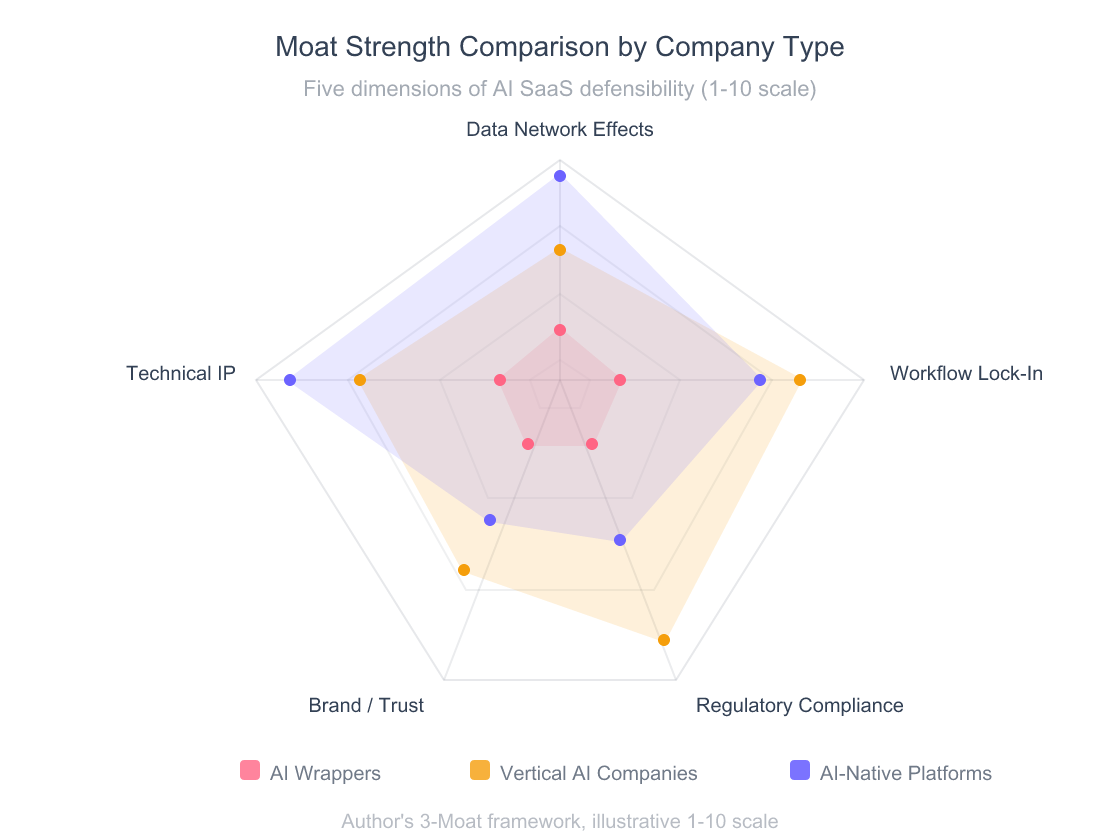
AI wrappers score low on every moat dimension. Vertical AI companies win on compliance and workflow. AI-native platforms dominate in data effects and technical IP.
How Much Revenue Do Wrappers Lose When Model Providers Compete Directly?
The revenue impact is immediate and brutal. When a model provider ships a feature that competes directly with a wrapper category, the affected startups don’t decline gracefully, they fall off a cliff inside a quarter or two. The economics underneath make it worse: inference prices have collapsed since 2023, so the margin between API cost and subscription price, the wrapper’s entire business, keeps thinning even before the provider ships a competing feature.
The pattern has played out across every major wrapper category. What follows are the documented cases, and the numbers are ugly.
AI writing tools took the hardest hit. When ChatGPT launched Teams and Enterprise tiers with persistent memory in late 2024, the category bled subscriptions to the native option. Jasper is the cautionary tale: it cut its internal valuation and revenue projections as customers defaulted to ChatGPT (The Information, 2023), with revenue sliding from roughly $120 million in 2023 to about $55 million in 2024.
AI meeting assistants were the next casualty. When Microsoft Teams and Google Meet added native AI summarization and action-item extraction, third-party meeting AI tools like Otter.ai and Fireflies saw significant user churn. Zoom’s built-in AI Companion, launched free for all paid users, undercut the entire category’s pricing model overnight.
AI image generation UIs suffered when both ChatGPT and Gemini added native image generation. Startups that had built wrappers around DALL-E or Stable Diffusion APIs found themselves competing with free, built-in alternatives from the very companies supplying their models.
Does this mean every AI startup is doomed? No. But it means that if your entire value proposition is a nicer interface on top of a foundation model, your revenue trajectory has an expiration date. The question isn’t if the model provider will absorb your features. It’s when.
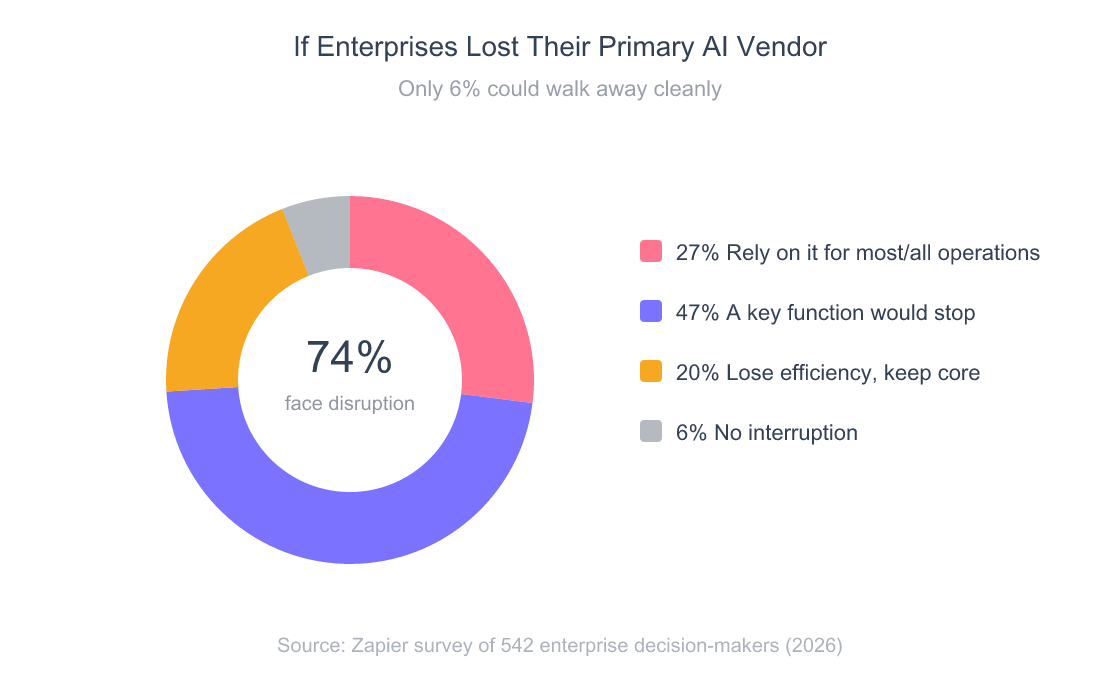
The flip side of the wrapper tax: deeply embedded vendors barely lose revenue when providers compete. 74% of enterprises say losing their main AI vendor would disrupt operations; just 6% could leave cleanly.
How Do You Apply the 3-Moat Test to Your Own Startup?
Applying the framework requires honesty, the kind most founders resist. Most founders rate their own defensibility as strong, then, pressed for specifics, describe a moat that exists only as long as their model provider chooses not to ship the same feature. That’s not a moat. That’s a gap on someone else’s roadmap.
Here’s the test. Answer these three questions.
Question 1: Does Your Product Get Better With More Users?
This tests for data network effects. Not “do you collect data?”, every SaaS product does that. The question is whether each new user’s data makes the product measurably better for existing users. Spotify’s recommendation engine is a classic example. In AI, Cursor’s codebase understanding improves as it sees more repositories and more coding patterns across its user base.
If your answer is “we fine-tune on user feedback”, that’s table stakes, not a moat. The model providers do that too, with vastly more data. Your data flywheel needs to be domain-specific, proprietary, and compounding in a way the foundation model can’t replicate from its general training data.
Question 2: How Painful Is It to Switch Away From Your Product?
This tests for workflow lock-in. The metric is switching cost, measured in both time and data loss. If a customer can switch to a competitor (or to ChatGPT) in an afternoon, you don’t have a workflow moat. If switching requires migrating years of organizational knowledge, retraining team workflows, and rebuilding integrations with five other tools, that’s a moat.
Calculate your “rip-out cost.” How many hours would it take a customer to fully migrate away from your product? If the answer is less than a day, you’re in trouble. The strongest workflow moats create rip-out costs measured in weeks or months.
Question 3: Does Compliance Prevent Your Customers From Using Generic Tools?
This tests for regulatory moats. If your customers operate in healthcare, finance, legal, or government, industries where data handling requirements are legally mandated, then compliance certifications become a structural advantage. A hospital can’t just pipe patient data to the ChatGPT API. They need HIPAA-compliant infrastructure, BAAs, audit logging, and data residency guarantees.
If you’ve spent the time and money to earn those certifications, you have a moat that no model provider will replicate for your niche. The general-purpose providers are focused on serving billions of users, not navigating the compliance requirements of 50 different regulated verticals.
When I think about building Growth Engine, this framework is front of mind. The product isn’t a wrapper around an LLM: it builds proprietary context about each user’s business, market position, and audience over time. That context accumulates. It’s a data flywheel specific to marketing strategy that no general-purpose chatbot can replicate, because the data doesn’t exist on the open web. It lives in the interaction history between the product and each user. Whether that moat proves durable is still an open question, but it’s the right kind of moat to build.
Citation Capsule: Most AI founders overestimate their defensibility, describing “moats” that exist only while their model provider chooses not to ship the same capability. The 3-Moat Test, data flywheel, workflow lock-in, and regulatory compliance, separates durable businesses from features. If your only edge is a gap in ChatGPT’s feature set, you have a release-note’s worth of runway.
What Does the Survival Data Actually Look Like?
The split is stark: among the 2023-2024 AI SaaS cohort, the companies still operating with growing revenue are overwhelmingly the ones with a structural moat, while the “better UX on someone else’s model” startups dominate the dead list. Moat type, not model quality, is the line between the two groups, and the market is making that distinction visible in where it puts its money: in 2025, venture investors backed far more vertical, defensible AI plays by deal count than horizontal application-layer ones (PitchBook, 2025).
The distribution of moat types among surviving companies is revealing. Among AI startups that are still alive and growing, workflow lock-in is the most common moat type, followed by data network effects and regulatory compliance. Among the dead, the overwhelming majority had no structural moat at all, just a prettier interface.
What’s perhaps most interesting is the intersection. Companies that stack two or more moat types are the most resilient of all. The combination of workflow lock-in plus data flywheel is particularly potent, it’s what you see in companies like Cursor (deep IDE integration plus codebase learning) and Harvey (legal workflow integration plus case law data).
Why Is “Just Add AI” the Most Dangerous Advice in Tech Right Now?
The “just add AI” mantra has become the startup equivalent of “just add blockchain” circa 2017. Roughly two-thirds of Y Combinator’s 2024 batches were AI startups, and by 2026 about half of each batch is building AI agents specifically (PitchBook, 2025). When that many teams chase the same thin layer on the same handful of models, most are building the same disposable feature. The problem isn’t AI itself. It’s the assumption that using AI constitutes a business.
Let me be blunt. Building a product on top of the OpenAI API and charging $20/month is not a startup. It’s arbitrage. And arbitrage opportunities close. They always close.
The Feature vs Product Distinction
Here’s a test I use. Ask yourself: “If OpenAI/Anthropic/Google added this exact feature to their product tomorrow, would anyone still pay for mine?” If the honest answer is no, you’ve built a feature, not a product. Features get absorbed. Products persist.
The distinction matters because VCs are still funding features. A total of $202.3 billion was invested in the AI sector in 2025 (Crunchbase, 2025). Much of that went into companies whose entire value proposition was a temporary gap in ChatGPT’s feature set. When that gap closes, and it always closes, the money burns.
The Pricing Trap
There’s a second problem most AI wrapper founders don’t see coming: the pricing trap. You’re charging $20-50/month for access to a model that costs you $0.01-0.05 per query. That margin looks great: until the model provider offers the same thing for $20/month directly, with better quality, broader context windows, and a brand your customers already trust.
ChatGPT Plus costs $20/month. Claude Pro costs $20/month. How do you justify charging the same price for a subset of what those products do? You can’t, unless you’re delivering value that those products structurally cannot.
marketing strategy for solo founders
Citation Capsule: The “just add AI” strategy mirrors “just add blockchain” from 2017. Roughly two-thirds of Y Combinator’s 2024 batches were AI startups, and about half of each 2026 batch is now building AI agents (PitchBook, 2025). The core problem: if a model provider can absorb your feature set in a single sprint, you don’t have a business, you have temporary arbitrage.
What Should AI Founders Build Instead?
If wrappers are dying and model providers keep expanding, where should founders focus? The money is already voting: in 2025, vertical AI applications drew far more venture deals than horizontal platforms, roughly 4,600 vertical deals versus 1,800 horizontal ones, making vertical the majority of AI raises by deal count (PitchBook, 2025). The answer comes from looking at what’s actually working. The AI companies thriving in 2026 share three characteristics that map directly to the 3-Moat Framework.
Build Vertical, Not Horizontal
Horizontal AI tools (writing assistants, general chatbots, image generators) are the most vulnerable to model provider absorption. Vertical AI tools, those built for specific industries with specific data requirements, are the most defensible.
Harvey (legal AI) raised a $300 million Series D at a $3 billion valuation in early 2025, not because their AI is better than ChatGPT at writing legal briefs, but because they’ve built on proprietary legal data, integrated into law firm workflows, and earned compliance certifications that general-purpose tools don’t have (Fortune, 2025). That’s all three moats in one company.
Abridge, which provides AI-powered clinical documentation for healthcare, reached partnerships with over 40 health systems. Their moat isn’t AI quality: it’s HIPAA compliance, EHR integration, and clinical workflow embedding that makes them nearly impossible to rip out once deployed.
Own the Data Layer
If you can’t own the model, own the data. The most durable AI companies are building proprietary datasets that improve with scale and can’t be replicated from publicly available information.
Scale AI understood this early. By building the largest proprietary dataset labeling and evaluation platform, they created a moat that grows with every customer engagement. Their data becomes the benchmark others rely on, a self-reinforcing position.
For smaller startups, the play is domain-specific data. Build products that generate proprietary data through usage, data that doesn’t exist on the open web and that foundation models can’t absorb from their training sets.
Make Switching Expensive
The unglamorous truth about defensibility: the best moat is often the one that makes leaving painful. Build integrations with every tool in your customer’s stack. Store historical context that would be lost on migration. Create workflows that depend on your product’s specific data structures.
This isn’t about trapping customers. It’s about delivering enough embedded value that the cost of leaving exceeds the benefit of switching. When a customer’s entire quarterly planning process runs through your AI platform, they don’t switch because ChatGPT added a new feature. The switching cost is too high.
the developer job market after AGI
What Does This Mean for Indie Hackers and Solo Founders?
Solo founders face the wrapper tax most acutely, because they don’t have the engineering bandwidth to keep rebuilding differentiation as model providers absorb features. A solo team that spent six months building tone controls and templates on top of GPT-4 simply can’t out-ship the lab that owns the model, and when feature parity arrives, the revenue follows the native option. This is exactly the trap solo AI founders keep walking into.
But there’s good news. Indie hackers have one advantage over funded startups: they can pick niches too small for model providers to care about.
The Niche Advantage
OpenAI isn’t going to build a specialized AI tool for veterinary practice management. Anthropic isn’t going to create a compliance automation platform for Brazilian fintech regulations. Google isn’t going to build an AI-powered curriculum generator for Montessori schools. These niches are too small for billion-dollar companies to pursue, but they’re perfect for solo founders.
The playbook for indie AI founders is straightforward. Pick a niche where you can build genuine domain expertise. Collect proprietary data that doesn’t exist elsewhere. Integrate deeply into the specific tools your niche already uses. And make sure your product gets smarter with every user, not just for that user, but for all users.
Stop Building Horizontal, Start Building Deep
The temptation for indie hackers is to build broad tools (“AI for everyone”) because the market seems bigger. But broad markets are exactly where model providers compete. They already serve everyone. You can’t out-serve everyone better than ChatGPT.
What you can do is out-serve a specific someone. A dentist. A real estate agent in Portugal. A Shopify store owner selling vintage furniture. The narrower your focus, the harder it is for a general-purpose tool to replicate your value. And the deeper you go, the stronger your moat becomes.
micro-SaaS niches AI can’t replicate
The Uncomfortable Conclusion
Here’s the part nobody in AI wants to hear. Of the $202.3 billion invested in AI in 2025 (Crunchbase, 2025), a significant share went to companies that shouldn’t exist. They don’t have proprietary data. They’re not embedded in workflows. They don’t solve compliance problems. They’re building features on top of rented intelligence and calling it a product.
The market is correcting. The shakeout isn’t a bug, it’s the market doing its job, separating real businesses from temporary arbitrage opportunities. And the correction isn’t over.
But here’s the flip side: the companies that survive will be extraordinary. With more than $200 billion in AI venture funding in 2025 (Crunchbase, 2025) and enterprise AI adoption still accelerating, the opportunity is enormous, for founders who build on defensible ground.
If you’re in the early stages of building an AI product, run the 3-Moat Test today. If you can’t pass at least one, pivot while you still can. Build the data flywheel. Earn the compliance certifications. Embed yourself so deeply into workflows that ripping your product out would cost your customers weeks of migration work.
The AI SaaS moat is drying up, but only for companies that never had one to begin with. The companies building real moats? Their moats are getting deeper every day.
Frequently Asked Questions
Can’t you just move faster than the model providers?
You can’t outrun companies with thousands of engineers and billions in revenue. OpenAI crossed roughly $20 billion in annualized revenue by the end of 2025 (Reuters, 2025), backed by an estimated 7,800-plus employees. Speed only works as a strategy when you’re building in a direction the model providers aren’t headed, which means building depth in a niche, not breadth in a feature category they’re already targeting.
Is fine-tuning a model a real moat?
Rarely. Fine-tuning creates a temporary advantage that erodes as base models improve. A model fine-tuned on medical data in 2024 was competitive then, but GPT-5 and Claude 4’s expanded knowledge bases have narrowed that gap significantly. Fine-tuning is a tactic, not a moat. The moat comes from the proprietary data you fine-tune on, if that data can’t be replicated, then you have something. If the data is publicly available, your fine-tuning advantage has a shelf life of 6-12 months.
What if I’ve already built a wrapper, is it too late?
Not necessarily, but you need to act quickly. Audit your product against the 3-Moat Test. Identify which of the three moat types is most accessible given your current user base and market position. The fastest path is usually workflow lock-in, build deep integrations with the tools your customers already use. Every integration increases switching costs. In a 2026 Zapier survey, 74% of enterprises said losing their primary AI vendor would disrupt operations or halt a key function, integration depth, not AI quality, is what holds them (Zapier, 2026). Start there.
Are AI-native platforms immune to the wrapper tax?
They’re more resistant, not immune. AI-native platforms like Cursor and Perplexity build their own architectural layer that model providers can’t absorb, because the value isn’t in the model, it’s in the product architecture. But they still face platform risk. If OpenAI changed its API terms or pricing dramatically, even architecturally differentiated companies would feel it. The difference is that AI-native platforms have enough proprietary value to survive the shock. Pure wrappers don’t.
How do I know if my data flywheel is real?
Ask two questions. First: does each new user’s data make the product measurably better for existing users? If you can’t measure the improvement, the flywheel isn’t spinning. Second: could a model provider replicate your data advantage by training on publicly available information? If yes, your data isn’t proprietary, it’s convenient. Real data flywheels compound value that doesn’t exist on the open web and can’t be reconstructed from general training data.
The $0 Marketing Stack for Indie Hackers in 2026
Why Indie Hackers Fail at Marketing (And What to Do Instead)