Why Indian Developers Should Stop Freelancing and Build SaaS
India’s tech workforce is roughly 5.8 million strong, and a growing share of them trade hours for dollars on Upwork, Fiverr, and Toptal (NASSCOM Strategic Review 2025, 2025). The rates look decent at first, $15 to $50 an hour, sometimes more. But here’s what nobody talks about: you’re selling your time in a market that treats it as a cheap good. The ceiling is fixed, and your income stops the moment you stop typing.
Meanwhile, Indian SaaS companies are scaling fast and are on track to reach $35 billion in ARR by 2027, growing 20-25% a year (Bain & Company, 2023). That growth didn’t come from outsourced labor. It came from Indian developers who chose to build products instead of building other people’s products. The math favors SaaS, especially for Indian developers whose costs are in rupees while their revenue can be in dollars.
This isn’t a rah-rah motivational post for Indian developers. It’s a breakdown of the real math, tax rules, payment rails, and edge cases that make India one of the best places in the world to bootstrap a SaaS business right now.
marketing strategy guide for solo founders
TL;DR: Indian developers freelancing at $15-50/hr face a hard income ceiling, their earnings stop when they stop working. Indian SaaS is on track for $35B in ARR by 2027 (Bain & Company, 2023), and India’s cost arbitrage (living in INR, earning in USD) means even $3,000 MRR replaces a senior freelancer’s income. Section 44ADA lets you treat 50% of gross receipts as taxable income. The math works.
What’s Wrong With Freelancing as an Indian Developer?
Nothing is “wrong” with freelancing, it’s a real way to earn. But for most Indian developers, it has a hard ceiling that hits hard after 2-3 years. According to Payoneer, the average freelancer worldwide earns about $21/hour, with Indian developers typically in the $15-25 range (Payoneer, 2022). At 160 billable hours a month, $21/hour is about $3,360, solid by Indian standards, but frozen in place. No raise comes unless you ask for one.
The time-for-money trap
Freelancing is linear for Indian developers. You work 8 hours, you get paid for 8 hours. Take a vacation? Revenue drops to zero. Get sick? Same thing. There is no compounding, and every month starts from scratch.
Compare that to SaaS. A $49/month product with 100 customers gives you $4,900 in monthly recurring revenue, whether you worked 160 hours that month or 40. The revenue keeps growing because customers stay. It’s the difference between a salary and an asset.
Rate ceilings are real
Even elite Indian freelancers on Toptal rarely cross $80/hour for long. The market anchors Indian rates lower than the same kind of US or European freelancers, not because of skill differences, but because of where you live. You can be the best React developer in Pune, and you will still quote less than an average one in Portland.
I spent two years freelancing on Upwork before I saw the pattern. My rates went from $25 to $45/hour over that period, sounds like growth, right? But the work to justify each rate hike was draining. I had to rewrite proposals, gather reviews, and keep proving I was “worth it.” My first SaaS side project, by contrast, hit $2,000 MRR within six months of launch with far less stress.
You’re building someone else’s equity
Every feature you ship as a freelancer adds value to your client’s product, not yours. After two years of freelance work, you have a portfolio. After two years of SaaS work as an Indian developer, you have a real business: recurring revenue, a user base, and (if things go well) an asset you could sell.
Citation Capsule: Indian freelance developers earn a median of $21/hour according to Payoneer’s 2026 Global Freelancer Income Report. At 160 billable hours per month, that’s $3,360/month with no compounding, compared to SaaS founders who build recurring revenue that persists between work sessions.
How Does the Freelancing vs. SaaS Income Math Actually Work?
The money side gets stark when you compare the same effort over time. An Indian developer freelancing at $30/hour for 160 hours a month earns $4,800/month, or $57,600/year. That number stays flat unless they raise rates. A SaaS founder who lands just 10 new customers a month at $49/month reaches $5,880 MRR by month 12, and that’s with 5% monthly churn already in the math.
Here’s what the numbers look like side by side for an Indian developer choosing between the two paths.
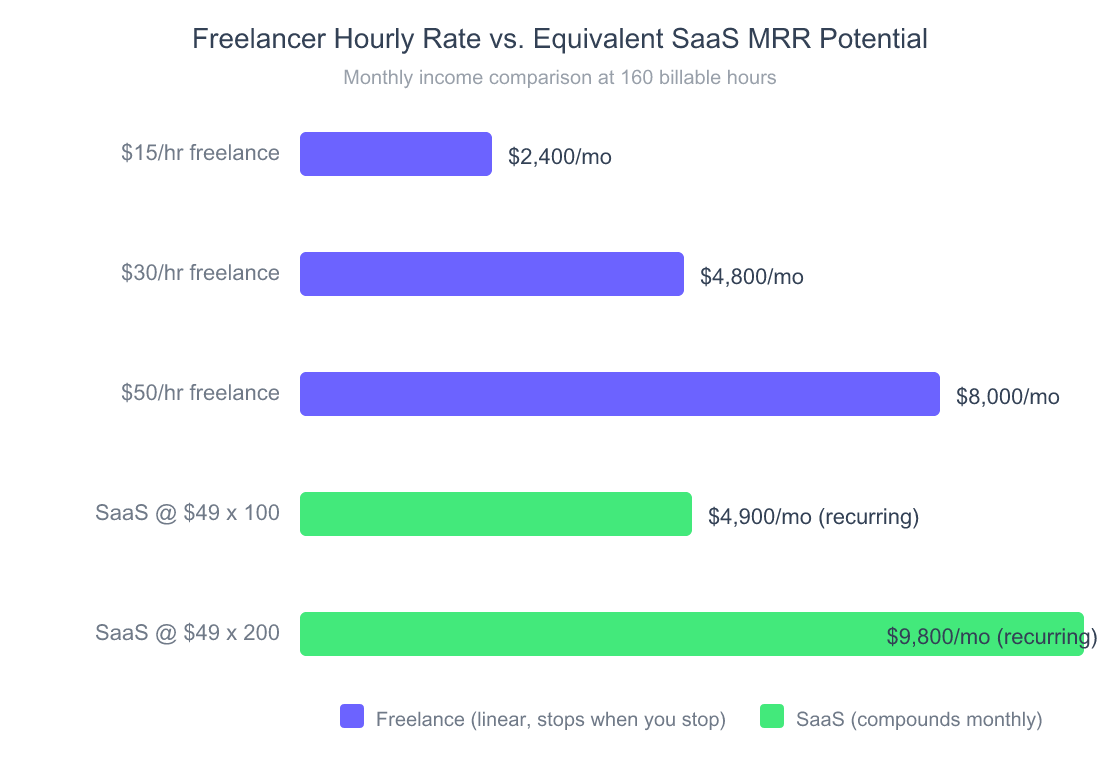
Freelance income is linear and capped by billable hours; SaaS MRR compounds as customers accumulate and stay.
The compounding effect
The freelancer’s line is flat, month 1 and month 24 look the same. The SaaS founder’s line curves upward. Even with modest growth, 10 new customers a month, 5% churn, the gap widens every single month.
Here’s the math I ran for an Indian developer weighing both paths: a developer charging $30/hour freelancing earns $57,600 in year one and $57,600 in year two, for a total of $115,200. A SaaS founder landing 10 customers/month at $49 with 5% monthly churn earns about $26,400 in year one but $58,900 in year two, total: $85,300. By month 24, their MRR is $5,880 versus the freelancer’s flat $4,800. By month 30, the SaaS founder’s total earnings pass the freelancer’s. By month 36, it is not even close.
But what about the ramp-up period?
Yes, SaaS has a ramp-up where you earn less (or nothing) while building. That’s real. The smart move for Indian developers is not to quit freelancing cold turkey, but to cut freelance hours slowly as MRR grows. Drop from 160 hours to 120, then 80, then 40. Let the recurring revenue replace the linear income.
defining your ICP with zero customers
Why Is India Uniquely Positioned for SaaS in 2026?
India’s SaaS scene is not just growing, it’s speeding up. The country now has well over 1,000 funded SaaS companies, with the sector set to hit $35 billion in ARR by 2027 (Bain & Company, 2023). What makes India special for Indian developers isn’t just the talent pool: it is the mix of low cost base, strong tech skills, and a home market of 900 million internet users.
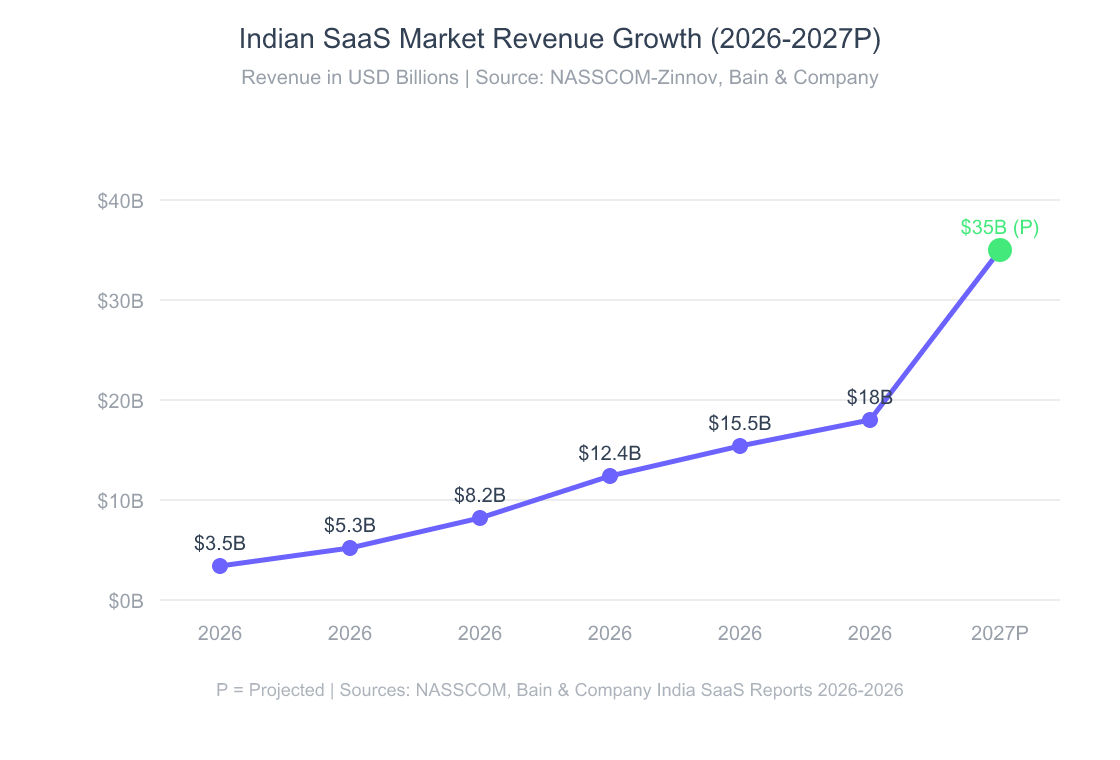
Indian SaaS revenue has grown 5x since 2026 and is projected to nearly double again by 2027. Source: NASSCOM-Zinnov, Bain & Company.
The INR/USD cost arbitrage
This is the edge most “build a SaaS” content skips because it’s written by Americans for Americans. When you live in India, your cost base is in rupees. Rent in Bangalore is Rs 25,000-40,000/month for a decent flat. In a tier-2 city like Pune, Jaipur, or Kochi, it can be Rs 12,000-20,000. Your food, transport, internet, all in rupees.
Now do the math. $3,000 MRR at today’s rate (roughly Rs 85/USD) is Rs 2,55,000 per month. That is more than what most senior software engineers at Indian product companies earn. And $3,000 MRR is seen as modest in the SaaS world, just a product with 61 customers paying $49/month. This rupee-dollar gap means an Indian developer does not need to build the next Slack. A small, focused tool for a niche audience can fund a very comfortable life.
The tier-2 and tier-3 city advantage
You don’t need to be in Bangalore or Mumbai. In fact, being in a smaller city is an edge for Indian developers. Costs are lower, there are fewer distractions, and India’s broadband boom means 100 Mbps fiber is now in most district capitals. Freshworks was bootstrapped in Chennai, not Silicon Valley. Zoho runs its operations from Tenkasi, a town in rural Tamil Nadu with under 100,000 people.
zero-dollar marketing stack for indie hackers
Citation Capsule: India produced over 2,500 SaaS companies by 2026, generating $18 billion in revenue with a projection to reach $35 billion by 2027, according to NASSCOM-Zinnov’s Indian SaaS Landscape Report. The INR/USD arbitrage means $3,000 MRR (roughly Rs 2,55,000) exceeds most senior developer salaries in India.
How Does Section 44ADA Change the Tax Math for SaaS Founders?
Section 44ADA of the Income Tax Act is one of the most underrated edges for Indian developers running solo. It lets professionals and self-employed people with gross receipts up to Rs 75 lakh (about $88,000) report only 50% of their gross receipts as taxable income (ClearTax, 2026). No need to keep full books of accounts, and no audit if you stay under the limit.
What this means in real numbers
Say you’re a solo SaaS founder earning $5,000/month: $60,000/year, or roughly Rs 51 lakh at Rs 85/USD. Under Section 44ADA, your taxable income is 50% of that: Rs 25.5 lakh. After the Rs 3 lakh basic exemption in the new tax regime, you would pay tax on Rs 22.5 lakh. That’s an effective rate of about 17-20%, well below the 30%+ that salaried employees at the same income level pay.
Here’s a comparison I ran: a salaried Indian developer earning Rs 51 lakh pays about Rs 13.5 lakh in taxes under the new regime (effective rate ~26%). A solo SaaS founder earning the same Rs 51 lakh under 44ADA pays about Rs 5.1 lakh (effective rate ~10%). That’s Rs 8.4 lakh (roughly $9,900) more in your pocket every year. Over five years, the tax savings alone could fund a year of runway.
The Rs 75 lakh threshold
There’s a catch. The presumptive limit was Rs 50 lakh until 2026, when it was raised to Rs 75 lakh for those getting more than 95% of payments digitally (ClearTax, 2026). For Indian developers taking payments through Stripe or Razorpay, this is met by default. If your yearly revenue crosses Rs 75 lakh ($88K), you’ll need full books and maybe an audit, but at that point, you can afford a CA.
Filing as a sole proprietor vs. LLP vs. Pvt Ltd
Most early-stage Indian SaaS founders file as sole proprietors. It’s the simplest setup with the lowest paperwork. Once revenue crosses Rs 40-50 lakh, many move to an LLP or Private Limited for liability cover and investor readiness. But don’t incorporate too early. Every structure adds work: yearly filings, GST returns, ROC filings. Start simple.
Citation Capsule: Under India’s Section 44ADA presumptive taxation, solo SaaS founders with gross receipts under Rs 75 lakh can declare only 50% as taxable income, according to the Income Tax Department. This results in an effective tax rate of approximately 10-17%, compared to 26%+ for salaried employees earning the same amount.
How Do You Handle GST When Selling SaaS From India?
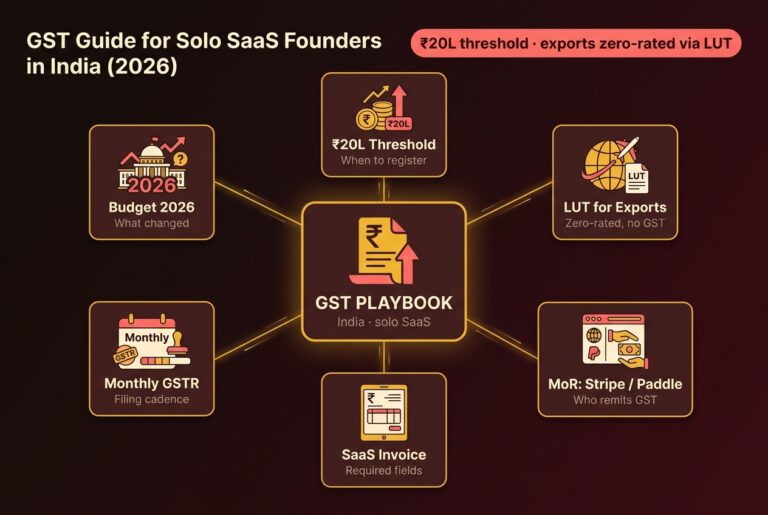
GST registration is required once your total turnover crosses Rs 20 lakh in a year (CBIC, 2026). For Indian developers selling globally, GST on software exports is zero-rated, meaning you charge 0% GST but can still claim Input Tax Credit (ITC) on your costs. You’ll need a Letter of Undertaking (LUT) filed with your GST officer to use this perk.
Domestic vs. international sales
If you sell to Indian customers, you charge 18% GST on SaaS subscriptions (filed under SAC 998314, “online content” services). This adds friction for price-sensitive Indian buyers, but it is the rule.
For sales abroad, which is where most bootstrapped Indian SaaS revenue comes from, the sale counts as “export of services” under IGST Act Section 2(6). The rules: the seller is in India, the buyer is outside India, payment comes in convertible foreign exchange, and the seller and buyer are not “merely establishments of the same person.”
The LUT (Letter of Undertaking) process
Filing an LUT sounds scary but takes about 15 minutes on the GST portal. You file Form GST RFD-11 online. No bond, no bank guarantee, no documents to upload, just a one-page form. Once approved (usually within 24-48 hours), your exports are zero-rated for the year. Renew it every April. I’ve seen Indian developers delay overseas sales for months because they didn’t know the process was this simple.
Input Tax Credit on expenses
Even though you charge 0% GST on exports, you still pay GST on your Indian business costs: hosting (AWS India charges 18% GST), software tools, coworking space rent, accounting services. With an active GST registration and LUT, you can claim all of this back as Input Tax Credit. For a solo Indian developer spending Rs 30,000-50,000/month on business costs, that’s Rs 5,400-9,000/month in ITC, real money back in your business.
When should you register for GST?
My pick: register as soon as you launch your SaaS, even before hitting the Rs 20 lakh limit. Here’s why. Early registration lets you claim ITC on all your setup costs: domains, hosting, tools. It also looks pro when dealing with Indian B2B buyers who need GSTIN on invoices. And if you sell abroad, you need the GST number to file your LUT anyway.
Which Payment Gateway Should Indian SaaS Founders Use?
The right payment gateway shapes your margins, payout speed, and global reach. According to a 2026 SaaSBOOMi survey, Razorpay handles payments for about 42% of Indian SaaS startups, followed by Stripe at 28% (SaaSBOOMi, 2026). But the market is moving as newer players like Dodo Payments offer India-first perks that the older players don’t match.
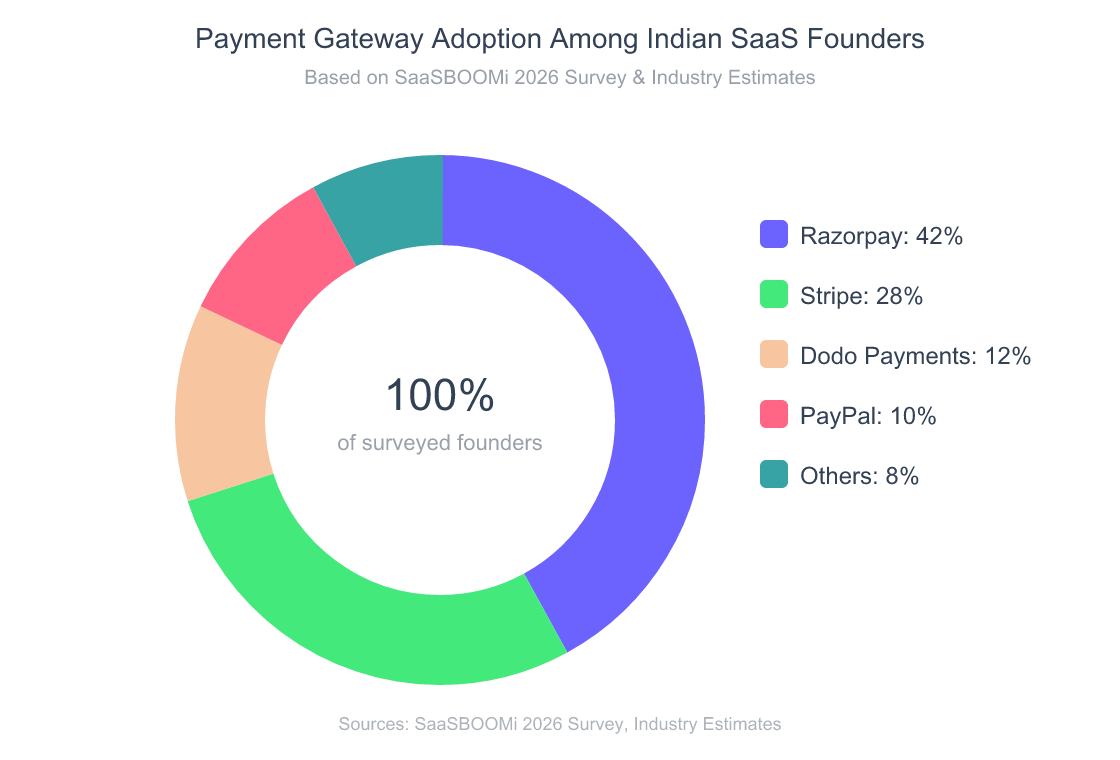
Payment gateway distribution among Indian SaaS founders. Razorpay leads but newer entrants like Dodo Payments are gaining share. Source: SaaSBOOMi, industry estimates.
Razorpay: the default choice
Razorpay is the top pick for a reason. Indian company, rupee payouts, great docs, and a dashboard that doesn’t make you want to throw your laptop out a window. Fees are 2% for domestic payments. They also offer Razorpay International for cross-border payments, though the forex markup and payout times are weaker than dedicated global gateways.
Where Razorpay falls short for Indian developers: global subscription billing. Their recurring billing works fine for Indian cards and UPI mandates, but handling global credit cards (mostly US and EU cards) needs extra setup and sometimes leads to higher decline rates than Stripe.
Stripe: the global standard
Stripe entered India in 2026 with full onboarding. Its billing engine (Stripe Billing) is best-in-class for SaaS. Webhooks, metered billing, trial mode, proration, it all works out of the box. The 2.9% + 30 cents per transaction fee is the global standard.
The downside for Indian developers: payouts come in USD to your Indian bank account, so you face forex rates and RBI’s FEMA rules. The payout cycle can be 7-14 days. But if your buyers are mostly outside India, Stripe is still the strongest pick for payment and billing logic.
Dodo Payments: the India-first alternative
Dodo Payments is worth a look. Built just for Indian SaaS founders selling globally, it acts as Merchant of Record (MoR): meaning they handle global tax filings, chargebacks, and currency moves for you. Their fee is 5% per transaction, which sounds higher than Stripe’s 2.9%, but with the MoR layer (which Paddle charges 5-8% for), it’s fair. Payouts in INR go straight to your Indian bank. No FEMA paperwork.
For a solo Indian developer who doesn’t want to deal with global tax filings, Dodo Payments cuts out a whole class of paperwork. Is it right for everyone? No. If you are already happy with Stripe and handle your own tax filings, the extra 2% fee does not make sense. But for someone just starting out, the simplicity has real value.
payment gateway comparison for developers
Citation Capsule: Razorpay processes payments for approximately 42% of Indian SaaS startups, according to a SaaSBOOMi 2026 survey. Stripe follows at 28%, while newer India-focused alternatives like Dodo Payments (12% share) offer Merchant of Record services that eliminate international tax compliance for Indian solo founders at 5% per transaction.
What Does the Income Ceiling Look Like Over Time?
The gap between freelancing and SaaS income gets dramatic over a 3-5 year span. An Indian developer freelancing at $30/hour maxes out at $57,600/year unless they raise rates, which the market pushes back on. A SaaS product with steady growth can reach $10,000-20,000 MRR in 2-3 years, per data from MicroConf surveys of bootstrapped founders (MicroConf, 2026).
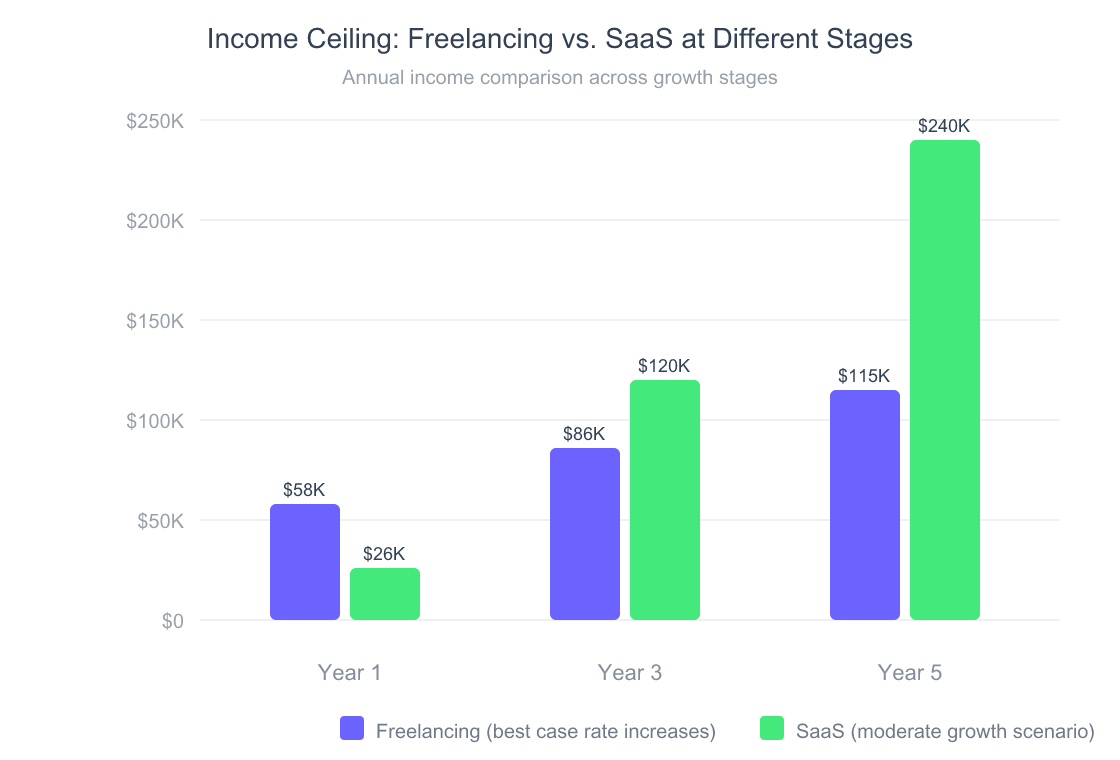
Freelance income grows linearly through rate increases; SaaS revenue compounds through customer accumulation. By year 5, the gap is 2x+ in the moderate scenario. Sources: MicroConf 2026, Payoneer 2026.
Year 1: freelancing wins
Let’s be honest about year one, the freelancer earns more. While you’re building your MVP, testing your idea, and getting your first 20 customers, the freelancer is billing $4,800/month like clockwork. This is why most Indian developers never make the switch. The short-term math doesn’t back it up.
Year 3: the crossover
By year three, the SaaS founder who stuck with it, growing at a modest 8-10% month-over-month, is earning $10,000+ MRR. That’s $120K/year in recurring revenue. The freelancer, even after pushing rates to $45/hour, is at $86K. And the freelancer is working more hours, not fewer.
Year 5: a different universe
A SaaS product at $20,000 MRR makes $240K/year. The freelancer, even at $60/hour (a rate that puts them in the top 5% of Indian freelancers) earns $115K. But more importantly, the SaaS founder owns an asset. A SaaS business selling at 3-5x ARR is worth $720K to $1.2 million. The freelancer’s business has no asset value beyond their personal brand.
Citation Capsule: According to MicroConf’s 2026 State of Independent SaaS report, bootstrapped SaaS founders who persist beyond year two commonly reach $10,000-20,000 MRR. At $20,000 MRR, the annual revenue ($240K) exceeds even elite Indian freelancer earnings ($115K at $60/hr), and the business itself carries 3-5x ARR asset value.
How Do You Deal With the “Get a Stable Job” Pressure?
This section won’t show up in any American SaaS playbook, but it is the biggest barrier for Indian developers. Many Indian engineering graduates face strong family pressure to take a stable corporate job soon after graduating. The pressure isn’t mean, it comes from a generation that saw a steady paycheck as the highest goal.
The conversation you need to have
When I told my family I was cutting freelance work to focus on a SaaS product, the reply was simple: “But freelancing is already risky, why take a bigger risk?” What worked was showing the math. I printed out a simple sheet: freelance income over 5 years vs. SaaS income over the same period. Numbers are harder to argue with than vibes.
The framing also matters for Indian developers having this talk. Don’t say “I’m quitting my job to start a startup.” Say “I’m building a software product that earns monthly recurring revenue, and I’m keeping some freelance clients while it grows.” The first sounds reckless, but the second sounds like a plan.
The parallel path strategy
You don’t have to go all-in on day one, in fact, you shouldn’t. Keep 2-3 retainer freelance clients that give you a base income. Spend mornings on SaaS, afternoons on client work. Set a clear milestone: “When my SaaS hits $2,000 MRR, I’ll drop to one freelance client.” This gives your family (and you) a safety net while you build.
Is it tiring? Yes. Is it short-term? Also yes. Most bootstrapped Indian developers I know ran a parallel path for 6-18 months before going full-time on their SaaS product.
Tier-2/3 cities make the math easier
Here’s where geography becomes strategy for Indian developers. If you’re a developer in Bangalore paying Rs 35,000/month for a 1BHK flat, your burn rate is high. But if you’re in Indore, Coimbatore, or Ahmedabad, the same quality of life costs Rs 12,000-18,000/month. Lower burn means you need less MRR to feel “safe,” and feeling safe means you won’t panic-quit your SaaS at the first dip.
An Indian developer in a tier-2 city with Rs 1,50,000/month in costs needs about $1,800 MRR to cover everything, that’s 37 customers at $49/month. Doable within 6-12 months of a well-aimed product.
why indie hackers fail at marketing
What Should You Actually Build?
The biggest mistake Indian developers make when moving to SaaS isn’t technical, it’s picking the wrong problem. Too many Indian developers build tools for developers (because that’s what they know), entering a market packed with well-funded rivals. The smarter move is to pick a boring, underserved niche where you have a real edge.
Boring problems pay well
According to MicroConf’s 2026 survey, the top-earning bootstrapped SaaS types were booking tools, vertical workflow software (dental clinics, real estate agents, trucking firms), and compliance/reporting tools (MicroConf, 2026). Not AI chatbots, and not developer tools. Just boring, focused software for non-tech users.
The India advantage for specific verticals
India has unique vertical openings that global SaaS firms won’t touch. GST compliance software, RERA reporting for real estate, FSSAI papers for food businesses, school ERP for India’s 1.5 million schools. These verticals have real pain points, low rivals, and customers happy to pay Rs 500-2,000/month for software that saves them hours of manual work.
One mental model I use: find a market where people now solve the problem with WhatsApp messages and Excel sheets. If a small business owner is running their workflow by sending photos on WhatsApp and tracking orders in Excel, there’s a SaaS product waiting to be built. India is full of these chances because digital adoption is moving faster than software supply can keep up.
Don’t start with an idea, start with a customer
Before writing a single line of code, talk to 20 people in your target market. Not friends, and not other developers, real potential buyers. Ask them what eats up their day. Ask what frustrates them. Ask what they’d pay to fix it. The answers will shock you, and they’ll save you from building something nobody wants.
defining your ICP with zero customers
How Do You Go From Freelancer Mindset to Founder Mindset?
The hardest shift isn’t technical, it’s mental. A 2026 Indie Hackers survey found that 62% of failed SaaS projects were dropped not because of market fit issues, but because the founder ran out of drive or went back to “safer” income (Indie Hackers, 2026). The freelancer mindset says “bill hours, get paid today.” The founder mindset says “invest hours, get paid for years.”
Stop thinking in hours
Freelancers track time, but founders track outcomes. If you spend 4 hours writing docs, a freelancer would bill $120. A founder would not count those hours at all, they’d track whether the docs cut support tickets. This shift is hard but it is what Indian developers need to make to win at SaaS.
Build in public
The Indian developer community on Twitter/X and LinkedIn is surprisingly active and warm. Sharing your progress, MRR wins, customer chats, product picks, does two things. It creates accountability (it is harder to quit when 500 people are watching), and it builds free marketing for your product.
Set a time horizon
Give yourself 18 months, not 3 months, not 6 months. Building a SaaS product that earns real revenue takes time. Set a clear goal: “I will work on this for 18 months, and if I haven’t reached $1,000 MRR by then, I’ll reassess.” This kills the daily “should I quit?” worry and lets you focus on building.
marketing strategy guide for solo founders
What’s the Practical Playbook for Making the Switch?
Here’s a step-by-step plan for Indian developers that handles risk while building toward a SaaS income. This isn’t a theory, it’s based on patterns I’ve seen work for Indian developers making this shift over and over.
Phase 1: Foundation (Months 1-3)
Keep freelancing full-time. Use evenings and weekends to test a SaaS idea. Talk to 20-30 potential buyers. Pick a niche based on those chats, not on guesses. Register a domain. Set up basic infrastructure. Don’t write product code yet, validate first.
Phase 2: Build (Months 3-6)
Cut freelance hours by 25%. Build your MVP, the smallest version of the product that gives real value. Launch to your first 5-10 beta users and collect feedback hard. Register for GST. Set up your payment gateway (Razorpay for India, Stripe or Dodo Payments for global sales).
Phase 3: Grow (Months 6-12)
Cut freelance hours by another 25%. Focus on marketing, content, and customer wins. Aim for $1,000-2,000 MRR. File your LUT if selling abroad. Start tracking metrics: MRR, churn, LTV, CAC. Reinvest revenue into the product.
Phase 4: Transition (Months 12-18)
When MRR covers 70-80% of your monthly costs, drop to one freelance client. When MRR covers 100%, go full-time on your SaaS. Set up Section 44ADA for tax filing. Consider moving from sole proprietorship to LLP or Pvt Ltd based on your CA’s advice.
zero-dollar marketing stack for indie hackers
Citation Capsule: A practical 18-month transition plan from freelancing to SaaS involves four phases: validation (months 1-3), MVP build (months 3-6), growth to $1,000-2,000 MRR (months 6-12), and full transition when recurring revenue covers monthly expenses (months 12-18). Indie Hackers‘ 2026 survey found that 62% of failed SaaS projects were abandoned due to motivation loss, not market fit, making a structured timeline essential.
Frequently Asked Questions
Can Indian developers build SaaS while working a full-time job?
Yes, and many Indian developers do exactly this. Most job contracts in India block moonlighting for rivals, not separate software products. Check your contract for non-compete and IP clauses. If your SaaS works in a different field than your employer, you are usually fine. About 38% of bootstrapped SaaS founders started while still employed, per MicroConf’s 2026 survey (MicroConf, 2026).
How much money do Indian developers need to start a SaaS from India?
Less than you think. A domain costs $10-15/year. Hosting on Vercel or Railway starts free. Your payment gateway has no setup fee. GST registration is free. Total first-year costs for a solo Indian developer: Rs 15,000-30,000 ($175-350). The real input is time, not money. This is another spot where India’s cost edge helps, you can run a SaaS business for less than the price of a monthly gym pass in San Francisco.
Do I need to form a company to sell SaaS from India?
No. Indian developers can start as a sole proprietor with a PAN card and GST registration. Sole proprietorship has zero setup cost and very little paperwork, just quarterly GST returns and yearly income tax filing under Section 44ADA. Form an LLP or Private Limited only when you need liability cover, investor funding, or hit revenue levels where the tax setup hurts you (typically above Rs 75 lakh/year).
Is the Indian SaaS market too crowded?
India has 2,500+ SaaS companies, but the global SaaS market has over 30,000 (Statista, 2026). India’s share is under 8%. More importantly, most Indian SaaS companies aim at US/EU markets, leaving local verticals open. Schools, hospitals, small makers, local services, these sectors have real demand for cheap, India-specific software that global tools don’t cover.
What’s the biggest mistake Indian developers make when starting SaaS?
Building before testing. Indian developers love writing code, so they spend 6 months building a polished product, launch it, and find out nobody wants it. The fix: talk to 20 potential buyers before writing a single line of code. If you can’t find 20 people who describe the problem you’re solving, you don’t have a product idea, you have a hobby project.
The Bottom Line
The math is clear. Freelancing at $15-50/hour gives Indian developers a decent income with a hard ceiling. SaaS gives Indian developers a shot at building something that compounds, where year three looks nothing like year one.
India’s unique mix of low living costs, friendly tax rules (Section 44ADA), zero-rated GST on exports, and a growing pool of payment tools makes it one of the best places in the world for Indian developers to bootstrap a SaaS business. You don’t need venture capital, you don’t need to move to Bangalore, and you don’t even need to quit freelancing, yet.
The shift takes 12-18 months of parallel work. It is harder than freelancing in the short term. But it is the difference between renting your skills and owning an asset, between a career with a ceiling and one with a trajectory.
If you’re an Indian developer billing $30/hour on Upwork right now, you already have every skill you need. What you’re missing isn’t skill, it’s the choice to start.
marketing strategy guide for solo founders
From 0 to $1K MRR: The Complete Playbook for Indian Solo Founders
What’s the Best Tech Stack for Micro SaaS in 2026?
Your Personal AI Team: How Solo Founders Will Run Entire Businesses With AI Agents by 2028
Trello Client Portal: How to Create One in 2026