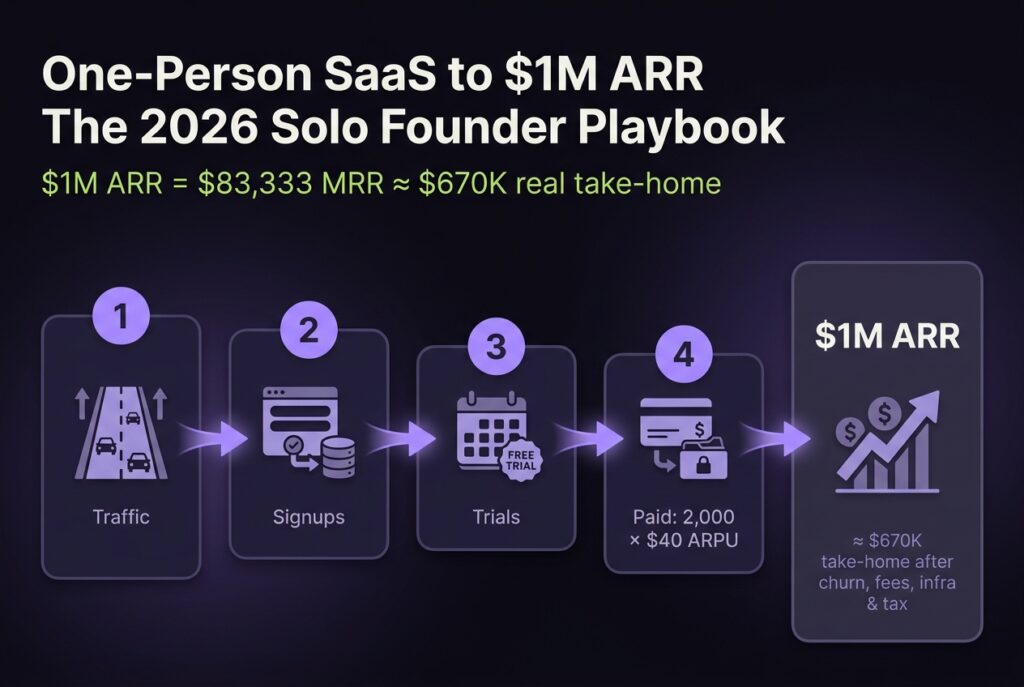
One-Person SaaS to $1M ARR: The 2026 Solo Founder Playbook
In early 2025, Pieter Levels went from zero to a $1M ARR run rate in 17 days with a browser flight simulator he built with AI help (@levelsio on X, 2025). Most coverage focused on the headline. Almost nobody ran the actual math behind it. That gap, between the inspiration tweet and the spreadsheet, is where most solo founders quietly stall out.
This piece is the spreadsheet. We’ll tear down the funnel arithmetic, churn-adjust the revenue, and look at solo founders with public revenue numbers at or near $1M ARR. Then we’ll do the uncomfortable part: what the median solo founder actually earns, why most readers won’t be Pieter, and how the cost structure of building from India bends the breakeven point in your favor.
If you came for inspiration, this isn’t that post. If you came for the playbook, with real numbers, you’re in the right place.
the billion-dollar one-person company thesis
Key Takeaways
- $1M ARR equals roughly $83,333 MRR, but with median B2B SaaS net revenue retention at 82% in 2025, you need to add about $15K of new MRR a year just to stay flat (ChartMogul, 2025).
- Public solo examples above $1M ARR: Pieter Levels (Photo AI alone at $132K-$138K MRR in late 2025), Tony Dinh (TypingMind at ~$130-160K/month), Marc Lou ($1.032M in 2025), and Damon Chen ($1.3M+ ARR across two products by late 2023).
- Indian solo founders selling in USD reach financial freedom around $5K-$8K MRR, a fraction of the US breakeven. A comfortable tier-2 city budget is ₹45,000-₹60,000/month in my experience, while the median Indian software engineer earns about ₹30 lakh a year (Levels.fyi, 2026).
What Does $1M ARR Actually Mean in 2026?
$1M ARR equals $83,333 MRR, but the headline number hides three multipliers most aspiring solo founders never compute: churn drag, payment-processor fees, and infrastructure cost ramp. ChartMogul’s 2025 data put median B2B SaaS net revenue retention at 82%, with the upper quartile at 97%, for businesses above $250K ARR (ChartMogul, 2025). AI-native products fared far worse, at a 48% median. At median B2B NRR, your $83K base shrinks to roughly $68K within 12 months without new acquisition.
The math is simple but rarely written down. If your gross monthly churn is 5% (typical for self-serve SMB SaaS), you lose around 46% of your customers per year through compounding. To maintain 2,000 paying customers at $40 ARPU, you need to acquire roughly 920 net-new paying accounts annually just to stand still. That’s the customer treadmill nobody mentions in the “$1M ARR” tweet.
The real take-home from $1M ARR
Subtract Stripe fees (2.9% + $0.30 per transaction, roughly 3.5% blended for SaaS), then subtract infrastructure. Vercel Pro is $20 per developer seat per month with a $20 usage credit, and Supabase Pro starts at $25/month with $10 of compute credits (Vercel, 2026; Supabase, 2026). At $1M ARR scale, infra and analytics tools typically eat 4-7% of revenue. After processor fees and infra, your $1M ARR is closer to $890K-$920K gross.
0 to $1k MRR playbook for solo founders
From my own books: When I crossed my first $5K MRR, I assumed take-home would be ~$5K. After Razorpay fees, refunds, GST set-aside, hosting, and three SaaS subscriptions I needed (analytics, email, error tracking), real cash in bank was ~$3,800. That’s a 24% leak. At $1M ARR scale, with US-grade tooling stacks, I’ve seen friends settle around 18-20% of gross revenue burning before they even pay themselves.
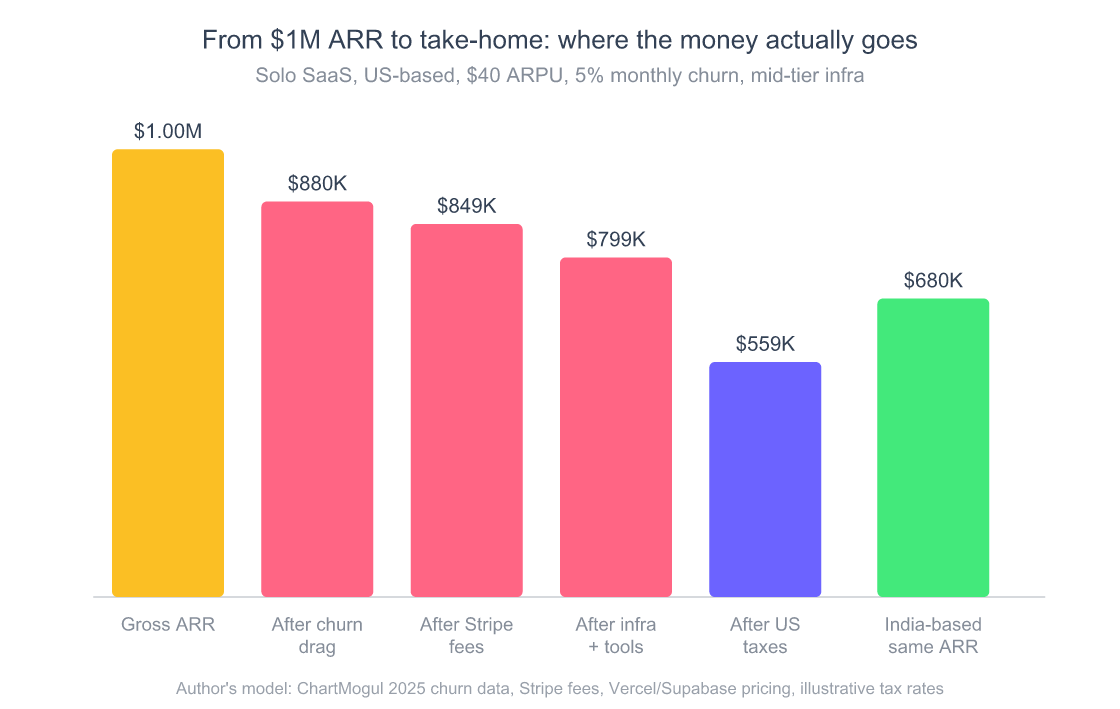
The “$1M ARR” headline obscures roughly $441K of leak in the US case. Indian solo founders retain materially more on the same gross.
Citation capsule: In my model, a US-based solo SaaS at $1M ARR retains roughly $559K after churn drag, payment processing, infrastructure, and federal plus state taxes. The same ARR for an India-based solo founder structured through a private limited company yields closer to $680K after a roughly 25% corporate rate and lower infra burn. The churn input comes from ChartMogul’s 2025 median B2B NRR of 82% (ChartMogul, 2025).
why AI SaaS moats are drying up faster than the revenue
Which One-Person SaaS Founders Have Crossed $1M ARR?
Three solo founders have publicly disclosed revenue at or above $1M ARR: Pieter Levels (across multiple products), Tony Dinh (TypingMind), and Damon Chen (Testimonial.to plus PDF.ai). A fourth, Marc Lou, crossed $1M in 2025 revenue across a portfolio. Each follows a different pattern with a different acquisition channel. Together they sketch the realistic shape of the achievable solo path.

Pieter Levels: portfolio strategy
Pieter Levels runs Nomad List, RemoteOK, Photo AI, Interior AI, and Fly. Photo AI launched in February 2023, hit $77K MRR a year later, and was at $132K-$138K MRR by November 2025 (Indie Hackers, 2025). The same case study puts Photo AI at about 70% of his total, which implies roughly $190K a month across the portfolio, comfortably above $2M ARR. Stack: PHP, jQuery, single index.php files, hosted on a handful of servers. No SPA. No microservices. No team.
Acquisition: he is the channel. Hundreds of thousands of X followers, perpetually building in public, with each launch broadcast to an audience that pre-validates demand. That’s not a copyable channel. It’s an outcome of 12+ years of consistent shipping.
Tony Dinh: the productized AI wrapper
Tony Dinh’s TypingMind is a frontend for OpenAI/Anthropic APIs with team plans. Monthly revenue runs $130-160K, with Team subscriptions now over half of monthly revenue (Tony Dinh newsletter, 2025). He says the product makes more than $1M a year and that he has cut back to about four hours of work a day.
Stack: React/Next.js frontend, BYOK (bring-your-own-key) model so he doesn’t carry token cost on the free tier, Stripe for billing. Acquisition: SEO + Product Hunt + organic referrals from developers. Geographic arbitrage matters here too; he ships from Vietnam.
Damon Chen: product-led B2B SaaS, then a second product
By November 2023, Damon Chen’s Testimonial.to was above $800K ARR and his second product, PDF.ai, above $500K, for $1.3M+ combined (Behind the Craft, 2023). Testimonial.to is a video and text testimonial collector for marketing teams. He launched on Product Hunt selling $199 lifetime deals, then grew through product-led loops: every embedded “Wall of Love” widget advertises the product. An affiliate program drives 10-15% of revenue, and he paid $35K for the testimonial.io domain (Behind the Craft, 2023).
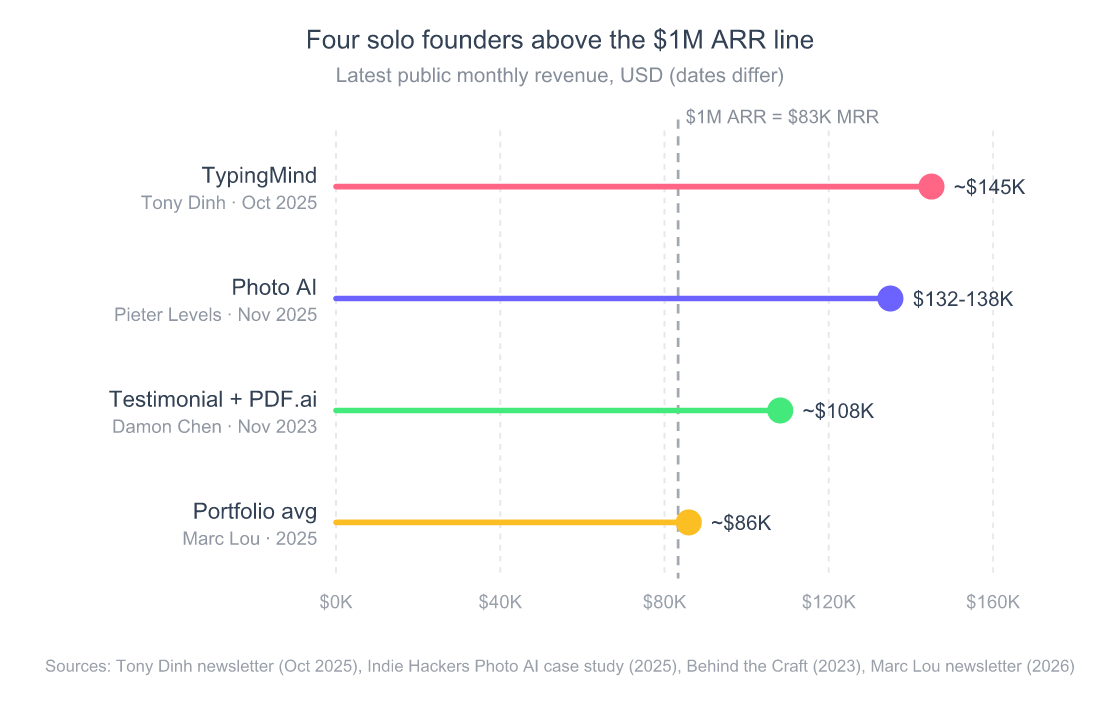
Latest public monthly revenue for four solo founders. Dates differ, so read this as order of magnitude, not a leaderboard.
Citation capsule: Three publicly documented solo SaaS businesses run above $1M ARR: Pieter Levels’ Photo AI at $132K-$138K MRR in November 2025 (Indie Hackers, 2025), Tony Dinh’s TypingMind at $130-160K a month (Tony Dinh, 2025), and Damon Chen’s Testimonial.to plus PDF.ai at $1.3M+ combined ARR in 2023 (Behind the Craft, 2023). Each got there with a single founder, a different acquisition channel, and no VC capital.
the best tech stack for solo founders in 2026
What Does the $1M ARR Funnel Actually Look Like?
Working backwards from $1M ARR at $40 ARPU, a solo SaaS needs roughly 2,083 paying customers, about 26,000 trials, and 300,000-370,000 visitors at industry-median conversion rates. ChartMogul’s January 2026 report on 200 B2B products found a median free-to-paid conversion of 8%. Card-required trials convert at more than 5x the rate of no-card trials: 25-35% counts as good with a card upfront, versus 4-6% without one (ChartMogul SaaS Conversion Report, 2026).
Visitor-to-opt-in-trial conversion runs 7.1% for paid traffic and 8.5% for organic search, across 86 SaaS companies tracked from 2022 to Q3 2025 (First Page Sage, 2025). Stack those numbers and the funnel reveals a brutal truth: solo founders chasing $1M ARR need either an SEO machine, a personal brand that converts cold traffic, or a credit-card-upfront pricing model that shrinks trial volume but converts at more than 5x the rate.
Charging the credit card upfront changes the entire funnel
This is why so many bootstrapped founders now ask for a card upfront. The path from 100,000 visitors to $1M ARR collapses to a feasible scale when you optimize the conversion bottleneck. No-card trials converting at 4-6%? You need roughly five times the top-of-funnel volume of a card-required trial converting at 25-35% (ChartMogul SaaS Conversion Report, 2026).
Counter-intuitive insight: Most “free trial vs paywall” debates frame it as a UX choice. It’s actually an acquisition arithmetic choice. If you have a personal brand or organic channel that funnels 5,000 monthly visitors, a paywall (CC required) puts you at $1M ARR plausibility. If you don’t, free trials buy you the trial volume needed to feed the funnel until you do.

Citation capsule: A solo SaaS targeting $1M ARR at $40 ARPU and ChartMogul’s 8% median trial-to-paid conversion needs roughly 26,000 trials, sourced from about 300,000 visitors at the 8.5% organic visitor-to-trial benchmark (First Page Sage, 2025). That equals ~25,000 monthly visitors over a year, achievable through SEO, X presence, or both, not through paid acquisition for a self-funded founder.
Why Is 2026 a Better Year to Go Solo?
Three structural shifts converged in 2025-2026 that materially lower the bar for one-person SaaS: AI-assisted development, infrastructure consolidation, and AI-driven distribution channels. Each independently shaved months off the build-to-revenue cycle. Stacked together, they compressed what used to be a five-engineer team’s output into a single founder’s weekend.
The Stack Overflow 2025 Developer Survey put 84% of developers using or planning to use AI coding tools, up from 76% in 2024, with 51% of professionals using them daily (Stack Overflow, 2025). Cursor reported that companies merge 39% more PRs after its agent became the default (Cursor, 2025). The cost of entry has dropped too. As of October 2026, Claude Code is included in the $20/month Claude Pro plan, with Max at $100 or $200 for heavier use (Claude pricing, 2026), and OpenAI includes its Codex agent on every ChatGPT plan (ChatGPT pricing, 2026). A solo founder’s whole AI build stack now costs less than one SaaS seat did in 2020.

But the productivity story isn’t clean
A METR study published in July 2025 found that AI tools actually slowed experienced open-source developers by 19%, even though those same developers self-reported being 20% faster (METR, 2025). In the 2025 Stack Overflow survey, 46% of developers said they don’t trust the accuracy of AI output, up from 31% a year earlier (Stack Overflow, 2025).
What does that mean for solo SaaS? The productivity gain is real for greenfield code, prototype velocity, and well-scoped CRUD work, exactly what a solo founder ships in months 1-12. It is not real for hardening, debugging legacy systems, or production-grade distributed code. Solo founders building V1 in 2026 are operating in the productivity sweet spot.
Citation capsule: AI coding tools deliver outsized productivity for solo founders in the prototype-to-V1 phase, with Cursor reporting 39% more PRs merged in agent mode and 84% of developers adopting AI tools by 2025 (Cursor, 2025; Stack Overflow, 2025). The same tools slow experienced developers by 19% on mature OSS codebases, so the advantage is asymmetric and concentrated in early-stage solo work (METR, 2025).
Survivor Bias Check: What Do Median Solo Founders Earn?
One 2025 analysis of 1,000+ micro SaaS businesses, drawing on MicroConf, Y Combinator and Stripe Atlas data, found 70% earn under $1K MRR, another 18% sit between $1K and $5K, and only 1-2% exceed $50K MRR (Rocking Web analysis, 2025). The “$1M ARR solo founder” you see on X is the p95-p99 outcome, not the median path.

This isn’t a reason to avoid building. It’s a reason to budget your runway, expectations, and personal psychology around the median, not the headline. Most solo founders who hit $1M ARR did so on their third, fourth, or seventh product. Pieter Levels’ Nomad List came out of his 2014 “12 startups in 12 months” challenge, and most of the others went nowhere. Marc Lou shipped a long string of small products before ShipFast became the cash cow.
The portfolio thesis matters more than the single-product thesis
If close to 90% of products never clear $5K MRR, the rational solo founder strategy isn’t “build the perfect product.” It’s “ship cheaply, kill ruthlessly, and let your hit rate compound across attempts.” Marc Lou’s $1.032M in 2025 came from 15 income sources, with ShipFast at about $20K a month alongside CodeFast, DataFast, and TrustMRR. Two of his 2025 launches flopped outright (Marc Lou newsletter, 2026).
From my own attempts: I’ve shipped four products since 2023. Three sit between $0 and $200 MRR. One crosses $1.5K MRR. The total time to reach my current MRR was 22 months across all four. If I’d bet everything on the first product, I’d still be at $0. The portfolio mindset is what separates a 22-month learning curve from a 22-month sunk cost.
Citation capsule: Roughly 70% of micro SaaS businesses earn under $1K MRR and only 1-2% exceed $50K MRR, per a 2025 analysis of 1,000+ businesses built on MicroConf, YC and Stripe Atlas data (Rocking Web analysis, 2025). The $1M ARR solo founder is a p95-p99 outcome, typically reached on a portfolio’s third or later attempt rather than a debut launch.
why most SaaS products are failing to scale
How Does the Indian Founder Advantage Change the Math?
An Indian solo founder selling globally in USD reaches financial freedom at roughly $5K-$8K MRR, compared to $20K-$30K MRR for a US-based founder targeting the same standard of living. Indian software engineers earn a median total comp of about ₹30 lakh (~$36K), while the US median is $196,250 (Levels.fyi India, 2026; Levels.fyi US, 2026).
In tier-2 Indian cities (Pune, Hyderabad, Indore, Coimbatore, Jaipur), a comfortable single-person budget runs ₹45,000-₹60,000 a month in my experience, which is roughly $475-$650. The rupee has traded above ₹90 to the dollar in 2026 (X-Rates, 2026). At $5K MRR (more than ₹4.5 lakh a month) you’re earning roughly 8-10x your local cost of living, which is what most US founders only achieve at $20K+ MRR.
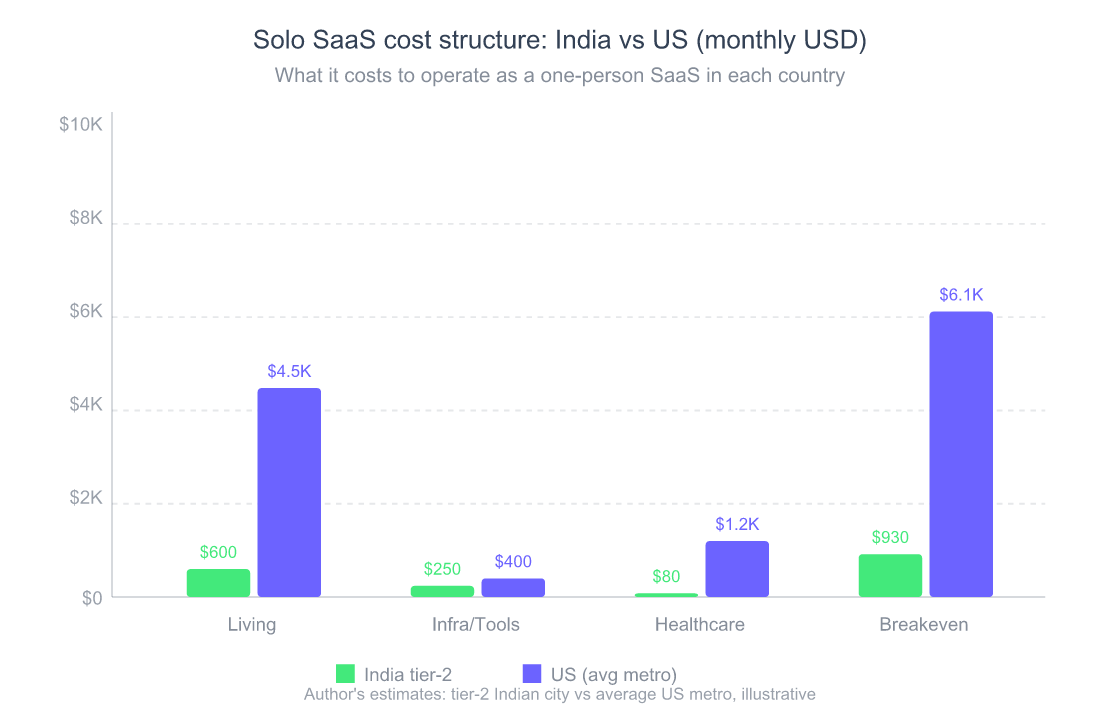
Indian solo founders break even at roughly one-sixth of the US founder’s monthly burn. The same MRR buys ~6x more runway.
Why this isn’t just a cost arbitrage story
The deeper advantage is psychological runway. A US founder at $2K MRR feels poor and quits. An Indian founder at $2K MRR is already net cash-positive and can keep iterating for years. That difference compounds, since most $1M ARR solo founders only hit it on attempt three, four, or seven. The founder who can survive seven attempts wins. Most solo founders quit on attempt two because they ran out of money first.
GST and corporate structure matter here. Setting up a private limited company in India at a roughly 25% corporate rate for turnover under ₹400 crore is materially better than passing $1M ARR through a US LLC, where profit lands in a 37% top federal bracket before state tax. Combine that with lower payroll (you pay yourself), and the Indian solo founder retains more of every dollar earned.
why Indian developers should choose SaaS over freelancing
Citation capsule: By my estimate, an Indian solo founder breaks even on ~$930/month versus ~$6,100/month for a US founder, allowing about 6x more iteration runway at any given MRR. The salary gap points the same way: the median Indian software engineer earns about $36K against $196K in the US (Levels.fyi, 2026). This compounds, because solo founders typically reach $1M ARR on attempt 3-7, and surviving that many attempts is mostly a function of personal burn rate.
What Does the Real MRR-to-Free-Cash-Flow Curve Look Like?
Solo SaaS founders typically don’t see meaningful free cash flow until $5K-$10K MRR, after which it scales nearly linearly until $50K MRR, where infrastructure and tooling costs start compressing margin again. The gap between MRR and take-home isn’t constant, it’s a curve, and understanding it matters more than chasing top-line ARR.
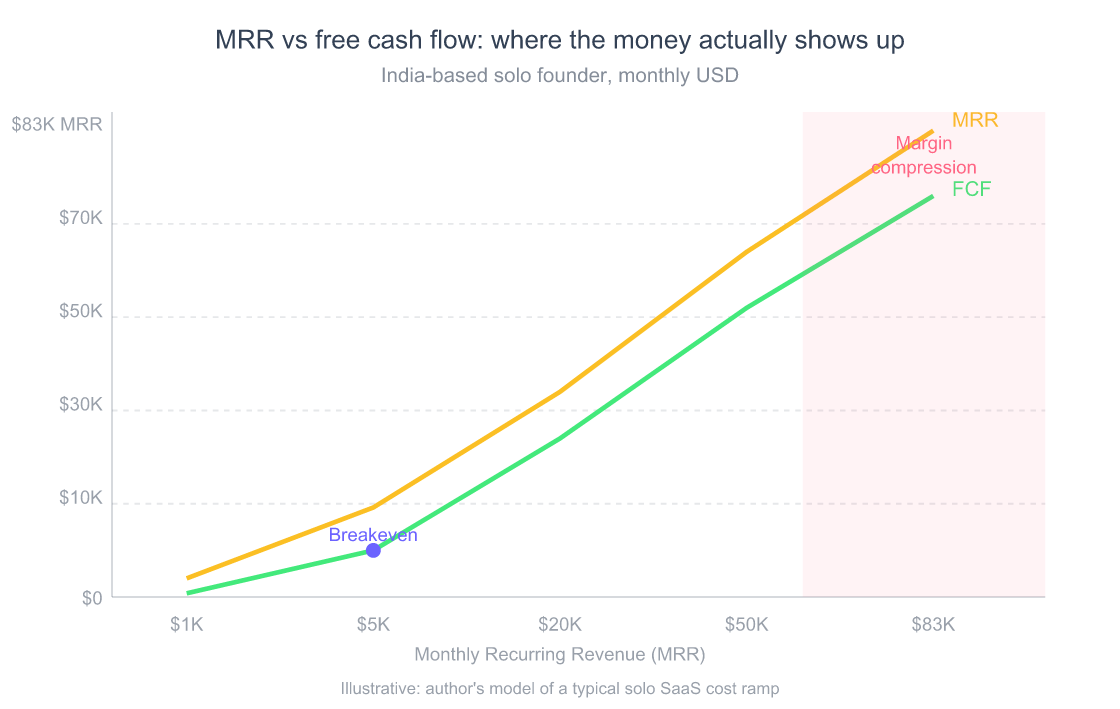
Free cash flow lags MRR throughout the journey. Margin compresses again past $50K MRR as paid tools and support load increase.
What this means for your roadmap
Don’t chase $1M ARR. Chase the slope of the FCF curve. Most solo SaaS that crash do so between $20K and $40K MRR, where founders hire prematurely, add a co-founder, take VC money, and break the unit economics that got them there. The founders who keep the curve steep are the ones who stay solo through the inflection.
Citation capsule: Free cash flow lags MRR for solo SaaS until roughly $5K-$10K MRR, then scales linearly until margin compression begins around $50K MRR from rising tooling and support costs. In the founders I’ve watched, attempts to scale by hiring or raising capital in the $20K-$40K MRR range frequently break the unit economics that got them there. That’s pattern-matching from a small sample, not survey data.
why your AI SaaS moat is drying up
What’s the Actual Playbook to $1M ARR as a Solo Founder?
The realistic playbook is a portfolio of 3-5 products over 4-7 years, with one breakout that crosses $50K MRR and pulls the rest along. No solo founder I’ve found in public revenue dashboards hit $1M ARR on their first product. The shortest path is also the most counter-intuitive one: build many small things until one starts working, then concentrate.
The five steps, ordered by what actually moves the needle
- Pick a market with USD-paying customers. Indian/Vietnamese/Eastern European founders selling to US/EU buyers compounds the cost arbitrage. Domestic-only SaaS in INR caps your ceiling at INR ARPU.
- Charge upfront. Require a credit card. This single decision compresses your funnel volume needs by 4x. It also filters out tire-kickers and gives you free cash flow from month one.
- Pick one acquisition channel and exhaust it. SEO, X audience, Product Hunt, Reddit, B2B outbound, pick one. Every solo founder above $1M ARR is exceptional at one channel, mediocre at others. None of them are good at five.
- Ship the next product before the current one is profitable. Marc Lou’s $1M year came from 15 income sources. Levels found Nomad List inside a 12-startups-in-12-months sprint. The portfolio is the strategy. Single-product solo SaaS is an unsystematic gamble.
- Stay solo through $50K MRR. Hiring is the most common failure mode in the $20K-$40K MRR band. AI tools have made the marginal cost of complexity higher than the marginal cost of solo execution.
why Indian developers should ship SaaS over taking freelance work
Frequently Asked Questions
How much MRR do I need for $1M ARR?
You need $83,333 MRR for $1M ARR. At 5% monthly churn, common for self-serve SMB SaaS, you’ll need to add roughly $4,200 of new MRR every month just to hold that base. Even at ChartMogul’s 2025 median B2B net revenue retention of 82%, you lose about $15K of MRR a year before any growth (ChartMogul, 2025).
What’s a realistic timeline to $1M ARR for a solo founder?
Public timelines vary widely. Pieter Levels’ Photo AI was at $77K MRR a year after launch, close to the $83K line (Indie Hackers, 2025), while Damon Chen took about three years to pass $1.3M ARR across two products (Behind the Craft, 2023). Both had shipped many products before. Most solo founders hit it on their third or later product, so realistically expect 4-7 years across multiple attempts.
Is $1M ARR realistic for solo founders without a personal brand?
Yes, but the channel changes. Damon Chen grew Testimonial.to past $800K ARR mostly through product-led loops (customer-embedded testimonial widgets) and an affiliate program that drives 10-15% of revenue (Behind the Craft, 2023). Tony Dinh used SEO plus Product Hunt for TypingMind. Personal brand accelerates but isn’t required if you can build a defensible distribution channel.
What’s the best stack for solo SaaS in 2026?
The publicly successful solo founders use stacks optimized for shipping speed: Pieter Levels uses PHP and jQuery with single-file architectures, and Tony Dinh uses a React/Next.js frontend with BYOK API patterns. Damon Chen reused about 80% of an earlier product’s code to ship Testimonial.to fast. The stack matters less than minimizing the operational surface area you need to maintain alone.
How do Indian taxes work on global SaaS revenue?
Indian solo founders typically structure as a private limited company under the IT exports framework, with corporate tax at 25% for revenue under ₹400 crore. GST does not apply to export of services when paid in foreign currency through proper channels. Consult a CA, this is the biggest structural decision affecting your take-home from $1M ARR.
The Only Thing That Actually Matters
The math works. Several solo founders have crossed $1M ARR with public revenue using different stacks, different channels, and different products. None of them did it on attempt one. None of them had a team. All of them ran the simple version of the funnel: cheap to build, expensive to charge, ruthless about killing what didn’t work.
For Indian founders, the cost structure tilts the equation further in your favor. You can iterate on three or four products at the cost runway it takes a US founder to attempt one. That’s not a small advantage. It’s the entire game, since the only solo founders who reach $1M ARR are the ones who survive long enough to find the product that does.
If you’re still here, stop reading playbooks and ship the next thing. The math has been waiting for you.