Most “awesome MCP servers” lists have the same problem: they tell you a server exists, not whether it still works. The biggest one on GitHub, punkpeye/awesome-mcp-servers, has nearly 90,000 stars and links to thousands of servers (Ecosyste.ms, 2026). It is a heroic catalog. It is also a flat list, where a server maintained by Stripe sits next to a weekend fork that last shipped a commit in 2024.
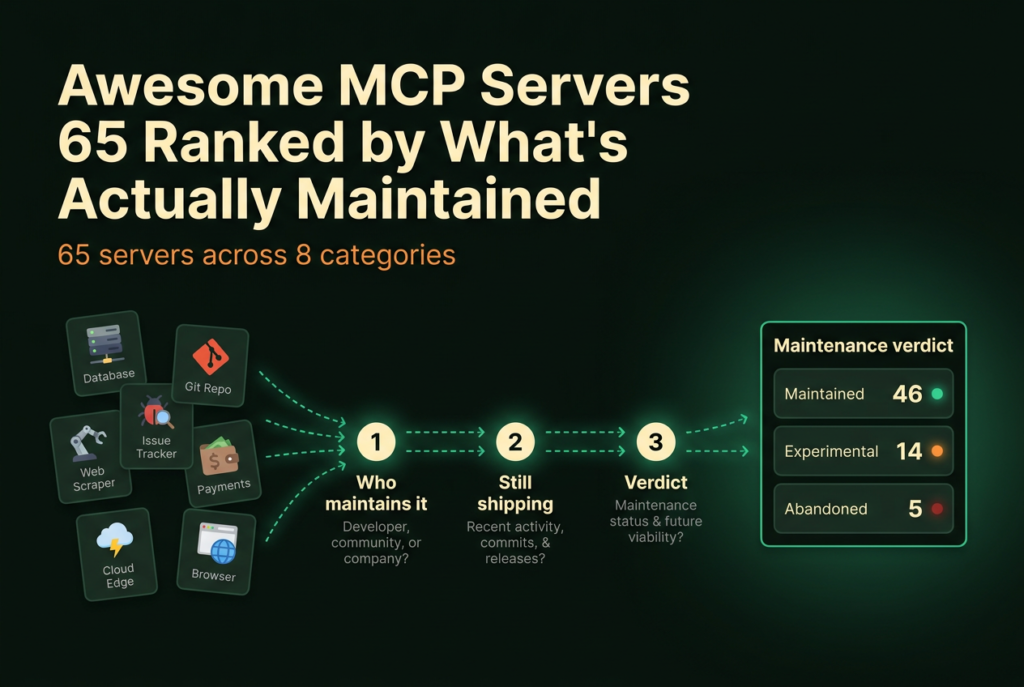
This is the other kind of directory. It is 65 servers I either run myself or have graded against hard repo signals, sorted into 8 categories, with one column that does the real work: a maintenance verdict. Maintained, Experimental, or Abandoned. That column is the whole point of the page. For what MCP actually is, the M×N integration problem it solves, and how transports work, start with the complete 2026 guide to MCP servers and the broader ecosystem; this spoke assumes you already know the basics and just want the ranked list.
Key Takeaways
- Anthropic archived 13 of its 20 original reference servers in 2025, leaving 7 maintained (Filesystem, Fetch, Memory, Sequential Thinking, Time, Git, Everything) (modelcontextprotocol/servers-archived, 2026). A directory without a maintenance column is already out of date.
- Of the 65 servers I rank here, 46 are Maintained, 14 Experimental, and 5 Abandoned. That looks healthy only because the list is pre-filtered. The wider ecosystem is 52% dead (Rapid Claw, 2026).
- Maintainer identity predicts survival better than star count. Every one of the 37 first-party vendor servers here is Maintained; the abandoned ones are all old reference repos or community wrappers a vendor later replaced.
- Install official-first. For most jobs the right pick is the server published by the company that owns the underlying API: GitHub, Stripe, Cloudflare, Linear, Notion, Supabase, Figma.
Table of Contents
- How Did I Rank These MCP Servers?
- Core Utilities and Anthropic Reference Servers
- Dev Tools and Code Intelligence Servers
- Database MCP Servers
- Search, Web, and Scraping Servers
- Productivity and SaaS Servers
- Cloud, Infra, and DevOps Servers
- AI, Media, and Generative Servers
- Communication and Messaging Servers
- What Does the Maintenance Split Tell You?
- How Do I Wire These Into Claude Code?
- Frequently Asked Questions
- The Bottom Line
How Did I Rank These MCP Servers?
Anthropic archived 13 of its 20 original reference servers in 2025, keeping just 7 alive (modelcontextprotocol/servers-archived, 2026). When the people who wrote the protocol retire two-thirds of their own examples, “does it exist” stops being a useful question. “Is anyone still fixing it” is the one that matters.
So every entry below carries one of three statuses, and I want to be honest about how I assigned them. I’ve run roughly 25 of these 65 in real projects. The rest I graded on repo signals you can check yourself: who maintains it, when the last commit landed, the open-to-closed issue ratio, and whether releases are tagged on a cadence or trail off.
Here is the rubric, plainly:
- Maintained. A first-party server from the vendor that owns the underlying API, or a community repo with commits in roughly the last 30 days, triaged issues, and tagged releases. Production-considerable, once you scope its credentials properly.
- Experimental. It works, but it’s young, single-maintainer, or a thin wrapper around one API. Commits come in bursts. Fine for personal and dev use; I would not build infrastructure on it yet.
- Abandoned. Archived, superseded by an official server, or quiet for six months or more. Listed on purpose, so you can recognize the dead fork before you install it.
One caveat on the data. I deliberately did not invent star counts or download numbers per server, because those get stale weekly and most “X downloads” claims are unverifiable. The signal I trust is recency and maintainer identity, and a 2026 Rapid Claw audit backs the instinct: across 2,181 remote endpoints, the median server had just 6 commits and was last touched 142 days ago. Most of the ecosystem is not abandoned because it failed. It’s abandoned because the vendor shipped an official replacement and everyone moved on.
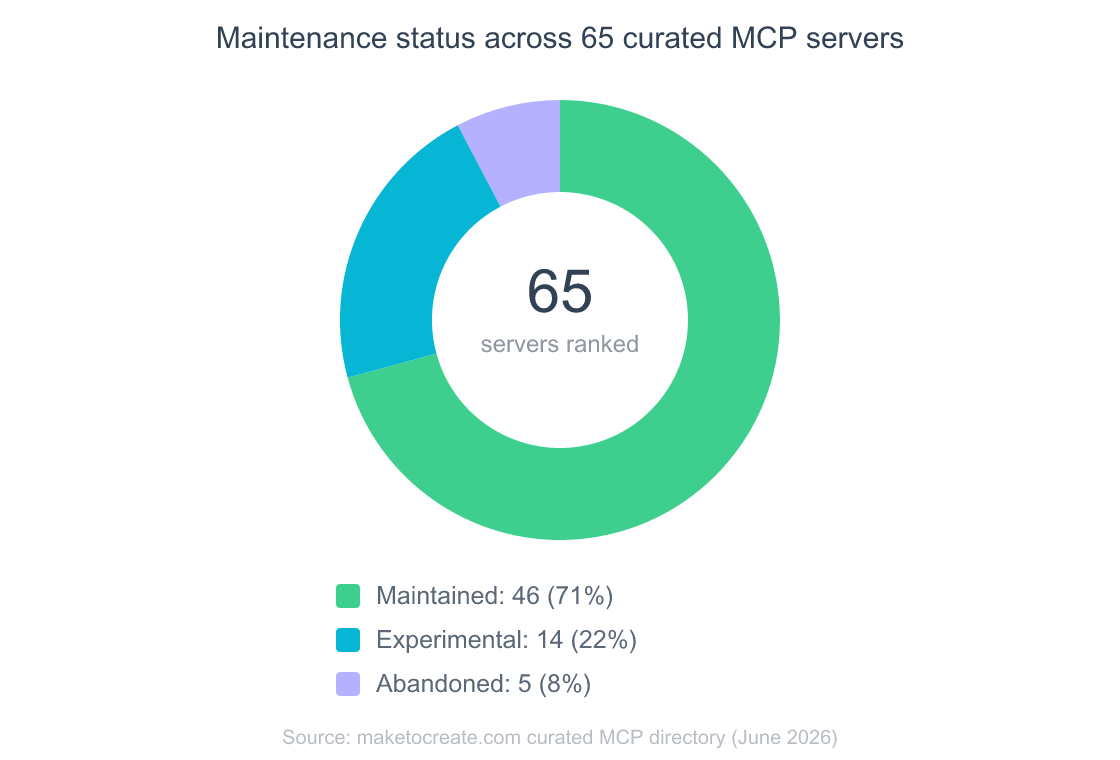
A reasonable question: if the open web is half-dead, why does my list read 71% Maintained? Because it’s a shortlist, not a census. I threw out the dead forks before counting. The ratio you see here is what’s left after the filter, which is exactly the filter you want someone else to have run for you.
Core Utilities and Anthropic Reference Servers
These are the primitives every other workflow leans on, and they are also where the archiving carnage is most visible. Of Anthropic’s reference set, 7 servers are still maintained and the rest now live in a read-only graveyard repo with no security guarantees (modelcontextprotocol/servers-archived, 2026). Install the live ones; recognize the dead ones so you don’t copy a 2024 config that points at them.
| Server | Maintainer | Status | Verdict |
|---|---|---|---|
| Filesystem | Anthropic (reference) | Maintained | The one nobody skips. Every agent that touches code needs scoped file I/O. Rock solid. |
| Fetch | Anthropic (reference) | Maintained | Pulls a URL to markdown. The HTML conversion is naive; pair it with Firecrawl for anything real. |
| Memory | Anthropic (reference) | Maintained | A knowledge graph that survives sessions. Cute demo; I use Notion or a real DB instead. |
| Sequential Thinking | Anthropic (reference) | Maintained | A structured reasoning loop. Helps weak models more than strong ones. when sequential-thinking actually earns its tokens. |
| Time | Anthropic (reference) | Maintained | Timezone math. A one-trick utility that does its one trick well. |
| Everything | Anthropic (reference) | Maintained | The test server that exercises every MCP feature. Build against it, don’t ship it. |
| Git | Anthropic (reference) | Maintained | Useful, but it took three CVEs in January 2026 (Hacker News, 2026). Pin a known-good version. |
| SQLite | Anthropic (archived) | Abandoned | Archived. Use a community fork or write your own; it’s about 200 lines. |
| Puppeteer | Anthropic (archived) | Abandoned | Archived in favor of Playwright. Don’t start here in 2026. |
| EverArt | Anthropic (archived) | Abandoned | Image-gen reference, archived. See the genmedia entry below instead. |
| Google Maps | Anthropic (archived) | Abandoned | The reference version is dead. Use a current community or Google-hosted server. |
Dev Tools and Code Intelligence Servers
This is where MCP earns its keep, and the split between official and community could not be cleaner. According to a 2026 vendor roundup, the verified vendor-maintained dev servers (GitHub, Microsoft Playwright, Figma, Sentry) are now the default in most installs (Techsy, 2026). The community code-intelligence tools are more interesting and far more volatile.
| Server | Maintainer | Status | Verdict |
|---|---|---|---|
| GitHub | GitHub (official) | Maintained | The gold standard. Rewritten in Go, 23 toolsets. Full field notes: the GitHub MCP server in depth, auth math and rate limits. |
| GitLab | Community | Experimental | Functional, but lags GitHub’s feature set. Fine if GitLab is where your work lives. |
| Sentry | Sentry (official) | Maintained | Query errors, releases, and replays from the editor. Surprisingly polished. |
| Atlassian (Jira/Confluence) | Atlassian (official) | Maintained | Solid. SSE transport is deprecated; migrate to Streamable HTTP before June 30, 2026. |
| Figma | Figma (official) | Maintained | Reads designs, extracts components, writes back to canvas. Genuinely impressive. |
| Context7 | Upstash (community) | Maintained | Injects up-to-date library docs into context. Very active; one of the few community servers I trust. |
| Serena | Community | Experimental | Semantic code retrieval over a project. Promising for large repos, still moving fast. |
| Desktop Commander | Community | Experimental | Terminal and file ops on your machine. Popular and handy, but the blast radius is your whole disk. |
| 21st.dev Magic | Community | Experimental | Generates UI components on demand. Fun, niche, and tied to one service’s roadmap. |
| Task Master | Community | Experimental | Breaks specs into agent task lists. Useful pattern, single-maintainer pace. |
Database MCP Servers
The database category is the highest-leverage one I run, and it’s also where Anthropic’s archiving stung most. The official Postgres reference is archived; the maintained successor is community-built and better. A working DB server changes how you prototype, so this is worth getting right. For the safe setup pattern (role hardening, the read-only trade-off, why you never hand an agent your superuser string) see the deep dive linked in the table.
| Server | Maintainer | Status | Verdict |
|---|---|---|---|
| Postgres MCP Pro | Crystal DBA (community) | Maintained | Configurable read/write plus an index advisor. The one I install everywhere. Setup walkthrough: connecting a Postgres MCP server to AI agents safely. |
| Postgres | Anthropic (archived) | Abandoned | The original reference, now archived. Superseded by Postgres MCP Pro. |
| Supabase | Supabase (official) | Maintained | Queries, migrations, logs, project management. Excellent for Supabase shops. |
| Neon | Neon (official) | Maintained | Branch-per-session is the killer feature. Spin up a throwaway DB branch for each agent run. |
| Redis | Redis Inc. (official) | Maintained | Key-value, streams, vector ops. Reliable for caching workflows. |
| ClickHouse | ClickHouse Inc. (official) | Maintained | Analytical SQL over your warehouse from a chat. Quietly excellent. |
| MongoDB | MongoDB (official) | Maintained | First-party document and aggregation access. A clean recent addition. |
| MySQL | Community | Experimental | Several forks, no clear winner. Works, but read the code before you trust writes. |
Search, Web, and Scraping Servers
If your agent needs the live web, this is the category that matters, and it is unusually healthy. Nearly every entry is a first-party server from a search or scraping vendor that treats the MCP as a product, not a side project. Firecrawl is the one I reach for first for structured scraping; Playwright owns browser automation via the accessibility tree rather than brittle vision.
| Server | Maintainer | Status | Verdict |
|---|---|---|---|
| Firecrawl | Firecrawl (official) | Maintained | Best-in-class scraping with structured extraction. My default for “read the web.” |
| Brave Search | Brave (official) | Maintained | An independent index. Cheaper and gentler on rate limits than the big search APIs. |
| Exa | Exa Labs (official) | Maintained | Semantic web search with domain and date filters. Excellent for research agents. |
| Tavily | Tavily (official) | Maintained | A search API built specifically for LLM agents. Clean results, low ceremony. |
| Perplexity (Sonar) | Perplexity (official) | Maintained | Adds Perplexity’s answer engine as a tool. Good when you want sourced summaries, not raw links. |
| Apify | Apify (official) | Maintained | Thousands of pre-built scrapers (Actors) exposed as tools. Powerful, metered by usage. |
| Browserbase (Stagehand) | Browserbase (official) | Maintained | Cloud browsers for automation at scale. The remote answer to local Playwright. |
| Playwright | Microsoft (official) | Maintained | Browser automation via the accessibility tree. Beats vision-based competitors on reliability. |
| Chrome DevTools | Google (official) | Maintained | Drives a real Chrome for debugging and perf traces. A strong recent first-party entry. |
| DuckDuckGo | Community | Experimental | A no-API-key search option. Handy for quick lookups; rate limits bite under load. |
Productivity and SaaS Servers
This is where MCP starts to feel like the future. An agent that reads your Linear tickets, posts to Slack, and updates Notion in one prompt is a different tool from “chat plus copy-paste.” The official servers here are reliable; the community ones are where you should scope tokens hardest, because a productivity server usually has write access to something you care about.
| Server | Maintainer | Status | Verdict |
|---|---|---|---|
| Notion | Notion (official) | Maintained | Pages, databases, comments, search. Smooth and well-documented. |
| Linear | Linear (official) | Maintained | Issues, projects, cycles. Best-in-class for issue tracking. |
| Slack | Salesforce / Slack (official) | Maintained | Search, read, post, create canvases. Powerful and a little scary; scope the workspace token. |
| Asana | Asana (official) | Maintained | Tasks, projects, timelines. Solid if your team lives in Asana. |
| Google Workspace | Google (official) | Maintained | Drive, Gmail, Calendar, Chat. Enormous blast radius; grant the narrowest scopes you can. |
| HubSpot | HubSpot (official) | Maintained | A first-party remote server for CRM data. Good for sales and marketing agents. |
| Airtable | Community | Experimental | Reads and writes bases. Works well; tied to one maintainer’s availability. |
| Obsidian | Community | Experimental | Talks to your local vault. Lovely for note workflows, several competing forks. |
Cloud, Infra, and DevOps Servers
These are the servers where you check the scope twice before you connect. A misconfigured Stripe server can refund a real customer; a misconfigured Cloudflare server can take a real site down. The good news is that this category is almost entirely first-party and well-maintained. The OX Security SDK flaw disclosed in April 2026 put an estimated 200,000 servers at theoretical risk, which is the strongest argument going for pinning versions and using official builds (The Register, 2026).
| Server | Maintainer | Status | Verdict |
|---|---|---|---|
| Cloudflare | Cloudflare (official) | Maintained | Workers, KV, R2, D1, Analytics. The reference implementation for a remote server. |
| AWS Labs | AWS (official) | Maintained | Cost Explorer, CloudWatch, Aurora, CDK, S3. Use read-only IAM roles. |
| Azure | Microsoft (official) | Maintained | First-party access to Azure resources and the CLI surface. Scope it down hard. |
| Vercel | Vercel (official) | Maintained | Deployments, env vars, logs. Useful for ops triage from the editor. |
| Docker | Docker (official) | Maintained | The MCP Catalog and Toolkit, plus a gateway for running servers in containers. |
| Terraform | HashiCorp (official) | Maintained | Reads registry modules and state. Good for IaC-aware agents; never auto-apply. |
| Grafana | Grafana Labs (official) | Maintained | Query dashboards, panels, and incidents. A clean observability bridge. |
| Stripe | Stripe (official) | Maintained | Customers, invoices, refunds. Use restricted keys, never live secret keys. |
| PayPal | PayPal (official) | Maintained | Inventory, payments, shipping. Read-only is your friend here. |
| Kubernetes | Community | Experimental | Several servers wrap kubectl. Genuinely useful, genuinely dangerous; read-only contexts only. |
AI, Media, and Generative Servers
If you want an agent to make images, audio, or video rather than fetch data, this is the category, and Google’s first-party suite leads it. The mcp-genmedia servers wire Gemini image generation, Veo, Chirp, and Lyria into any MCP client, billed through Vertex AI instead of a separate key. I cover the tool schema and which model IDs are production-ready in the deep dive linked below.
| Server | Maintainer | Status | Verdict |
|---|---|---|---|
| Google genmedia | Google (official) | Maintained | Gemini images, Veo video, Chirp TTS, Lyria music in one suite. Field notes: running Google’s genmedia MCP for Gemini image generation. |
| ElevenLabs | ElevenLabs (official) | Maintained | Text-to-speech and voice tools. The reliable pick for narration and audio agents. |
| Hugging Face | Hugging Face (official) | Maintained | Search models and datasets, run inference endpoints. A good open-model bridge. |
| Replicate | Community | Experimental | Runs Replicate models as tools. Flexible, but quality tracks whatever model you point it at. |
Communication and Messaging Servers
This is the most community-heavy category in the directory, which is exactly why it has the lowest Maintained ratio. Chat platforms are easy to wrap and hard to keep current as APIs shift, so most of these are single-maintainer projects. Twilio is the outlier with a first-party server; treat the rest as convenient rather than dependable.
| Server | Maintainer | Status | Verdict |
|---|---|---|---|
| Twilio | Twilio (official) | Maintained | First-party SMS and messaging access. Early but vendor-backed. |
| Discord | Community | Experimental | Reads and posts to channels. Popular, but bot-token scope is everything. |
| Telegram | Community | Experimental | Bot-based messaging. Works; several forks, pick the most recently updated. |
| Resend | Community | Experimental | Sends transactional email. Simple and handy, watch the send scope. |
What Does the Maintenance Split Tell You?
The clearest signal in this whole directory is not which server is best. It’s who maintains it. Every one of the 37 first-party vendor servers I ranked is Maintained. Every Abandoned entry is either an old Anthropic reference repo or a community wrapper a vendor later replaced. Maintainer identity, not stars, is the variable that predicts whether a server will still install cleanly next quarter.
That’s the pattern worth internalizing: the remote ecosystem grew from 16 hosted servers in January 2026 to more than 25 by April as Atlassian, HubSpot, Linear, Slack, Sentry, Neon, and Vercel all shipped official endpoints (Techsy, 2026). Each official launch quietly kills a handful of community forks. So the half-dead ecosystem isn’t a failure story, it’s a succession story, and the chart below is the shape of it.
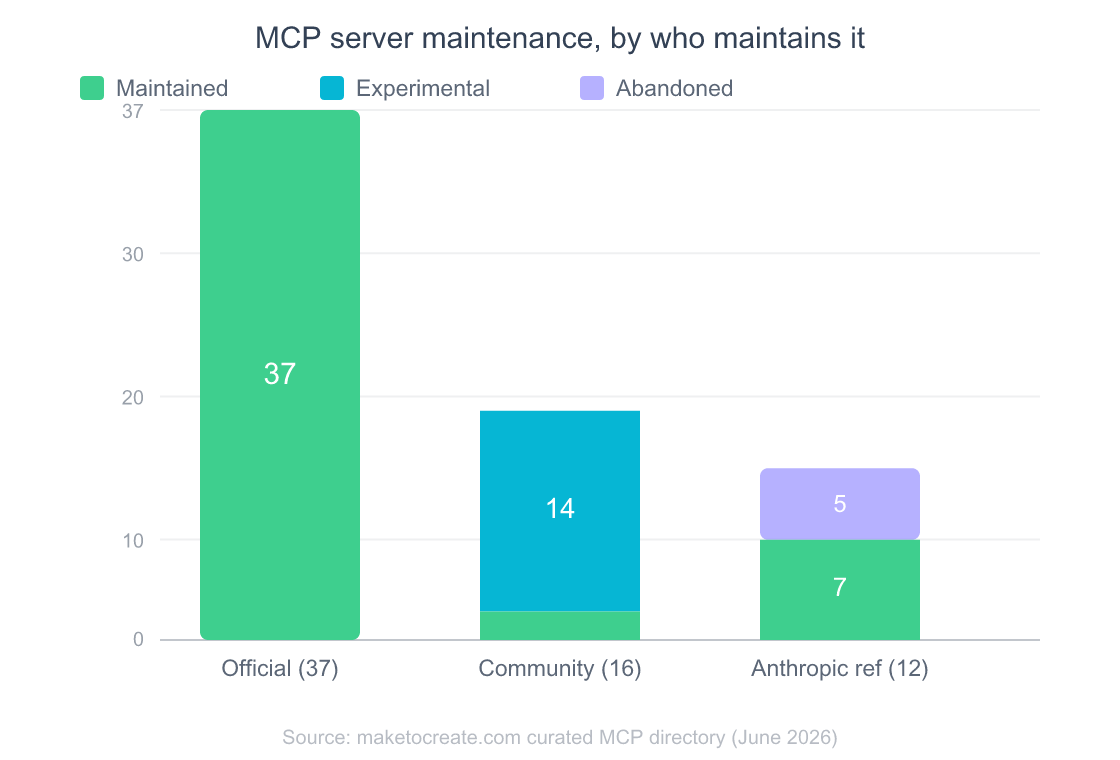
Read it left to right and the buying advice writes itself. The official column is a solid wall of green. The community column is mostly experimental, with two standouts (Context7 and Postgres MCP Pro) that earned their Maintained badge the hard way. The reference column is split down the middle: a healthy maintained core, and a pile of archived servers you should stop copying from old tutorials.
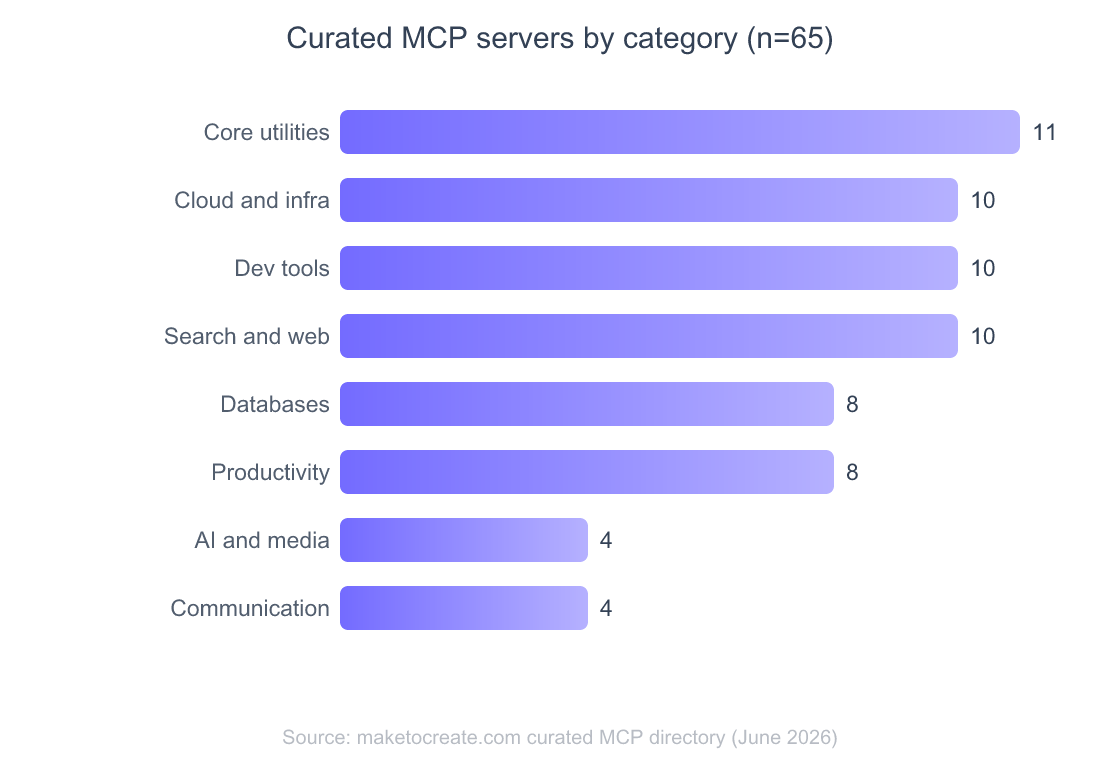
For balance, here’s the same 65 sorted by category, so you can see where the depth actually is.
How Do I Wire These Into Claude Code?
Picking a server is half the job; the other half is plumbing it into your client without leaking a credential. The official MCP Registry launched in preview on September 8, 2025 as a single source of truth for discovery, which makes finding the right package easier than it was a year ago (Model Context Protocol Blog, 2025). It does not, however, tell you how to scope the thing safely.
The honest order of operations I follow: pick by maintainer first, transport second, use case third. Prefer Streamable HTTP for remote servers and stdio for local tools you trust. Pin a specific version rather than chasing @latest, because npx -y package@latest is a supply-chain rug-pull waiting to happen. Then grant the narrowest scope the server will accept, because the difference between a read-only token and a write token is the difference between a helpful agent and an incident.
For the actual config files, the JSON shapes, and the per-client gotchas across Claude Code and Claude Desktop, follow the complete guide to wiring MCP servers into Claude Code and Desktop. If your stack is ChatGPT rather than Claude, the connector model is different and worth its own read: 12 MCP integrations that work with ChatGPT today.
Frequently Asked Questions
What is the awesome-mcp-servers list?
“awesome-mcp-servers” usually refers to the GitHub repo punkpeye/awesome-mcp-servers, a community catalog with nearly 90,000 stars linking to thousands of servers (Ecosyste.ms, 2026). It’s comprehensive but flat: it lists servers without telling you which are maintained, which is the gap this ranked directory fills.
What are the best MCP servers in 2026?
For most developers the best MCP servers are the first-party ones from the API owner: GitHub, Stripe, Cloudflare, Linear, Notion, Supabase, and Figma, plus Firecrawl and Playwright for the web. All 37 vendor servers in this directory rank Maintained, while only 2 of 16 community servers do. Maintainer identity is the strongest quality signal you have.
How many MCP servers actually exist?
The official registry and community catalogs list thousands, but most are inactive. A 2026 Rapid Claw audit of 2,181 remote endpoints found just 9% fully healthy, 31% lightly maintained, and 52% abandoned or erroring (Rapid Claw, 2026). The realistic shortlist worth evaluating is a few dozen, which is why this directory caps at 65.
Are MCP servers safe to use?
It depends entirely on the server. Official servers from major vendors are audited and patched. Random community servers are risky: researchers filed 30-plus CVEs against popular servers in early 2026, and tool-poisoning attacks succeed about 84% of the time against auto-approving clients (MCPTox, 2025). Pin versions, scope credentials, and prefer first-party.
Should I use the official Anthropic reference servers?
Use the 7 still maintained (Filesystem, Fetch, Memory, Sequential Thinking, Time, Git, Everything) and ignore the rest. Anthropic archived 13 of its original 20 references into a read-only repo with no security guarantees (modelcontextprotocol/servers-archived, 2026). Old tutorials still point at the dead ones, so check before you copy a config.
The Bottom Line
A good MCP server directory isn’t the longest list. It’s the one that already threw out the dead forks for you. The 65 servers here are the ones I’d actually evaluate in 2026, and the single most useful column is the status: 46 Maintained, 14 Experimental, 5 Abandoned.
If you remember one thing, make it this: install official-first. The vendor that owns the API has every incentive to keep its server alive, and the data bears it out, every first-party server in this directory is Maintained while half the reference repos are dead. Start with the boring official servers, add a community one only when it earns the Experimental risk, and pin your versions either way. For the why behind all of it, the protocol, the transports, and where the ecosystem is heading, go back up to the complete 2026 guide to MCP servers.