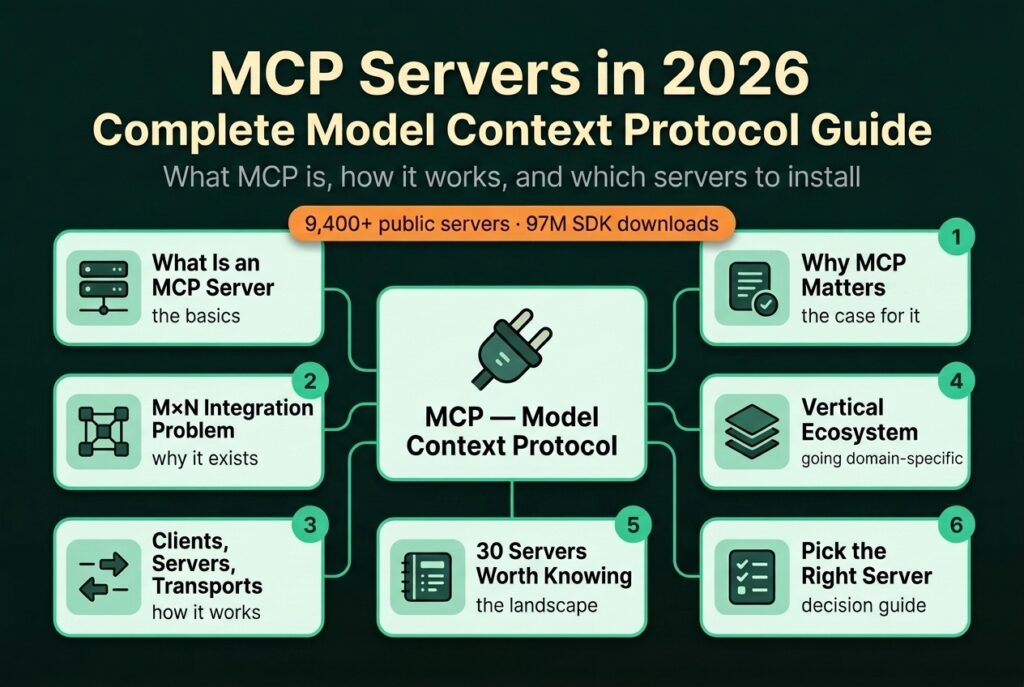
Eighteen months after Anthropic shipped the Model Context Protocol, the registry counts have gone vertical. Public MCP servers jumped from roughly 1,200 in Q1 2025 to 9,400+ by April 2026 (Zylos research, 2026), and SDK downloads cleared 97 million monthly in March (Digital Applied citing Anthropic, 2026). OpenAI adopted it. Google adopted it. Microsoft shipped it inside Copilot Studio. Yet I’d argue maybe a tenth of the servers in those registries are actually worth installing.
I’ve evaluated and wired MCP servers into Claude Code, custom agents, and a few internal tools over the past year. This guide is the working map: what MCP is in plain language, how the architecture really works after the 2025 transport shake-up, and a categorized landscape of 30 servers I’ve personally checked, with the honest take on which are production-ready and which are vibe experiments.
Key Takeaways
- MCP is an open protocol that lets any AI client talk to any tool through a single JSON-RPC interface, it solves the M×N integration explosion by becoming M+N (Anthropic, 2024).
- The ecosystem grew 30 → 9,400 servers in 18 months and SDK downloads hit 97M/month in March 2026, with stdio and Streamable HTTP as the two transports that actually matter.
- 52% of remote MCP endpoints are effectively dead as of April 2026; only 9% are fully healthy (Rapid Claw audit, 2026). Pick maintainers, not stars.
- Official first-party servers from GitHub, Stripe, Linear, Cloudflare, Notion, Sentry, and Figma are the safest bets, most “Awesome MCP” entries are abandoned forks.
- Security is the unsolved problem. Three CVEs hit Anthropic’s own Git server in January 2026, and a critical RCE (CVSS 9.6) shipped in
mcp-remote(JFrog, 2025).
What Is an MCP Server, Actually?
An MCP server is a small program that exposes tools, resources, and prompts to an AI client through the Model Context Protocol, a single JSON-RPC 2.0 interface Anthropic open-sourced in November 2024 (Anthropic, 2024-11-25). Think USB-C, but for plugging AI assistants into data sources, APIs, and local tools. The client (Claude Code, Cursor, OpenAI’s Agents SDK, Gemini) doesn’t need to know anything about Stripe’s API or Postgres internals, it just calls tools/list and tools/call over the protocol, and the server does the rest.
The original announcement was modest. Anthropic shipped reference servers for filesystem, fetch, git, and a handful of databases, plus SDKs in Python and TypeScript. Then the dominoes fell. OpenAI announced full MCP support on March 26, 2025 across its Agents SDK, Responses API, and ChatGPT desktop client (TechCrunch, 2025). Google DeepMind committed Gemini to the standard two weeks later (TechCrunch, 2025). Microsoft made MCP generally available in Copilot Studio later that year (Microsoft, 2025).
What makes MCP different from “yet another plugin system”? Three things. First, it’s bidirectional, servers can request things from the client too, not just respond. Second, it’s transport-agnostic, so the same server can run as a local subprocess or a remote HTTPS endpoint. Third, every major AI vendor agreed on it within a year. That last part is the moat. The Stack Overflow 2025 Developer Survey found 43% of AI-agent developers already using the GitHub MCP server alone (Stack Overflow, 2025), parity with Redis usage, which is wild for a 12-month-old standard.
The mental model that finally stuck for me: a server is a typed wrapper around a backend (a database, an API, a piece of the filesystem). The protocol gives every AI client the same shape to call into it. You stop writing per-model adapters and start writing per-service servers. Once.
Why MCP Matters: The M×N Integration Problem
Before MCP, every AI client had to write a custom integration for every tool, an M×N problem that scaled badly. With 5 clients and 50 tools, that’s 250 integrations, each one rotting at a different pace. MCP collapses this to M+N: each client implements the protocol once, each tool exposes a server once, and they connect through a stable interface (MCP spec, 2025).
This is the same shift OpenAPI made for REST or LSP made for editor language support. Before LSP, every editor wrote a Python plugin, a Go plugin, a TypeScript plugin (N×M chaos).After LSP, a language ships one server and every editor speaks it. MCP is the LSP moment for AI agents. Anthropic openly cited LSP as the inspiration when they shipped it (Anthropic engineering, 2025).
What most listicles miss: the real value of MCP isn’t reducing integration count. It’s reducing coordination cost. If Stripe wants to enable AI agents, they ship one official MCP server. That server immediately works with Claude Code, ChatGPT, Cursor, Gemini, and every internal Agents SDK build at every Fortune 500 customer. They don’t negotiate a partnership with Anthropic, then a different partnership with OpenAI, then a third with Google. They publish a server, and the entire ecosystem picks it up. This is why Stripe, Linear, Notion, GitHub, Cloudflare, Figma, PayPal, and Asana all shipped first-party servers within a year of the spec landing, the unit economics finally made sense.
The pattern is also why low-status integrations got served first. A Postgres MCP server doesn’t need executive buy-in or a roadmap slot; one engineer writes it in a weekend and the entire AI tooling stack instantly grows a hands-on database tool.
How MCP Works: Clients, Servers, and Transports
An MCP system has three pieces: clients (Claude Code, Cursor, ChatGPT, custom agents), servers (the wrappers around tools), and transports (how the JSON-RPC messages travel between them). Clients discover servers via configuration, call initialize to negotiate capabilities, then call tools/list to find what’s available and tools/call to invoke them (MCP spec, 2025). For client-specific setup, see the deep dives on configuring MCP servers in Claude Code, scope rules, and the debugging loop and the 12 ChatGPT MCP integrations worth wiring up in Developer Mode.

The transport layer is where most of the confusion lives, because it has changed twice in 18 months. There are three transport types you’ll see in the wild:
- stdio, the server runs as a local subprocess, the client pipes JSON-RPC over standard input/output. Fastest, simplest, no network. Every local dev tool ships this way. Roughly 62% of registry servers use stdio.
- Streamable HTTP, the current standard for remote servers. Added in the March 26, 2025 spec revision to replace the original HTTP+SSE pattern. Single endpoint, supports both request/response and server-initiated streaming. About 31% of servers and climbing fast.
- HTTP+SSE (deprecated), the original remote transport. Server-Sent Events plus a separate POST endpoint. Still around but officially superseded. Atlassian’s Rovo MCP is forcing migration by June 30, 2026 (Atlassian, 2026).
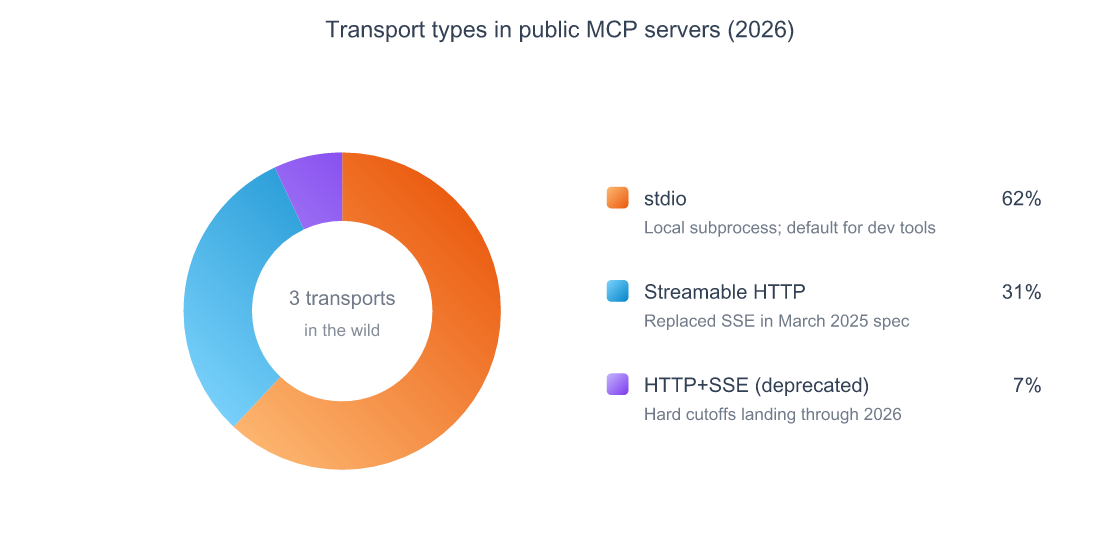
Source: Apigene transport survey, MCP spec revision 2025-03-26, Atlassian Rovo deprecation notice (2026)
Auth lives on top of the transport. Local stdio servers usually take credentials through environment variables or a config file. Remote servers almost universally use OAuth 2.1 with PKCE, which the MCP spec adopted as the recommended pattern in the same March 2025 revision. The auth handshake is one of the parts that tripped me up early, if you’ve ever wondered why your remote server prompts you to log in every time you restart your client, you’re hitting a token-storage mismatch the spec is still ironing out.
The MCP Ecosystem Has Gone Vertical
If you’d told me in late 2024 that a brand-new JSON-RPC protocol would have 9,400 public servers, 97M monthly SDK downloads, and OpenAI’s blessing inside 16 months, I’d have called it optimistic marketing. The growth curve isn’t a hockey stick, it’s a ladder (Pento year-in-review, 2026).
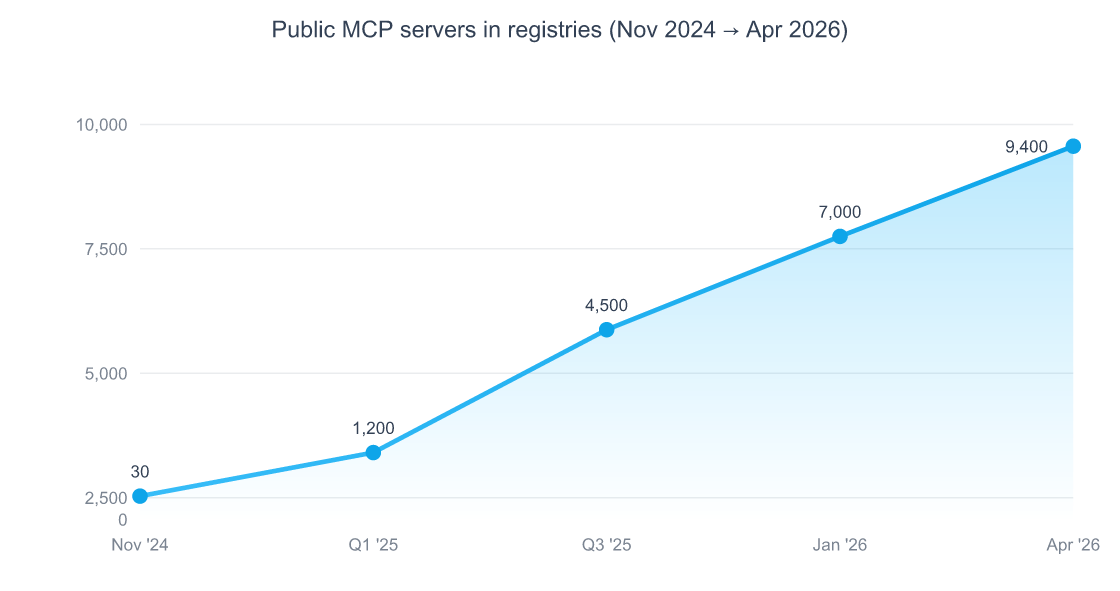
Source: Anthropic launch reference, PulseMCP and Zylos registry counts (2025–2026)
The repos that anchor the ecosystem are easy to spot. modelcontextprotocol/servers (the reference implementations) sits at 85.7k GitHub stars; the community-curated awesome-mcp-servers list passed it at 86.9k (GitHub, 2026). The Python and TypeScript SDKs combined account for over 35k stars and that 97M monthly download figure. For a 2024-vintage standard, those numbers put MCP roughly in the same orbit as Next.js or LangChain when they hit their inflection points.
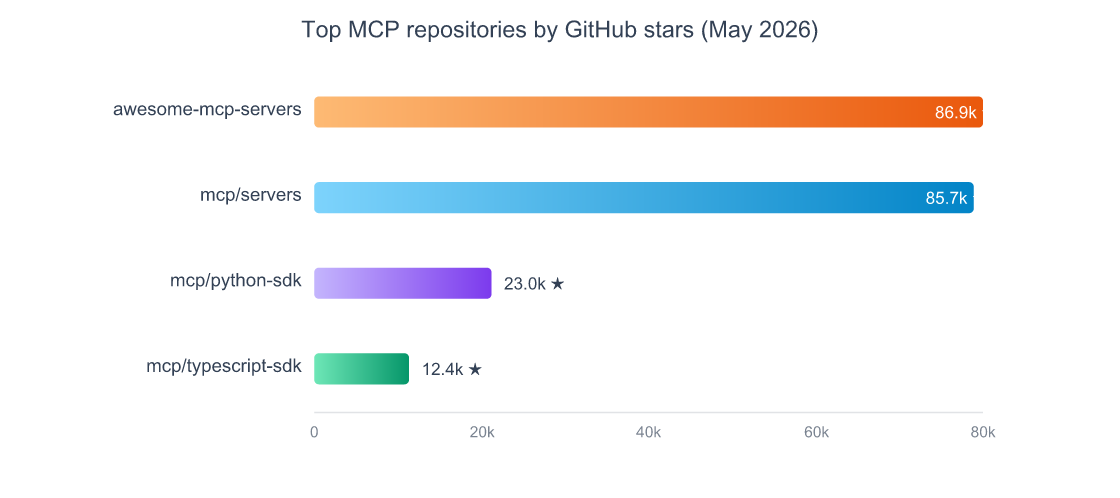
Source: GitHub.com snapshot, May 14, 2026
Cloudflare’s MCP Demo Day on May 1, 2025 was the moment remote servers became a real category. The event launched first-party endpoints from Asana, Atlassian, Block, Intercom, Linear, PayPal, Sentry, Stripe, and Webflow simultaneously (Cloudflare, 2025). Before Demo Day, MCP was mostly a Claude Desktop thing for power users. After Demo Day, it was the standard interface for SaaS APIs in agent workflows.
A Shortlist of 10 MCP Servers Worth Installing First
Install official-first: start with the server published by the company that owns the API, and add a community server only when it clearly earns its place. The Anthropic registry lists thousands of options, but most are forks, abandoned experiments, or thin wrappers around a curl command. These are the ten I reach for first, one per job. For the complete version, with all 65 servers graded Maintained, Experimental, or Abandoned, see the ranked directory of MCP servers with a maintenance verdict on each.
| Server | Maintainer | Why it makes the shortlist |
|---|---|---|
| Filesystem | Anthropic (reference) | Scoped file read/write. The first thing I add to any code agent, and the least likely to break. |
| GitHub | GitHub (official) | PRs, issues, code search, and Actions in one place. Deep dive: GitHub MCP setup, auth math, and the rate limits that bite. |
| Postgres MCP Pro | Crystal DBA (community) | The maintained replacement for Anthropic’s archived Postgres reference, with an index advisor. Setup: connecting Postgres to an AI agent without surrendering write access. |
| Firecrawl | Firecrawl (official) | Turns a messy page into clean structured data. My go-to when an agent needs the live internet. |
| Playwright | Microsoft (official) | Drives a real browser through the accessibility tree, steadier than screenshot-and-click approaches. |
| Linear | Linear (official) | Reads and moves issues, projects, and cycles. The tidiest project-management server I’ve run. |
| Notion | Notion (official) | Search and edit pages and databases. The one that finally retired my copy-paste workflow. |
| Cloudflare | Cloudflare (official) | Workers, KV, R2, and D1, plus a masterclass in how a hosted remote server should behave. |
| Stripe | Stripe (official) | Customer and invoice ops from chat. Scope it to a restricted key; the blast radius is real money. |
| Context7 | Upstash (community) | Feeds current library docs into the model so it stops citing 2023 APIs. The community server I trust most. |

One category I left off the shortlist on purpose: generative media. If you want an agent to make images rather than fetch data, Google’s first-party mcp-genmedia suite wires Gemini image generation (plus Veo, Chirp, and Lyria) into any MCP client, billed through Vertex AI instead of a separate API key. I cover the tool schema, the model IDs, and what’s actually production-ready in the field notes on running Google’s mcp-genmedia for Gemini image generation in Claude and Cursor.
The pattern behind the shortlist holds across the whole field: first-party servers from the vendor that owns the API stay better maintained than community alternatives, Streamable HTTP is winning the remote category, and Anthropic’s own reference repo has aged unevenly (Puppeteer, Postgres, and SQLite are all archived now). The full directory grades every server on exactly that axis, which is the part a flat list on GitHub will never give you.
How Do I Pick the Right MCP Server?
Pick by maintainer first, transport second, and use case third, in that order. A first-party server from the vendor that owns the underlying API will outlive a community fork in almost every case, because the maintainer eats their own dogfood. A January 2026 audit by Rapid Claw found that 52% of remote MCP endpoints were effectively dead, most of those were community wrappers around APIs whose vendors later shipped official servers (Rapid Claw, 2026).
A working filter for evaluating any candidate server:
- Maintainer status. Is the company that owns the underlying service publishing this server? If yes, default trust. If no, check the last 30 days of commits and open issue count. Median MCP server has 6 commits and was last touched 142 days ago (Rapid Claw, 2026), anything quieter than that is a red flag.
- Transport fit. stdio if it’s a local tool and you trust the machine. Streamable HTTP if it’s a remote API. Avoid SSE-only servers, the spec deprecated that transport in March 2025.
- Auth model. OAuth 2.1 with PKCE is the spec-blessed pattern for remote servers. Bearer tokens are fine for stdio. If the server asks you to paste a long-lived API key into a config file that gets synced anywhere, treat that like a credit card number.
- Pin the version.
npx -y package@latestis a rug-pull waiting to happen. OX Security disclosed a systemic SDK flaw in April 2026 that put ~200,000 servers at risk (OX Security via The Register, 2026). Pin a specific version in production configs. - Blast radius. Before connecting any server with write access to a real account (Stripe, Google Workspace, Linear, Cloudflare), use a restricted scope. Most providers offer read-only or sandbox tokens, use them.
The smell test I run last: would a tired version of me, three months from now, regret installing this? If yes, I skip it.
The Honest Take: Most of the Ecosystem Is Not Production-Ready
According to a 2026 Rapid Claw audit of 2,181 remote MCP endpoints, only 9% were fully healthy, 31% were lightly maintained, and 52% were abandoned or returning errors (Rapid Claw, 2026). When I describe MCP to non-technical friends, this is the slide I keep coming back to. The protocol is good. The ecosystem is mostly noise.
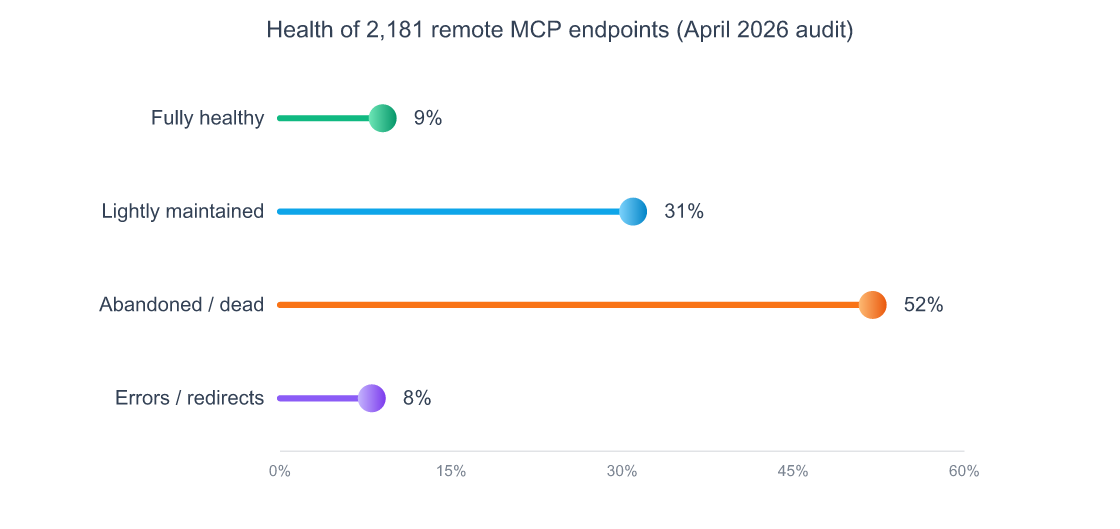
Source: Rapid Claw remote MCP audit, n=2,181 endpoints (April 2026)
Security is the other open wound. Three CVEs (CVE-2025-68143/144/145) hit Anthropic’s own Git MCP server in January 2026, including an RCE via git_init chained with the filesystem server (Hacker News, 2026). A critical RCE with CVSS 9.6 shipped in mcp-remote in mid-2025 (JFrog, 2025). Tool poisoning attacks (where a malicious server description embeds hidden instructions that hijack the agent) work on most clients with auto-approval enabled, with an 84.2% success rate in benchmark testing (MCPTox arXiv, 2025). The Stack Overflow 2025 survey captured the trust collapse precisely: 84% of developers use AI tools, but only 29% trust them, down 11 points year-over-year (Stack Overflow, 2025).
What I’ve actually seen, running this stuff: the official servers from major vendors (GitHub, Stripe, Cloudflare, Linear, Notion, Figma, Sentry) are genuinely production-quality. They get maintained, they ship security fixes, they update against the latest spec revision. The community servers are bimodal, a handful of excellent ones (Crystal DBA’s Postgres MCP Pro, Firecrawl) and a long tail of weekend hacks pretending to be infrastructure. The official Anthropic reference repo is somewhere in the middle, and a few of its servers have aged poorly. Treat the official Anthropic refs as starting points, not endpoints.
The signal-to-noise problem is the single biggest reason MCP feels chaotic. Once you filter for first-party + actively-maintained + Streamable HTTP for remote + pinned versions, the field shrinks from “thousands of options” to “maybe forty servers worth considering, of which you’ll install six.”
Where Is the MCP Ecosystem Heading?
Three trends will define MCP in the next 12 months: remote-first, registry consolidation, and security maturity. The remote shift is already happening, every official server launched after May 2025 has shipped a hosted Streamable HTTP endpoint alongside (or instead of) the local stdio version (Cloudflare, 2025). Vercel, Neon, HubSpot, and a wave of others followed in Q1 2026. Why does this matter? Because local stdio servers can’t be patched centrally. Remote servers can.

Registry consolidation is the second shift. Right now, “the MCP registry” is a polite fiction: there are at least nine major directories, and Cyata-style audits have found that 9 of 11 will accept typosquatted payloads with no automated review (Qualys, 2026). Expect Anthropic, Cloudflare, and the major IDEs to push toward a signed, verified registry by late 2026, partly because they have to, partly because tool poisoning attacks will force their hand.
Security maturity is the third. The MCP spec didn’t ship with a strong authentication or capability model in November 2024, that’s been added incrementally through 2025 and 2026. The next round of spec revisions is expected to land tool-attestation, signed servers, and a formal capability-scoping model. Until then, my advice doesn’t change: stick to first-party servers, pin versions, scope credentials tightly, and assume any community server you install is roughly as trusted as a curl command you found on Stack Overflow.
The bigger picture: MCP has won. JetBrains’ State of Developer Ecosystem 2025 survey found 62% of developers relying on at least one AI coding assistant or agent (JetBrains, 2025), and the protocol that gives those assistants hands is now standardized across every major vendor. The question isn’t whether to use MCP. It’s which six servers belong in your config tomorrow morning.
Frequently Asked Questions
What is MCP in simple terms?
MCP (Model Context Protocol) is an open standard from Anthropic that lets AI assistants connect to external tools, databases, APIs, file systems, through one consistent JSON-RPC interface (Anthropic, 2024). Instead of writing custom integrations per AI model, you write one MCP server per tool, and every compatible client (Claude Code, ChatGPT, Cursor, Gemini) can use it.
Is MCP only for Claude?
No. Anthropic created MCP, but OpenAI adopted it in March 2025 across Agents SDK and ChatGPT desktop (TechCrunch, 2025). Google committed Gemini to MCP in April 2025, Microsoft made it generally available in Copilot Studio later that year, and most agent frameworks (LangGraph, AutoGen, CrewAI) support it. The protocol is vendor-neutral.
What’s the difference between an MCP server and an API?
An API exposes a service over HTTP with custom endpoints, auth, and request shapes. An MCP server wraps that API behind a standardized JSON-RPC interface defined by the protocol: tools/list, tools/call, plus resource and prompt primitives. The point is uniformity: any MCP-aware AI client can use any MCP server without learning the underlying API.
How many MCP servers exist in 2026?
Public registries listed over 9,400 MCP servers as of April 2026, with roughly 7,800 GitHub repos tagged mcp-server (Zylos research, 2026). The catch: an April 2026 audit found 52% of remote endpoints abandoned or dead. The healthy slice is closer to a few hundred.
Are MCP servers safe to use?
It depends entirely on the server. Official first-party servers from major vendors (GitHub, Stripe, Cloudflare, Notion) are well-maintained and audited. Random community servers are risky, three CVEs hit Anthropic’s own Git server in January 2026 (Hacker News, 2026) and tool-poisoning attacks succeed 84% of the time against auto-approving clients. Pin versions, scope credentials, prefer first-party.
What transport should I use, stdio or HTTP?
Use stdio for local tools (filesystem, git, databases on your machine), it’s fastest and has no network surface. Use Streamable HTTP for remote services and SaaS APIs. Avoid HTTP+SSE; it was deprecated in the March 2025 spec revision and major providers like Atlassian are sunsetting SSE endpoints by mid-2026.
The Bottom Line
MCP went from “interesting Anthropic announcement” to “standard interface every major AI vendor speaks” in 18 months. The ecosystem is loud and a lot of it is noise: half the remote endpoints are dead, security is unfinished, and the signal-to-noise ratio is rough if you’re shopping by GitHub stars alone.
But the protocol itself is solid, and the official first-party servers from GitHub, Stripe, Linear, Notion, Cloudflare, Sentry, and Figma are genuinely production-quality. Install five or six of those, pin your versions, use Streamable HTTP for remote endpoints, and you’ll have an agent stack that does things last year’s tooling couldn’t. The next year is going to be about consolidation: fewer registries, more attestation, better defaults. The servers worth installing today are mostly the ones that’ll still be here.