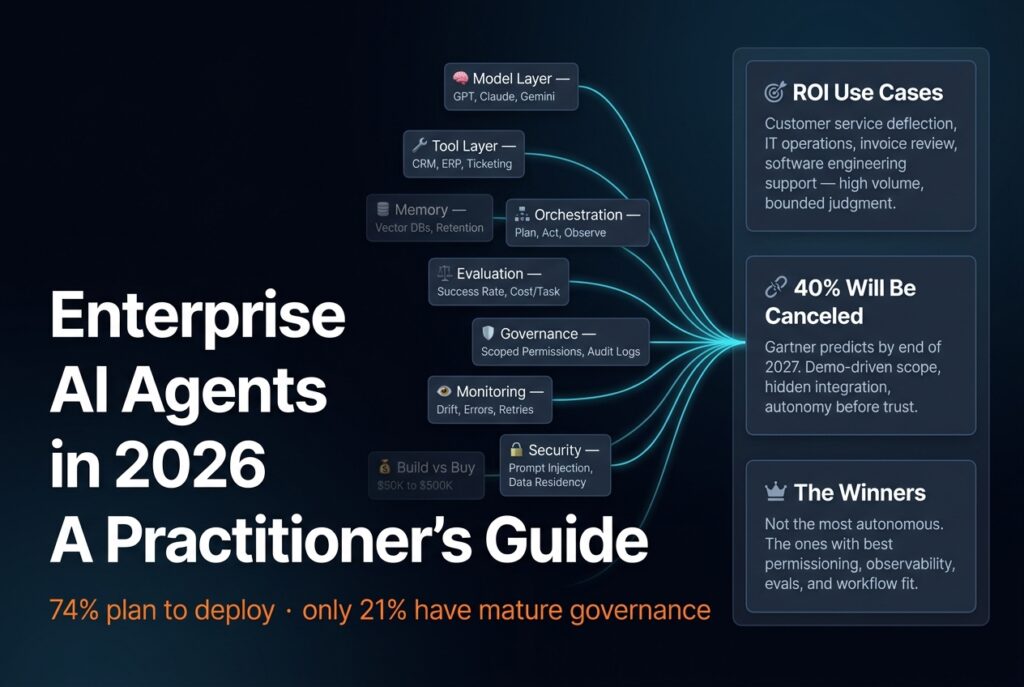
Enterprise AI agents are software systems that use an AI model to plan work, call tools, remember context, and take bounded actions across business systems. The practical takeaway: consumer agents optimize for convenience, but enterprise agents optimize for controlled execution. That means permissions, audit logs, data residency, exception handling, and cost controls matter as much as model quality.
The teams that win in 2026 won’t buy “autonomy” as a slogan. They’ll pick one workflow, prove the economics, and only then widen the agent’s permissions. For the development-team side of this cluster, keep ai coding agents specifically for engineering teams open as the next read.
Key Takeaways
- Enterprise AI agents are not smarter chatbots. They combine models, tools, memory, orchestration, permissions, monitoring, and audit trails.
- Gartner predicts more than 40% of agentic AI projects will be canceled by the end of 2027 because of cost, weak value, or poor risk controls (Gartner, 2025).
- McKinsey’s 2025 survey found AI high performers are 2.8 times more likely to redesign workflows before scaling AI (McKinsey, 2025).
- Deloitte’s 2026 enterprise AI survey found nearly 3 in 4 companies plan to deploy agentic AI within two years, but only 21% report mature governance for autonomous agents (Deloitte, 2026).
- The best 2026 use cases are narrow, high-volume, and easy to audit: service deflection, invoice review, internal IT, regulated document workflows, and software engineering support.
- The overhyped use cases are broad autonomous strategy, unsupervised sales outreach, open-ended research agents, and anything touching money or medical decisions without human approval.
- Build when the workflow is proprietary or regulated. Buy when the workflow is standard, the integration surface is familiar, and a platform already owns the system of record.
What Are Enterprise AI Agents?
Gartner’s January 2025 polling found 19% of organizations had made significant investments in agentic AI, while 42% had made conservative investments and 31% were still waiting (Gartner, 2025). That split explains the market: everyone is interested, but most teams are still testing where autonomy is useful.
An AI agent is an application that can decide the next step toward a goal instead of only responding once to a prompt. Enterprise agentic AI adds the boring parts that make the system usable at work: identity, permissions, data controls, monitoring, human review, and a way to recover when the agent gets stuck.
So what are AI agents in plain language? They are model-driven workers with a tool belt. The model reasons. The tool layer acts. The orchestration layer decides when to retry, escalate, or stop. Memory keeps useful context available. Governance decides what the agent is allowed to touch.
What is agentic AI, then? It is the design pattern behind those systems. Instead of a user asking one question and receiving one answer, the agent can break a request into steps, fetch data, write to an application, call an API, and report back with evidence.
The enterprise version is less about “autonomous intelligence” and more about constrained delegation. I don’t judge an enterprise agent by how impressive the demo looks. I judge it by how easy it is to answer four questions after something goes wrong: what did it see, what did it decide, what did it change, and who approved that permission?
According to Gartner, at least 15% of day-to-day work decisions could be made autonomously through agentic AI by 2028, up from effectively 0% in 2024 (Gartner, 2025). Enterprise AI agents are the systems that turn that forecast into controlled, logged business execution rather than unsupervised automation.
skills as reusable agent capabilities
How Enterprise AI Agents Work
OpenAI’s Computer-Using Agent reached 58.1% success on WebArena and 87% on WebVoyager, but OpenAI also noted it still needed improvement on more complex computer-use tasks (OpenAI, 2025). That is the right mental model for how enterprise AI agents work: useful, but not magic.
Most production systems have six layers.
First, the model layer interprets intent and reasons about the next action. This may be GPT, Claude, Gemini, an open-source model, or a routed mix. Better models reduce dead ends, but they don’t remove the need for product design.
Second, the tool layer connects the agent to real systems: CRM, ERP, ticketing, email, data warehouses, document stores, browser sessions, and internal APIs. This is where enterprise agents become valuable and dangerous. A chatbot can be wrong. A tool-using agent can be wrong and change a record.
Third, the memory layer stores what the agent needs to remember. Short-term memory lives in the current run. Long-term memory usually sits in a database or vector store. Memory should be scoped by tenant, role, purpose, and retention policy. If that sounds tedious, it is also where many privacy reviews start.
Fourth, orchestration controls the loop: plan, act, observe, revise, stop. Simple agents use fixed workflows. More flexible agents use planners, evaluators, retries, and task queues. The more autonomy you add, the more you need guardrails that stop runaway loops and costly tool calls.
Fifth, evaluation and monitoring measure whether the agent is doing the job. You need task success, escalation rate, cost per completed workflow, hallucinated action attempts, tool error rates, and user overrides. Without these, the agent becomes another black box nobody trusts.
Sixth, governance sets the permission model. The agent should not inherit a human admin’s full access just because it runs on their behalf. Use scoped service accounts, domain allowlists, approval gates for high-risk actions, and immutable logs for every tool call.
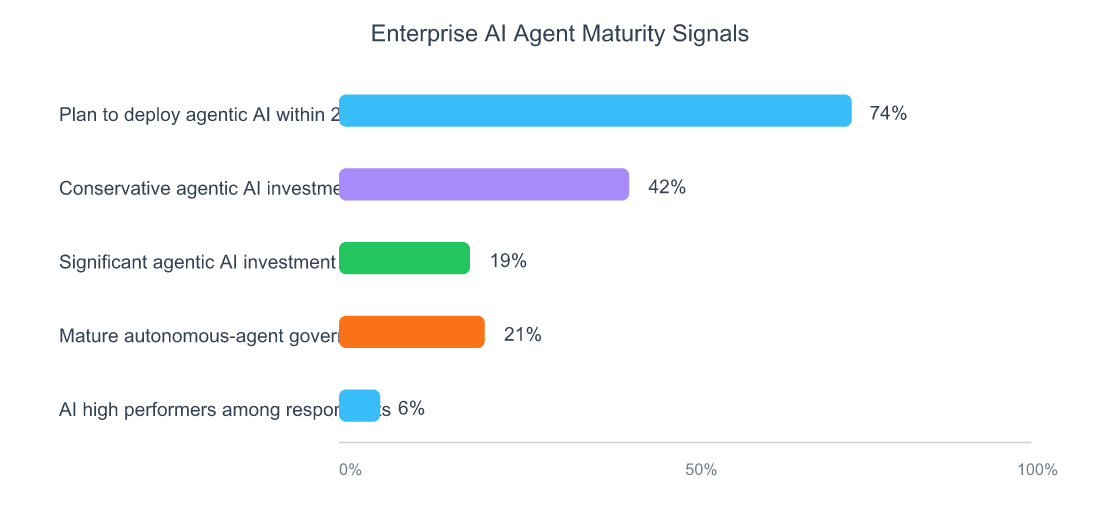
Sources: Gartner agentic AI forecast, 2025; Deloitte State of AI in the Enterprise, 2026; McKinsey State of AI, 2025.
The architecture is easy to draw and hard to operate. If your agent can write to Salesforce, issue refunds, update a service ticket, or run shell commands, the real product is not the model. The real product is the control plane around the model.
MCP for connecting agents to enterprise tools
The Enterprise AI Agent Landscape in 2026
IDC expects agentic AI to exceed 26% of worldwide IT spending by 2029, with AI spending growing 31.9% annually from 2025 to 2029 (IDC, 2025). That explains why every software vendor now has an agent story. It does not mean every story is equally useful.
I group the market into five categories.
If you track AI agents enterprise news, most announcements blur these categories on purpose. For buyers comparing AI agents for enterprise use, the taxonomy matters because each category shifts the risk to a different owner: the platform vendor, the implementation partner, or your internal engineering team.
System-of-record agents live inside platforms such as Salesforce, ServiceNow, Microsoft, SAP, Workday, and Atlassian. Their advantage is proximity to data and workflow permissions. Their weakness is scope. They work best when the task stays inside the vendor’s world.
Agent-building platforms let teams create agents across systems. Microsoft Copilot Studio, Salesforce Agentforce, ServiceNow AI Agent Studio, Google Agentspace-style offerings, and newer enterprise platforms fit here. These are often the best default for business teams that need governed automation without building the whole stack.
Developer frameworks such as LangGraph, CrewAI, AutoGen-style stacks, and orchestration libraries suit engineering teams building custom agents. They give control, but you own evaluation, security, deployment, and observability.
Vertical agents target narrow business domains: revenue operations, customer support, legal intake, claims, logistics, recruiting, finance close, software testing, or healthcare admin. They can ROI quickly when the workflow is standard. They can also become shelfware if they need deep internal customization.
Computer-use agents operate browser or desktop interfaces when APIs do not exist. OpenAI reported strong results on simpler web tasks but lower success on complex web tasks (OpenAI, 2025). Use them for brittle but valuable gaps. Don’t make them the backbone of a regulated process if an API exists.
Gartner warned in 2025 that only about 130 of thousands of agentic AI vendors were “real,” with many products engaging in agent washing (Gartner, 2025). A good vendor evaluation starts with one blunt request: show me the agent’s tools, permissions, memory, evals, audit log, and failure handling.
low-code platforms for non-engineering teams
Top Use Cases By ROI
ServiceNow reported more than $325 million in annualized value from AI agents across its own operations, including 3 million employee hours freed and 76% IT support self-service (CX Today, 2025). The pattern is clear: ROI shows up first where volume is high and judgment is bounded.
The strongest use cases in 2026 share three traits. The input is repetitive. The action is reversible or reviewable. The business value is easy to measure. That is why support, IT service management, invoice review, employee help desks, software engineering, and document-heavy operations keep showing up in credible case studies.
Customer service is the obvious starting point. Salesforce reported Grupo Falabella resolved 60% of WhatsApp inquiries autonomously, Reddit resolved chat inquiries 84% faster, and Fisher & Paykel increased self-service rates from 40% to 70% (Salesforce, 2025). These are vendor-reported numbers, but the use case makes economic sense.
Internal IT and service operations are the second strong category. The workflows are documented, the systems are already ticketed, and escalation paths exist. If the agent fails, it can route to a human instead of making a high-stakes final decision.
Logistics and finance operations are promising when the agent reviews documents and flags exceptions. Microsoft described Dow’s agentic workflow for freight auditing across up to 4,000 daily outbound shipments and roughly 100,000 PDFs annually (Microsoft, 2025). That is a better candidate than a vague “strategic planning agent.”
Software engineering agents ROI well when scoped to code search, test generation, migration assistance, review prep, and internal tooling. They struggle when management expects autonomous feature delivery without review.
The weak use cases are the ones nobody wants to price honestly. Fully autonomous outbound sales can create brand and compliance risk. Executive strategy agents often become fancy research assistants. Medical or financial decision agents need heavy human oversight. Broad “digital employee” programs usually hide the lack of one measurable workflow.
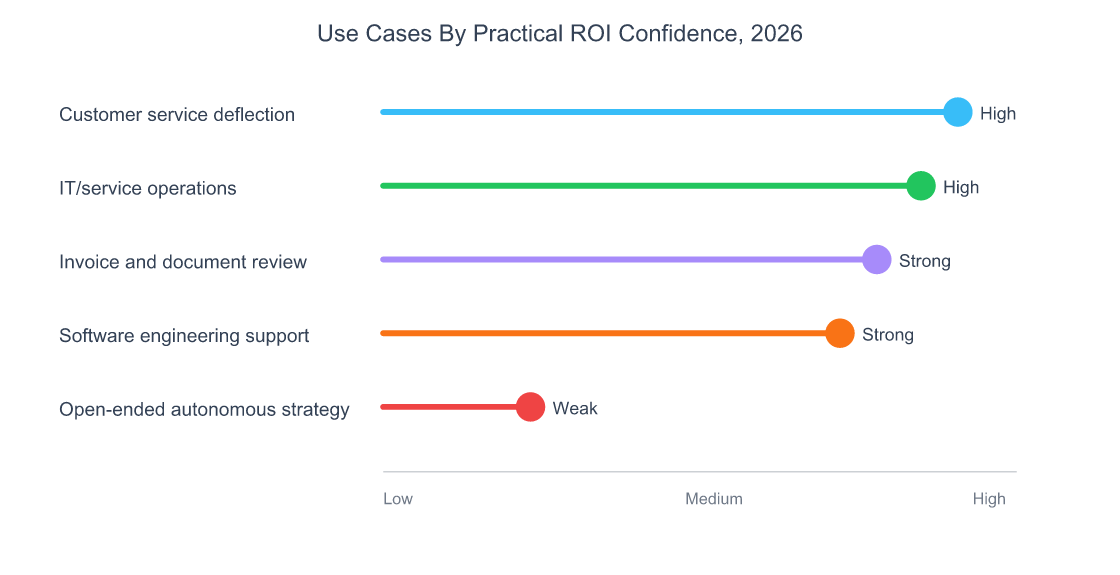
Source: Author scoring based on cited 2025-2026 case studies from ServiceNow, Salesforce, Microsoft, Deloitte, and McKinsey.
Use this test: if a human team already handles a high-volume queue with documented procedures, an agent may help. If nobody can describe the workflow in writing, don’t automate it yet.
Build Vs Buy: Decision Framework
Technova’s 2026 implementation guide estimates specialist boutique AI agent projects at EUR20,000-EUR80,000, mid-tier consultancies at EUR50,000-EUR200,000, Big 4 projects at EUR150,000-EUR500,000, and no-code DIY routes at EUR10,000-EUR40,000 plus internal effort (Technova Partners, 2026). Those ranges are imperfect, but they are useful planning anchors.
Here is the decision framework I would use before funding the first pilot.
| Criterion | Weight | Buy if… | Build if… |
|---|---|---|---|
| Workflow uniqueness | 20% | The workflow matches a standard support, sales, IT, HR, or finance pattern. | The workflow is proprietary, regulated, or core to differentiation. |
| System ownership | 15% | One vendor already owns most data and actions. | The workflow spans several internal systems with custom rules. |
| Compliance burden | 15% | Vendor controls satisfy your audit and residency needs. | You need custom retention, residency, logging, or approval controls. |
| Speed to value | 15% | You need a pilot in weeks. | You can fund a 3-6 month build and iteration cycle. |
| Internal talent | 15% | You lack agent orchestration, eval, security, and integration skills. | You have engineers who can own production reliability. |
| Cost predictability | 10% | Per-seat or platform pricing is easier to budget. | Usage-based economics are favorable at your scale. |
| Vendor lock-in risk | 10% | Lock-in is acceptable because the workflow lives in that platform. | You need portability across models, clouds, and systems. |
If the score is close, buy the pilot and build the differentiating layer later. The worst option is building a custom platform before proving that the workflow deserves one.
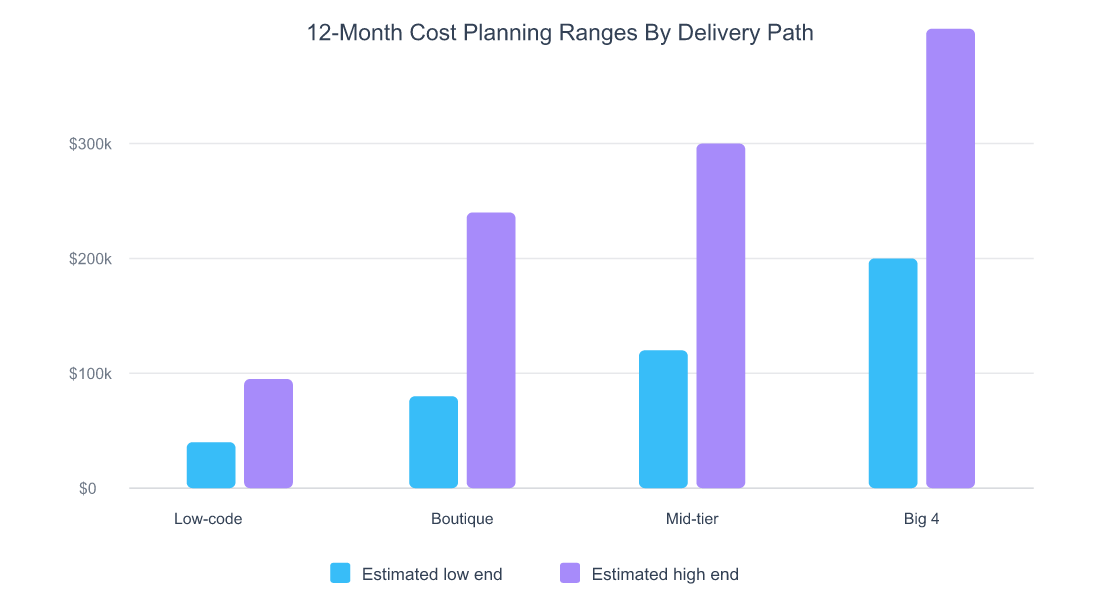
Source: Technova Partners implementation cost ranges, 2026. USD-equivalent chart rounded from EUR ranges for planning, not procurement.
The hidden cost line matters more than the sticker price. Technova estimates hidden first-year costs can add EUR15,000-EUR65,000, or 30%-60% of initial implementation investment (Technova Partners, 2026). That includes integration cleanup, monitoring, training, process redesign, and support.
For a full pricing breakdown, see full cost breakdown.
Security, Compliance, And Governance
Deloitte found nearly 3 in 4 companies plan to deploy agentic AI within two years, but only 21% report a mature governance model for autonomous agents (Deloitte, 2026). That is the gap security teams should care about: deployment intent is outrunning operating controls.
The practitioner question is not “Is the model secure?” The better question is “What can the agent do when the model is wrong, tricked, or overconfident?”
Start with permissions. Each agent needs its own identity, scoped to the minimum set of actions required. Don’t let an agent borrow a human admin token. Don’t give a customer support agent write access to billing unless the workflow truly needs it.
Then handle data residency and retention. If the agent reads customer data, employee data, health data, financial data, source code, or contracts, you need to know where prompts, tool outputs, memory records, and logs are stored. The memory store is often where teams accidentally create a second sensitive database.
Prompt injection is the practical risk everyone underestimates. Anthropic’s 2025 browser-use research said Claude for Chrome reached roughly a 1% attack success rate against adaptive attackers after new defenses, down from earlier research-preview levels, while noting the problem is not solved (Anthropic, 2025). One percent is good in a benchmark and unacceptable if the agent can move money.
My rule for enterprise agents is simple: treat every external document, webpage, ticket, email, and tool result as hostile input. If the agent reads it, the content can try to instruct the agent. That means retrieval is not just a relevance problem. It is part of the security boundary.
Audit logs are non-negotiable. You need a durable record of every model decision, tool call, retrieved document, approval event, error, retry, and final action. Without that, incident response becomes archaeology.
For high-risk actions, use human approval. The approval should happen at the action boundary, not after the agent has already modified the system. Refunds, account closures, wire instructions, medical recommendations, legal advice, permission changes, and production code deployment should all have explicit gates.
Finally, monitor behavior drift. Agents change when prompts, models, tools, documents, data distributions, or user behavior change. Regression tests should include successful tasks, adversarial prompts, permission boundary tests, and failure handling.
According to Deloitte, 77% of surveyed companies say the location of AI development is a key factor when choosing new technologies (Deloitte, 2026). Security reviews for enterprise AI agents should cover data location, tool permissions, memory retention, prompt-injection exposure, and auditability before the pilot touches production data.
autonomous agents and computer use
Implementation Roadmap
Deloitte’s 2026 survey found only 25% of companies had moved 40% or more of AI experiments into production, although 54% expected to reach that level within three to six months (Deloitte, 2026). That optimism is useful, but production is where the real work starts.
Use four phases.
Phase 1: Workflow selection, 2-3 weeks. Pick one workflow with measurable volume, known escalation paths, and clear value. Document the current process. Count the baseline: tickets per month, minutes per ticket, error rate, cost per transaction, SLA misses, and customer impact.
Phase 2: Controlled pilot, 4-8 weeks. The agent should read more than it writes. Start with suggestion mode, summary mode, draft mode, or exception-flagging mode. Measure acceptance rate, time saved, error categories, escalation quality, and user trust. If people keep ignoring the agent, fix the workflow before adding autonomy.
Phase 3: Bounded production, 8-12 weeks. Give the agent narrow write permissions and approval gates. Add monitoring, on-call ownership, audit logs, rollback paths, and cost alerts. Production means someone owns the pager when the agent fails at 2 a.m.
Phase 4: Expansion, ongoing. Expand by adjacent workflows, not by executive enthusiasm. A support agent that handles refund-policy questions might next draft return labels. It should not suddenly negotiate enterprise contracts.
McKinsey found AI high performers were 2.8 times more likely to fundamentally redesign workflows in their AI deployments (McKinsey, 2025). That is the implementation lesson: don’t wrap an agent around a broken process and call it transformation.
A good pilot ends with a go/no-go document. It should list realized value, failure modes, unit economics, security exceptions, support load, user feedback, and a recommendation. If the champion cannot write that in plain English, the pilot is not ready to scale.
vendor shortlist for build-out partners
Common Failure Modes
Gartner predicts more than 40% of agentic AI projects will be canceled by the end of 2027 because of escalating costs, unclear business value, or inadequate risk controls (Gartner, 2025). That is not anti-agent pessimism. It is a warning about bad deployment patterns.
The first failure mode is demo-driven scope. The agent works beautifully in a scripted environment, then breaks when real users ask messy questions, attach strange documents, or route cases through old systems.
The second is hidden integration work. Enterprise agents need clean APIs, reliable identity, consistent data, and strong logging. If your systems are held together by spreadsheets and tribal knowledge, the agent inherits that mess.
The third is autonomy before trust. Teams jump from “the agent can draft a response” to “the agent can send the response” too quickly. The safer path is observe, recommend, draft, act with approval, then act autonomously inside a low-risk boundary.
The fourth is cost surprise. Agents use more tokens than chatbots because they reason, retrieve, call tools, inspect results, retry, and sometimes loop. Add monitoring and budget alerts before usage goes broad.
The fifth is weak evaluation. A few happy-path test prompts are not an eval suite. Test edge cases, adversarial inputs, permission boundaries, stale data, malformed documents, unavailable tools, and bad user instructions.
The sixth is governance theater. A policy document is not a control. Controls look like scoped identities, audit logs, allowlists, approval gates, retention limits, red-team tests, and someone accountable for exceptions.
The most expensive agent failures I’ve seen are not hallucinations. They are workflow misunderstandings. The model may summarize correctly, but the product lets it act at the wrong step, with the wrong permission, before the right human has reviewed the exception.
According to Deloitte, use cases that look successful in pilots can stretch from three months to 18 months when integration complexity appears in production (Deloitte, 2026). Enterprise AI agents fail when teams budget for the demo and forget the operating system around it.
What’s Changing In The Next 12 Months?
IDC forecasts agentic AI will become a major IT-budget force through 2029, with agentic AI expected to exceed 26% of worldwide IT spending by then (IDC, 2025). In the next 12 months, the interesting changes will be operational, not just model capability.
First, agent platforms will move from demos to control planes. Expect more built-in evals, permission templates, audit-log products, cost management, and policy engines. Buyers will start asking harder questions because early pilots have already exposed the messy parts.
Second, computer-use agents will improve, but APIs will still win where reliability matters. Browser control is useful for systems without APIs. It is also brittle, slow, and harder to audit than direct integrations.
Third, budgets will shift from model access to integration and monitoring. The model line item gets attention, but the real enterprise spend sits in data prep, tool wiring, workflow redesign, governance, support, and measurement.
Fourth, the market will split. Platforms will handle standard workflows. Specialist vendors will own vertical workflows. Engineering teams will build custom agents around proprietary data and process advantage.
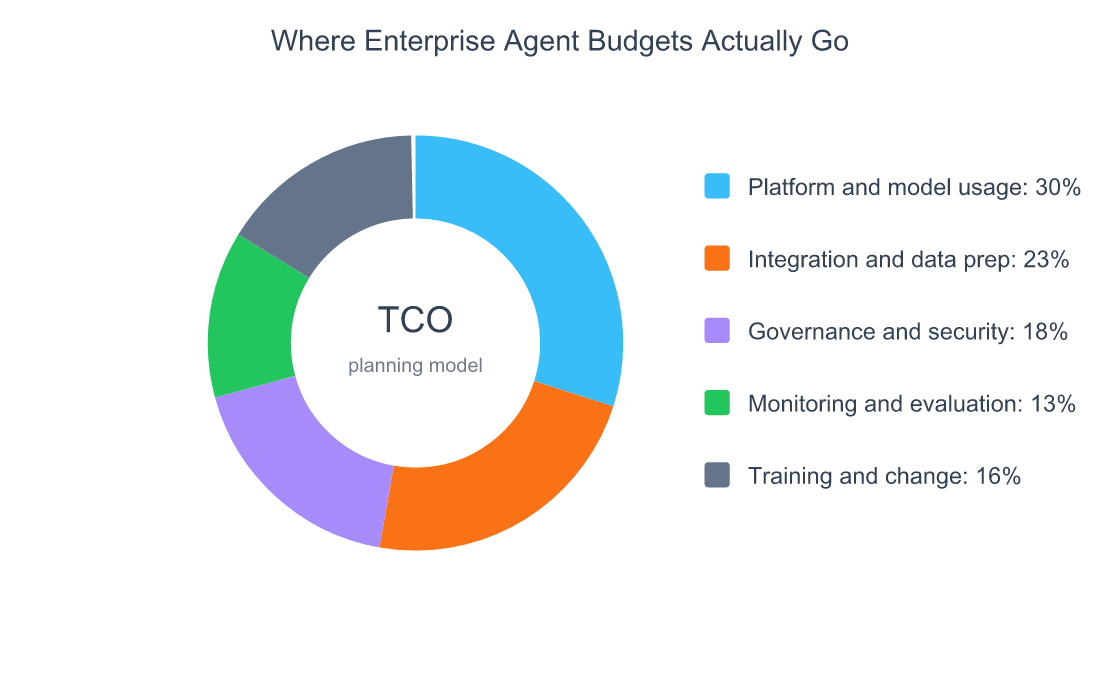
Source: Author planning model based on Technova 2026 cost ranges, Deloitte 2026 production-readiness findings, and practitioner TCO categories.
My conservative prediction: the winners won’t be the most autonomous agents. They’ll be the agents with the best permissioning, observability, evals, and workflow fit. That sounds less exciting. It is also what production systems usually reward.
voice agents for customer-facing use cases
Frequently Asked Questions
What are enterprise AI agents?
Enterprise AI agents are AI systems that reason, use tools, remember context, and take controlled actions across business systems. Gartner found 19% of organizations had made significant agentic AI investments by early 2025, while 42% were investing conservatively (Gartner, 2025).
How are enterprise AI agents different from chatbots?
Chatbots mainly answer. Agents can act. OpenAI’s Computer-Using Agent reached 58.1% on WebArena and 87% on WebVoyager, showing that tool-using agents can operate interfaces but still struggle with complex tasks (OpenAI, 2025).
How much do enterprise AI agents cost?
Public 2026 implementation ranges vary widely. Technova estimates no-code DIY routes at EUR10,000-EUR40,000, boutique implementations at EUR20,000-EUR80,000, mid-tier consultancies at EUR50,000-EUR200,000, and Big 4 projects at EUR150,000-EUR500,000 (Technova Partners, 2026).
Which enterprise AI agent use cases ROI fastest?
High-volume support, IT service operations, invoice review, document workflows, and software engineering assistance usually ROI fastest. ServiceNow reported $325 million-plus in annualized value from agents across its own operations, including 3 million employee hours freed (CX Today, 2025).
Should we build or buy enterprise AI agents?
Buy when the workflow is standard and already lives inside one platform. Build when the workflow is proprietary, regulated, or crosses multiple custom systems. IDC expects agentic AI to exceed 26% of worldwide IT spending by 2029, so vendor choice now can shape long-term architecture (IDC, 2025).
What is the biggest risk with enterprise agentic AI?
The biggest risk is giving an unreliable agent too much permission too early. Deloitte found nearly 3 in 4 companies plan to deploy agentic AI within two years, but only 21% report mature governance for autonomous agents (Deloitte, 2026).
How long does implementation take?
A controlled pilot can run in 4-8 weeks, but production often takes longer because integration, security, monitoring, and support appear after the demo. Deloitte noted AI use cases estimated at three months can stretch to 18 months when integration complexity emerges (Deloitte, 2026).
The useful enterprise AI agents in 2026 won’t feel like science fiction. They’ll feel like disciplined workflow software with a model inside: narrow permissions, clear economics, visible failures, and enough auditability that a CTO can defend the deployment after the demo buzz fades.