B2B SaaS 2026: Complete Guide to Metrics, GTM & AI
Every founder I talk to these days wants to “build a B2B SaaS.” Most of them can’t actually define what that means beyond “charge businesses a monthly fee.” That gap is fine when you’re bootstrapping a side project. It’s expensive when you’re raising money, hiring salespeople, or deciding whether to compete with an AI-native startup that just raised $200M.
AI companies captured close to 50% of all global venture funding in 2025, pulling in about $211 billion, up 85% year-over-year (Crunchbase, 2025). That money is reshaping what B2B SaaS looks like: who builds it, how buyers evaluate it, and which metrics actually matter.
This guide pulls together the numbers I care about when I think about B2B SaaS in 2026: market size, the metrics VCs and acquirers actually grade you on, how buying has changed, and whether the AI shift is an opportunity or a death sentence for traditional software. No hype. No “it depends.” Just what the data says.
my take on whether traditional SaaS has a future post-AI
Key Takeaways
- AI startups took
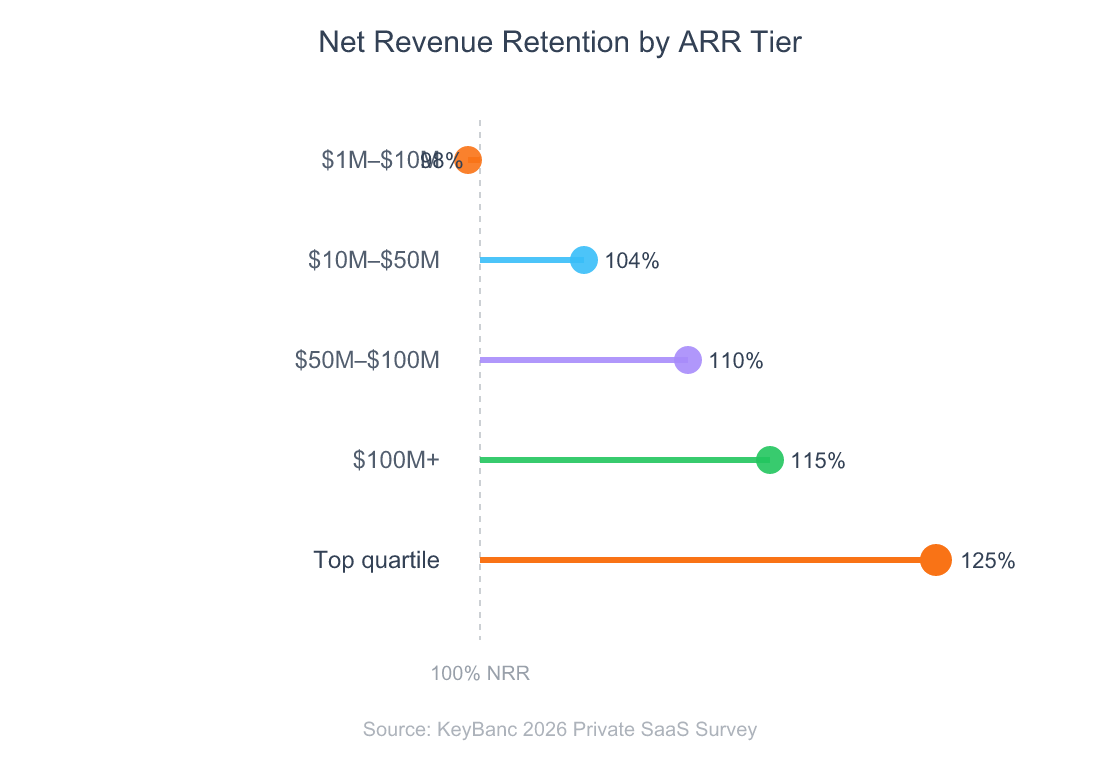
50% of 2025 global VC funding ($211B), up 85% YoY (Crunchbase, 2025).- Median B2B SaaS net revenue retention sits at 106%; 115%+ puts you in the top quartile (KeyBanc, 2026).
- 94% of B2B buyers now use LLMs during vendor research, and 60% of the journey is done before they talk to sales (6sense, 2026).
- Only ~11–30% of private SaaS hit Rule of 40, but those that do command a significant valuation premium (ICONIQ, 2025).
What Is B2B SaaS, Really?
B2B SaaS is subscription software sold to businesses instead of consumers, usually priced by seats, usage, or tiered feature sets. The global B2B SaaS market is on track to hit roughly $634 billion in 2026 and compound at ~27.5% through the decade (Fortune Business Insights, 2026). That scale is why every founder ends up thinking about it eventually.
What actually separates B2B SaaS from consumer software isn’t the product, it’s the economics. You have fewer customers, each worth much more. A consumer app might have a million users paying $5 a month. A B2B SaaS can hit the same ARR with a thousand customers paying $400, and a handful paying $50,000. That ratio changes everything about how you sell, support, and retain.
The other distinction is who decides. In B2C, the user and the buyer are the same person. In B2B, you’re selling to a committee: the user who’ll use it daily, the manager who’ll approve the budget, the IT person who’ll vet security, and sometimes a procurement team who’ll negotiate it down 20% just because. That complexity is why B2B SaaS sales cycles keep getting longer, not shorter.
Our finding: Most first-time founders underestimate how much of B2B SaaS is distribution vs product. The product is table stakes. Winning means finding a distribution wedge (a niche audience, a vertical, an integration) that keeps CAC below what you can afford to pay over the customer’s lifetime.
If you’re still deciding what to build, my list of micro SaaS ideas that hold up post-AI is a better starting point than another “trending niches” listicle.
How Big Is the B2B SaaS Market in 2026?
The B2B SaaS market sits at ~$634B in 2026 per Fortune Business Insights, though more conservative trackers place the 2026 figure closer to $311–492B depending on what they count as “SaaS” (Fortune Business Insights, 2026). The spread matters: if you read one headline saying the market is $4T by 2034 and another saying it’s under $400B today, you’re not comparing apples.
Inside enterprises, the reality is messier than the top-line number suggests. The average enterprise now runs 275 SaaS applications and spends roughly $49 million a year on them, about $4,830 per employee, with 7.6 new apps entering the stack every month (Zylo, 2026). That sprawl is itself a market: procurement, observability, identity, and cost-management tools exist to tame it.
Here’s the uncomfortable part for founders entering now. Business units (not IT) control 70% of that spend, meaning the person who can approve a $1,500/month tool is often a director with a credit card and no centralized oversight. Good news: you can land deals fast. Bad news: the same director can cancel without a procurement review the moment a cheaper alternative shows up. Retention is everything.
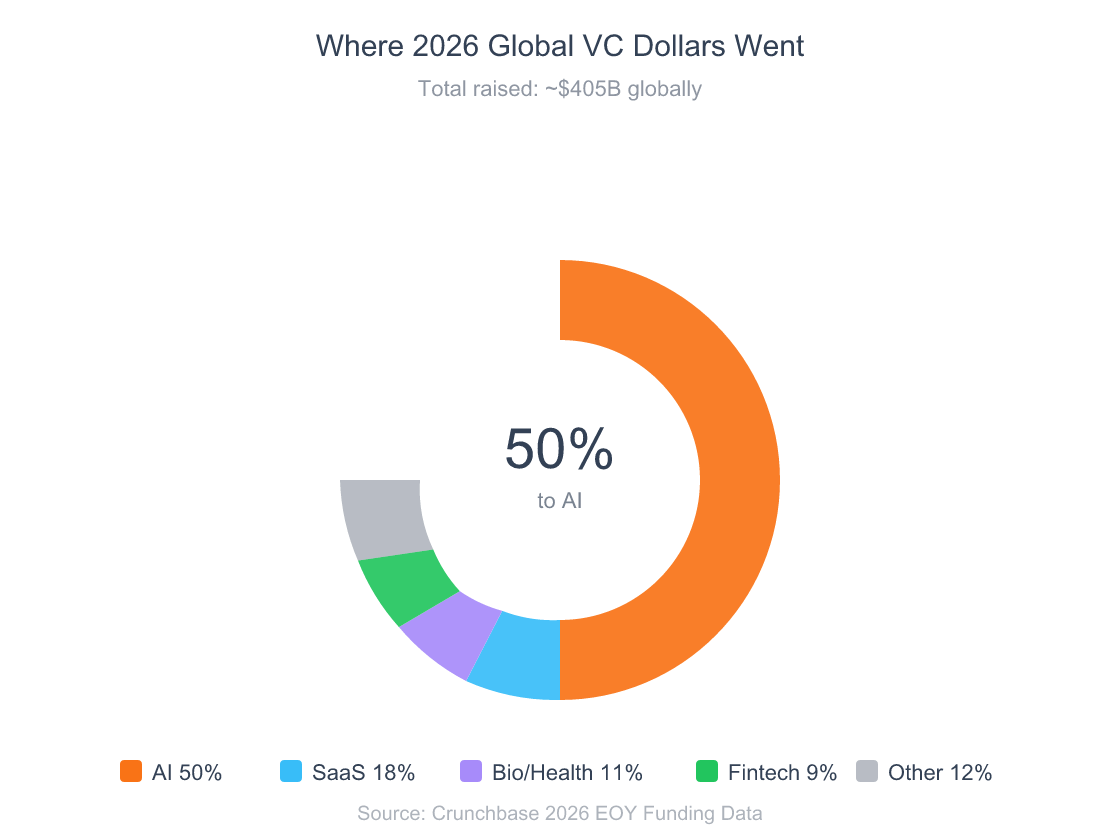
According to Crunchbase’s 2025 year-end report, AI companies pulled in ~$211 billion: close to 50% of all global venture dollars, with the five biggest AI companies alone raising $84 billion (Crunchbase, 2025). Pure-play “SaaS” is no longer where the capital is flowing. Either the money has moved, or the definition of SaaS has.
Which B2B SaaS Metrics Actually Matter?
Five metrics dominate every board deck, every diligence call, and every acquisition conversation I’ve seen: net revenue retention, gross retention, CAC payback, gross margin, and Rule of 40. Median B2B SaaS NRR in 2026 sat at 106% and gross retention at 90%, with top-quartile companies above 115% and 94% respectively (KeyBanc, 2026).
Net Revenue Retention (NRR) is the single most important number. It tells you what happens to a cohort of customers over 12 months without any new logos, expansions and upsells minus churn and downgrades. NRR above 100% means your existing customers pay you more over time. Below 100% means you’re filling a leaky bucket.
Gross Retention (GRR) strips out expansion and just asks: of the revenue you had a year ago, how much did you keep? GRR tells you if customers stay. NRR tells you if they spend more. Both matter, but they answer different questions.
CAC Payback, how many months of gross margin it takes to recover your customer acquisition cost, tells you how capital-efficient your sales motion is. The median payback across B2B SaaS is around 16 months, but segment matters enormously: SMB under 12, enterprise often 24+ (Benchmarkit, 2025).
Gross Margin caps everything else. Median subscription gross margin is around 77%, with top quartile above 80% (Benchmarkit, 2025). If you’re below 65%, you’re not actually selling software, you’re selling services with a dashboard on top.
Then there’s Rule of 40, the old rule that your growth rate plus FCF margin should clear 40%. Only about 11–30% of private SaaS clear it, and those that do command a meaningful valuation premium over the rest (ICONIQ, 2025). The median SaaS is sitting at ~21% growth + 5% FCF = 26, well short of the bar.

What does this mean for a founder? If you track only one metric religiously before PMF, track NRR. It’s the clearest signal that customers are getting value. Revenue you keep beats revenue you have to re-acquire every year. For a deeper metric walk-through, see my playbook on hitting $1K MRR without burning runway.
How Has B2B Buying Actually Changed?
The B2B buyer in 2026 talks to an LLM before they talk to you. 94% of B2B buyers now use generative AI tools during vendor research, and 60% of the buying journey is completed before they ever contact a vendor (6sense, 2026); SMB buyers are now building vendor shortlists directly inside LLMs (Bain & Company, 2025). That’s not a minor shift. That’s the sales funnel getting rewritten in real time.
The research also shows 95% of eventual winners were on the buyer’s Day-One shortlist, and 80% of deals go to whichever vendor the buyer preferred before reaching out. In plain English: if you’re not already the front-runner the moment a buyer emails you, your win rate collapses. Sales conversations increasingly confirm a decision rather than create one.
The uncomfortable insight: Your outbound SDR team is competing with an AI assistant that already answered the buyer’s questions, and may have recommended a competitor by name. The content you publish, the quality of your docs, and how AI tools summarize your category now drive more pipeline than any cadence tool can.
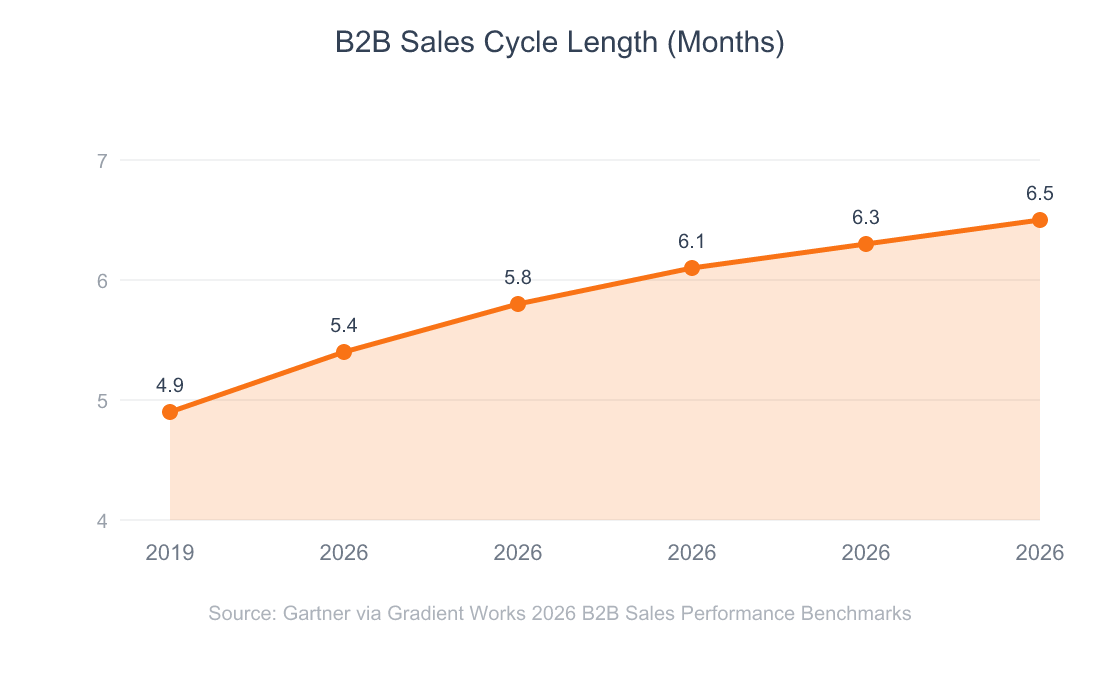
The cycle itself is getting longer. The average B2B sales cycle hit 6.5 months in 2026, up from 4.9 in 2019, roughly 33% slower in six years. Deal committees grew too: 6–10 stakeholders is typical, enterprise deals touch 17+ (Gradient Works, 2025). Everyone’s buying more cautiously, asking for more approvals, and using AI to pressure-test vendor claims.
So what do you do? Build for the 60% of the journey you’ll never see. That means unambiguous positioning on your homepage, comparison pages against the obvious alternatives, developer docs a stranger can learn from in 20 minutes, and content that answers buyer questions the way an AI will summarize it. Being discoverable and quotable matters more than being clever: which, by the way, is why the 2026 SaaS naming crisis is hurting so many launches: clever, AI-bro names that no buyer can recall and no AI can disambiguate.
Sales-Led vs Product-Led: Which GTM Actually Wins?
61% of the Bessemer Cloud 100 use product-led motions, and product-led companies are roughly 2x more likely to grow quickly than sales-led peers (OpenView Product Benchmarks, 2022). The short version: PLG won the marketing narrative, but the reality underneath is more nuanced than the decks suggest.
Product-led growth (PLG) works when your product delivers value in minutes, not meetings. Think Notion, Linear, Figma, PostHog. Users sign up, hit an “aha” moment inside a free tier, and either upgrade themselves or drag their team in. Sales exists, but its job is expansion and enterprise, not qualifying inbound MQLs.
Sales-led growth (SLG) still dominates whenever the buyer isn’t the user: regulated industries, security tools, procurement platforms, deeply-integrated enterprise software. If your buyer is a CISO or a VP of RevOps, they’re not going to swipe a credit card to try you. They need a security review, a SOC 2 report, and a 45-minute demo.
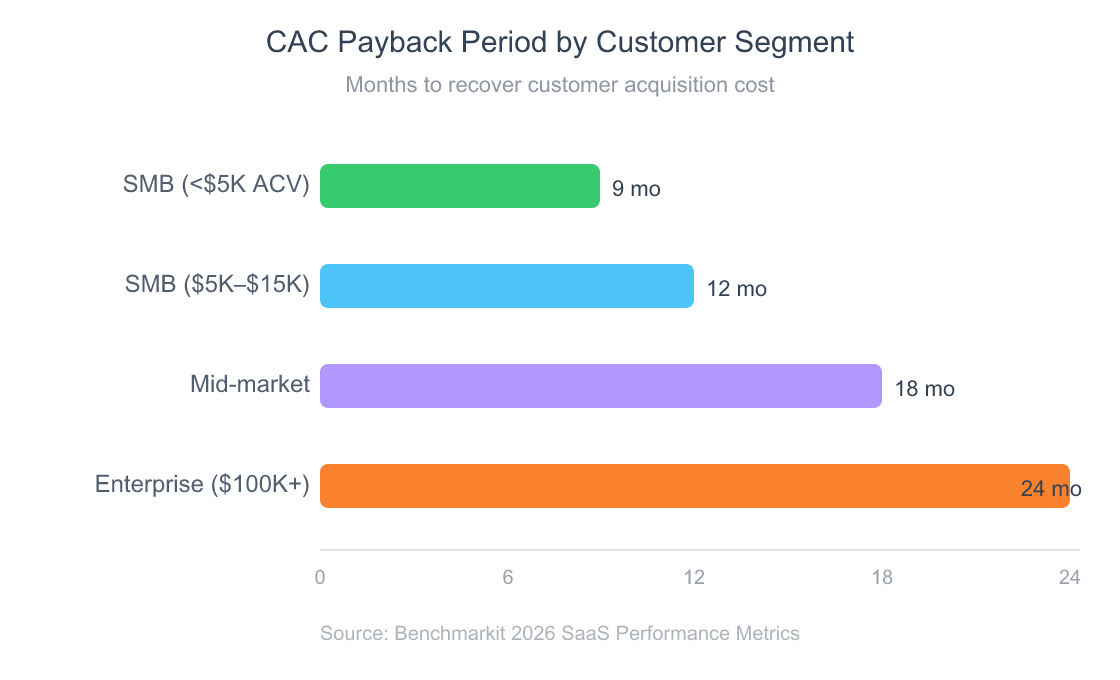
Benchmarkit’s 2025 data puts SMB CAC payback at 9–12 months, mid-market at 18, and enterprise at 24+ (Benchmarkit, 2025). That spread explains why most bootstrapped founders should start PLG and SMB: you recover your acquisition cost in a year, not two, which means you can reinvest faster without raising capital. Enterprise sounds glamorous on a pitch deck. It punishes anyone without a runway.
The dirty secret is most successful B2B SaaS ends up hybrid: PLG for self-serve, light-touch sales for the $15K–$50K deals, and a dedicated AE for anything over $75K. Picking a “motion” in 2026 is less about religion and more about knowing which motion matches which ACV band. For how to pick your first wedge, see the tech-stack guide for founders shipping from zero.
How Is AI Actually Reshaping B2B SaaS?
AI-native B2B SaaS hit a revenue efficiency threshold traditional SaaS hasn’t touched in a decade. Bessemer’s 2026 “AI Supernovas” (the top AI-first companies) averaged $1.13M ARR per full-time employee, roughly 4–5x typical SaaS efficiency, while a new cohort of LLM-native vertical startups is reaching 80% of incumbent ACV with ~400% YoY growth at ~65% gross margins (Bessemer, 2026).
That changes what “good” looks like. If you’re pitching VCs in 2026, your growth numbers are being compared to companies growing 4x with a tenth of the headcount. Even if you beat every 2026 benchmark, you can lose the pitch simply because an AI-native in your category outpaces you on capital efficiency. The bar moved.
The flip side: incumbents are getting squeezed but not dying. Most established B2B SaaS companies are bolting AI onto existing products, charging more for it, and riding installed-base inertia. Enterprise customers don’t rip out Salesforce because Clay is faster, they pay for both and figure it out later. SaaS sprawl, for a few more years, is the moat.

Where does this leave a founder starting today? I’d argue the sweet spot is vertical AI: picking a specific industry (legal, construction, insurance brokers, trade contractors) and building an end-to-end workflow that does something the incumbent’s generic dashboard can’t. Bessemer’s thesis is that the vertical AI market cap will eventually be 10x legacy vertical SaaS because the addressable workflows are bigger when AI can actually do the work.
Contrarian take: The “AI is commoditized” narrative is half-right and dangerous. Foundation models are commoditized. The data, the workflow, and the last-mile integration are not. Moats in 2026 live in the boring middle: proprietary data loops, workflow depth, and domain-specific UX. If your whole product is “GPT + a textbox,” yes, you’re cooked.
For the longer argument, see my deeper analysis of AI SaaS moats and what actually defends them.
Should You Build a B2B SaaS in 2026?
It depends on your honest answer to three questions: do you have an unfair distribution wedge, can you survive a 6-month sales cycle, and will your product still matter if GPT-6 ships tomorrow? Only about 11–30% of private SaaS clear Rule of 40 (ICONIQ, 2025). Building software is easy. Building a venture-grade business is still rare.
If you’re bootstrapping with founder-led sales, B2B SaaS is arguably the best risk-adjusted path in software: high gross margins, recurring revenue, expansion built into the model. You don’t need VC. You need one narrow vertical, a $50–$500/month price point, and enough content discipline to show up in the 60% of the buying journey AI is mediating.
If you’re raising venture capital, the bar is brutal. Generic horizontal SaaS with 21% growth and 5% FCF margin is a tough pitch in the same year where AI-native companies are posting 4x efficiency. You either need to be AI-native yourself, or you need a defensible vertical niche where AI plus your proprietary workflow compounds over time. Before you pitch, get crisp on what actually counts as a moat in 2026, most “moats” investors are hearing right now don’t survive a single follow-up question.
For a first-principles framework on whether to build vs freelance, see my case for building SaaS instead of staying on freelance rails.
Frequently Asked Questions
What’s the difference between B2B SaaS and SaaS?
SaaS is the delivery model, software via subscription over the internet. B2B SaaS specifies the buyer: a business. That one distinction changes everything downstream: longer sales cycles (6.5 months average per Gradient Works, 2025), 6–10 stakeholders per deal, higher ACVs, and committee-driven procurement. B2C SaaS, by contrast, has shorter cycles and single-person buyers.
What’s a “good” NRR for B2B SaaS in 2026?
Median B2B SaaS NRR is 106%, and top-quartile companies clear 115% (KeyBanc, 2026). Under 100% signals structural churn problems. 100–110% is healthy. 120%+ typically requires either usage-based pricing, aggressive seat expansion, or enterprise-grade account management. For early-stage startups below $1M ARR, expect 98–100% as a realistic starting band.
Is product-led growth always better than sales-led?
No. PLG works when the user is the buyer, the product delivers value in minutes, and pricing is under ~$500/month self-serve. For security, regulated industries, or anything requiring procurement, sales-led wins, 61% of the Cloud 100 use PLG (OpenView Product Benchmarks, 2022) but most also have sales teams for expansion and enterprise deals.
How much runway does a B2B SaaS startup actually need?
Depends on segment. SMB CAC payback is 9–12 months, so 18–24 months of runway is survivable for founder-led SMB. Enterprise payback hits 24 months (Benchmarkit, 2025), which means enterprise-focused startups need 30–36 months minimum plus a real sales team. Bootstrapping enterprise is almost impossible without outside capital or deep industry relationships.
Will AI kill traditional B2B SaaS?
Not immediately, but it’s compressing margins and raising the growth bar. AI captured close to 50% of 2025 VC dollars (Crunchbase, 2025), and AI-native companies are posting stronger revenue efficiency than traditional SaaS. Generic horizontal SaaS is the most exposed. Vertical SaaS with deep workflow integration and proprietary data loops has clear defensibility and is where the smart money is going now.
Conclusion: What Actually Matters in B2B SaaS in 2026
B2B SaaS isn’t dying, the rules just changed underneath it. The market is bigger than ever, but the money has rotated. Buyers are doing 60% of their work before they talk to you. The winners post 115%+ NRR and 4x the revenue efficiency of the median. The losers keep pitching 2026 numbers to 2026 investors and wondering why no one’s calling back.
If I were starting a B2B SaaS today, I’d pick a vertical, aim for a $200–$2,000/month ACV, go product-led with light-touch sales, and treat content, docs, and comparison pages as pipeline infrastructure, not marketing. I’d obsess over NRR before I chased new logos. And I’d assume every buyer I meet already asked an AI whether I’m worth it.
Next up, read my breakdown of how AI is collapsing the team size needed to build a venture-scale company, it’s the logical next question after “should I build B2B SaaS” lands on “yes, but solo.”