The 2026 SaaS Naming Crisis: Why Every Good Startup Name Is Already Dead
I spent a full day naming a SaaS last week. By hour seven, Google was actively gaslighting me. I’d type my best candidate into the search bar (a clean, two-syllable invented word with the .com still available) and Google would respond, in that polite condescending tone only an algorithm can manage: “Did you mean: Flume?”
No, Google. I did not mean Flume. Flume is an Australian electronic musician with millions of monthly listeners. I meant my brand-new SaaS that I’m about to spend the next five years of my life building.
That was the moment I realized the era of finding a clean, available, ungoogled SaaS name is over. Not “harder.” Over.
This isn’t a “5 tips to find the perfect name” article. It’s the opposite. After running 150+ candidate names through Namelix, FindNextDomain, and manual compound testing in a single sitting, I want to be honest about what’s actually happening to the naming market in 2026, and what the three remaining options are. None of them is “find the perfect clean name.” That option got bought up while you were sleeping.
SaaS market saturation context
Key Takeaways
- The internet now holds 159.4 million .com registrations (Verisign DNIB, Q3 2026). Every clean two-syllable invented word is taken, parked, or shadowed by a larger brand.
- The Google SERP test, checking whether your name triggers “Did you mean” or surfaces a dominant competitor, is missing from every naming guide and matters more than the trademark search.
- In 2026 founders have three honest options: pay $1K-$50K for a brandable, accept mild SERP friction and grind brand equity, or defer with a descriptive domain until product-market fit.
What Actually Changed Between 2015 and 2026?
In 2015, you could spend an afternoon, generate fifty candidates in a notebook, find one with the .com available, and ship by Friday. In 2026, that workflow is dead. Three forces broke it.
First, the .com market saturated. As of Q3 2026, the internet held 159.4 million .com registrations, up 4.5% year-over-year (Verisign DNIB, 2026). BrandBucket and Squadhelp combined now list over 296,000 curated brandable names for sale, and that’s just the inventory specialists chose to surface (Squadhelp, 2026). Every two-syllable invented word with a Latin or Greek root has been mined, suffixed, parked, or sold.
Second, AI naming tools flooded the same shrinking pool. Namelix, Brandsnap, NameSnack, and a dozen ChatGPT wrappers all sample the same vowel-consonant patterns and generate thousands of candidates per minute. The result isn’t more variety, it’s the same names being independently generated by every founder simultaneously. I’ve watched four different products go to market with names that differed by a single letter.
Third, and this is the one nobody talks about, AI funding made everything worse. Venture funding to AI hit $211 billion in 2025, up 85% from $114 billion in 2024 (Crunchbase, 2025). Every one of those startups needed a name. Most went to market with the same Namelix-shaped vocabulary. The pool didn’t just shrink. It got 85% more crowded year over year.
This is the macro context. You aren’t failing to find a clean name. The market genuinely ran out.
AI funding’s impact on startup competition
Citation Capsule: With 159.4 million .com domains registered as of Q3 2026 and a record $211 billion in AI venture funding (Verisign DNIB, 2026; Crunchbase, 2025), the 2026 startup naming market is structurally exhausted, not from founder laziness, but from a decade of compounding domain registration plus AI-assisted candidate generation hitting the same saturated namespace.
Why Is the Google SERP Test Missing from Every Naming Guide?
Most naming guides walk you through the same checklist. Domain availability. USPTO trademark search. Social handles. Pronunciation test. Friend feedback. None of them mention what I now believe is step one: type your candidate name into Google and see what happens.
This is the test that killed every name I generated last week.
A clean trademark and an available .com mean nothing if Google has already decided your brand name refers to a different, larger company. You aren’t competing with other startups for that SERP. You’re competing with the entire internet’s existing semantic memory of those phonemes. And the internet doesn’t reconsider casually.
Here’s what to actually do. For each candidate name, run these four queries in an incognito window:
- The bare name:
[name] - The name plus your category:
[name] saasor[name] software - Quoted exact match:
"[name]" - Branded-intent variants:
[name] login,[name] pricing,[name] reviews
Then watch for these failure signals. Does Google show “Did you mean: [different word]”? Does the AI Overview define your name as something unrelated? Does the first page surface a competitor with overlapping product positioning? Does the name parse as a sentence fragment that means something specific in another language?
If yes to any of those, you’re not buying a name, you’re buying a 12-to-18-month brand investment to overcome opposition Google has already baked into its ranking signals.
SaaS launch pre-flight checklist

The Severity Hierarchy of SERP Failure (With Real Examples)
Not all SERP failures are equal. Some are recoverable. Some are unrecoverable. After testing 150+ candidates in a single naming sprint for a premium AI marketing intelligence tool (brand identity target: editorial authority, $49-99/month price point) I built this severity hierarchy from the actual results. Every example below is a real candidate I tested.
Fatal: SERP takeover by a dominant company. The candidate “Throughwise” scored 7/10 on every paper test. The .com was available. No trademark conflicts. Then I searched it. Google parsed the word as “through Wise”: and Wise, the multi-billion-pound fintech, owned every page-one result. There is no recovery path. You can’t outrank Wise’s domain authority with a startup blog. This tier is unrecoverable.
Severe: “Did you mean” autocorrect to another company. The candidate “Fylumen”, six letters, balanced phonetics, .com confirmed available, got crushed twice. Google’s AI Overview defined it as the Swedish plural of “fylum,” a biology taxonomy term. And Google’s algorithm helpfully autocorrected branded searches to Lumen Technologies, a multi-billion-dollar telecom. A real-word collision in another language plus permanent autocorrect equals permanent SEO opposition.
Severe: Phonetic redirect to a famous person or product. The candidate “Fylume” passed every paper test. The .com was clean. Then Google’s “Did you mean: Flume” autocorrect routed every branded search to an Australian electronic DJ with millions of monthly listeners. To win that SERP, I’d need to invest 12-18 months of brand work to outrank a single musician. Not impossible. Not worth it.
Mild: Phonetic adjacency to a small brand. The candidate “Thraline” survived the SERP test with only one issue: phonetic similarity to Theraline, a baby pillow brand. That’s a recoverable conflict. Theraline is a small player in an unrelated category, and Google can disambiguate over time. This is the best tier of imperfection available in 2026.
Mild: Common word collision. Stripe. Linear. Ramp. Arc. Notion. Every one of these launched into a SERP saturated with their literal dictionary meaning. They won by burning brand investment for years.
Ideal (extinct in 2026): Genuinely clean SERP. I haven’t found one in months. If you stumble onto one, register it the same day. Then check it again in an incognito window because you probably misread the autocorrect.
Here’s the honest implication nobody writes down: the only way to pass every test in 2026 is to pick a name so terrible, so phonetically awkward, that nobody else thought about it, because nobody cared enough to claim it. The clean SERP exists because the name actively repels interest. The last ungoogled corner of the alphabet belongs to the names every other founder rejected. That’s the trade you’re actually making.
Here’s the visualization of how badly each candidate failed:
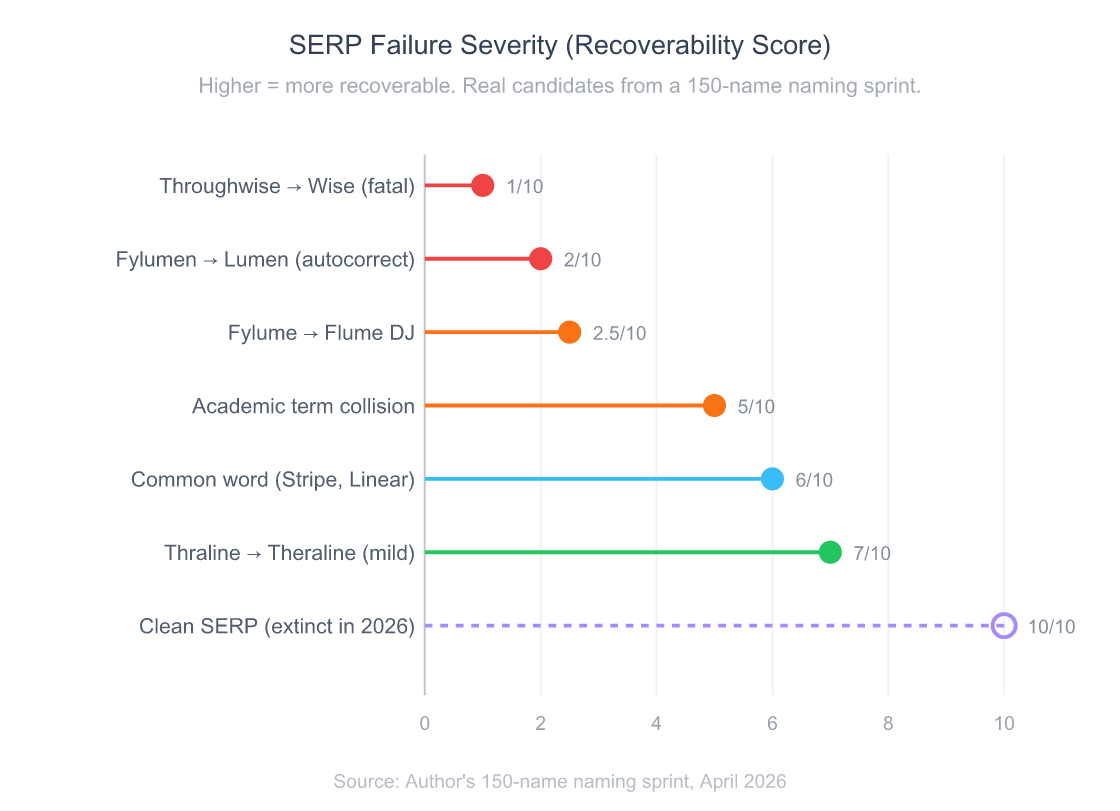
Real candidates ranked by SERP recoverability. Brand-takeover failures are unrecoverable. Mild phonetic adjacency to small brands is the realistic best case in 2026.
Citation Capsule: SERP failure has a severity hierarchy that founders ignore at their cost. Brand-takeover and “Did you mean” autocorrect failures are unrecoverable; phonetic adjacency to a small brand in an unrelated category is the realistic best-case outcome in 2026. The candidates Throughwise, Fylumen, and Fylume each passed paper tests with available .com domains and zero trademark conflicts, and all three were killed by Google SERP results before the founder could write a single line of brand copy.
Why Every Iconic SaaS You Love Launched with SERP Friction
This is the part that makes the 2026 naming reality bearable. Once you internalize it, the perfectionism stops.
Stripe launched in 2010 with a name that competed with bra stripes, road stripes, and zebra Wikipedia entries. Linear launched in 2019 against linear algebra textbooks and high-school math worksheets. Ramp launched in 2019 against wheelchair ramps, skateboard ramps, and parking infrastructure. Notion launched in 2016 against the literal dictionary definition, used in millions of unrelated contexts. Arc launched in 2026 against electrical arcs, story arcs, and a dozen other products literally named Arc.
None of them launched clean. They won by outranking the dictionary through three to five years of compounding brand investment, content production, and product traction. That’s the actual playbook. Not “find a clean name.” Make your name dominate the SERP through sheer force of brand weight over time.
This reframes the problem. The question isn’t “is there friction?” It’s “is the friction recoverable?” Stripe’s friction was recoverable because none of the competing SERP entities were dominant brands actively competing for the same audience. Bra stripes don’t market themselves to fintech CTOs. Wise does market itself to anyone searching for money-related software.
That’s the real test: not “is the SERP clean?” but “does anyone competing for this SERP also compete for my customer’s attention?”
competitive moats in 2026 SaaS

What Are the Three Honest Naming Options for SaaS Founders in 2026?
After a full week of hitting walls, I’ve concluded there are exactly three viable paths. Every “fourth option” I’ve seen marketed is one of these three with extra steps.
Option 1: Pay for a Premium Brandable
The brandable domain marketplaces (BrandBucket (145,000+ listings), Squadhelp (151,000+ listings), Brandpa, Atom) exist for exactly this moment. The average sale on Brandpa runs around $3,000, with brandable domains typically pricing $1,000-$10,000 and outliers exceeding $100,000 (NamePros, 2026). Premium two-syllable invented .coms regularly clear $30,000-$50,000.
This is the cleanest path, and it’s underrated by founders allergic to upfront cost. The math works. If a $5,000 domain saves you 12 months of SERP-recovery brand investment, it’s the best ROI line item in your launch budget.
Option 2: Accept Imperfection (Thraline-Tier)
If you can’t or won’t pay, the realistic ceiling is mild SERP friction. Find a name that survives the severity hierarchy at the bottom rung, phonetic adjacency to a small brand in an unrelated category, or a common word your category can plausibly own. Then commit to 12-18 months of brand investment to take ownership of the SERP. This is what Stripe, Linear, and Ramp did. It works. It just costs you in time instead of dollars.
Option 3: Defer with a Descriptive Domain
The contrarian option, and the one I’m most often recommending to first-time founders. Ship with a descriptive domain, getproduct.com, useproduct.com, productapp.com, validate product-market fit, then rebrand at $1M ARR when you can comfortably write a $30,000 check for the perfect domain. Domain sales actually crashed in 2025 partly because more founders are doing exactly this (Tech Startups, 2025).
There’s a real risk: rebranding mid-flight is expensive. One AI startup that used an AI-generated name without proper trademark screening incurred roughly $350,000 in legal fees, rebranding costs, and lost momentum after 14 months (Frozen Lemons, 2025). But for many founders, deferring is still cheaper than buying premium upfront and discovering the product itself needed to pivot anyway.
defensible product ideas worth naming
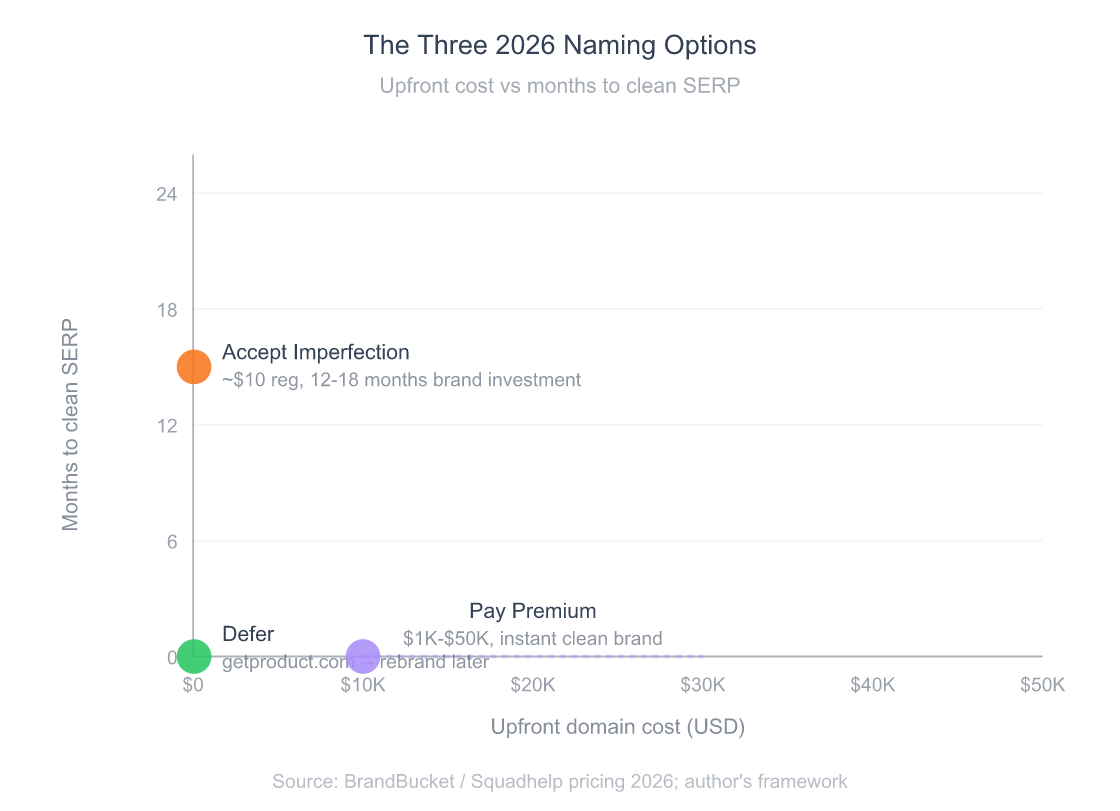
No option is free. You pay in dollars, months, or both. Pick the resource you have more of.
Citation Capsule: Founders in 2026 have three honest paths: pay $1,000-$10,000 for a brandable on Squadhelp or Brandpa (median around $3,000), accept Thraline-tier mild SERP friction and invest 12-18 months in brand recovery, or defer with a descriptive domain like
getproduct.comuntil product-market fit. Option three is increasingly common as domain sales softened in 2025 (Tech Startups, 2025).
When Does a Descriptive Name Beat a Brandable?
This is the insight that took me longest to internalize. Brandable names and descriptive names solve different problems. They aren’t comparable along a single axis.
Descriptive names (GrowthEngineKit, StatusPagePro, InvoiceLink) are SEO assets. They tell Google and humans what the product does in the URL itself. They’re great for utility tools where buyers search for the function, not the brand. If your distribution strategy is organic SEO traffic for high-intent keywords, descriptive wins.
Brandable names, Stripe, Notion, Linear, are trust assets. They signal premium positioning, editorial authority, “this product expects to last.” If you’re charging $49-99/month for a tool where the buyer is paying for confidence and craft, a descriptive name actively undermines you. Nobody pays a premium price to a domain called BestGrowthTool.com.
The same founder may need different naming strategies for different products. A free internal tool can ship as dashboardkit.com forever. A premium SaaS competing on brand authority cannot.
This is also why generic naming advice fails. A tactic that works for a $9/month utility actively damages a $99/month editorial brand. Know which product you’re naming before you pick a methodology.
Frequently Asked Questions
Should I check trademarks before or after the Google SERP test?
Run the Google SERP test first. It eliminates 60-70% of candidates in seconds, before you’ve sunk time into a USPTO search. Trademark conflicts are real (one startup paid roughly $350,000 to rebrand after ignoring trademark screening (Frozen Lemons, 2025)) but trademark search is slow and expensive. SERP test first, trademark second on survivors.
Is the .com still required in 2026?
For premium brand positioning, yes. Alternative TLDs (.io, .ai, .co) signal “couldn’t get the .com” to sophisticated buyers. For utility tools with descriptive names, a .ai or .io is fine. The 296,000+ curated brandable .coms on BrandBucket and Squadhelp exist because the .com still anchors trust (Squadhelp, 2026).
What do AI naming tools actually do well?
They generate volume, and that’s it. Namelix and similar tools are useful for breaking creative blocks and exploring phonetic territory you wouldn’t reach manually. They aren’t useful for selecting a name. Every candidate must still pass the Google SERP test, which AI tools can’t perform with judgment.
How much should I budget for a premium brandable?
Plan for $3,000-$10,000 as the realistic range, with $30,000-$50,000 as the ceiling for clean two-syllable .coms. Brandpa’s average is around $3,000 with most listings priced over $1,000 (Brandpa, 2026). Negotiate. Many sellers will accept 60-70% of list price.
Can I just use the brand name even if the .com is taken?
You can, but expect 30-40% of organic branded traffic to leak to whoever owns the .com. For a free product, acceptable. For a premium SaaS where every lead matters, costly. Better to negotiate the .com purchase, pick a different name, or use a clean descriptive until you can buy it back.
You’re Not Failing at Naming. The Market Changed.
If you’ve been beating yourself up for not finding the perfect name, stop. The market genuinely ran out of clean names somewhere around 2018, and the 2026-2026 explosion in AI startup funding plus AI-generated naming candidates accelerated the saturation past any reasonable founder’s ability to brute-force their way through.
Every iconic brand you admire launched with SERP friction, trademark conflicts, or a domain compromise. They won by investing in brand over time, not by starting from a clean slate. The clean slate is gone.
Pick your option. Pay for a brandable. Accept Thraline-tier imperfection. Or defer with a descriptive and rebrand later. All three are legitimate. None of them is failure.
What is failure is spending another six weeks searching for the perfect name that doesn’t exist. Ship the imperfect name. The product matters more than the alphabet you wrap around it.