
What’s the Best Tech Stack for Micro SaaS in 2026?
Every week, someone posts “what stack should I use for my SaaS?” on Reddit or Indie Hackers. The replies are always the same: people recommending whatever they already know. That’s not helpful. What’s helpful is data.
The global SaaS market reached $315.68 billion in 2026 (Vena Solutions, 2026). Micro SaaS founders building solo or in tiny teams can capture a slice of that, but only if they pick a stack that lets them ship fast without burning cash. The wrong choice means months of yak-shaving instead of talking to customers.
This guide breaks down every layer of the micro SaaS tech stack using real adoption data from Stack Overflow, GitHub Octoverse, and State of JavaScript surveys. No opinions without numbers. No “it depends” without telling you what it depends on.
AI-proof micro SaaS ideas with defensible moats
TL;DR: The best micro SaaS stack in 2026 is Next.js + TypeScript + Supabase (PostgreSQL) + Stripe + Vercel. PostgreSQL hit 55.6% developer adoption in 2025 (Stack Overflow, 2025), TypeScript became GitHub’s #1 language by contributors, and this full stack runs at $0/month until you hit real revenue. Data backs every recommendation below.
Why Does Your Tech Stack Decision Matter More in 2026?
TypeScript overtook Python and JavaScript in August 2026 to become the #1 language on GitHub by monthly contributors, growing 66% year-over-year to 2.63 million active contributors (GitHub Octoverse, 2026). That’s not a trend. That’s a tectonic shift in what the developer ecosystem standardizes around: and it directly affects which frameworks, tools, and libraries get the best support.
The serverless computing market is projected to hit $32.59 billion in 2026, up from $26.51 billion in 2026 (Mordor Intelligence, 2026). For solo founders, this means the infrastructure layer keeps getting cheaper and simpler. You don’t need to manage servers anymore. You probably shouldn’t.
But here’s what most “best stack” articles miss: your stack choice in 2026 isn’t just about the technology. It’s about the ecosystem. Which framework has the best AI coding tool support? Which database has the most active community answering questions at 2 AM? Which deployment platform lets you go from git push to production in under a minute?
The real insight: The best stack isn’t the most powerful one. It’s the one with the widest adoption, because wide adoption means better AI autocomplete, more Stack Overflow answers, more YouTube tutorials, and faster debugging. Every percentage point of market share translates directly into hours saved when you’re building alone.
The data below tells you exactly where the ecosystem has converged.
Which Frontend Framework Should You Pick?
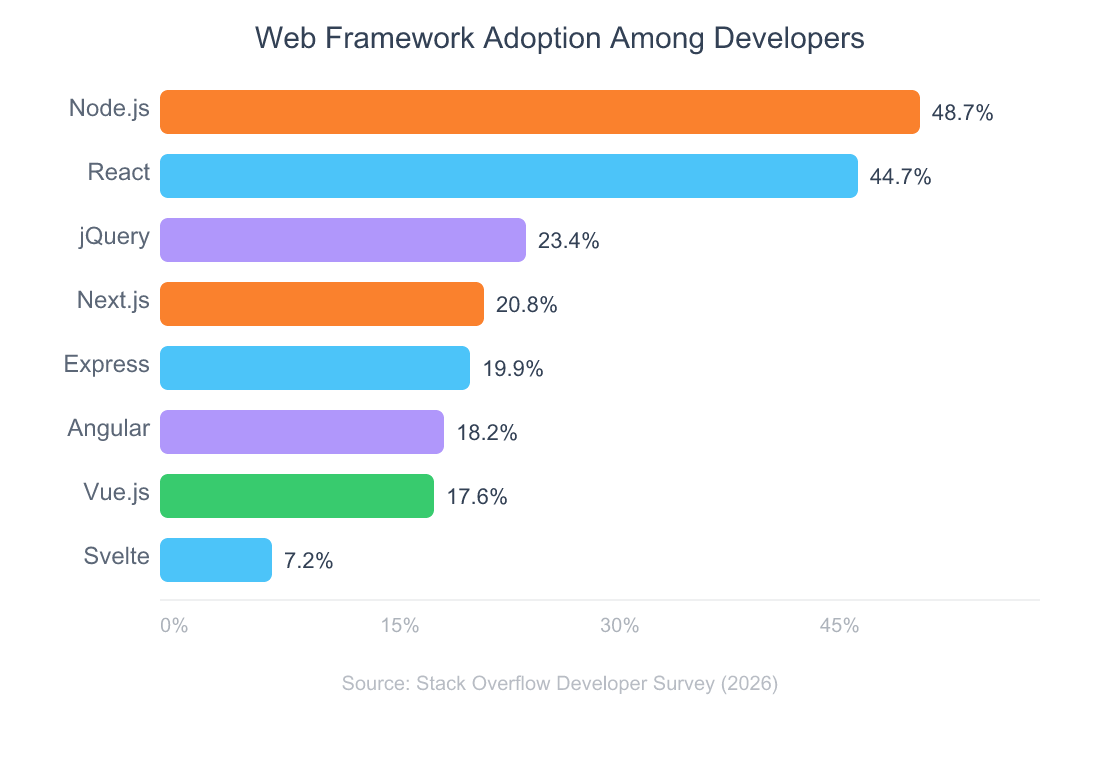
React is used by 44.7% of developers, and Next.js (React’s most popular full-stack framework) sits at 20.8% adoption according to the Stack Overflow 2025 survey (Stack Overflow, 2025). For micro SaaS founders, Next.js is the default choice because it combines your frontend, API routes, and server-side rendering in a single project.
The State of JS 2024 survey confirms this: Next.js hit 59% usage among JavaScript developers, while Vite (the build tool that powers most modern frameworks) reached 84% usage with 98% satisfaction (State of JS 2024). Webpack satisfaction, meanwhile, dropped to 26%. The tooling has spoken.
Why Next.js Wins for Solo Founders
Next.js gives you file-based routing, API routes, server components, and image optimization out of the box. That’s four fewer decisions to make. When you’re building alone, every decision you don’t have to make is time you can spend on the product.
The App Router (stable since Next.js 13.4) introduced React Server Components, which means you can fetch data directly in your components without building separate API endpoints for every page. For a micro SaaS dashboard, which is mostly “fetch data, render it”, this cuts your codebase nearly in half.
When to Consider Alternatives
Not every micro SaaS needs Next.js. If you’re building a Chrome extension with a simple landing page, Astro or plain Vite + React is lighter. If you’re already deep in the Vue ecosystem, Nuxt 3 is excellent. SvelteKit is worth watching. Svelte sits at 7.2% adoption but has the highest satisfaction scores in every survey it appears in.
But here’s the pragmatic truth: Next.js has the largest ecosystem of templates, tutorials, and AI coding tool support. When Cursor or Claude suggests code, it’s most likely suggesting Next.js patterns. That matters when you’re shipping solo.

how AI-native app architectures are changing development
Why Is PostgreSQL the Only Database You Should Consider?
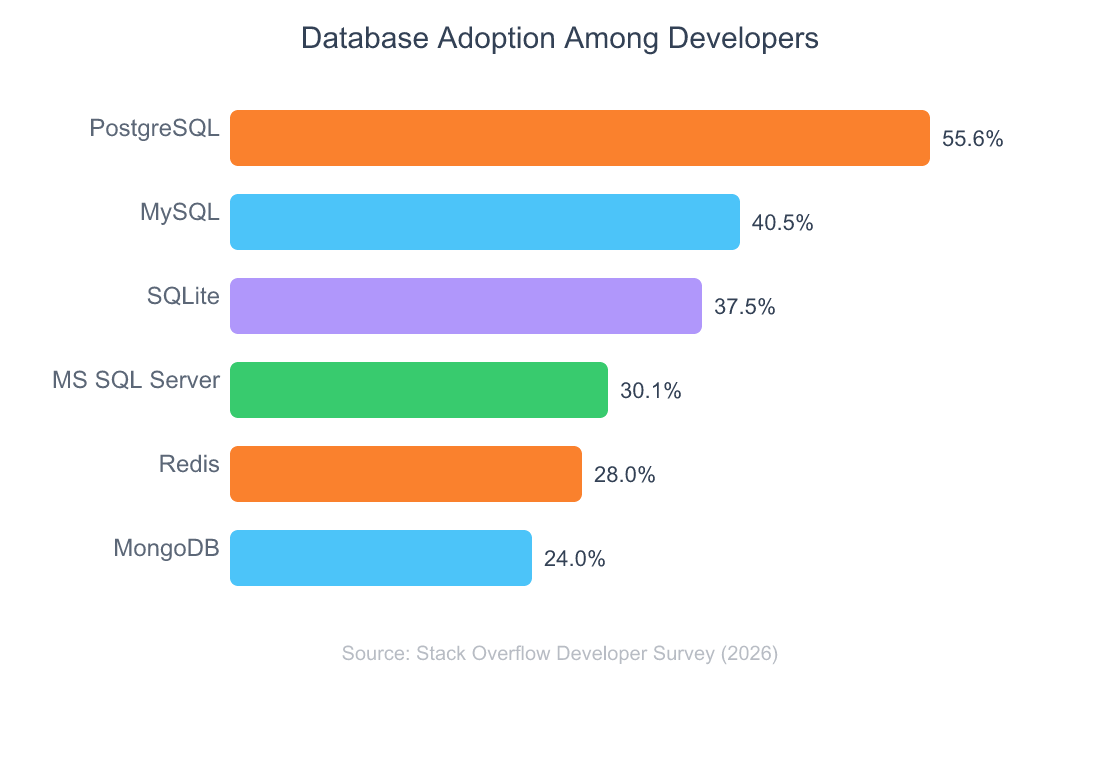
PostgreSQL is used by 55.6% of developers, up 6.9 percentage points year-over-year, making it the #1 database for the third consecutive year (Stack Overflow, 2025). MySQL trails at 40.5%. MongoDB sits at 24%. For micro SaaS, PostgreSQL isn’t just the popular choice, it’s the rational one.
The serverless PostgreSQL market alone is growing at 28.1% CAGR, from $1.71 billion in 2026 to $2.19 billion in 2026 (Research and Markets, 2026). Managed providers like Supabase and Neon are driving this growth by making PostgreSQL as easy to spin up as a Firebase project.
According to a 2026 market analysis, PostgreSQL’s dominance is driven by its extensibility: JSONB columns, full-text search, PostGIS for geospatial data, and pgvector for AI embeddings all come built-in (Research and Markets, 2026). You don’t need Redis for caching simple queries. You don’t need Elasticsearch for basic search. PostgreSQL handles both.
What About MongoDB or MySQL?
MongoDB makes sense if your data is genuinely document-shaped: think CMS content, event logs, or nested JSON structures. But most micro SaaS products are relational at their core: users have subscriptions, subscriptions have invoices, invoices have line items. That’s a relational model. Fighting it with documents creates complexity you don’t need.
MySQL is fine. It works. But PostgreSQL does everything MySQL does, plus JSONB, plus better extensions, plus it’s what every modern BaaS platform (Supabase, Neon, Railway) defaults to. Swimming with the current is easier than swimming against it.
Is Supabase Really Replacing Firebase?
Supabase grew from 1 million to 4.5 million developers in under a year, hosts over 1 million active databases, and is used by 55% of the most recent Y Combinator batch (Craft Ventures, 2026). That growth rate is staggering, and it tells you where the ecosystem is heading.
Supabase gives you a PostgreSQL database, authentication, real-time subscriptions, file storage, and edge functions, all from a single dashboard. For micro SaaS founders, this eliminates five separate vendor decisions. You don’t need Auth0 for auth. You don’t need AWS S3 for file uploads. You don’t need Pusher for real-time features. It’s all there.
Supabase vs. Firebase in 2026
Firebase still has more total users and a larger ecosystem of tutorials. But Firebase locks you into Google’s proprietary database (Firestore), which means your data model is dictated by their NoSQL structure. Migrating off Firebase is painful. Migrating off Supabase means you’re just migrating off PostgreSQL, the most portable database in the world.
When Supabase Isn’t Enough
If you need complex background job processing, Supabase’s edge functions won’t cut it. You’ll want Inngest or Trigger.dev for that. And if your product is computation-heavy (video processing, ML inference), you’ll outgrow Supabase’s infrastructure and need dedicated compute on Railway or Fly.io. But for 90% of micro SaaS products (dashboards, CRUD apps, API services) Supabase handles the entire backend.
Worth noting: Supabase’s real advantage isn’t any single feature. It’s that their free tier is generous enough to build and launch a product without spending a dollar. You get 500MB of database storage, 1GB file storage, 50,000 monthly active users for auth, and 500,000 edge function invocations. That’s enough to validate a product and get your first 100 paying customers.
playbook for reaching $1K MRR as a solo founder
How Does Stripe Compare to Alternatives for Billing?
Stripe processed $1.9 trillion in total payment volume, up 34% year over year, and its Revenue suite (Billing, Invoicing, Tax) is on track for a $1 billion annual run rate (Stripe, 2025). Over 5 million businesses use Stripe. 80% of the Nasdaq 100 uses Stripe. The ecosystem effects are enormous: every SaaS template, boilerplate, and tutorial integrates Stripe first.
For micro SaaS, Stripe Billing handles subscription management, proration, dunning (failed payment recovery), and customer portals. You don’t need to build any of that yourself. The integration takes an afternoon with their Next.js examples.
When Stripe Isn’t the Right Choice
Stripe doesn’t operate everywhere. If you’re selling to customers in India, you’ll need Razorpay or Dodo Payments alongside Stripe. If you want to avoid handling sales tax entirely, Lemon Squeezy or Paddle act as Merchant of Record: they handle VAT, GST, and sales tax for you, taking a slightly higher percentage in exchange.
Here’s the cost tradeoff:
- Stripe: 2.9% + $0.30 per transaction. You handle tax compliance.
- Lemon Squeezy: 5% + $0.50. They handle tax globally.
- Paddle: 5% + $0.50. They handle tax globally.
At $5K MRR, the difference between Stripe and a Merchant of Record is roughly $105/month. Whether that’s worth it depends on how much you value not thinking about tax filings in 40 countries.
Where Should You Deploy: Vercel, Railway, or Fly.io?
Vercel raised $300 million at a $9.3 billion valuation in September 2026, and Railway raised $100 million in January 2026 (Vercel, TQ Ventures, 2026-2026). Both platforms are betting heavily on making deployment invisible for small teams. But they serve different needs.
Vercel is purpose-built for Next.js. If you’re using Next.js (and you should be, per the data above), Vercel gives you zero-config deployments, edge functions, automatic preview URLs for every pull request, and a generous free tier. The integration is seamless because Vercel literally maintains Next.js.
Railway is more flexible. It runs any Docker container, which means you can deploy Next.js alongside a Python ML service, a Redis instance, and a cron job runner, all from one dashboard. If your micro SaaS needs more than just a web app, Railway is the play.
Fly.io excels when latency matters globally. They deploy your app to data centers worldwide and route users to the nearest one automatically. If your micro SaaS serves real-time data (monitoring, analytics, collaboration), Fly.io’s multi-region deployment is worth the extra complexity. Whichever host you pick, fronting it with Cloudflare costs nothing and saves you from edge-case routing nightmares (I learned this the hard way when my ISP silently blocked my own site and Cloudflare fixed it in 15 minutes).
The Free Tier Comparison
For pre-revenue founders, the free tier is what matters. Here’s the honest breakdown:
- Vercel: Generous for hobby projects. 100GB bandwidth, serverless functions, edge network. Falls off a cliff at the Pro tier ($20/month per team member).
- Railway: $5 of free usage per month. Enough to run a small app. Transparent usage-based pricing after that.
- Fly.io: 3 shared VMs, 160GB outbound bandwidth. Good for testing, but you’ll hit limits fast with real traffic.
- Render: Free static sites, free web services (spin down after 15 min inactivity). Good for landing pages, less great for production SaaS.
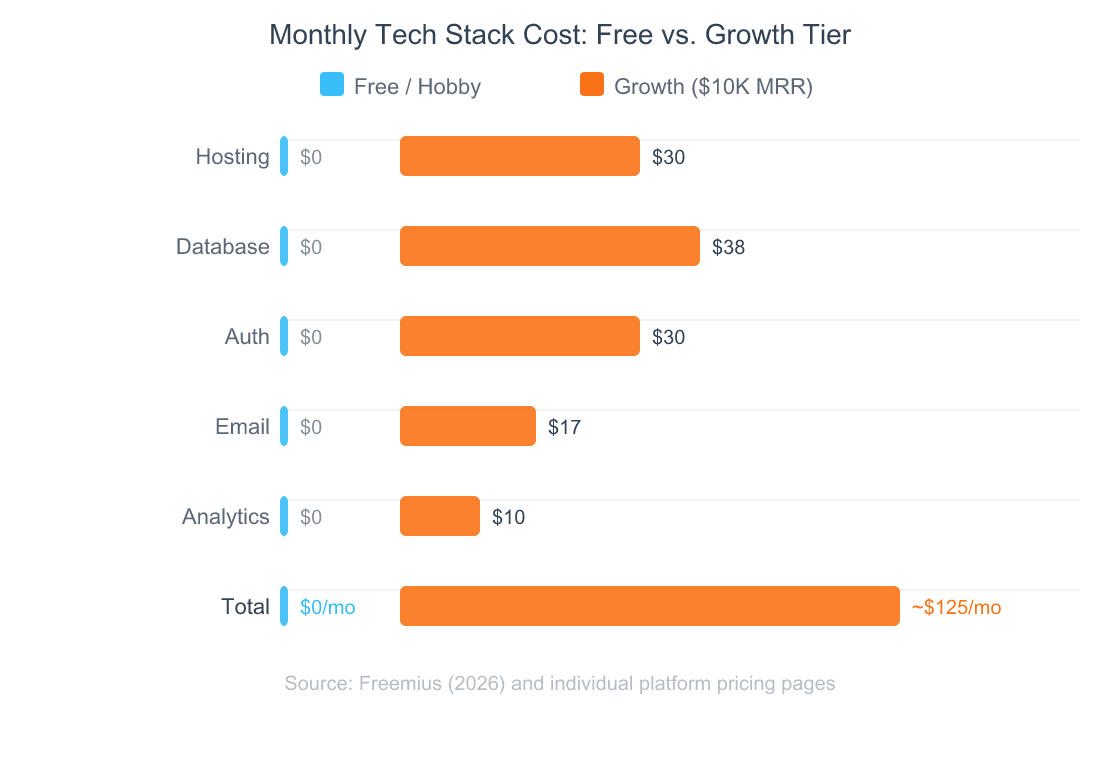
A lean micro SaaS stack can operate under $75/month before reaching $10K MRR, and one founder reported growing revenue 150% while reducing support tickets 60% after simplifying their stack (Freemius, 2026). Less tools, less complexity, more focus on the product.
What About Auth, Email, and Analytics?
Micro SaaS products with profit margins up to 80% can’t afford to waste 10% of revenue on overlapping SaaS tools (Vena Solutions, 2026). Here’s the supporting stack that minimizes both cost and decision fatigue.
Authentication
Supabase Auth is free and comes bundled with your database. It handles email/password, magic links, OAuth (Google, GitHub, etc.), and row-level security policies. If you’re already using Supabase, adding a separate auth provider makes no sense.
Clerk is the alternative when you need more polished pre-built UI components, organization/team management, or webhook-based event handling. Their free tier covers 10,000 monthly active users, more than enough to validate.
Transactional Email
Resend is built by the team behind react.email, so if you’re in the React/Next.js ecosystem, the developer experience is unmatched. Free tier: 3,000 emails/month. Their API is simple, send an email in three lines of code.
Loops is better if you also need marketing automation (drip sequences, onboarding flows). It’s more expensive but replaces both your transactional email provider and your email marketing tool.
Product Analytics
PostHog gives you event tracking, session replays, feature flags, and A/B testing in a single open-source platform. Their free tier is genuinely generous: 1 million events/month, 5,000 session recordings, unlimited feature flags. Most micro SaaS products won’t outgrow this for a long time.
Skip Google Analytics. It tells you page views. PostHog tells you what users actually do inside your product.
How Are AI Tools Changing Stack Decisions in 2026?
In the State of JS 2024 survey, the single largest group of respondents writes exclusively in TypeScript, and 67% write more TypeScript than JavaScript (State of JS 2024). AI coding tools are accelerating this shift. Cursor, GitHub Copilot, Claude, and v0 all produce significantly better output when the codebase is TypeScript, because type information gives the AI more context about what you’re trying to build.
This creates a feedback loop: more developers use TypeScript, so AI tools get trained on more TypeScript, so they get better at TypeScript, so more developers adopt it. If you start a micro SaaS project in plain JavaScript in 2026, you’re opting out of the best tooling available.
The hidden advantage: Vercel’s v0 has been used by over 4 million people since launch (Vercel, 2026). It generates full Next.js components from text prompts, but only if you’re using Next.js and TypeScript. Choosing the most popular stack isn’t just about community support anymore. It’s about getting 10x more help from AI tools that understand your codebase.
What does this mean practically? Pick TypeScript. Pick Next.js. Pick the stack that AI tools are optimized for. When you’re building alone, AI is your co-founder, and you want it operating at peak performance.
complete guide to using Claude Code for development
The Recommended Stack: One Table
Here’s the full recommended stack, consolidated. Every tool listed has a free tier sufficient for pre-revenue validation.
| Layer | Tool | Why |
|---|---|---|
| Language | TypeScript | #1 on GitHub, best AI tool support |
| Frontend Framework | Next.js (App Router) | 20.8% adoption, 59% among JS devs |
| Styling | Tailwind CSS | Industry default, utility-first |
| Database | PostgreSQL (via Supabase) | 55.6% adoption, #1 for 3 years |
| Auth | Supabase Auth | Free, bundled, 50K MAU |
| Backend/BaaS | Supabase | 4.5M devs, 55% of YC |
| Payments | Stripe Billing | $1.9T volume, 5M businesses |
| Resend | 3K free emails/month, React templates | |
| Analytics | PostHog | 1M free events/month, open source |
| Deployment | Vercel | Zero-config for Next.js, edge network |
| AI Coding | Cursor + Claude | TypeScript-optimized, best-in-class |
Total cost at $0 MRR: $0/month. Total cost at $10K MRR: ~$125/month (excluding Stripe’s percentage).
Frequently Asked Questions
Is Next.js overkill for a micro SaaS?
No. Next.js handles routing, API endpoints, and server rendering in one framework, that’s less code, not more. The App Router with React Server Components actually simplifies data fetching compared to older patterns. According to Stack Overflow’s 2025 survey, Next.js is used by 20.8% of developers (Stack Overflow, 2025), which means you’ll never lack for answers when you hit a problem.
Should I use Supabase or Firebase in 2026?
Supabase is the better bet for new projects. It grew from 1 million to 4.5 million developers in under a year and is used by 55% of the latest YC batch (Craft Ventures, 2026). More importantly, Supabase uses PostgreSQL, so you’re never locked in. Firebase uses proprietary Firestore, which makes migration painful.
why your AI SaaS moat might be weaker than you think
How much does a micro SaaS tech stack cost per month?
Zero dollars before you have revenue. The recommended stack (Next.js, Supabase, Stripe, Vercel, Resend, PostHog) runs entirely on free tiers until you have meaningful traffic. At $10K MRR, expect roughly $125/month in infrastructure costs, giving you profit margins above 80% (Freemius, 2026).
Can I build a micro SaaS without knowing TypeScript?
Technically, yes. Practically, you’re handicapping yourself. TypeScript became the #1 language on GitHub by monthly contributors in 2026, growing 66% year-over-year (GitHub Octoverse, 2026). AI coding tools produce better output with TypeScript. Stack Overflow has more TypeScript answers. The ecosystem has picked its winner. If you’re still on the fence, my longer breakdown of the JavaScript vs TypeScript trade-off for solo builders walks through exactly when each one wins.
What’s the fastest way to ship a micro SaaS MVP?
Use a SaaS boilerplate. Projects like Shipfast, Supastarter, or create-t3-app give you authentication, billing, database, and email pre-configured. Combine that with Cursor or Claude Code for AI-assisted development, and you can go from idea to deployed MVP in a weekend. The key is picking tools you don’t need to configure, which is exactly what the stack above optimizes for.
why developers should build products instead of freelancing
Conclusion
The data is unusually clear in 2026. PostgreSQL dominates databases at 55.6%. TypeScript dominates GitHub. Next.js dominates React frameworks. Supabase is growing faster than anything in the BaaS space. And the entire stack runs free until you have paying customers.
Here’s what to remember:
- Start with Next.js + TypeScript + Supabase + Stripe + Vercel. This stack has the widest adoption, best AI tooling support, and lowest starting cost.
- Don’t optimize for scale you don’t have. A $0/month stack that gets your first 100 customers is worth more than a $500/month stack that’s “enterprise-ready.”
- Pick the popular choice. When you’re building alone, the size of the ecosystem is your competitive advantage. More users means more answers, more templates, more AI training data.
The best tech stack isn’t the most technically impressive one. It’s the one that lets you stop thinking about infrastructure and start thinking about customers.
complete playbook for hitting $1K MRR
Should Indie Hackers Choose Supabase or Firebase in 2026?
The $0 Marketing Stack for Indie Hackers in 2026
Why Indie Hackers Fail at Marketing (And What to Do Instead)