Should Indie Hackers Choose Supabase or Firebase in 2026?
Supabase grew from 1 million to over 4.5 million developers in under a year (Fortune, 2025). Meanwhile, Firebase usage on Stack Overflow’s annual survey dropped from 13.9% to 13.1% (Stack Overflow, 2025). Something shifted in the BaaS landscape, and indie hackers building their next SaaS need to pay attention.
Picking the wrong backend-as-a-service platform means a painful migration later: rewriting auth flows, restructuring data models, and rebuilding real-time subscriptions. That’s weeks of work you can’t afford as a solo founder.
This comparison uses real pricing data, developer survey results, and growth metrics to help you make the right call. No hand-waving, no “it depends” cop-outs.
TL;DR: Supabase is the better default for most indie hackers in 2026. It’s built on PostgreSQL, open source, and 30-50% cheaper at scale. Firebase still wins for mobile-first apps deep in the Google ecosystem. Supabase hit $70M ARR with 250% YoY growth (Sacra, 2026), and 55% of YC’s latest batch uses it.
How Fast Is Supabase Actually Growing?
Supabase reached $70 million in annual recurring revenue by August 2026, up from $30 million at the end of 2026, that’s 250% year-over-year growth (Sacra, 2026). For an open-source database company competing against Google, those numbers are almost absurd. The developer community isn’t just curious about Supabase anymore. They’re building production apps on it.
The funding trajectory tells the same story. Supabase raised $80 million at a $765 million valuation in September 2024, then $200 million at $2 billion in June 2025, and another $100 million at $5 billion by October 2025 (TechCrunch, 2025). That’s a 6.5x valuation jump in thirteen months. Total funding: $500 million.

Worth noting: 55% of Y Combinator’s most recent batch and over 1,000 YC companies total now use Supabase (Craft Ventures, 2026). When the startup accelerator that backed Stripe, Airbnb, and Dropbox overwhelmingly picks one BaaS platform, that’s a strong signal for indie hackers evaluating their options.
Firebase, by comparison, sits at around 3 million app developers and roughly 63,000 companies globally (6sense, 2026). It’s still massive. But its growth curve has flattened while Supabase’s hockey-sticks upward.
Supabase now manages over 1 million active databases, with 2,500 new databases created daily (Craft Ventures, 2026). The platform reached roughly 99,600 GitHub stars by early 2026, making it one of the fastest-growing open-source projects in the database space.
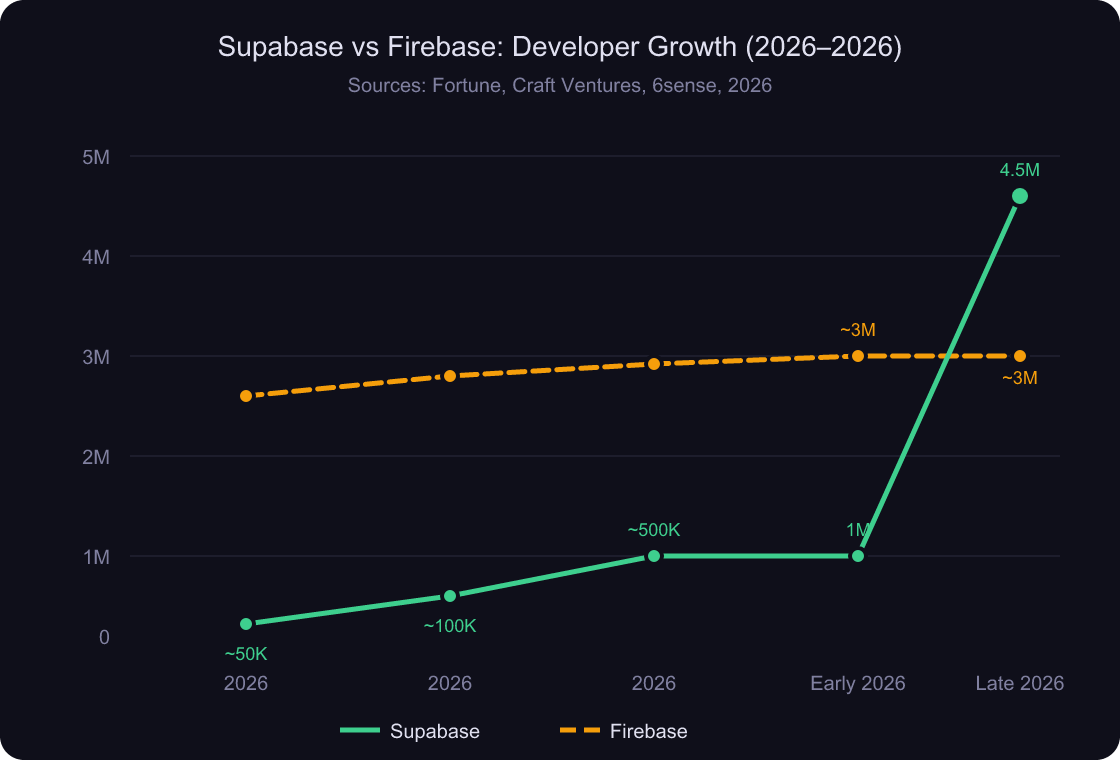
Sources: Fortune, Craft Ventures, 6sense (2026)
According to Sacra Research, Supabase reached $70 million ARR by August 2026 while trading at a 71x revenue multiple at its $5 billion valuation (Sacra, 2026). That multiple reflects investor confidence that Supabase is capturing a generational shift in how developers build backends, particularly as AI-assisted coding tools drive new developer signups.
article on ACID transactions and database internals
What Does the Developer Community Actually Prefer?
PostgreSQL usage jumped from 48.7% to 55.6% in the 2025 Stack Overflow Developer Survey, making it the most popular database for the fourth consecutive year with a 65.5% admiration rate (Stack Overflow, 2025). This matters because Supabase is built directly on PostgreSQL. Every skill you develop using Supabase transfers to the broader PostgreSQL ecosystem.

Firebase’s Realtime Database dropped to 5.0% usage, down from 5.8% in 2024 and 6.2% in 2023. As a cloud platform, Firebase fell from 13.9% to 13.1%. Supabase moved the opposite direction, up from 3.8% to 5.4% (Stack Overflow, 2025).
Does that 5.4% number look small? It shouldn’t. Supabase didn’t exist five years ago. Firebase has had a decade-long head start and Google’s marketing budget behind it. Closing the gap from 3.8% to 5.4% in a single year while Firebase declines is a trend, not a blip.
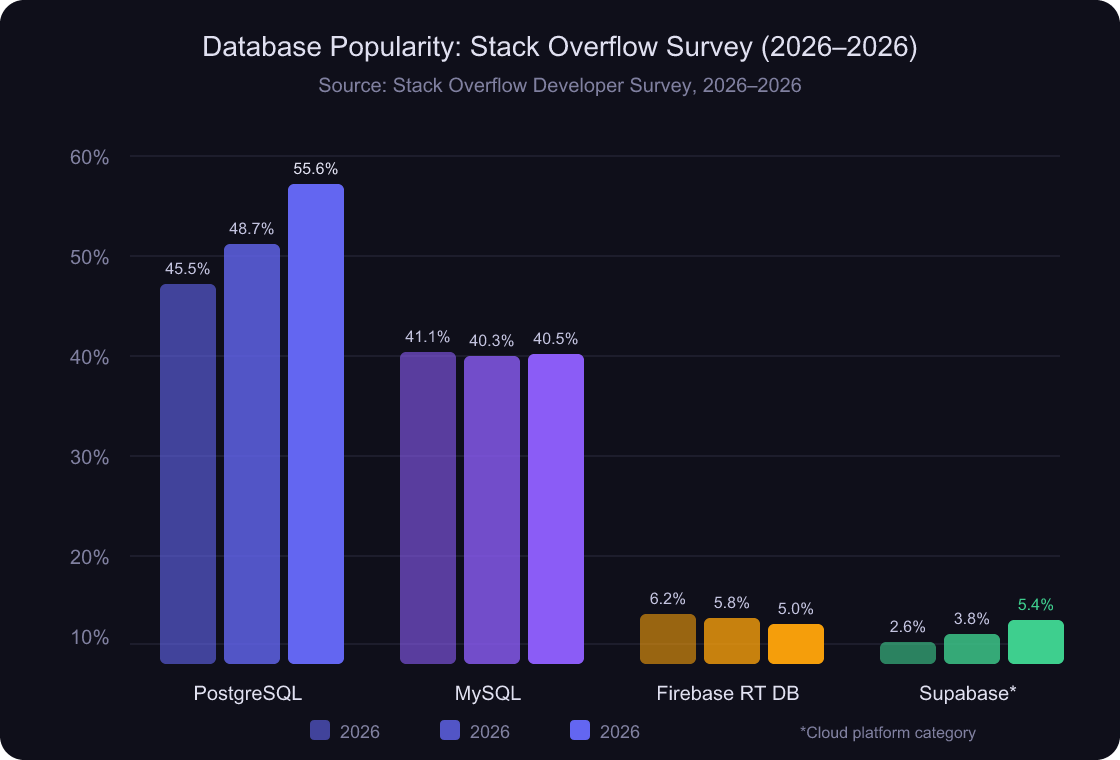
Source: Stack Overflow Developer Survey, 2026–2026
The PostgreSQL moat: MongoDB is the only major database showing negative growth in Stack Overflow’s 2025 survey, dropping 0.7% (Vonng, 2025). The entire NoSQL wave that Firebase rode is receding. PostgreSQL’s dominance means Supabase developers build on the most portable, most in-demand database skill in the market.
SQL skills transfer everywhere. Firestore’s proprietary query language doesn’t. For an indie hacker who might pivot, get acquired, or hire their first engineer, that portability matters more than any single feature comparison.
article on rate limiting, CORS, CSRF, and JWT
How Do Supabase and Firebase Compare Feature by Feature?
Both platforms offer auth, database, storage, real-time subscriptions, and serverless functions, but the underlying architectures differ fundamentally. Firebase uses Firestore (NoSQL document model) while Supabase uses PostgreSQL (relational, SQL-based) (Supabase, 2026). That architectural choice shapes everything downstream.

Here’s how they stack up across the features indie hackers care about most:
Database
Supabase gives you full PostgreSQL with extensions like pgvector (for AI embeddings), PostGIS (for geospatial), and full-text search built in. You write standard SQL. Firebase’s Firestore uses a document-collection model with its own query syntax. Simple reads are fast, but complex queries (joins, aggregations, full-text search) require workarounds or Cloud Functions.
Authentication
Both offer free auth up to 50,000 monthly active users. After that, Supabase charges $0.00325 per MAU while Firebase charges $0.0055 per MAU (Zuplo, 2026). At 100K MAUs, that’s $162.50 versus $275 per month. Both support social logins, magic links, and phone auth.
Real-Time
Firebase’s Realtime Database clocks around 600ms round-trip latency, while Firestore averages roughly 1,500ms for similar operations (Daniel Schreiber, 2026). Supabase Realtime uses PostgreSQL’s built-in Change Data Capture. Different approach, comparable performance for most indie hacker use cases.
Storage and Edge Functions
Supabase’s free tier includes 1 GB storage and 500K edge function invocations. Firebase’s Spark plan offers 5 GB storage but caps Cloud Functions at 125K invocations per month. Supabase’s Pro plan ($25/month) bumps storage to 100 GB and functions to 2 million invocations.
| Feature | Supabase Free | Supabase Pro ($25/mo) | Firebase Spark | Firebase Blaze (pay-as-you-go) |
|---|---|---|---|---|
| Database | 500 MB PostgreSQL | 8 GB PostgreSQL | 1 GB Realtime DB | Pay per GB stored + reads/writes |
| Auth MAUs | 50,000 | 100,000 | 50,000 | $0.0055/MAU after 50K |
| Storage | 1 GB | 100 GB | 5 GB | $0.026/GB |
| Functions | 500K invocations | 2M invocations | 125K/month | $0.40/million |
| API Requests | Unlimited | Unlimited | 50K reads + 20K writes/day | Pay per operation |
| Backups | None | Daily | None | Manual only |
For most indie hackers building a SaaS with auth, a database, and some serverless logic, Supabase’s Pro plan at $25/month covers what Firebase only matches at $50-100+/month depending on usage patterns.
article on ACID transactions, isolation levels, and WAL
Which Platform Costs Less as You Scale?
Supabase runs 30-50% cheaper than Firebase at typical indie hacker scale, according to pricing analysis by Getmonetizely (Getmonetizely, 2026). The gap widens as you grow. Firebase’s per-operation pricing model means costs scale linearly with every database read, write, and function invocation. Supabase’s flat-rate Pro plan absorbs most growth without surprise bills.
Here’s what the numbers look like at different stages:
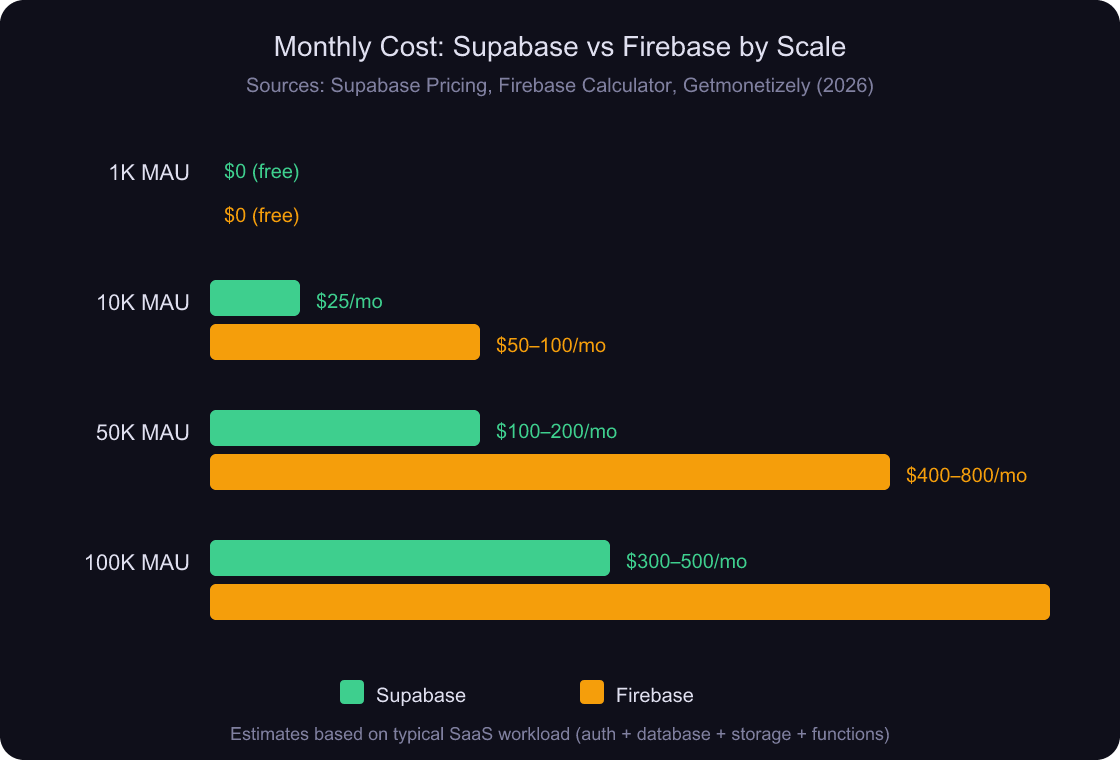
Sources: Supabase Pricing, Firebase Pricing Calculator, Getmonetizely (2026)
The real cost difference: At 50K MAUs, a realistic milestone for a successful indie SaaS, you’re looking at $100-200/month on Supabase versus $400-800/month on Firebase. That $300-600/month gap pays for your domain, email service, and error monitoring combined.
Firebase’s pricing model has a second, sneakier problem. Firestore charges per document read. A single page load that queries 50 documents costs 50 reads. Batch those across thousands of users and the bill climbs fast. Supabase charges for database size and compute, not individual queries, so a complex SQL join that touches a million rows costs the same as a simple SELECT.
The free tier comparison favors Supabase for API-heavy apps (unlimited requests vs. Firebase’s 50K reads + 20K writes per day). Firebase’s free tier is more generous on storage (5 GB vs. 1 GB). For most indie hackers burning through API calls during development, Supabase’s unlimited requests win.
One catch: Supabase pauses free-tier databases after 7 days of inactivity. That’s fine for active projects but annoying for side projects you revisit monthly. The $25/month Pro plan removes the pause.
When Should You Pick Firebase Instead?
Firebase processes data for roughly 1.5 million apps worldwide, and Google’s infrastructure behind it handles scale that most indie hackers will never hit (6sense, 2026). Dismissing Firebase completely would be a mistake. There are clear scenarios where it’s the better choice.

Mobile-first apps. Firebase’s SDKs for iOS, Android, Flutter, and React Native are years ahead of Supabase’s mobile tooling. Offline persistence, automatic sync when reconnection happens, and deep integration with Google’s mobile analytics stack make Firebase the default for apps that live primarily on phones.
The Google ecosystem. If you’re already using Google Analytics, Crashlytics, Remote Config, A/B Testing, and Cloud Messaging, Firebase ties them together with zero integration work. Supabase doesn’t have equivalents for most of these. You’d stitch together third-party services instead.
Realtime-first use cases. Firebase’s Realtime Database was built for low-latency sync. At ~600ms round-trip for simple operations (Daniel Schreiber, 2026), it’s battle-tested for chat apps, collaborative editors, and live dashboards. Supabase Realtime works well, but Firebase has a decade of production hardening here.
You need to ship this weekend. Firebase’s console, documentation, and tutorial ecosystem are more mature. The “zero to deployed” path has been smoothed over years. If time-to-market matters more than long-term cost optimization, Firebase gets you there faster.
What about the BaaS market overall? It’s growing fast. The mobile BaaS market hit $10.15 billion in 2026 and is projected to reach $16.75 billion by 2030 at a 10.34% CAGR (Mordor Intelligence, 2026). Both platforms are riding this wave, the question is which architecture serves your specific use case better.
What About Vendor Lock-In and the Exit Strategy?
Supabase is open source and self-hostable. Your data lives in standard PostgreSQL, which means you can migrate to any PostgreSQL host (AWS RDS, Railway, Neon, or your own server) with a pg_dump command (Supabase, 2026). You aren’t locked into Supabase’s managed service. You’re locked into PostgreSQL, and that’s a lock-in most developers are comfortable with.
Firebase is a different story. Firestore’s document-collection data model is proprietary. There’s no standard equivalent. Migrating away means rewriting your data access layer, restructuring your schema for a relational or different NoSQL database, and rebuilding auth integrations. Developers who’ve gone through Firebase-to-Supabase migrations consistently report it as a multi-week effort.
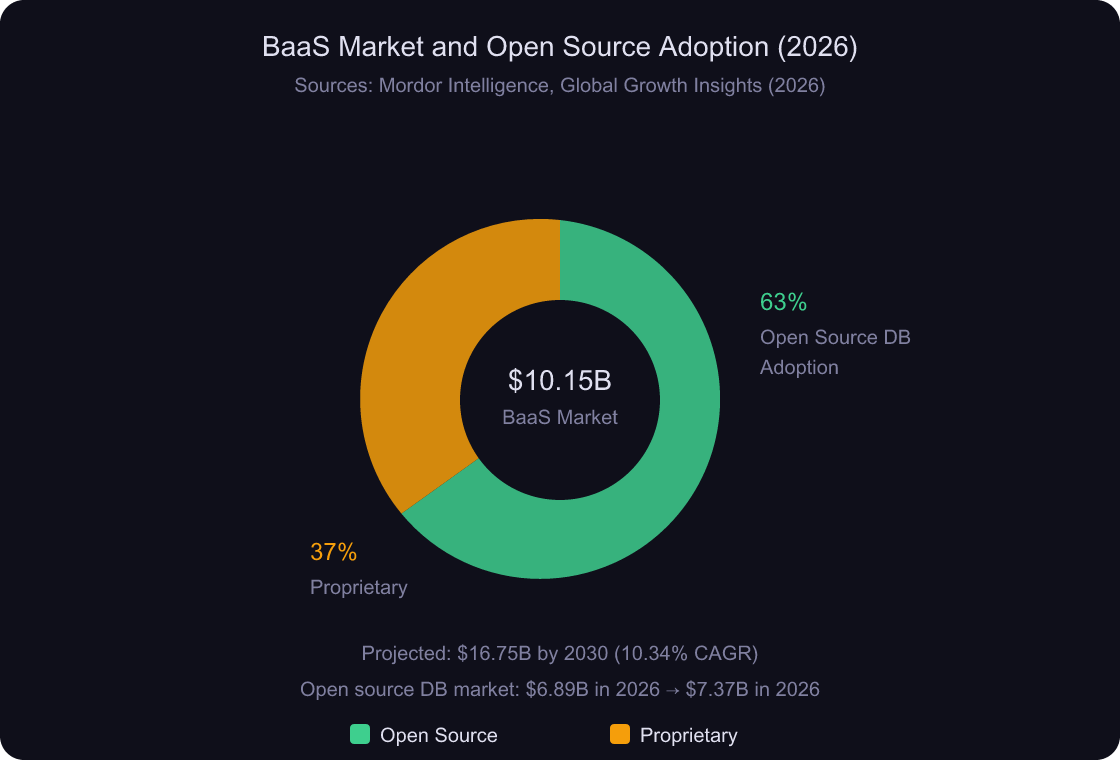
Sources: Mordor Intelligence, Global Growth Insights (2026)
The vibe-coding factor: About 30% of Supabase’s new signups are “AI builders” using tools like Bolt.new and Lovable to generate full-stack apps (Fortune, 2025). These AI coding tools default to Supabase because its SQL-based interface is easier for LLMs to generate correct queries for. If you’re using AI assistants to build your SaaS, Supabase’s PostgreSQL foundation gives those tools a better surface to work with.
Enterprise adoption of open source databases hit 63% in 2026, and the open source database market reached $6.89 billion (Global Growth Insights, 2026). The industry is moving toward open, portable data layers. Building on a proprietary data model runs against that grain.
Google Cloud holds 13% of the worldwide cloud infrastructure market behind AWS (30%) and Azure (20%) (Synergy Research Group, 2026). Firebase inherits that position, it’s solid infrastructure, but you’re betting your data layer on one cloud vendor’s roadmap.
article on rate limiting, CORS, CSRF, and JWT best practices
Frequently Asked Questions
Can I migrate from Firebase to Supabase?
Yes, but expect a multi-week effort. Supabase provides migration guides and a Firestore-to-PostgreSQL conversion tool, but the fundamental shift from NoSQL documents to relational tables requires restructuring your data model. Auth migration is smoother, both use similar OAuth providers. Over 1,000 YC companies have already made Supabase their primary backend (Craft Ventures, 2026), so there’s strong community support for the transition.
Is Supabase production-ready?
Supabase manages over 1 million active databases with 2,500 new ones created daily (Craft Ventures, 2026). It runs on standard PostgreSQL, which powers companies from Instagram to Discord. The Pro plan includes daily backups and point-in-time recovery. At $70M ARR and $5B valuation, Supabase isn’t a weekend project anymore.
Which is better for real-time features?
Firebase’s Realtime Database offers ~600ms round-trip latency, roughly 2.5x faster than Firestore’s ~1,500ms for simple sync operations (Daniel Schreiber, 2026). Supabase Realtime uses PostgreSQL Change Data Capture and performs well for most use cases. For latency-critical apps like multiplayer games or live trading, Firebase Realtime Database still has an edge.
real-time architecture
Does Supabase work with mobile apps?
Yes. Supabase offers official SDKs for Flutter, Swift, and Kotlin. However, Firebase’s mobile SDKs are more mature: they include offline data persistence, automatic reconnection sync, and deeper integration with platform-specific tools like Crashlytics. If your app is mobile-first, evaluate Firebase’s SDK maturity against Supabase’s cost and SQL advantages.
Can I self-host Supabase?
Yes. Supabase is fully open source and provides Docker Compose files for self-hosting. You get the full stack: PostgreSQL, GoTrue (auth), PostgREST (API), Realtime, and Storage. Self-hosting eliminates the $25/month Pro cost but means you handle backups, scaling, and security yourself. Firebase has no self-hosting option, it’s Google Cloud or nothing.
The Bottom Line for Indie Hackers
The BaaS market is projected to grow from $10.15 billion to $16.75 billion by 2030 (Mordor Intelligence, 2026). Both Supabase and Firebase will be around for the long haul. But the right choice depends on what you’re building.

Choose Supabase if you’re:
- Building a web-first SaaS or dashboard
- Cost-conscious and planning to scale past 10K users
- Using AI coding tools to accelerate development
- Want SQL skills that transfer to any PostgreSQL host
- Building something you might self-host or migrate later
Choose Firebase if you’re:
- Building a mobile-first app (iOS, Android, Flutter)
- Deep in the Google ecosystem (Analytics, Crashlytics, Remote Config)
- Need battle-tested offline sync and real-time data
- Prioritizing speed to market over long-term cost optimization
For most indie hackers building a SaaS product in 2026, Supabase is the stronger default. It’s cheaper at scale, built on the most popular database in the world, and doesn’t lock your data into a proprietary format. The 250% year-over-year growth isn’t just a vanity metric, it reflects a real shift in what developers are choosing when they start fresh.
Start with Supabase’s free tier. If you hit the 7-day inactivity pause, that’s actually a good sign, it means you should upgrade to Pro and keep building.
SaaS pricing strategy
What’s the Best Tech Stack for Micro SaaS in 2026?
The $0 Marketing Stack for Indie Hackers in 2026
How to Create a Marketing Strategy When You’re a Solo Founder With No Budget