How to Secure an API: The 4-Layer Framework That Works
APIs are the backbone of every modern app. They are also the most common entry point for attackers. Most developers bolt security on as an afterthought: one middleware, one config flag, one if user.is_authenticated check. That’s not how you secure an API. That’s a single lock on a door with three open windows.
To secure an API properly, you need to think in layers. Each layer stops a different class of attack. Skip one, and the whole system fails. According to Traceable AI (2025), 57% of organizations had an API-related data breach in the past two years. That number drops sharply when all four layers are in place.
This guide walks through each layer: what it stops, how it works, and the one rule that keeps you from getting it wrong. For more on REST API design fundamentals, see our companion guide.
TL;DR: To secure an API, you need four distinct layers. Traffic control (rate limiting + WAF) stops abuse. Origin control (CORS + VPN) restricts access points. Request authenticity (CSRF tokens + JWT) verifies intent. Input/output safety (SQL/XSS prevention) protects data. According to Traceable AI (2026), 53% of organizations have faced bot attacks on their APIs. A single missing layer is all it takes to get breached.
Why Do So Many APIs Get Breached?
According to Wallarm (2026), 98% of API vulnerabilities are easy or trivial to exploit. And 59% require no authentication at all. These aren’t fancy zero-days. They’re basic misconfigurations any developer can prevent, but most don’t know where to look first.
The root cause is almost always single-layer thinking. Teams ship OAuth, call it done, and leave rate limits wide open for brute-force attacks. Or they set up CORS and assume that covers cross-origin threats. They don’t realize CORS doesn’t touch server-to-server requests. To secure an API, you can’t trust one control to do another’s job. Security fails at the seams between what you implemented and what you forgot.
What do the four layers actually look like in practice?
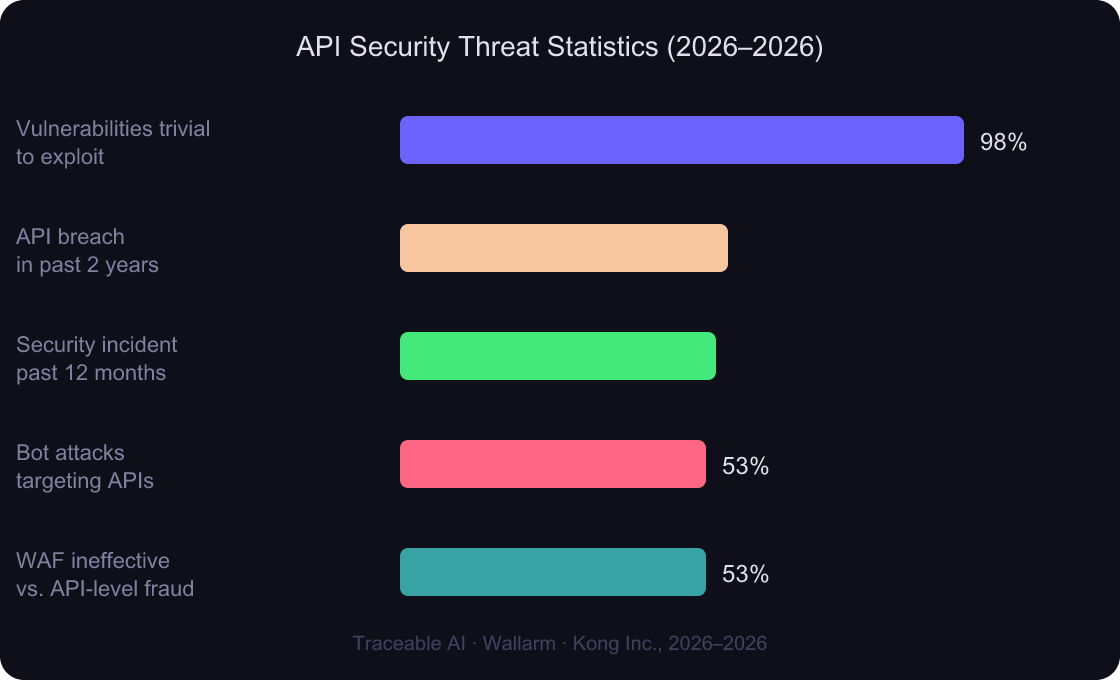
Sources: Traceable AI 2026 State of API Security, Wallarm 2026 API ThreatStats Report, Kong Inc. API Security Perspectives 2026
Wallarm’s 2026 API ThreatStats Report shows that 43% of all newly added CISA Known Exploited Vulnerabilities in 2026 were API-related. That’s 106 of 245 total KEVs. The report also confirms that 98% of API vulnerabilities are easy or trivial to exploit, and 59% require no authentication. This makes the work to secure an API one of the highest-leverage security investments any engineering team can make.
How Does Traffic Control Prevent API Abuse?
Traffic control is the first layer that stands between your API and the flood: brute-force logins, credential stuffing, scraping, and volumetric DDoS. According to Imperva (2026), 37% of all internet traffic is bad bots. Automated traffic now makes up 51% of all web requests for the first time in a decade. To secure an API at scale, you have to treat that flood as the default, not the exception.
Rate Limiting

Rate limiting caps how many requests a client can send in a given time window. At its simplest: 100 requests per minute per IP. In practice, you need multiple scopes: per IP, per user account, and per API key. One scope is never enough.
The rule worth memorizing: even authenticated users must be rate-limited. Authenticated does not mean trusted. A legit account can be compromised, scripted, or abused. Treat every token like it could be automated.
Common rate limit strategies:
- Fixed window, simple, but vulnerable to burst attacks at window boundaries
- Sliding window, smoother enforcement, eliminates the boundary exploit
- Token bucket, allows short bursts while enforcing a long-run average
In practice: Fixed-window limits at minute boundaries create a predictable attack surface. An attacker who knows your window resets at :00 can send 99 requests at :59 and 99 more at :00-198 requests in 2 seconds while staying under your limit. Sliding window eliminates this completely. It’s worth the slightly higher implementation cost.
Web Application Firewall (WAF)
A WAF inspects incoming requests and blocks patterns that match known attack signatures. Think SQL strings in query params, oversized headers, or malformed JSON. It runs at the edge, before your app code does.
Here’s the problem. 53% of organizations report their WAF is ineffective at detecting API-level fraud (Traceable AI, 2025). WAFs were built for HTML web apps. A WAF that blocks <script> tags in form fields won’t catch {"query": "1=1 OR"} in a POST body unless you set it up for JSON traffic.
Use a WAF, but configure it for your API’s actual request shape. Set rules for JSON payloads, not just URL parameters. Pair it with rate limiting too. WAFs filter, they don’t throttle. Edge providers also catch routing-layer issues your app server can’t see. I had one in early 2026 that I wrote up as how Cloudflare fixed an ISP route block in 15 minutes.
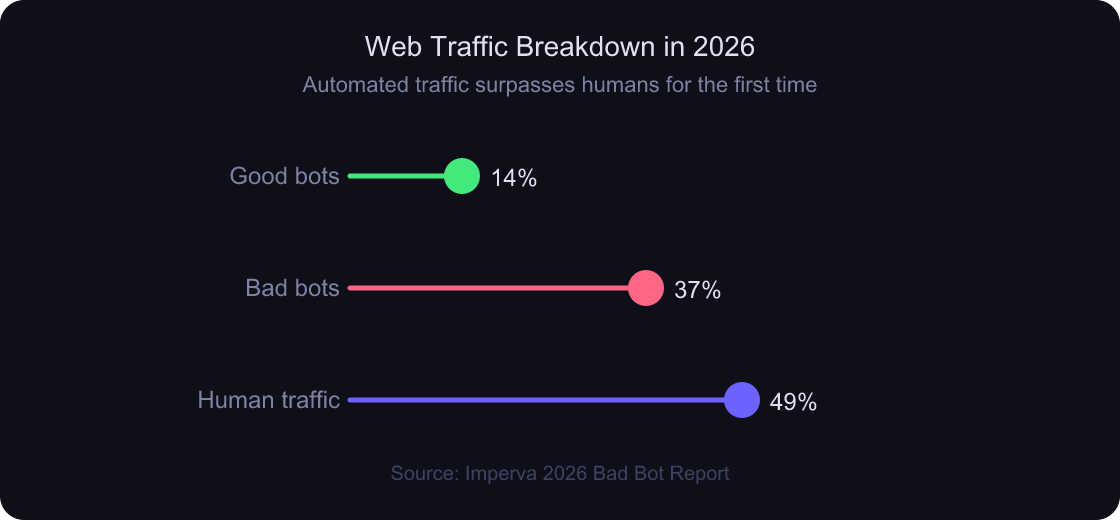
Source: Imperva 2026 Bad Bot Report. Automated traffic (51%) now exceeds human traffic for the first time in a decade
According to Imperva’s 2026 Bad Bot Report, 37% of all internet traffic is now bad bots. Total automated traffic now beats human activity at 51%, a first in a decade. For API teams, this means a big chunk of your inbound traffic is abuse by default. Without rate limiting, you can’t secure an API against this baseline level of automated noise.
CORS vs VPN: What’s the Real Difference for API Access Control?
CORS and VPN sound like they solve the same problem: who can access my API? But they work at very different layers and protect against very different threats. Confusing them is one of the most common mistakes when teams try to secure an API. It’s more dangerous than it looks.

CORS (Cross-Origin Resource Sharing)
CORS is a browser-enforced mechanism. It tells the browser whether a web page at app.example.com is allowed to make requests to api.example.com. The browser sends a preflight OPTIONS request. Your API responds with headers listing allowed origins. Then the browser decides whether to allow the main request.
The critical limit: CORS is not authentication. It controls which browser-based origins can talk to your API. Nothing more. Server-to-server calls, curl, Postman, and every non-browser HTTP client skip CORS entirely. An attacker doesn’t need a browser. CORS stops bad cross-origin browser scripts. It does nothing to stop a determined attacker with a terminal.
The correct CORS posture is to set the minimum necessary origin list. Access-Control-Allow-Origin: * on a private API is almost always wrong. Lock it to specific production domains.
VPN and Private Network APIs
VPN and private network controls are the network-level answer to origin control. Internal APIs like billing, admin, and user management shouldn’t be publicly routable at all. VPN puts them behind a network boundary that no browser-origin header can cross. Only authenticated network clients can even reach the TCP port.
Zero-trust is replacing traditional VPN for many teams. The old model said “authenticated to the network = trusted.” The new model says each API call must present its own credential, no matter where it comes from. This is strictly more secure and fits modern cloud deployments better.
Worth noting: Many teams treat CORS misconfiguration as a low-severity finding because “the attacker would need a browser.” That’s backwards. CORS is your only control against malicious browser-based attacks like XHR from a phishing page. If
Access-Control-Allow-Origin: *is set on an endpoint that reads session cookies, it’s a critical bug. The browser will happily attach cookies and forward the response to the attacker’s origin.
CORS is enforced by browsers. It controls which web origins can issue cross-origin requests, and that’s it. It does nothing to prevent server-to-server abuse or curl-based attacks. VPN and network-level access controls protect APIs at the infrastructure layer, regardless of browser behavior. Using both isn’t redundant. They address different attack vectors entirely. Neither replaces the other.
How Do CSRF Tokens and JWT Protect Against Forged Requests?
To secure an API against request forgery, you need to prove two things. Not just who is making a request, but that the request was intentionally started by a real user. Both CSRF tokens and JWT do this. But they apply to different auth models, and mixing them up creates security gaps.
CSRF Tokens (For Cookie-Based Auth)
Cross-Site Request Forgery tricks a logged-in user’s browser into making unintended requests to your API. Browsers send cookies with every request to a matching domain. So a malicious page can trigger account changes or fund transfers without the user knowing.
CSRF tokens break this by requiring a secret value the malicious site can’t know. The server issues a token per session. The client includes it in every state-changing request. The server validates it before acting. No token match means the request gets rejected.
When do you need CSRF tokens? Only when your API uses cookie-based session authentication. If your API uses Authorization: Bearer <token> headers and doesn’t touch cookies, CSRF isn’t a threat. Browsers don’t auto-send custom headers cross-origin.
JWT and OAuth (For Token-Based Auth)
JWT (JSON Web Token) is the standard for stateless API authentication (IETF RFC 7519, 2015). The server signs a token containing the user’s identity and permissions. Clients include it in the Authorization header. The server validates the signature without a database lookup.
According to Ping Identity (2026), 85% of enterprises use OAuth to secure external application integrations. OAuth builds on JWT by adding a delegation model. Users grant third-party apps access to specific resources without sharing credentials. The access token has a short lifetime. The refresh token handles renewal.
The rule of thumb: CSRF → cookies → need CSRF tokens. JWT → headers → no CSRF risk. Protecting a JWT API with CSRF tokens adds complexity without any security benefit.
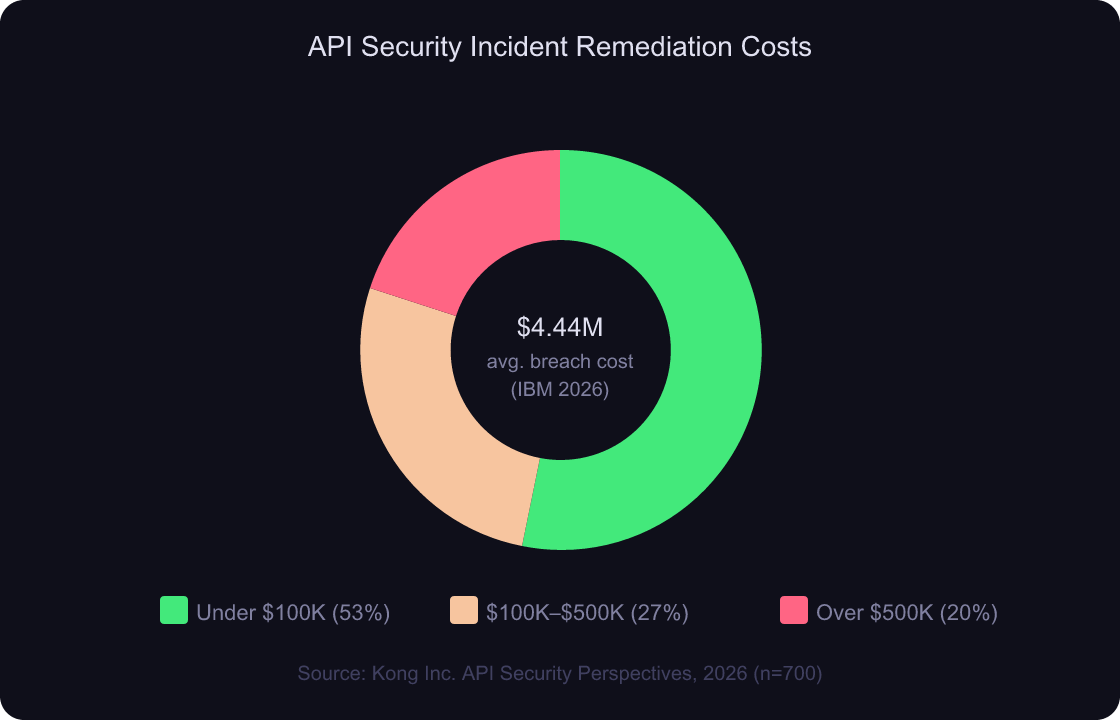
Source: Kong Inc. API Security Perspectives 2026: 47% of breached organizations faced remediation costs over $100,000
Kong Inc.’s 2026 API Security Perspectives survey (n=700 IT leaders) found that 55% of organizations had an API security incident in the past 12 months. One-third of those were classified as “severe.” Of those breached, 47% faced remediation costs over $100,000. The financial case to secure an API with proper JWT and CSRF design is clear. The cost of a breach far exceeds the cost of doing it right.
How Do SQL Injection and XSS Attacks Exploit APIs?
The final layer protects the data flowing in and out of your API. SQL injection and XSS don’t exploit bad headers or missing tokens. They exploit the content of requests your app trusts and processes. The golden rule: never trust user input. Ever.

SQL Injection
SQL injection happens when user-controlled data gets dropped directly into a database query. The classic example: SELECT * FROM users WHERE email = '${input}'. If input is [email protected]' OR '1'='1, the query returns every user in the database.
The fix is parameterized queries (prepared statements), not sanitization. Sanitization is fragile. You’ll miss edge cases. Parameterized queries separate data from code at the database driver level. That makes injection structurally impossible, no matter what the input looks like.
According to Aikido (2026), over 20% of closed-source projects show SQL injection bugs on first security assessment. Affected codebases average 30 vulnerable spots. NoSQL databases aren’t safe either. MongoDB’s $where operator and similar vectors allow the same kind of attack if inputs aren’t validated before they hit the query object.
XSS (Cross-Site Scripting)
XSS targets your users by injecting bad scripts into API responses rendered by browsers. Stored XSS is the most dangerous. An attacker submits a script via your API that gets saved to your database and served to every user who views that resource. Reflected XSS bounces the script off a single response without saving it.
According to OWASP (2025), XSS has generated over 30,000 CVEs, more than twice the 14,000+ from SQL injection. In API contexts, XSS often targets JSON responses rendered by front-end frameworks without proper escaping.
The fix: HTML-encode all output. Use Content-Security-Policy headers to restrict script execution. Treat every piece of user data as untrusted, even content from your own database. Your database might already be poisoned.
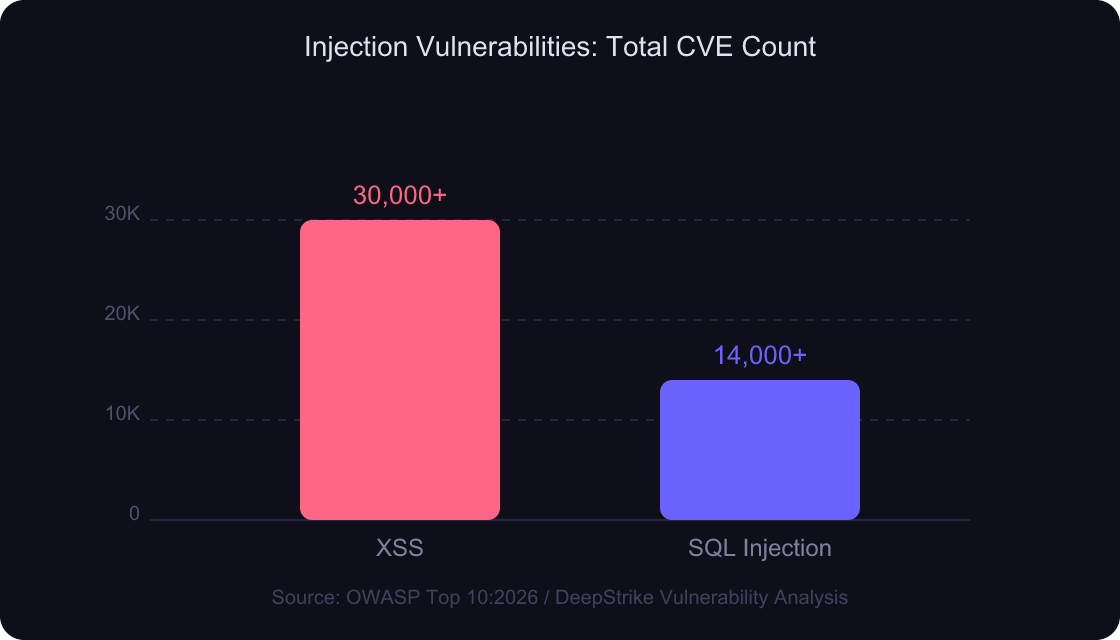
Source: OWASP Top 10:2026. XSS has generated over 30,000 CVEs, more than twice the count for SQL injection
Worth noting: Most SQL injection guidance focuses on
SELECTandWHEREclauses in relational databases. GraphQL APIs introduce a different injection vector: deeply nested queries that trigger unintended joins or bypass field-level authorization. The parameterized query habit doesn’t automatically transfer. GraphQL resolvers need their own input validation layer, and most WAFs have no GraphQL-aware rules at all.
XSS has generated over 30,000 CVEs and SQL injection over 14,000. Injection is ranked #5 in OWASP’s Top 10:2025 and present in 100% of apps tested for some form of it (OWASP, 2025). For APIs, stored XSS via JSON responses and NoSQL injection through MongoDB’s $where operator are fast-growing attack surfaces that traditional WAF rules don’t cover.
The API Security Checklist: All 4 Layers Together
Security is only as strong as its weakest layer. To secure an API end to end, verify it covers all four layers before it ships:
Layer 1: Traffic Control
- Rate limiting applied per IP, per user account, and per API key (sliding window preferred)
- WAF configured for JSON/API request shapes, not just HTML form inputs
- DDoS mitigation at the edge (CDN or cloud provider level)
Layer 2 (Origin & Access Control)
-
Access-Control-Allow-Originset to explicit domains, never*for private APIs - Internal APIs behind VPN or private network, not publicly routable
-
SameSite=StrictorSameSite=Laxon all session cookies
Layer 3: Request Authenticity
- CSRF tokens on all state-changing endpoints if using cookie auth
- JWT with short expiry (15–60 min) + refresh token rotation
- OAuth scopes as narrow as possible, principle of least privilege
Layer 4 (Input & Output Safety)
- All database queries use parameterized statements (zero string interpolation)
- All user-supplied content HTML-encoded before rendering
-
Content-Security-Policyheader restricts inline script execution
Frequently Asked Questions
What’s the difference between authentication and authorization in API security?
Authentication proves who you are (valid JWT, correct password). Authorization decides what you’re allowed to do (can this user delete this resource?). Both are required, but neither replaces the other. According to Wallarm (2026), 59% of exploitable API vulnerabilities require no authentication at all. That makes authentication the highest-priority layer when you secure an API.
Should I use CSRF tokens if my API uses JWT bearer tokens?
No. CSRF attacks exploit auto cookie-sending by browsers. If your API uses Authorization: Bearer headers, browsers don’t auto-attach those cross-origin. CSRF isn’t a threat. CSRF tokens are only for cookie-session APIs. Adding them to JWT APIs adds complexity without any security benefit.
How do I rate-limit API endpoints without blocking legitimate users?
Use per-user rate limits, not just per-IP. Shared IPs like corporate NAT and mobile carriers can block real users. Set up graduated responses: throttle first (add delay), then 429 Too Many Requests, then temporary block. Always expose rate limit headers (X-RateLimit-Remaining, Retry-After) so clients can back off gracefully.
What’s the fastest SQL injection fix for an existing codebase?
Replace all string-interpolated queries with parameterized queries. In most languages: db.query("SELECT * FROM users WHERE id = ?", [userId]) instead of "SELECT * FROM users WHERE id = " + userId. If you use an ORM, check that it uses parameterized queries by default. Most do, but raw query methods often don’t.
Is NoSQL safe from injection attacks?
No. MongoDB’s $where, $regex, and operator injection attacks are the NoSQL version of SQL injection. If your API passes user input directly into a MongoDB query object without validation, an attacker can send {"$gt": ""} to bypass field comparisons. Validate the shape and type of all input. Never assume a non-relational database is injection-proof.
Conclusion
To secure an API isn’t a feature you ship once. It’s a property you maintain across four distinct layers. Each layer stops attacks the others can’t touch. Rate limiting and WAF can’t stop XSS. CORS can’t stop SQL injection. JWT can’t stop a brute-force bot if there’s no rate limit. The layers add up. They don’t replace each other. The same logic now applies to model traffic. If you’re routing requests to LLMs, see the AI gateway pattern for the seven cross-cutting concerns you can’t safely bolt on later.
Start with the layer your current architecture is most obviously missing. Add rate limiting first if you have nothing. It stops the widest range of automated abuse with the least work. Then work through access control, request authenticity, and input safety in order.
Key takeaways for how to secure an API in 2026:
- Even authenticated users must be rate-limited
- CORS is not authentication, it’s browser-level origin filtering
- CSRF tokens are for cookie auth; JWT covers token-based auth
- Never trust user input, parameterize everything, encode all output
Quantum Computing for Web Developers: What You Need to Know in 2026
Trello Client Portal: How to Create One in 2026