Fable 5 spent its first two weeks in the news for being switched off. Anthropic shipped it on June 9, a US export-control order pulled it worldwide on June 12, and it only came back on July 1 once Commerce lifted the order (Anthropic, 2026). Since then it has sat quietly in your Claude Code model picker, one rung above Opus.
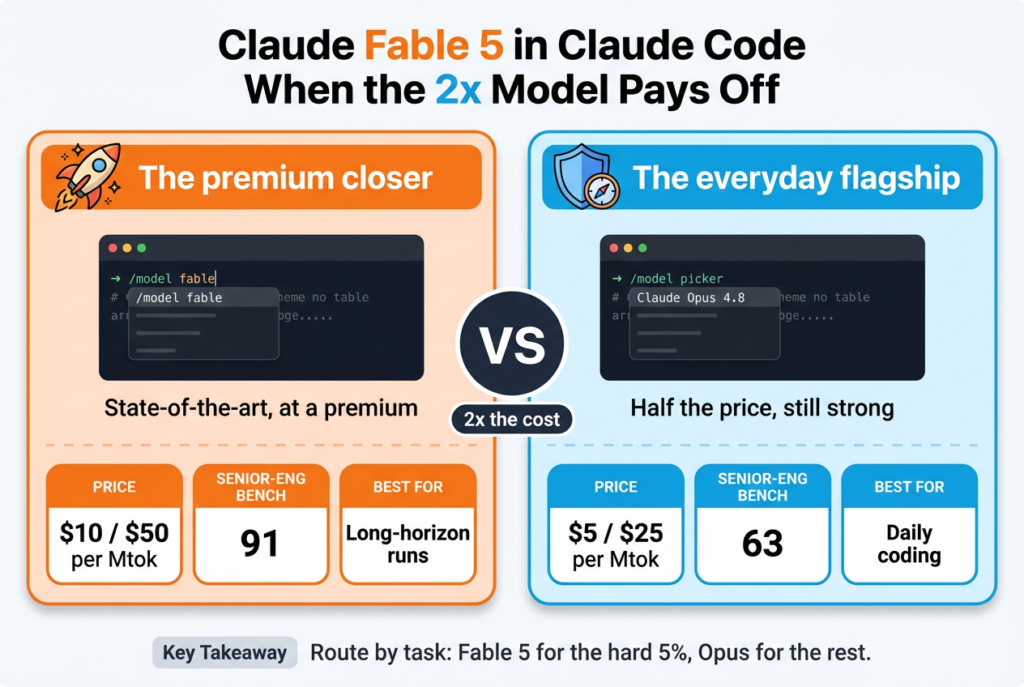
Here’s the tension. Fable is the most capable coding model line Anthropic has shipped, and it’s also the most expensive: exactly double Opus 4.8 at launch, and 2.5x Opus 5.5 at October 2026 list prices. Default to it for everything and you’ll drain your weekly limit before Thursday. This is where it earns the premium, where it doesn’t, how to turn it on, and the routing policy I use so I only pay for it when it pays me back.
October 2026 update: The current version is Fable 5.1, released on 1 September 2026 (model ID
claude-fable-5-1). It’s the same model as Mythos 5.1 with different safeguards: Fable 5.1 is generally available, including in Claude Code, and ships with stronger bio, cyber and anti-distillation safeguards, while Mythos 5.1 is limited to vetted cyber and life-science partners. The list price is unchanged at $10 / $50 per million tokens, but Anthropic says typical workloads cost about 25% less than on Fable 5, mainly because cache reads dropped to $0.25 per million tokens, with savings up to around 45% on highly agentic tasks (Anthropic, 2026). Below Fable, Opus 5.5 (22 September, $4 / $20) and Sonnet 5.5 (28 September, $2 / $10) replaced Opus 4.8 and Sonnet 5 (Anthropic, 2026). The benchmarks and first-hand notes below are from Fable 5 in July; the pricing and routing advice is updated for October.
Key Takeaways
- Fable 5 has been live in Claude Code since July 1, 2026: model
claude-fable-5, needs v2.1.170+, switch with/model fable. Since September 1 the current version is Fable 5.1 (claude-fable-5-1).- It costs $10/$50 per million tokens, which was exactly 2x Opus 4.8 (Claude Platform, 2026) and is 2.5x Opus 5.5 ($4/$20) today, and it draws down your weekly limit faster.
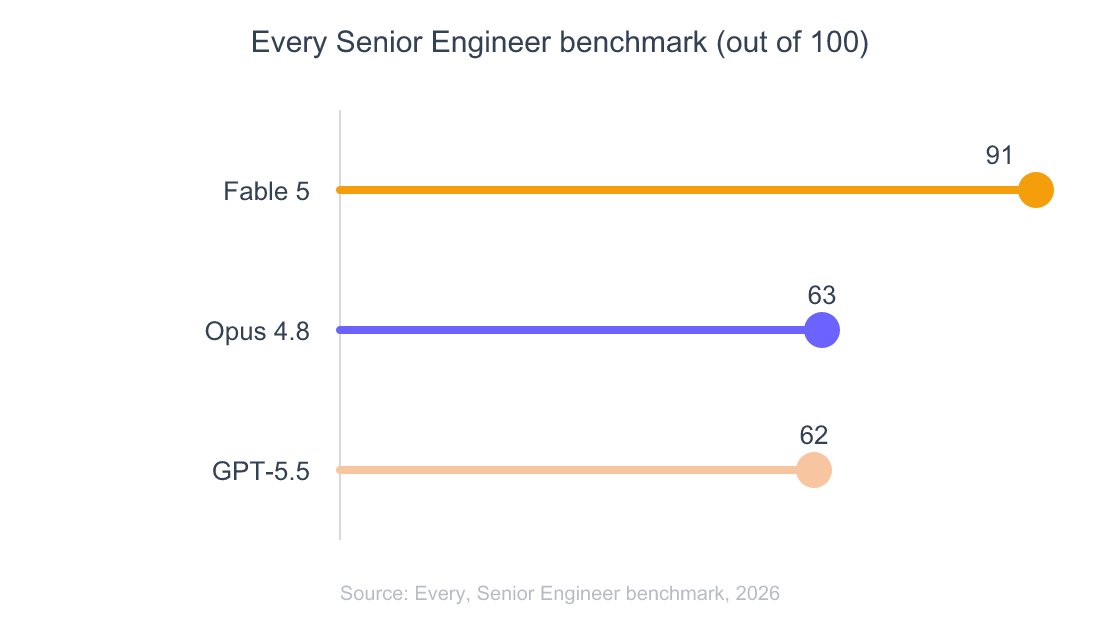
- It scored 91 on Every’s Senior Engineer benchmark against Opus 4.8’s 63 (Every, 2026): the lead is real, and it grows with task length.
- Use it for long-horizon, multi-file, autonomous work. Keep quick edits and bulk coding on Sonnet or Opus.
Is Fable 5 actually available in Claude Code?
Yes. Fable 5 returned to Claude Code on July 1, 2026, one day after the US Department of Commerce lifted the export-control order that had disabled it and its sibling Mythos 5 worldwide (Anthropic, 2026). It runs across Claude.ai, the Claude API, Claude Code, AWS Bedrock, Vertex AI, and Microsoft Foundry. Since 1 September 2026 the version you get is Fable 5.1, which is available on all the same platforms and defaults to High effort in Claude Code (Anthropic, 2026).
Anthropic describes it as its most capable model, “state-of-the-art on nearly all tested benchmarks of AI capability” (Anthropic, 2026). Fable 5 is the version made safe for general use; Mythos 5, the less-restricted sibling, stays limited to vetted partners. For Claude Code, the practical detail is simple. Fable sits above Opus in your picker (Opus 4.8 in July, Opus 5.5 since 22 September), and it’s the one you reach for when a job is genuinely hard.
I won’t rehash the June shutdown here. If you want the full saga, including why it was the first time export controls hit an AI model rather than chips, I covered it in the export-control order that took Fable 5 offline in June. The short version: it’s back, it’s stable, and the interesting question is no longer political. It’s whether the extra cost is worth it for your work.
How do you switch to Fable 5 in Claude Code?
The fastest way is /model fable inside a running session. That’s it, no restart. You can also launch with the flag claude --model claude-fable-5, or run /model with no argument to open the picker and choose it from the list (Claude Code Docs, 2026).
Two things trip people up. First, Fable 5 needs Claude Code v2.1.170 or later. Older builds don’t show it in the picker at all, so run claude update before you go hunting for it (the same goes for Fable 5.1). Second, at launch it wasn’t the default on any plan, Pro, Max, Team, or Enterprise. You have to opt in every time, unless you select it with /model, which saves it as your default for future sessions.
# Update first, or Fable 5 won't appear
claude update

# Switch mid-session (saved as your default afterward)
/model fable

# Or launch straight into it
claude --model claude-fable-5

# Pin the current version (October 2026)
claude --model claude-fable-5-1
That’s the whole setup. The reason this article is long isn’t the how, it’s the when. Turning Fable 5 on is thirty seconds of work. Deciding which of your tasks deserve it is the part that actually saves you money, and it’s where most write-ups stop short.
What is Fable 5 actually better at?
Long, hard, autonomous work, and the gap widens the longer the task runs. On Every’s Senior Engineer benchmark, Fable 5 scored 91 against Opus 4.8’s 63 and GPT-5.5’s 62 (Every, 2026). Anthropic’s own framing matches: “the longer and more complex the task, the larger Fable 5’s lead” (Anthropic, 2026).
The headline example is Stripe. It used Fable 5 to run a 50-million-line Ruby codebase migration in a single day, work Anthropic says would have taken a team roughly two months (Anthropic, 2026). It also posted the top score among frontier models on Cognition’s FrontierCode evaluation, which grades maintainable production code rather than tests that merely pass. Third-party round-ups peg it near 80% on SWE-bench Pro, against about 69% for Opus 4.8. I’d treat the exact 80% as directional until Anthropic’s model card confirms it. The 69% for Opus, though, matches what I measured in my own testing.
Beyond raw scores, the thing reviewers keep noting is judgment. Given enough context, Fable 5 moves straight into implementation instead of over-explaining a plan or asking for permission at every step. It’s at its best owning a whole assignment end to end, planning, using tools, and repairing its own output over a multi-hour run.
What I saw: I haven’t run Fable 5 heavily yet, so take this as an early read, not a benchmark. But on the one longer, multi-step task I handed it in Claude Code, it held together better than Opus. It needed less steering to stay on track, and got closer to done without me babysitting each step. The way people are getting the most out of it is Claude Code’s
/goalcommand, which sets a finish line the agent keeps working toward instead of stopping short. That fits what I felt: give it your hardest, longest task, and the longer it runs, the more it pulls ahead.
What does Fable 5 cost in Claude Code?
$10 per million input tokens and $50 per million output tokens. At launch that was exactly 2x Opus 4.8’s $5/$25 and five times Sonnet 5’s introductory $2/$10 (Claude Platform, 2026). Through July 7, Pro, Max, Team, and select Enterprise plans could spend up to 50% of their weekly limit on Fable 5; after that it shifted to usage credits.
As of October 2026, Fable 5.1 keeps the same $10/$50 list price, but cheaper cache reads cut typical bills by about 25% versus Fable 5 (Anthropic, 2026). The models below it got cheaper too: Opus 5.5 is $4/$20 and Sonnet 5.5 is $2/$10 (Claude pricing, 2026), so on list price Fable is now 2.5x Opus and 5x Sonnet.
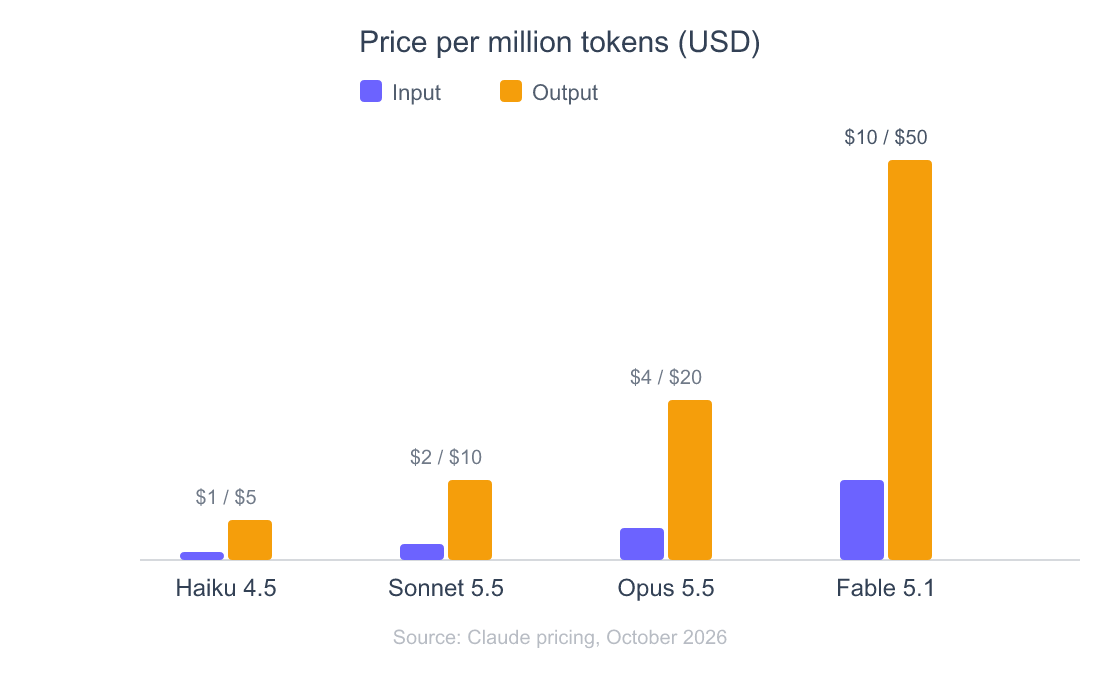
The sticker price isn’t the number that should worry you, though. On a subscription, what bites is the burn rate: Fable 5 draws down your weekly limit noticeably faster than Opus, and Opus already burns fast. So the real budgeting question isn’t “$10 versus $5.” It’s “how many premium tasks fit in my week before I’m buying usage credits?” Frame it that way and you stop reaching for Fable 5 out of habit.
One nuance from launch: Opus 4.8 in Fast Mode also cost $10/$50 (Claude Platform, 2026). If you were already paying Fast Mode rates for Opus, Fable 5 was a capability upgrade at the same token price, not a price jump. For the fuller picture, I broke down the tiers and weekly caps in how Claude Code’s weekly usage limits actually work.
When should you not use Fable 5?
Most of the time, honestly. For quick edits, small bug fixes, routine tests, and anything you iterate on rapidly, Fable 5 is the wrong tool. It’s slow and token-hungry, especially at high effort (Every, 2026), and at two to three times Opus’s price, that slowness costs you twice. It also does more than you ask. Anthropic’s own guide warns that on routine work at higher effort it can “gather context and deliberate beyond what the task needs” and tidy or refactor code you never touched (Anthropic, 2026).
Three specific failure modes to watch for. It’s slow, which kills the tight feedback loop you want when you’re fixing something small. It’s over-eager, so a small fix can come back as a sprawling refactor you didn’t ask for, which a short scope instruction in your prompt reins in. And the stricter safety classifier it ships with flags benign coding and debugging requests more often than Opus does, which interrupts security or systems work with false positives. None of these matter on a two-hour migration. All of them matter on a five-minute fix.
My honest caveat: I haven’t used it enough to hit the over-engineering or false-flag problems reviewers describe. The thing that actually holds me back is cost. Opus is already a pricey model, and Fable is double it. So the friction isn’t the output. It’s watching a premium meter run on work I’m not sure needed the premium in the first place.
The rule I’ve settled on: Fable 5 rewards a clear brief and punishes a loose one. Hand it a sharp target with edges and it closes the loop beautifully. Hand it a vague “clean this up” and you pay premium rates to watch it wander. That mismatch, not the price, is what turns people off it in the first week.
A model routing policy for Claude Code
Don’t pick one model, route between them. The cheapest way to use Fable 5 well is simple. Reserve it for the handful of tasks where a single better answer is worth double the cost, and push everything else down the ladder. Anthropic’s guidance lines up with what teams report in practice: Fable 5 is a planning and hard-problems model, not a daily driver (Anthropic, 2026).
Here’s the policy I run, updated for the October 2026 lineup:
| Task | Model | Why |
|---|---|---|
| Multi-file refactors, migrations, long autonomous runs | Fable 5.1 | Its lead grows with task length; worth the premium |
| Architecture and planning before a big build | Fable 5.1 | Best judgment on underspecified, high-stakes decisions |
| Bulk feature coding, day-to-day implementation | Sonnet 5.5 | Fast and cheap where the frontier gap is small |
| General frontier work, code review | Opus 5.5 | Strong all-rounder at 40% of Fable’s list price |
| High-volume, repetitive, or throwaway tasks | Haiku 4.5 | Cheapest; save your limit for the hard stuff |
The trick that makes this cheap is /model mid-session. Start a build on Sonnet, hit a genuinely hard architectural decision, escalate that one turn with /model fable, then drop back down. You pay the premium for the 5% of the work that needs it, not the 95% that doesn’t.
For long-horizon jobs specifically, reach for Claude Code’s /goal command. You set a condition, and Claude keeps working across turns until it’s met. After each step it rechecks its own state instead of stopping at the first plausible pause (Claude Code Docs, 2026). It pairs unusually well with Fable 5. Anthropic’s guide warns the model can occasionally end a long run early with a bare statement of intent. A concrete goal, a passing test, an exit code, an expected output string, gives it a finish line to drive toward instead (Anthropic, 2026). It shipped in v2.1.139, so any build new enough to run Fable 5 (v2.1.170+) already has it. Pair it with /effort, the other lever most people skip. Anthropic recommends high by default, but dropping routine work to medium or low still beats prior models at their strongest setting, and it’s cheaper and faster. That goal-directed mode is where Fable 5 stretches its legs, and where its lead over Opus is widest. If you’re orchestrating this across a bigger workflow, it slots neatly into handing a long-horizon subtask to a dedicated subagent, and if you want to automate the switching itself, routing requests across multiple model backends covers the tooling.
Why did Claude switch to Opus in the middle of my task?
Because Fable’s safety classifier flagged your prompt and rerouted that turn to Opus. At the July relaunch, the fallback was Opus 4.8. The reinstated model ships with a single tuned filter that blocks the jailbreak technique behind June’s shutdown in more than 99% of cases. When it triggers, Claude Code routes the request to Opus and notifies you (The Hacker News, 2026).
You didn’t do anything wrong, and you didn’t get a refusal, you got an Opus answer instead of a Fable one. The catch is that the classifier over-triggers on legitimate work, especially security research, vulnerability analysis, or anything that reads like it touches exploits. So if you’re mid-task and notice the model quietly changed, that’s the mechanism. Anthropic’s own documentation confirms flagged prompts fall back to Opus rather than failing. Fable 5.1 keeps the same pattern with broader safeguards: restricted cyber tasks such as exploit generation, and some biology research queries, are redirected to Anthropic’s Opus models (Anthropic, 2026). For most coding it’s invisible; for security-adjacent work, it’s worth knowing why your “best model” occasionally hands off to a cheaper one.
Frequently Asked Questions
Is Fable 5 available in Claude Code?
Yes, since July 1, 2026, after Commerce lifted the June export-control order (Anthropic, 2026). You need Claude Code v2.1.170 or later, then switch with /model fable. It’s available on Pro, Max, Team, Enterprise, and the API. Since 1 September 2026 the current version is Fable 5.1 (claude-fable-5-1), which defaults to High effort in Claude Code (Anthropic, 2026).
How much does Fable 5 cost compared to Opus?
Fable 5 and Fable 5.1 both list at $10 per million input tokens and $50 per million output. That was exactly double Opus 4.8’s $5/$25 (Claude Platform, 2026) and is 2.5x Opus 5.5’s $4/$20 as of October 2026, though Fable 5.1’s cheaper cache reads trim typical bills by about 25%. It also draws down your weekly subscription limit faster, so the effective cost gap in daily use feels larger than 2x.
Is Fable 5 free on Pro or Max?
Not exactly. Through July 7, 2026, Pro, Max, Team, and select Enterprise plans could use Fable 5 for up to 50% of their weekly usage limit (Search Engine Journal, 2026). Past that allowance, or after July 7, continued use moves to metered usage credits.
Why did Claude switch to Opus mid-conversation?
Fable’s safety classifier flagged your prompt and routed that turn to Opus (Opus 4.8 at the July relaunch) (The Hacker News, 2026). The filter blocks the reported jailbreak in over 99% of cases but sometimes trips on benign coding or security work. You still get an answer, just from Opus rather than Fable.
Is Fable 5 worth it for coding?
For long-horizon, multi-file, autonomous work, yes: it scored 91 to Opus 4.8’s 63 on Every’s Senior Engineer benchmark (Every, 2026). For quick edits and rapid iteration, no, use Sonnet 5.5 or Opus 5.5 and save the premium for the hard problems.
The verdict
Fable, now in its 5.1 version, is the strongest coding model you can run in Claude Code, and that’s exactly why it’s easy to misuse. Point it at everything and you’ll blow your weekly limit on work a cheaper model would have handled fine.
- It’s back in Claude Code as of July 1, and genuinely state-of-the-art on hard, long-horizon tasks.
- It cost 2x Opus 4.8 at launch and lists at 2.5x Opus 5.5 today, and it burns your limit faster, so treat it as a premium closer, not a default.
- Route by task: Fable 5 for migrations, planning, and multi-hour autonomous runs; Sonnet and Opus for the rest.
- Escalate mid-session with
/model fableso you pay for the 5% that’s hard, not the 95% that isn’t.
If cost is your main lever, the smarter move is a deliberate multi-model setup rather than one expensive default. I compared where each model actually wins in how Fable 5 stacks up against the rest of the coding-model field, and paired with a routing policy, that’s how you get frontier output without a frontier invoice.