The Developer Identity Crisis: Are We Builders or Orchestrators Now?
I spent ten years mastering PHP, Laravel, MySQL, design patterns, and SOLID principles. I can architect systems that handle millions of requests. I’ve debugged race conditions at 3 a.m. and felt that quiet satisfaction when a complex migration runs without a hitch.
Last month, a product manager with zero coding experience built a working SaaS prototype in a weekend using Claude. Authentication, Stripe integration, admin dashboard. All functional. I watched the demo and felt something I didn’t expect: a genuine identity crisis.
This isn’t a thinkpiece written from a safe distance. I’m writing this as someone actively going through this transition, a senior backend developer who now spends more time prompting AI than writing PHP. The craft I built my career on still matters, but it matters differently now. And honestly? That’s been hard to sit with.
Anthropic’s 2025 labor market study identified computer programming as the single profession most exposed to AI disruption (Anthropic, 2025). Not “one of the most exposed.” The most exposed. If you’re a developer reading this and feeling uneasy, you’re not imagining things.
How vibe coding is accelerating this shift
TL;DR: Developers are experiencing an identity crisis as AI reshapes what it means to code. Anthropic’s 2025 study ranks programming as the #1 AI-exposed profession (Anthropic, 2025). The shift isn’t from employed to unemployed; it’s from builder to orchestrator. The developers who adapt will thrive. But the transition hurts.
Why Did We Tie Our Identity to the Craft of Coding?
Developers have always defined themselves by the languages they write and the patterns they master. A 2025 Stack Overflow survey found that 65% of developers consider their primary programming language a core part of their professional identity (Stack Overflow, 2025). We didn’t just learn frameworks. We became them.
Think about how developers introduce themselves. “I’m a Laravel developer.” “I’m a React engineer.” “I write Go.” These aren’t job descriptions. They’re identities. Nobody in accounting says “I’m an Excel person” with the same conviction a developer says “I’m a Python developer.”
There was real pride in this. Clean code was a badge of honor. Knowing when to apply the Strategy pattern versus the Observer pattern felt like wisdom earned through years of battle scars. We debated tabs versus spaces with the intensity of religious conflict. We built communities around shared tooling. We wore our framework preferences like team jerseys.
And the pride was justified. Writing elegant, maintainable software is genuinely hard. Understanding memory management, concurrency, distributed systems. These are deep skills that took years to develop. The craft of programming was rare, valuable, and respected.
But here’s the uncomfortable part: what happens to an identity built on scarcity when the scarce thing becomes abundant?

The broader market impact of this identity shift
Citation Capsule: Developers have historically tied their professional identity to language and framework mastery, with 65% considering their primary programming language a core part of who they are (Stack Overflow, 2025). That identity is now under pressure as AI makes the act of writing code increasingly accessible.
What Actually Happened to the Value of Writing Code?
AI didn’t make developers useless. It made coding dramatically faster while compressing the gap between experience levels. GitHub reports that 41% of all code is now AI-generated, and developers using Copilot complete tasks 55% faster (GitHub Octoverse, 2026). The act of writing code didn’t disappear. Its value as a differentiator did.
Here’s the honest reckoning I’ve had with myself. A junior developer armed with Claude Code can now produce output comparable to a mid-level developer. Not because the junior suddenly understands system design or edge cases, but because the AI fills in the gaps in syntax, patterns, and implementation details that used to take years to learn.
The skill floor rose overnight. Everyone got better at producing code. And when everyone gets better at something, the thing itself becomes less valuable as a distinguishing trait.
I think of this as “craft compression.” In every profession, automation first targets the skills that are most teachable and most repetitive. For developers, that’s writing code, the very thing we built our identities around. Architecture, judgment, and product intuition remain hard to automate. But those were never the skills we bragged about at meetups.
This doesn’t mean experience is worthless. Far from it. But the experience that matters has shifted. It’s no longer “I can write a complex database query faster than you.” It’s “I know which database query should be written, and I can spot when the AI writes a dangerously inefficient one.”
InfoWorld put it bluntly: the bottleneck is no longer the ability to write code, but the ability to creatively shape the product itself (InfoWorld, 2026). The constraint moved. And many of us are still optimizing for the old one. I’ve argued elsewhere that language mastery is dead and product thinking is the new moat, and that reframing is exactly what makes this identity crisis solvable instead of terminal.
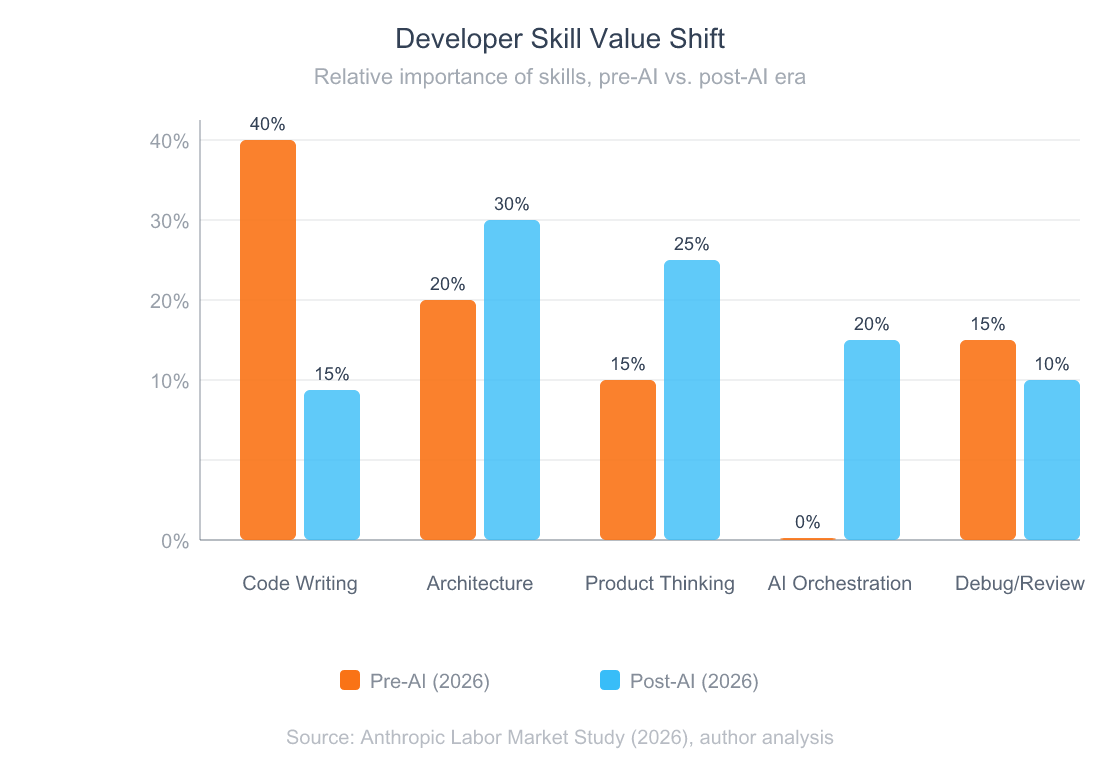
Code writing’s relative value dropped from the top developer skill to the lowest, while architecture, product thinking, and AI orchestration surged.
Citation Capsule: AI-assisted coding tools now generate 41% of all code, and developers using them complete tasks 55% faster (GitHub Octoverse, 2026). The value bottleneck has shifted from writing code to creatively shaping the product itself (InfoWorld, 2026).
What Does the New “Orchestrator” Identity Look Like?
The emerging developer role looks less like a craftsperson and more like a technical director. Stanford’s 2026 AI Index found that the era of AI evangelism is giving way to AI evaluation: the question is no longer “Can AI do this?” but “How well, at what cost, and for whom?” (Stanford HAI, 2026). Developers who internalize that shift are the ones redefining the profession.
Here’s what my daily work looks like now versus two years ago.
Instead of writing code from scratch, I’m directing AI to write it. I describe the architecture, the constraints, the edge cases. The AI handles implementation. I review every line.
Instead of debugging line by line in Xdebug, I’m reviewing AI-generated output for logical flaws, security holes, and performance pitfalls. The debugging is higher-level now, structural rather than syntactic.
Instead of memorizing syntax or framework APIs, I’m learning how to articulate intent clearly. The primary skill has become what some call “English language programming,” describing what you want precisely enough that the AI produces correct output.
The valuable skill shifted from “how to implement this” to “what should be implemented” and “why does this approach make sense.” And here’s the thing that nobody talks about: this feels less tangible. Less “real.” When I could point to 500 lines of elegant code I’d hand-written, there was a physical artifact of my skill. Now my contribution is more invisible: better prompts, better architectural decisions, better reviews. How do you show that off?

What this means for traditional user interfaces
Citation Capsule: Stanford’s 2026 AI Index marks a transition from AI evangelism to AI evaluation, with researchers noting the question is no longer “Can AI do this?” but “How well, at what cost, and for whom?” (Stanford HAI, 2026). Developers who embrace this evaluator mindset define the emerging orchestrator role.
Is the Orchestrator Identity Actually Liberating?
Despite the grief, the shift opens possibilities that manual coding never allowed. Developers using AI tools save an average of 3.6 hours per week, time that compounds into entire products over months (DX, 2026). When you stop being limited by typing speed and syntax recall, something surprising happens: you start thinking bigger.
I’m going to be honest about both sides of this.
The loss is real. There’s a meditative quality to hand-writing code that I genuinely miss. The flow state of solving a complex algorithm, line by line, with nothing but your brain and a text editor. That was beautiful. And I don’t think it’s sentimental to mourn it.
But the gain is also real. My ten years of experience matter more now, not less. Here’s why: AI can write code, but it can’t tell you whether the code should exist. It can’t evaluate trade-offs between consistency and availability in a distributed system. It can’t smell a bad architectural decision from three sentences in a product spec.
Architecture decisions. Security thinking. Performance intuition. Understanding when a “simple” feature request will cascade into six months of technical debt. These are all things I developed over a decade of building production systems. And they’re exactly the things AI can’t replicate.
Last week, Claude generated a perfectly functional caching layer for one of my projects. Syntactically flawless. But I spotted immediately that it would create a thundering herd problem under load, something the AI had no context for because it didn’t understand our traffic patterns. My experience caught a failure mode that would have taken down the service. That’s the value senior developers bring now: knowing what “correct” code can still be wrong.
Product thinking has become the new superpower. When you’re not bottlenecked by implementation speed, you can prototype three approaches before lunch. You can test ideas that would have been “too expensive to try” a year ago. The constraint shifts from “can we build this?” to “should we build this?” And that’s a much more interesting question.
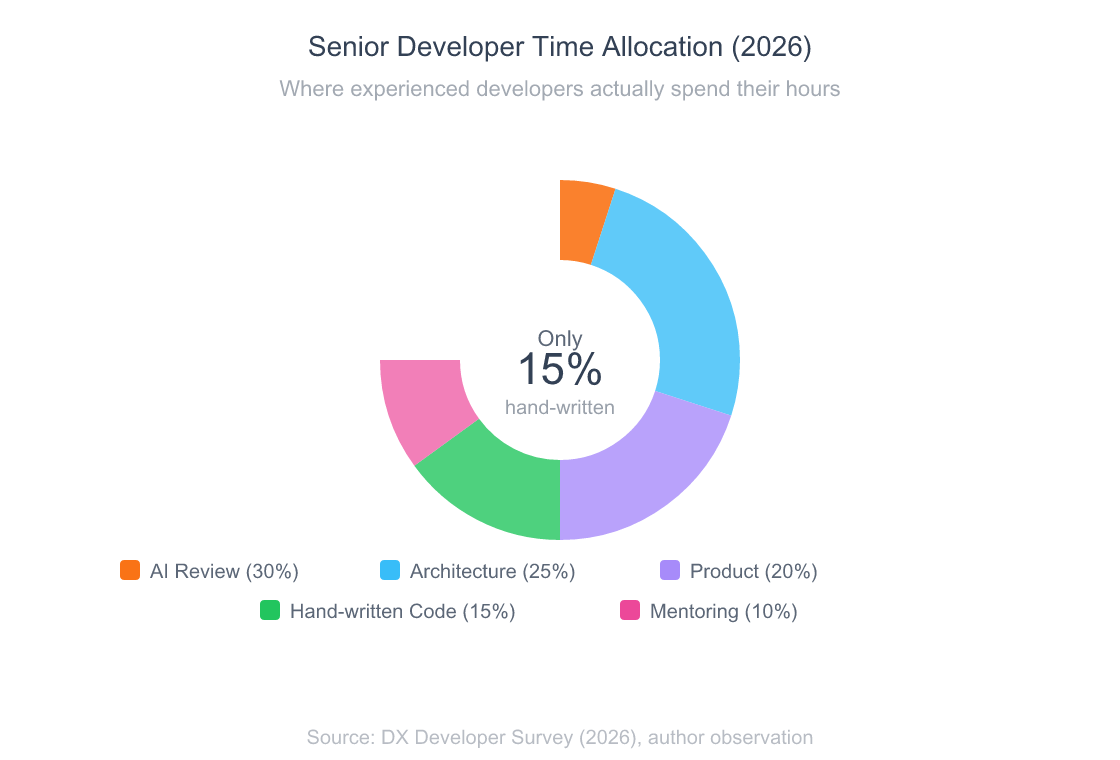
Senior developers now spend only 15% of their time writing code by hand, with the majority going to AI review, architecture, and product strategy.
Can You Be Both a Builder and an Orchestrator?
The binary framing is a trap. The most effective developers in 2026 aren’t purely builders or purely orchestrators. They’re hybrids who do both. Industry data shows that 70-80% of agentic AI initiatives struggled to scale in enterprise environments, proving that human oversight and hands-on intervention remain critical (Bain & Company, 2026). Pure orchestration without building skill is fragile.
I’ve started thinking of myself as a “technical director” rather than a “coder.” A film director doesn’t operate every camera, but they’d better understand cinematography. A technical director doesn’t write every line of code, but they’d better know when the AI’s output will fall apart in production.
Here’s how I split the work now:
What I still hand-code
Security-sensitive logic. Authentication flows, authorization rules, encryption implementations, anything where a subtle bug means a data breach. AI-generated code has 2.74x more security vulnerabilities than human-written code (CodeRabbit, 2026). That stat alone justifies writing security code by hand.
Performance-critical paths. The hot loops, the database query optimizations, the caching strategies that make the difference between 50ms and 500ms response times. AI doesn’t understand your specific load patterns.
Core business logic. The rules that define what your product actually does. This is where your domain expertise lives, and where a misunderstanding from AI could create bugs that look like features.
What I delegate to AI
CRUD operations. Create, read, update, delete: the bread and butter of web development. AI handles these perfectly. It’s repetitive, pattern-based work that benefits from speed over craft.
UI components and styling. Layouts, forms, responsive design. AI generates these quickly and correctly. I review for accessibility and consistency, then move on.
Boilerplate and configuration. Docker files, CI/CD pipelines, migration scripts, test scaffolding. The kind of code that follows templates and rarely needs creative thinking.
Documentation and tests. AI writes thorough documentation and test suites faster than I ever could. I review for coverage gaps and edge cases.
The hybrid identity feels more honest than either extreme. I’m not pretending AI doesn’t change things. I’m also not abandoning the skills that make me valuable. It’s a both/and, not an either/or.
How AI-proof SaaS products are built differently
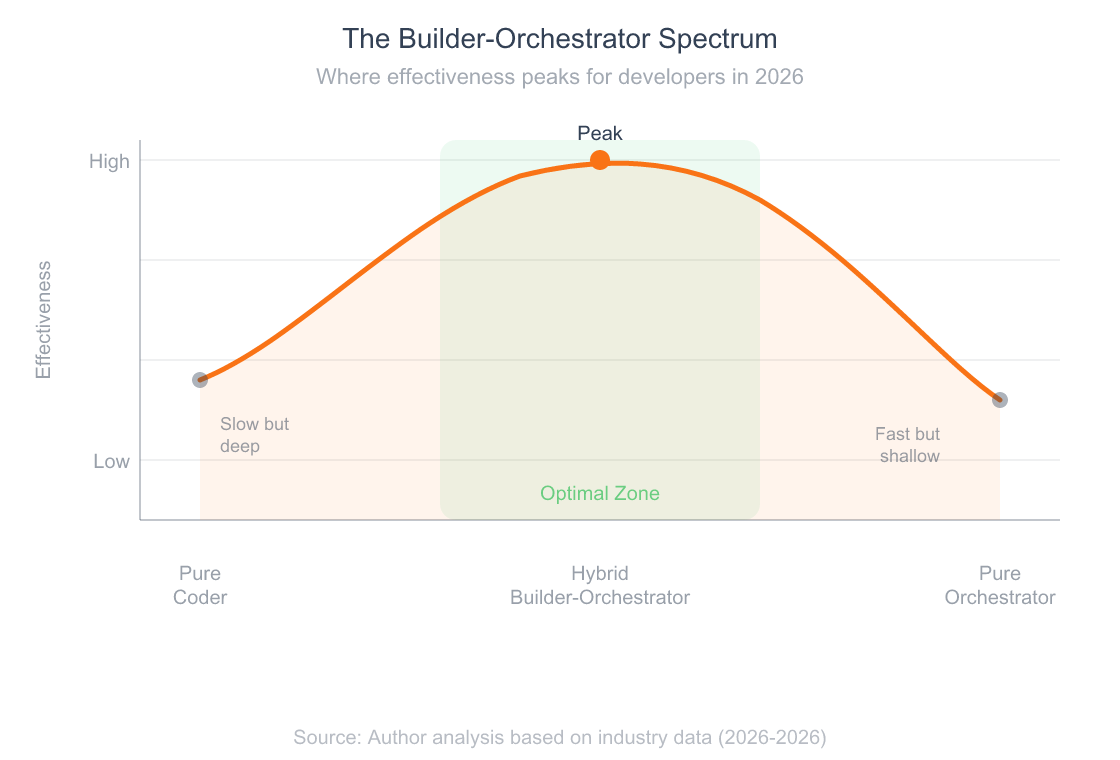
Developer effectiveness peaks in the hybrid zone, those who both write critical code by hand and orchestrate AI for everything else.
Citation Capsule: Enterprise data shows 70-80% of agentic AI initiatives struggled to scale, confirming that human oversight remains critical in production environments (Bain & Company, 2026). Developers who combine hands-on building skill with AI orchestration outperform those who adopt either approach alone.
What Am I Personally Doing About This Identity Shift?
The shift from coder to builder-orchestrator isn’t theoretical for me; it’s the transition I’m living right now. Only 9% of developers believe AI-generated code can ship without human oversight (BairesDev, 2026). That stat gives me confidence that my experience still has a home. But I’ve had to deliberately restructure how I spend my time.
Building products, not just writing code. I’m building SaaS products now (StatusLink, Growth Engine) because the ability to ship a complete product matters more than the ability to write a perfect function. Product thinking is the skill that scales when code writing gets automated.
Learning AI orchestration deliberately. Multi-agent systems, Model Context Protocol, prompt engineering patterns. I’m studying these the way I studied design patterns ten years ago. It’s a new craft, and it deserves the same rigor.
Building distribution. Blog, Twitter, audience. This is the one thing AI fundamentally can’t replicate: trust built through consistent, honest communication with real people. You’re reading this right now because I chose to build in public. No AI agent is going to do that authentically.
Investing in domain expertise over syntax mastery. I’m doubling down on understanding payment systems, subscription businesses, and indie SaaS economics. These domains have nuances no language model learns from training data alone.
Accepting that “developer” means something different now. This is the hardest one. I had to grieve the version of myself that felt most alive writing elegant Laravel controllers at 11 p.m. That version isn’t gone, but it’s no longer enough.
The turning point for me was realizing I’d been confusing the tool with the talent. My real skill was never “writing PHP.” It was understanding systems, predicting failure modes, and making good decisions under constraints. PHP was just the medium. AI is the new medium. The underlying talent hasn’t changed. Only the instrument has.
Practical SaaS ideas for this new era

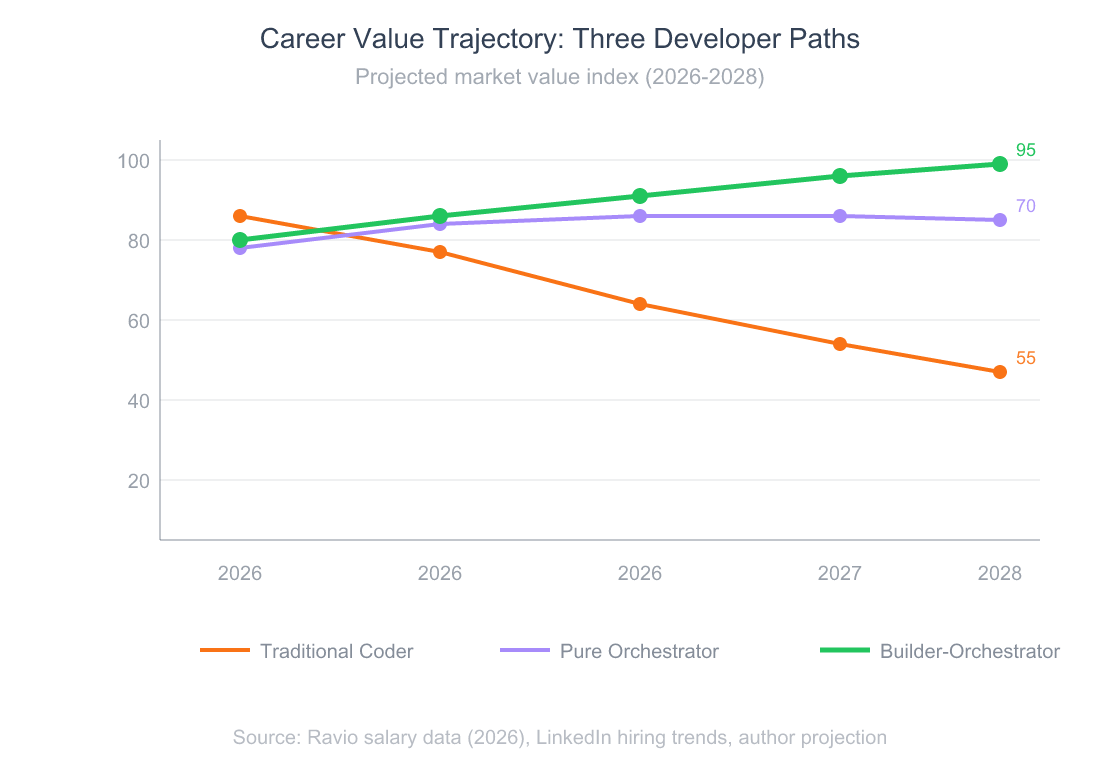
The builder-orchestrator hybrid path shows the strongest projected career trajectory, outperforming both pure coding and pure orchestration approaches.
Citation Capsule: Only 9% of developers believe AI code can ship without human oversight (BairesDev, 2026). A senior developer’s value now comes less from writing complex code and more from knowing what code should be written and verifying AI’s output against real-world requirements.
Frequently Asked Questions
Is this developer identity crisis something most developers are feeling?
Yes. Anthropic’s 2025 labor market study ranks computer programming as the profession most exposed to AI, and 65% of developers already say their primary language is a core part of their identity (Stack Overflow, 2025). When the skill at the center of your identity gets automated, the existential discomfort is widespread. You aren’t alone in feeling it.
Will AI completely replace the need to learn programming?
No. The 70-80% failure rate of agentic AI initiatives at enterprise scale shows that human oversight remains essential (Bain & Company, 2026). Learning to code builds the mental models you need to evaluate and direct AI output effectively. The knowledge transfers even if the activity changes.
How do I transition from “coder” to “builder-orchestrator”?
Start by using AI tools on a real project this week. Direct the AI, review its output critically, and notice where your experience catches mistakes. AI-fluent engineers already command a 12% salary premium (Ravio, 2026). Build products, not just features. That’s the fastest way to develop the product thinking that defines the new role.
Does this mean junior developers have no future?
Not at all. But the entry path is shifting. Goldman Sachs data shows a 16% employment drop among young workers in AI-exposed roles (Goldman Sachs, 2026), yet the BLS projects 15% overall developer job growth through 2034. Juniors need to learn AI orchestration alongside fundamentals, not instead of them.
What skills should I invest in right now?
Architecture, domain expertise, and AI orchestration. The World Economic Forum reports that 39% of all job skills will transform by 2030 (WEF, 2026). Focus on understanding systems, building products end-to-end, and developing expertise in a specific industry vertical. These skills compound in ways that syntax knowledge doesn’t.
Where to find AI-resilient SaaS opportunities
The Identity Shift Isn’t the End. It’s a Beginning
The developer identity crisis is real. I feel it every day. The craft I spent a decade building is being transformed by tools that make it accessible to people who’ve never written a for loop. That stings. And anyone who tells you it shouldn’t is either lying or hasn’t been paying attention.
But here’s what I keep coming back to: we’ve been through identity shifts before. “Webmaster” became “frontend developer” became “full-stack engineer.” Each transition felt like the old identity was dying. Each time, the developers who adapted didn’t just survive. They found the new version of the work more interesting than the old one.
AI-fluent engineers already earn 12% more than their peers (Ravio, 2026). The market is pricing in the transition. The question isn’t whether it’s happening. It’s whether you’ll fight it or flow with it.
I think the developers who’ll struggle most aren’t the least skilled. They’re the ones most emotionally attached to a specific way of working. The best code I’ve ever written isn’t the most elegant function. It’s the product decisions I’ve made that kept systems running, users happy, and businesses growing. That kind of work doesn’t get automated. It gets amplified.
If you’re feeling this identity shift too, you’re not alone. The developers who thrive won’t be the best coders; they’ll be the best thinkers who happen to use code (and AI) as their medium.
I’m figuring this out in public. Follow the journey at maketocreate.com.
Read the full analysis of how vibe coding is replacing traditional programming
How the SaaS market is reshaping around this shift
I Built a Multi-Agent Code Review Skill for Claude Code: Here’s How It Works
What’s the Best Tech Stack for Micro SaaS in 2026?
The $0 Marketing Stack for Indie Hackers in 2026