Vibe Coding Jobs in 2026: 71% of the Hiring Rebound Is Senior
Two numbers sit on my desk this week. US software development postings on Indeed have grown almost 15% since Claude Code launched in February 2025, and 71% of that increase between May 2025 and May 2026 came from senior roles (Indeed Hiring Lab, Jul 2026). Meanwhile, workers aged 22-25 in the most AI-exposed occupations now sit about 19% below where their employment would be if it had kept pace with less-exposed peers (Stanford Digital Economy Lab, Aug 2026). Both are real. One comes from job-board data, the other from ADP payroll records. Both describe the same labor market.
Almost every “vibe coding jobs” article I’ve read this year picks one number and runs with it. Either AI is killing junior developers, or it’s minting a generation of $250K AI engineers. Neither story survives ten minutes with the actual data.
So here’s my answer, rebuilt on the October 2026 numbers. What “vibe coding jobs” actually means (there are two questions hiding inside that phrase), what the hiring numbers say, what the salary numbers say once you strip out senior-engineer comp masquerading as the median, and what a developer should do this fall if they want to come out of this on the right side of the data.
the structural split between AI-fluent and legacy developer roles
Key Takeaways
- Some titles are exploding: Forward Deployed Engineer postings rose 1,165% YoY over January-October 2025 (Bloomberry, 2025), and AI Engineer is #1 on LinkedIn’s 2026 Jobs on the Rise list for the US (LinkedIn, 2026).
- Software postings are recovering, but not for juniors: up ~15% since February 2025 yet still ~27.5% below February 2020, with 71% of the recent gain going to senior roles (Indeed Hiring Lab, Jul 2026). Senior roles made up 69.3% of software postings in Q1 2026.
- The AI-fluency salary premium widened at the top (Staff-level AI specialists out-earned peers by 18.7% in 2025) but compressed at entry level, from 10.7% in 2024 to 6.2% in 2025 (Levels.fyi, Q3 2025).
- In Stack Overflow’s 2026 survey of 30,000+ developers, 73% of AI-assistant users use them daily, but 48% trust AI only when they can easily validate the answer (Stack Overflow 2026 Developer Survey, Oct 2026). That validation gap is where the new hiring criteria live.
What Does “Vibe Coding Jobs” Actually Mean in 2026?
It means two completely different questions wearing the same coat. The first: are companies hiring people to vibe code? The second: what’s happening to dev jobs because of vibe coding? Both questions matter. They have different answers, different data, and different implications for your next move. Anthropic’s January 2026 Economic Index found computer and mathematical (mostly coding) tasks made up 34% of Claude.ai conversations and 46% of first-party API traffic in November 2025 (Anthropic, 2026), so both pressures are real.
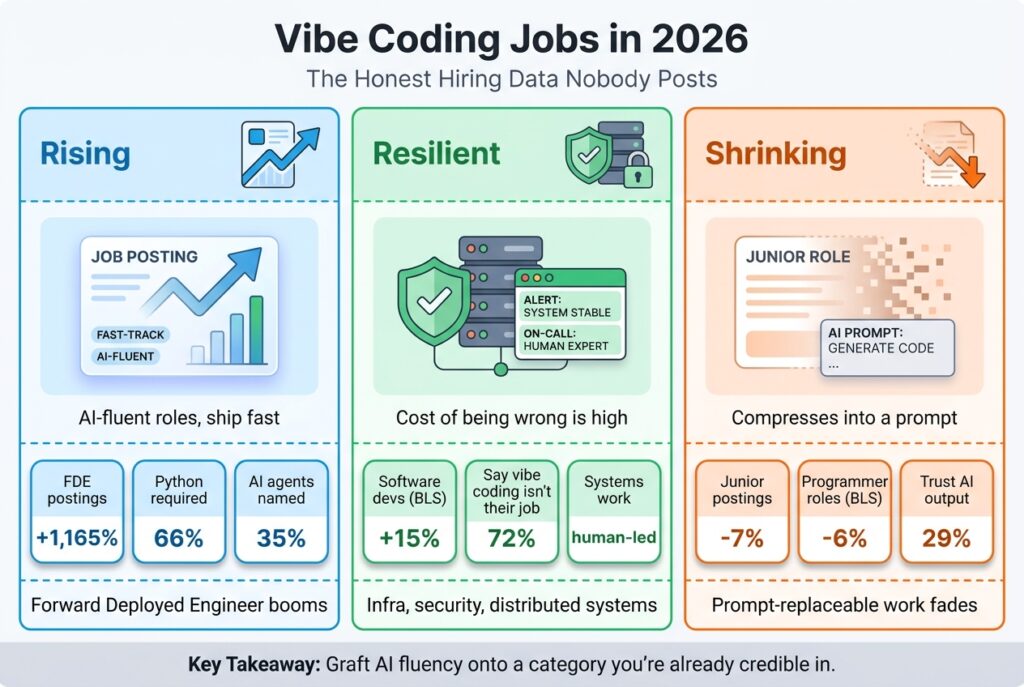
Ask the first question and the headlines look great. New job titles. Salary premiums at the top of the curve. Bloomberry’s analysis of 1,000 Forward Deployed Engineer postings found median base pay of $173,816, with 35% of postings explicitly requiring AI agents experience and 60% of those that specified experience targeting three to five years (Bloomberry, 2025). LinkedIn’s 2026 Jobs on the Rise list put AI Engineer at number one in the US, followed by AI Consultant/Strategist, with data annotators and AI/ML researchers also in the top five (LinkedIn, 2026).
Ask the second question and the picture changes. Stanford’s “Canaries in the Coal Mine?” study uses high-frequency ADP payroll microdata across millions of US workers, and its August 2026 revision found 22-to-25-year-olds in AI-exposed jobs still losing ground while less-exposed peers kept growing (Stanford Digital Economy Lab, 2026). Indeed Hiring Lab’s July 2026 data shows the same squeeze from the posting side: across all jobs, senior-level postings were up 14.7% year over year in May 2026 while entry-level postings fell 7.5% (Indeed Hiring Lab, Jul 2026). One signal isn’t a contradiction of the other. They’re the same trend hitting different ends of the curve.
the production-readiness pillar that gives this whole shift its context
Are Companies Actually Hiring People to Vibe Code in 2026?
Yes, but under different titles than you’d expect. The job postings that match what most developers call “vibe coding” (generating working software with an AI agent in the loop) show up as Forward Deployed Engineer, AI Engineer, AI Product Engineer, and AI-Forward Engineer. The titles are new. The work, translating fuzzy product intent into shipped code with Cursor or Claude Code doing the typing, is what’s actually growing.
Bloomberry’s analysis of 1,000 FDE postings between January and October 2025 documented the shape clearly: Python in 66% of postings, AI agents in 35%, a median base salary of $173,816, and only 12% of experience-specifying roles open to 0-2 years (Bloomberry, 2025). Indeed’s 2026 data adds the AI-title angle: 37% of the May 2025 to May 2026 increase in software postings came from jobs with “AI” in the title (Indeed Hiring Lab, Jul 2026). Meanwhile the title that sounds most like a vibe coding job (Prompt Engineer) is mostly gone. Indeed’s own economist said in 2025 that prompt engineering is “a good thing to have, but it’s not an entire title” (Fortune, 2025), and it didn’t make the top ten AI roles leaders plan to add in Microsoft’s 2025 Work Trend Index (Microsoft, 2025).
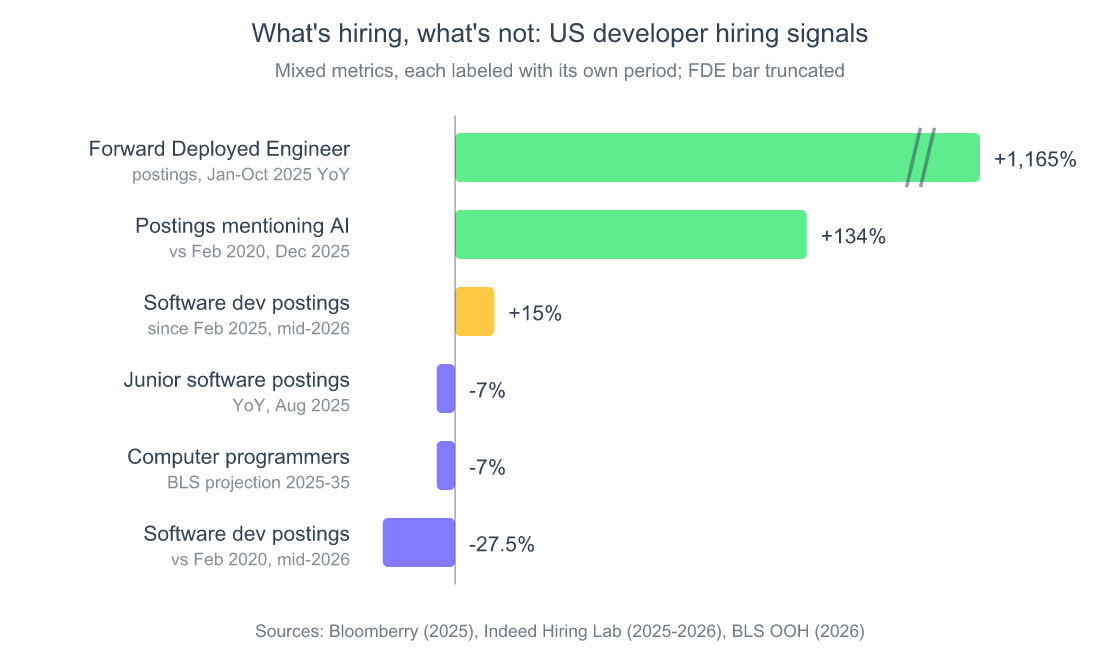
Sources: Bloomberry (2025), Indeed Hiring Lab, Jan 2026, Indeed Hiring Lab, Jul 2026, Indeed Hiring Lab, Sep 2025, BLS OOH, computer programmers.
The signal here isn’t subtle. Posts with “AI” in the title or stack are running at growth rates that don’t make sense in any other corner of the labor market. Generic software postings have stopped falling and started climbing, but they’re still well below 2020, and the climb is happening at the senior end. Mid-curve titles, the ones that could pivot either way, are the ones to watch carefully.
The thing nobody writes about: the FDE explosion isn’t a vibe-coding role in the consumer sense. It’s the enterprise version of vibe coding, where the same skill (translating fuzzy intent into shipped software with an AI agent) gets paid a $173K median base because the customer is paying for an outcome, not for lines of code. That’s the real shape of “vibe coding jobs” at the high end of the curve in 2026.
my full thesis on why this is structural, not cyclical
What Is Vibe Coding Doing to the Junior Developer Pipeline?
It’s compressing it, and the 2026 recovery hasn’t reached the bottom rung yet. In February 2025, The Pragmatic Engineer’s read of Indeed’s tracker had software development postings at roughly 65% of their January 2020 level, about 3.5x below the mid-2022 peak (The Pragmatic Engineer, 2025). By mid-2026 they’d climbed back to about 27.5% below the pre-pandemic level (Indeed Hiring Lab, Jul 2026). Better. But the mix shifted. Indeed’s September 2025 update found junior postings down 7% year over year in August 2025 while senior postings rose 4%, with fewer than 2% of tech and engineering postings aimed at junior roles (Indeed Hiring Lab, 2025). By Q1 2026, senior-level positions made up 69.3% of software development postings, the highest share of any job category Indeed tracks (Indeed Hiring Lab, Jul 2026).

Stanford’s “Canaries in the Coal Mine?” study put numbers on the generational split using ADP payroll microdata. In its August 2026 revision, employment of 22-to-25-year-olds in the two most AI-exposed occupation quintiles fell about 11% between November 2022 and June 2026, while the same age group in the least-exposed quintiles grew about 10%. The relative shortfall widened from 15% in the July 2025 data to 19% by June 2026, and it runs mainly through fewer hires rather than more layoffs (Stanford Digital Economy Lab, 2026). The cohort hit hardest is the one whose entry-level work, bug fixes, boilerplate, scaffolding, is exactly what an AI agent can ship in twelve seconds.
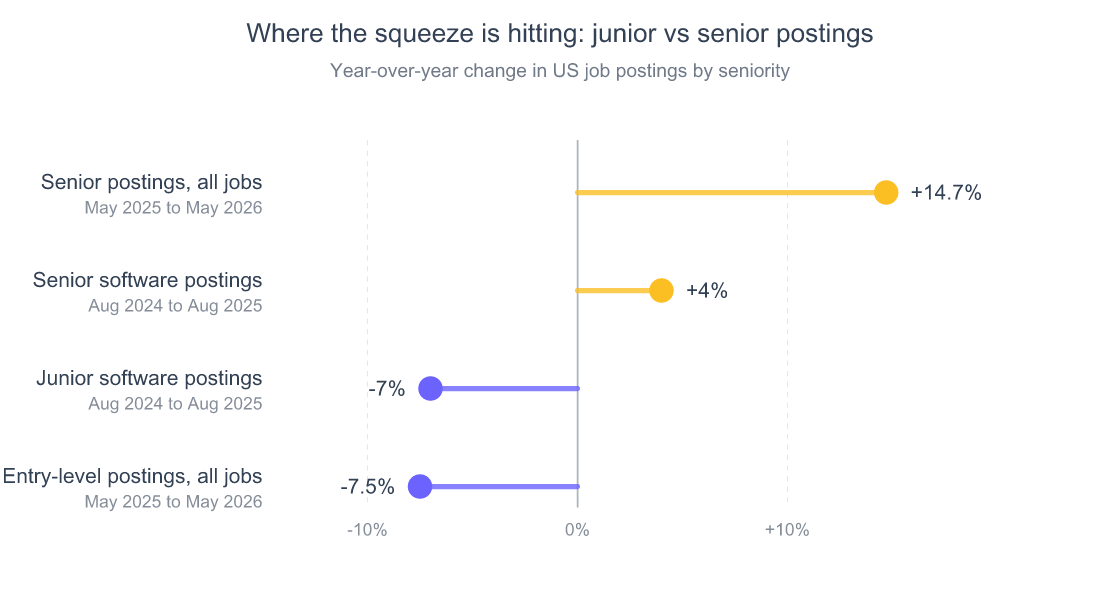
Sources: Indeed Hiring Lab, Sep 2025 (software, junior vs senior titles) and Indeed Hiring Lab, Jul 2026 (all jobs, by seniority).
Stack Overflow’s developer surveys add the qualitative half. In 2025, 84% of developers used or planned to use AI tools (up from 76% the year before), yet more of them actively distrusted AI output (46%) than trusted it (33%) (Stack Overflow, 2025). The 2026 survey, published this week with 30,000+ responses, shows usage deepening: 73% of developers who use AI coding assistants or agents use them daily, and Claude Code (66%) and GitHub Copilot (59%) lead the agent category. Trust is still conditional, though. The single biggest group, 48%, trusts AI only when they can easily validate the answer (Stack Overflow, 2026). That gap is what the hiring squeeze runs through: companies need people who can read and verify what the model wrote, not juniors who can write what the model already writes.
The role that’s actually disappearing is the one that just runs the keyboard. The role that’s growing is the one that owns the outcome and uses an AI agent to get there faster. That’s the real division line, and “junior” versus “senior” titles are a noisy proxy for it.
my deeper guide to the entry-level AI job market
Are AI-Fluent Developers Actually Earning More?
At the top of the seniority curve, yes, substantially. At the bottom, the premium is collapsing. Levels.fyi’s Q3 2025 compensation analysis of self-reported pay found Staff-level engineers with AI specialization earning 18.7% more than non-AI Staff peers in 2025, up from 15.8% in 2024 (Levels.fyi, Q3 2025). The Engineer-level premium edged from 11.6% to 11.9%, and Senior held flat around 14%. But the Entry-level premium dropped from 10.7% to 6.2%. Same data set, opposite directions. It’s 2025 data, the most recent level-by-level cut Levels.fyi has published that I could verify, but nothing in the 2026 posting data suggests the junior end has recovered since.
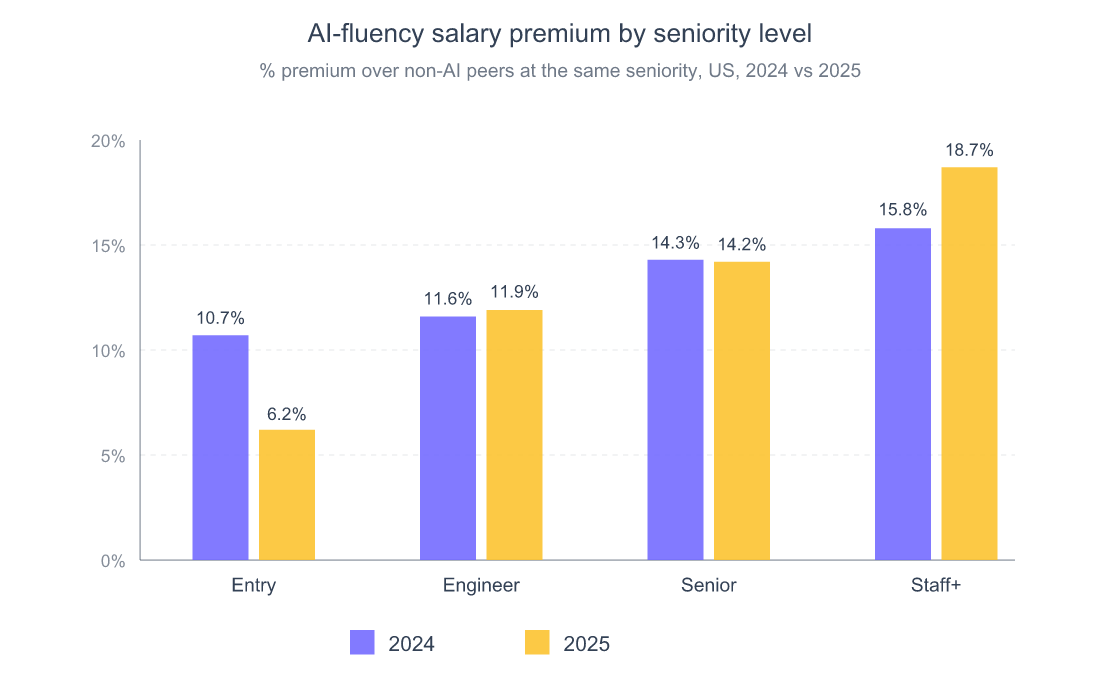
Source: Levels.fyi AI Engineer Compensation Trends, Q3 2025.
The reason the entry-level premium compressed is the same reason the junior posting volume fell. The supply of “I’m fluent in Cursor” candidates outran demand at the bottom of the curve faster than anyone expected. Every CS grad now claims it. Every bootcamp teaches it. The signal that mattered in 2024, “you can pair with an AI”, became table stakes in 2025. By 2026, with 73% of AI-using developers on these tools daily, it’s just how the job works. The premium moved up the ladder because the differentiation moved up the ladder.
Anthropic’s Economic Index makes the demand half explicit. In its November 2025 sample, computer and mathematical tasks made up 34% of Claude.ai conversations and 46% of API traffic, and “modifying software to correct errors” alone accounted for 6% of Claude.ai use and roughly one in ten API records (Anthropic, 2026). The companies paying the premium aren’t paying for typing speed. They’re paying for the layer of judgment that decides what the model should change and verifies that it actually did.
I’ve reviewed maybe forty job applications for friends in the last six months. The candidates who landed AI-titled interviews weren’t the ones with the most Cursor screenshots in their portfolio. They were the ones whose GitHub had a public repo with a README that read like a postmortem: what they built, what broke, how they measured the fix. That pattern is invisible on a resume and obvious in a thirty-second skim of a repo. It’s the cheapest way to send the only signal that’s actually getting weighted in 2026.
How Do You Position Yourself for the Vibe-Coding Era?
Stop optimizing your resume. Optimize the artifact you point to from your resume. Stack Overflow’s 2026 survey found that while daily AI use is now the norm, the largest group of developers (48%) trusts AI output only when they can easily validate it, and only 20% use AI for production systems work (Stack Overflow, 2026). That validation gap is the entire hiring signal. Companies are looking for evidence that you sit on the trustworthy side of it, that you can ship with an AI agent and catch what the agent missed. Everything else is decoration.

Here’s the playbook I’d run if I were re-entering the market in late 2026, in the order it actually matters:
1. One real, public repo with a README that reads like a postmortem. “I built X with Claude Code, it broke twice in production, here are the two things I added that fixed it.” That’s the entire signal. Hiring managers skim the README first, the resume second. If your README is auto-generated, you’re invisible.
2. Ship something an AI agent couldn’t have shipped alone. Integration tests against a sandbox. A pre-commit hook that catches the failure mode the agent created. A rate-limiter you wrote because you blew through $40 of credits on day two. The point is to demonstrate the layer of judgment, not the layer of typing.
3. A working knowledge of evaluation, not just prompting. HackerRank added RAG assessments in an AI-assisted, repo-based coding environment to its screens in April 2025 (HackerRank, 2025). The Anthropic Economic Index found augmented conversations on Claude.ai rose to 52% in November 2025 while automated ones fell to 45% (Anthropic, 2026), meaning more of the work is “model proposes, human evaluates.” That’s the skill that gets you to the second interview.
4. Python plus one production-relevant framework. Bloomberry found Python required in 66% of Forward Deployed Engineer postings, with AI agents specifically called out in 35% (Bloomberry, 2025). For ML-leaning roles, PyTorch is the framework I see asked for most. If you’ve shipped one real thing in Python with one real framework, you clear the bar. If you haven’t, that’s the gap.
5. Remove the dead signals. “Prompt Engineer” in your LinkedIn headline is a negative signal in 2026; see the Indeed and Microsoft data above. “AI enthusiast” is filler. “10+ years of Java” without a current GitHub commit is worse than silence. Strip everything that doesn’t point to a public artifact you’d defend in an interview.
6. Pick a stack and have one strong opinion about it. Cursor versus Claude Code versus Cline. DeepSeek V4 versus Claude Opus 5.5 versus GPT-6.1 Sol for coding. Whether you let the agent loop autonomously or keep it on a leash. The opinion doesn’t have to be right. It has to be yours, and it has to be defensible with one or two real experiences. That’s what gets weighted as “engineering judgment” on the screening call.
why shipped output beats language depth on a resume
Which Developer Roles Are More Secure Right Now?
The roles where the cost of being wrong is high and the work doesn’t compress into a prompt. Infrastructure, security, distributed systems, and on-call ops are the categories where the labor market is actively tightening rather than loosening. BLS projects software developer employment to grow 10% from 2025 to 2035 (much faster than average) while computer programmer roles are projected to decline 7% over the same window, a decline BLS explicitly ties to AI automating programming tasks (BLS Occupational Outlook Handbook, 2026). That split tells you everything.

The pattern is consistent across the data. Stack Overflow’s 2025 survey found 72% of developers said vibe coding, generating entire applications from prompts, was not part of their professional work, with another 5% emphatically opting out (Stack Overflow Blog, 2025). The 72% aren’t holding the line out of stubbornness. They’re working on the things where prompt-to-code doesn’t survive contact with production: regulated workloads, multi-tenant data isolation, the load balancer that pages someone at 3 AM. A year later, the 2026 survey still has only 20% of developers using AI for production systems work. GitHub’s Octoverse 2025 shows the volume side: its coding agent generated more than 1 million pull requests between May and September 2025, though GitHub itself frames that as a correlational signal, not proof of impact (GitHub, 2025).
If you’re already in one of those categories, you have more leverage than the news cycle suggests. If you’re not, the move isn’t to flee into “AI Engineer” hoping for the premium. The move is to graft AI fluency onto whichever category you’re already credible in. A security engineer who can rip through a Claude Code session is more valuable in 2026 than a Cursor power user who’s never read an audit report.
Frequently Asked Questions
Is “vibe coding” a real job title in 2026?
Almost never as a literal title. The work shows up under Forward Deployed Engineer, AI Engineer, AI Product Engineer, or AI-Forward Engineer, with FDE postings up 1,165% YoY over January-October 2025 and median base pay of $173,816 (Bloomberry, 2025). “Vibe coder” remains a vibe, not a billing code.
Are junior developers being replaced by AI?
The data points to compression, not full replacement. Stanford’s ADP payroll study found employment of 22-to-25-year-olds in the most AI-exposed occupations about 19% below their less-exposed peers as of June 2026, driven mainly by fewer hires rather than layoffs (Stanford Digital Economy Lab, 2026). On the posting side, entry-level postings fell 7.5% year over year to May 2026 while senior postings rose 14.7% (Indeed Hiring Lab, 2026).
Do AI-fluent developers actually earn more?
At Staff level and above, yes: 18.7% more than non-AI Staff peers in 2025, up from 15.8% in 2024 (Levels.fyi, Q3 2025). At entry level, the premium dropped from 10.7% to 6.2% over the same window. The reward goes to engineers whose judgment is rare, not to anyone who can run an agent.
What programming languages and tools matter most for vibe coding jobs?
Python is the floor. Bloomberry’s analysis of 1,000 FDE postings found Python required in 66% of them and AI agents called out specifically in 35% (Bloomberry, 2025). Add a working production framework (PyTorch, FastAPI, or LangChain depending on the role) plus real experience with Cursor or Claude Code, and you clear the screening bar.
Is prompt engineering still a career path?
Not as a standalone title. Indeed searches for prompt engineering roles peaked in April 2023 (Fortune, 2025), and it was absent from the top ten AI roles leaders plan to add in Microsoft’s 2025 Work Trend Index (Microsoft, 2025). The work folded into normal AI Engineer scope. Don’t put it on your resume.
the longer structural breakdown of where developer roles split next
What This Means for Your Next Move
“Vibe coding jobs” is two trends pulling in opposite directions. New AI-titled roles are growing at rates that look fake until you check the source. Generic and junior software roles are contracting at rates that look fake until you check the source. The middle reading is that 2026 rewards developers who can ship with an AI agent in the loop and read what it wrote, and it punishes everyone whose work was already the cheapest part of the pipeline.
If you’re early-career, the move is to make one public artifact that proves the trust-gap reading is wrong about you. If you’re mid-career, the move is to graft AI fluency onto your existing credibility instead of trading it in. If you’re senior, the data says you’ve never had more leverage than you do right now, use it before the next cohort catches up.
the production-readiness pillar that explains why this hiring shift is structural