Entry-Level AI Jobs in 2026: 5 Roles That Still Hire Juniors
Stanford’s Digital Economy Lab updated its “Canaries in the Coal Mine” study in August 2026, and the gap got wider. Employment of workers aged 22-25 in the most AI-exposed occupations now sits about 19% below where it would be had it kept pace with less-exposed peers, up from a 15% shortfall in the July 2025 data (Stanford Digital Economy Lab, Aug 2026). For software developers specifically, employment of 22-25 year olds fell nearly 20% from its late-2022 peak (Stanford AI Index 2026, 2026). That isn’t a vibe. It’s payroll data.
I’ve watched every career site write the same article for two years. They list five roles, paste a viral $206K average salary, mention “prompt engineering,” and move on. None of that is honest, and none of it helps a junior dev, a CS grad, or a web developer trying to pivot into AI work figure out what’s actually on the other side of the application portal.
This guide is the developer version. What “entry-level AI” actually means in 2026, which roles are real, which are dead, what hiring managers screen for, and what the salary numbers look like once you strip out the senior-engineer comp masquerading as the median. No hype. Lots of citations, and every one of them was re-checked in October 2026.
Key Takeaways
- Stanford/ADP payroll data puts 22-25 year olds in AI-exposed occupations about 19% behind less-exposed peers as of June 2026, and young software developer employment is down nearly 20% from its late-2022 peak (Stanford Digital Economy Lab, 2026).
- Software development postings on Indeed are up almost 15% since February 2025, but 71% of the May 2025 to May 2026 increase came from senior roles (Indeed Hiring Lab, Jul 2026). The recovery is real. It just isn’t for juniors yet.
- Python appears in 71% of AI engineer postings, PyTorch in ~38%, RAG in ~14%, LangChain in ~11%, and only 2.5% of those postings are entry-level (365 Data Science analysis of 903 US listings, 2026).
- The viral “$206K average AI engineer” figure is an average across postings that are 97.5% non-entry-level. ZipRecruiter’s average for entry-level ML engineer is $69,362 (Oct 2026); BLS puts the software developer median at $135,980 (BLS, May 2025).
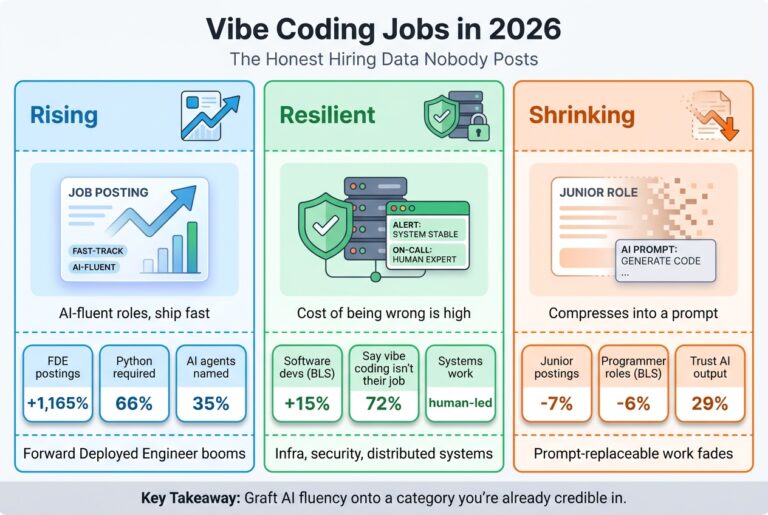
The structural split between AI-fluent and legacy developer roles
What Counts as an “Entry-Level AI Job”, and Why Most Listings Lie About It
The label means almost nothing in 2026. Indeed Hiring Lab’s July 2025 analysis found that experience requirements tightened during the tech hiring freeze: between Q2 2022 and Q2 2025, the share of tech postings asking for 5+ years rose from 37% to 42%, while the 2-4 year bracket shrank from 46% to 40% (Indeed Hiring Lab, 2025). Postings open to 0-1 years held flat at 17-18%. And for AI engineering specifically, 365 Data Science found only 2.5% of 903 US postings were entry-level (0-2 years) (365 Data Science, 2026). In practice the label is recruiter shorthand for “we’ll consider non-staff candidates,” not a real seniority bracket.
For developers, three things actually correlate with getting hired into an AI-adjacent role at junior level:
- A working portfolio that proves you’ve shipped something, anything, with an LLM in production
- Comfort with Python plus one ML framework (PyTorch dominates; TensorFlow is fading)
- Evidence you can evaluate models, not just prompt them
The job description will say “Bachelor’s in CS or equivalent, internship preferred, familiarity with Python.” The screening process will test whether you can build a retrieval-augmented generation pipeline with a vector DB and an evaluation harness. Those are not the same thing.
I review junior dev portfolios for friends and colleagues regularly. The pattern that lands callbacks isn’t a fancy resume: it’s a public GitHub repo where the README starts with “I built X, here’s what broke, here’s how I measured it.” Hiring managers I’ve talked to skim the README first and the resume second. If you’ve never written that kind of README, that’s the gap.
Why “shipped something measurable” outperforms language depth on a resume
Why Is the Junior Developer Pipeline Cracking?
Because AI hits the bottom of the experience ladder first, and the data keeps pointing the same way. A Stack Overflow blog roundup pulled together the attitude numbers: in a 2024 SHRM survey, 70% of hiring managers said AI can do the work of interns and 57% said they trust AI’s output more than that of interns or recent grads, and a Newsweek-reported poll had 37% saying they’d rather “hire” AI than a new graduate (Stack Overflow Blog, 2025). Handshake’s 2025 Internships Index, cited in the same piece, showed tech-specific internship postings down 30% since 2023. Read that twice. Then look at any junior-dev job board.
The 2026 posting data is more nuanced, and more useful. Indeed Hiring Lab reports US software development postings have grown almost 15% since late February 2025, yet they still sit about 27.5% below their February 2020 level. The catch: 71% of the May 2025 to May 2026 increase came from senior roles, and 37% came from jobs with “AI” in the title (Indeed Hiring Lab, Jul 2026). A separate Hiring Lab analysis found senior-level positions made up 69.3% of software development postings in Q1 2026, the highest share of any category, while entry-level postings across the whole market fell 7.5% year over year to May 2026 (Indeed Hiring Lab, Jul 2026). Meanwhile, postings that mention AI ended 2025 at 134% above their February 2020 baseline (Indeed Hiring Lab, Jan 2026).
So hiring is back for software, and AI is where the growth is. It’s just landing on people with five years of experience first.
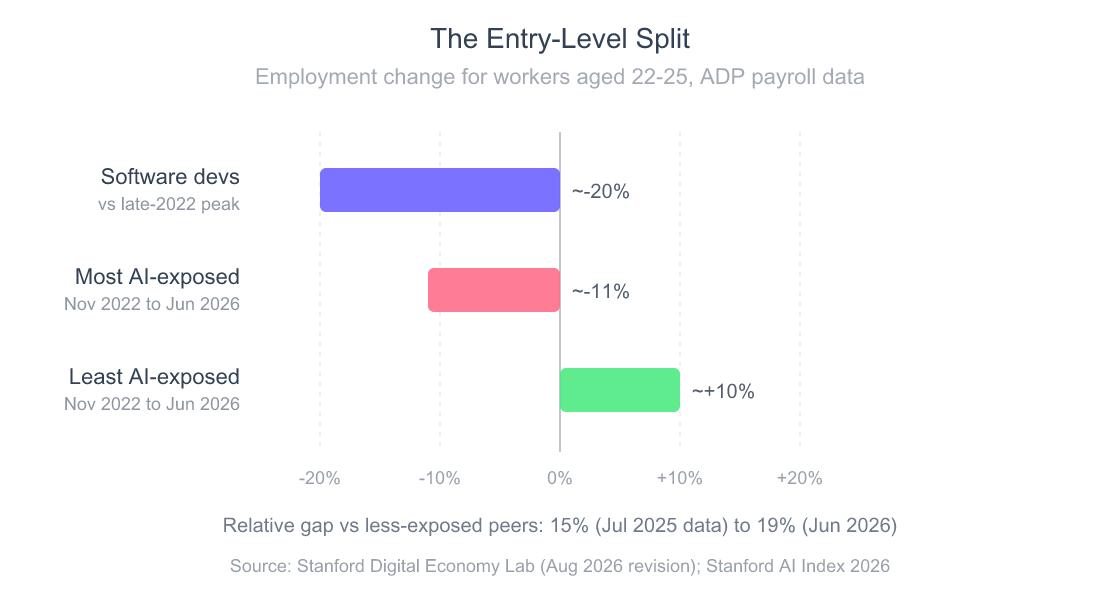
Stanford’s own read of the mechanism matters here: the adjustment runs mainly through reduced hiring of young workers, not layoffs, and it’s concentrated in jobs where AI automates tasks rather than complements them (Stanford Digital Economy Lab, 2026). The authors are careful to call these descriptive patterns, not causal proof, and the gap shrinks once you account for education. Fair. But “the door isn’t opening” is exactly what a junior feels.
The practical mechanism is simple. Tasks that used to be junior-developer training grounds (CRUD endpoints, basic data transformations, first-pass test writing) are now what AI tools do credibly enough that managers skip the human hire. The skills that aren’t automated (judgment, integration across systems, debugging novel failures) are the ones senior developers already have. So the entry rung is getting kicked out, not the whole ladder.
That doesn’t mean you can’t get hired. It means the path looks different than it did in 2021. You’re not interviewing for “write code we tell you to write.” You’re interviewing for “make AI-generated code actually work in our production environment.”
The seven fundamentals AI keeps getting wrong, and why you still need them
Which Entry-Level AI Roles Are Actually Real in 2026?
Five role categories actually post at junior level and actually hire. Everything else is either renamed senior work or a recruiter fishing expedition.
The Stanford AI Index 2026, built on Lightcast posting data, found 2.5% of all US job postings mentioned AI skills in 2025, up 55% in a year. The sharpest move was agentic AI: that skill cluster went from 0.06% of postings in 2024 to 0.23% in 2025, a jump of more than 280% and nearly 90,000 US postings (Lightcast summary of the Stanford AI Index 2026, 2026). Python was the most in-demand specialized skill, showing up in 258,674 AI postings, nearly 30% more than in 2024. That’s where the actual budget is going: people who can build and run AI systems, not people who talk about them.
The five that hire juniors
-
Junior AI / Applied AI Engineer. The renamed “junior backend engineer,” now with an LLM in the request path. You’re building APIs that call models, wiring up vector search, writing the prompt + retrieval logic, and handling structured output validation. This is the most common entry door for web devs pivoting in.
-
ML Engineer (Associate / I). Less common at true entry level but real. You’ll work on feature pipelines, model serving infrastructure, and evaluation tooling. Requires more rigorous ML coursework than the applied AI role.
-
AI Evaluation / Red Team Engineer. Growing fast, often hidden under titles like “Trust & Safety Engineer” or “Model Quality Analyst.” You design eval harnesses, write adversarial test cases, and run regressions against new model checkpoints. Forgiving on credentials, brutal on attention to detail.
-
AI Platform / MLOps Engineer (Junior). DevOps with a model registry attached. If you’ve already done infra work in web dev, this is the cleanest pivot. Kubernetes, observability, GPU scheduling, model versioning.
-
AI Software Engineer at a non-AI company. The biggest absolute volume. Banks, retailers, healthcare orgs hiring developers to embed LLMs into existing workflows. Lower comp, fewer GPUs, slower stacks, but the bar is also realistic and the work is real.

What you’ll see posted that isn’t real
- “Generative AI Strategist.” Marketing.
- “AI Researcher” at a pre-seed startup. Founder doing the work, you’d be a glorified intern.
- “Junior Prompt Engineer.” See the next section.
- “AI Product Manager (entry-level).” PM job, not a dev role, and usually requires prior PM experience anyway.
The pattern across all of these: if the title promises strategy, research, or “vision” at junior level, someone senior is doing the real work. Apply where the build work is.
The agent-shaped work driving the AI engineer hiring boom
Is Prompt Engineering Still a Job in 2026?
Not as a title. Indeed economist Allison Shrivastava put it plainly in 2025: “Prompt engineering as a skill is still definitely a good thing to have, but it’s not an entire title.” Searches for prompt engineering roles on Indeed peaked back in April 2023, and generative-AI terms appeared in only about 3 of every 1,000 Indeed postings at the time (Fortune, 2025).
Microsoft’s 2025 Work Trend Index, a survey of 31,000 workers across 31 markets, asked leaders which AI roles they’re considering adding in the next 12-18 months. The top ten were AI trainer, AI data specialist, AI security specialist, AI agent specialist and similar operational roles. Prompt engineer didn’t make the list (Microsoft Work Trend Index, 2025). And in 365 Data Science’s 2026 sample of AI engineer postings, prompt engineering shows up as a skill in just 8.9% of listings.
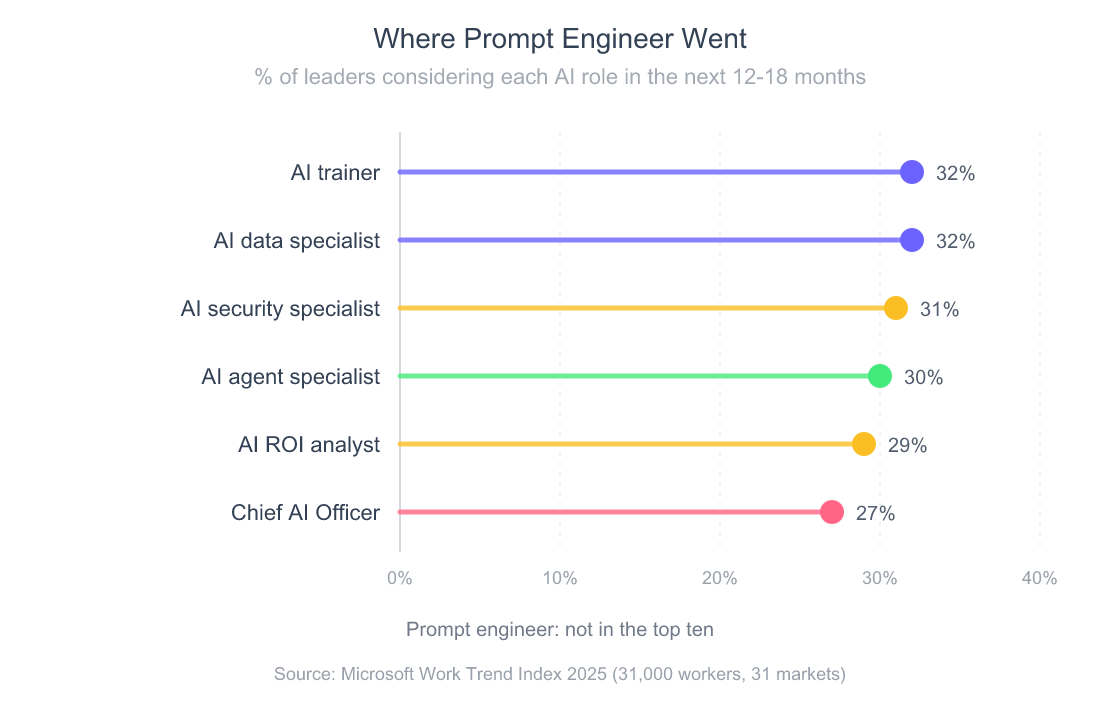
Why did it collapse so fast? Because prompt engineering was never a discipline. It was a temporary skill gap. In 2023, models were finicky and the marginal expert who could coax decent output out of GPT-3.5 looked magical. By late 2024, frontier models followed instructions well enough that the “prompt expert” no longer added measurable value over a thoughtful product engineer. The 2026 crop (Claude Opus 5.5, GPT-6, Gemini 3.1 Pro) only widened that gap. The role evaporated into the JD of “AI engineer who can also write good prompts.”
The deeper version of the skill, designing eval-driven prompt systems, debugging context window failures, building structured-output pipelines, is alive and well. It just isn’t a job title anymore. It’s a checkbox inside the AI engineer JD. If you’ve spent the last year preparing to become a “prompt engineer,” redirect now.
There’s a corollary worth saying out loud: every AI role advertised primarily on the basis of soft skills (“creative thinker,” “great at experimentation”) and not engineering rigor is going to compress the same way prompt engineering did. The roles that hold up are the ones with verifiable technical screens. If you can’t be tested, you can’t be hired durably.
How real teams replaced “good prompts” with eval-driven iteration
What Skills Do AI Hiring Managers Actually Screen For?
The published JD lies. The screen tells the truth. 365 Data Science’s analysis of 903 US AI engineer postings on Glassdoor found Python in 71% of them, PyTorch in 37.7%, AWS in 32.9%, RAG in 13.6%, and LangChain in 10.7%. Prompt engineering shows up in just 8.9%, as one line item among many (365 Data Science, 2026).
The bigger signal: HackerRank, which runs technical screens for thousands of companies, added RAG (retrieval-augmented generation) assessments and AI-assisted coding environments in its April 2025 release (HackerRank, 2025). The new questions drop you into a VS Code-style environment built on a code repository, with hard limits (30 requests and 3,000 tokens per minute), and ask you to build something that works under those constraints. That’s what the industry now believes “AI engineering ability” means.
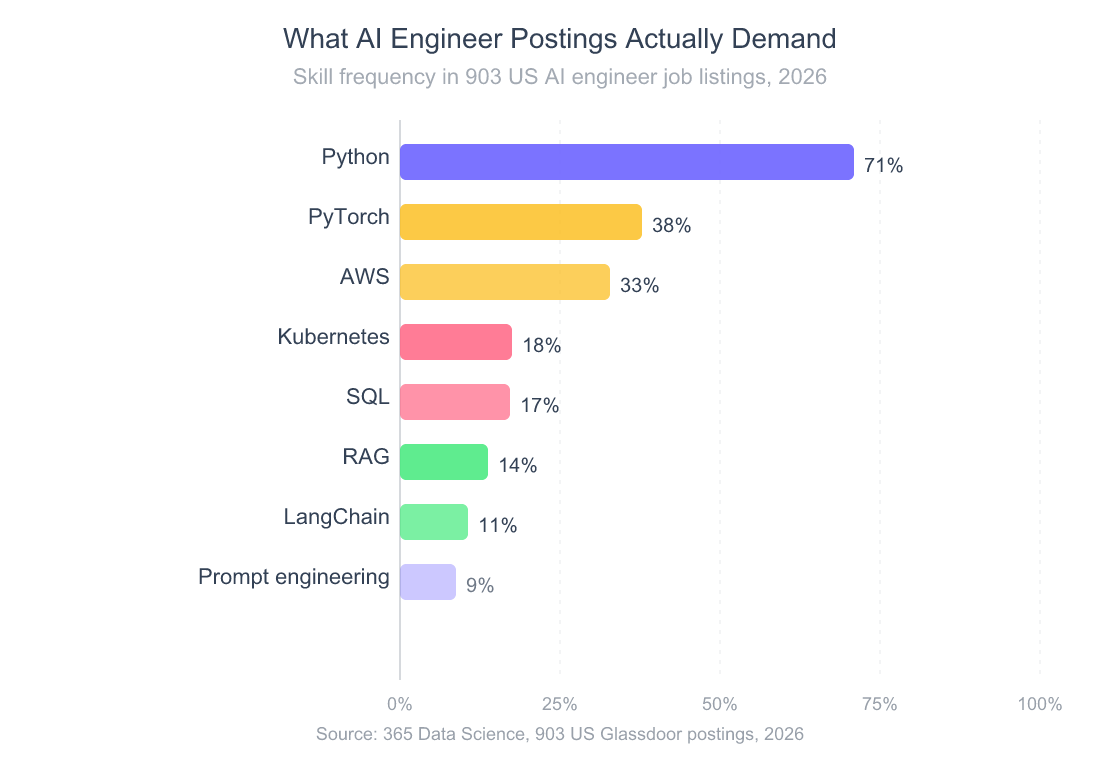
So what does that mean practically? If you can do these four things, you’ll pass most junior AI engineer screens:
- Build a working RAG pipeline. Document loader → chunker → embedding model → vector store → retriever → generation. Know the trade-offs at each step (chunk size, recall vs precision, embedding model choice).
- Write evals. Build a small benchmark of ~30 hand-labeled cases, run them against multiple models, produce a scored comparison. This proves you understand that “looks fine” is not “works.”
- Ship a Python service. FastAPI is fine. Containerize it. Stand up logging. Add a rate limiter. The infra fundamentals are non-negotiable.
- Read a research paper end-to-end. You don’t need to publish. You need to be able to read a recent arXiv paper, find the github implementation, and run it without flinching.
Notice what’s not on the list: deep theoretical ML, transformer math from scratch, originating novel architectures. Those are research roles, which are not entry-level for most developers anyway.

A technical deep-dive on retrieval architectures you can build for a portfolio
The Salary Reality: Stop Reading Viral Tweets
The most common piece of bad advice in this space is “AI engineers make $300K out of the gate.” That number is a senior-staff comp datapoint at FAANG and AI labs, retold as a median by people who benefit from your career anxiety. The actual data is much more boring, and much more useful.
The Bureau of Labor Statistics reports the May 2025 median annual wage for software developers at $135,980, data scientists at $120,230, and computer and information research scientists at $140,300 (BLS, 2025). BLS also projects software developer employment to grow 10% over 2025-2035, “much faster than the average.” There’s no separate BLS code for “AI engineer”, that work falls under those three.
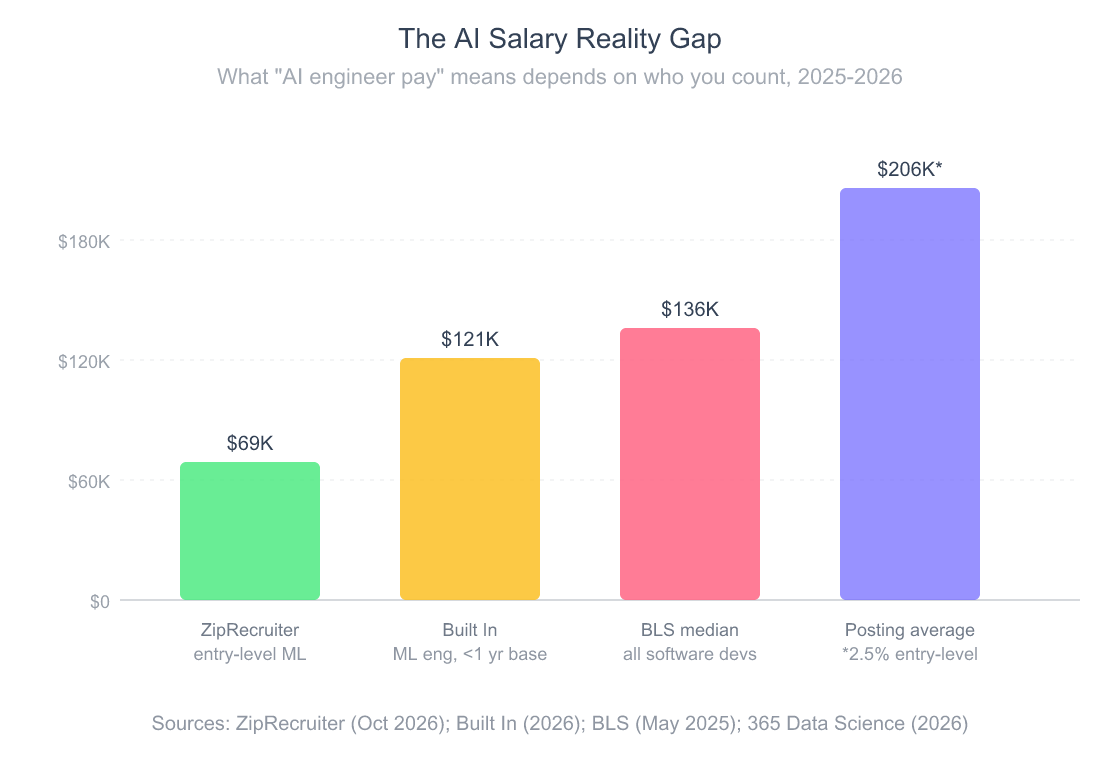
Entry-level ML engineer averages vary wildly by source because the role definition varies wildly. ZipRecruiter averages $69,362 for entry-level ML engineer roles as of October 2026, with most falling between $51,500 and $78,500 (ZipRecruiter, 2026). Built In, which skews toward tech-company employers, puts the average base for ML engineers with under a year of experience at $120,571 (Built In, 2026). And the much-shared $206,000 “average AI engineer salary” comes from 365 Data Science’s sample of postings, where only 2.5% were entry-level and 10+ year roles averaged $269,000+. The $200K+ numbers describe experienced hires and top-of-band offers, not the median junior experience.
What actually shifts your offer:
- Location: SF Bay Area / NYC at the top, then Seattle / Austin / Boston, then everywhere else. Remote roles compress the gap but rarely match in-person Bay Area bands.
- Whether you have a research output: papers, kaggle wins, open-source ML library contributions. These move offers more than years of experience.
- Which company tier you target, frontier AI labs > FAANG > AI-first startups > enterprise tech > non-tech industry. The spread can be 2-3x for the same skills.
My rough framing: if you land an entry-level AI engineering role at a non-AI company in a mid-tier US city in 2026, expect $90-130K total comp. If you land one in the Bay Area at a well-funded AI startup, expect $150-220K with equity that may or may not be worth anything. Both are good outcomes. Neither is the $300K tweet.
The identity shift behind “I’m an AI engineer” and what it actually means
The 90-Day Plan If You’re Actually Pivoting In
If you’re a CS grad, a junior dev, or a web developer trying to make this move, here’s the plan that actually works. It’s the one I’d give a friend over coffee, and it’s the one I’ve watched land interviews.

Days 1-30: Build the foundation
- Week 1: Get Python comfortable if you aren’t already. Stand up FastAPI, write three endpoints, deploy to Fly.io or Railway. No AI yet.
- Week 2: Add an LLM call. Use the Anthropic or OpenAI SDK, structured output, retries, timeouts. Log every call.
- Week 3: Replace one endpoint’s hardcoded logic with a real RAG pipeline. Embed 1,000 documents (your own: blog posts, docs, anything), use a free vector DB (Chroma or pgvector), build the retriever.
- Week 4: Write 30 evals by hand. Score the system. Find where it fails. Write up what you learned in a public README.
Days 31-60: Build a real project
- Pick a domain you know well (or actually care about). Build something genuinely useful: a researcher for your specific field, an inbox triager for your specific workflow, a customer-support bot trained on a real company’s public docs.
- The project must include: evals with measurable accuracy, a deployment story, and a postmortem of what broke and how you fixed it.
- Open-source it. Write a blog post. Publish it under your real name.
Days 61-90: Apply with leverage
- Don’t apply to “AI roles” broadly. Identify 30 companies whose stack matches what you’ve built. Find the engineer who shipped their AI feature on LinkedIn. Send them a short message referencing one specific technical decision in their public work.
- For every application, lead with your project, not your resume. Recruiters skim a resume in seconds. In my experience, an engineer will happily spend five minutes poking at a working demo.
- Practice the HackerRank-style screen. Build a second RAG pipeline under time pressure. Build it again. Build a third one.
The pattern I see in candidates who land offers vs candidates who stall: the ones who land offers consistently have a single, deeply-built artifact (with evals, a postmortem, and one production-style refinement) rather than four shallow demos. Depth signals seriousness. Breadth signals a tutorial trail.
On bootcamps and master’s programs: if a bootcamp quotes a placement rate, ask whether it reports through the Council on Integrity in Results Reporting (CIRR), which publishes school-level employment outcomes at 90, 180 and 360 days under a standard methodology (CIRR, 2026). Most self-reported bootcamp outcome numbers are marketing. A master’s in CS or ML can help if you don’t already have a CS degree, but only if it includes a research output or substantial applied project. Otherwise the same 90 days of focused portfolio work outperforms the credential.
A practical workflow tutorial you can adapt into a portfolio project
Frequently Asked Questions
Are entry-level AI jobs actually entry-level?
Often no. Indeed Hiring Lab found the share of tech postings asking for 5+ years rose from 37% to 42% between Q2 2022 and Q2 2025 (Indeed Hiring Lab, 2025), and only 2.5% of AI engineer postings in a 2026 sample were entry-level. Treat the label as a hint about seniority bracket, not a guarantee.
What’s the difference between an AI engineer and an ML engineer?
AI engineer typically means “software engineer who integrates LLMs and AI APIs into products”: heavy on Python, FastAPI, RAG, vector databases. ML engineer leans further toward model training, feature pipelines, and serving infrastructure, with more rigorous ML coursework expected. AI engineer is the more accessible entry-level pivot for web developers; ML engineer typically requires a CS or stats background.
Should I skip web development and go straight into AI?
Not necessarily. Web development is where most AI engineering work actually lives: APIs, services, integrations, deployment. A solid full-stack foundation plus AI-specific skills (RAG, evals, structured output) is a more hirable combination than ML theory without engineering chops. Goldman Sachs estimates AI erased roughly 16,000 net US jobs per month over the past year (about 25,000 lost to substitution, 9,000 added back through augmentation), with the damage concentrated in routine entry-level roles (Fortune, 2026). Building the AI systems puts you on the augmentation side of that ledger.
Is a master’s degree worth it for AI jobs?
It depends. The Stanford AI Index 2026 shows AI skills in 2.5% of all US postings, up 55% in a year, but most postings screen for demonstrated technical skill rather than a specific degree. A master’s helps if you lack a CS background or want research roles. For applied AI engineering, a strong public portfolio outperforms the degree in most hiring funnels.
Do I need GPUs to build a portfolio?
No, not for the projects that land jobs. RAG pipelines, evals, fine-tuning small models on hosted services, and structured-output workflows all run on standard developer hardware. Fine-tuning large models is a research workflow, not an entry-level workflow. Focus your portfolio on production-style application code, not GPU-hungry training.
The Bottom Line
Entry-level AI work in 2026 is real, but the door is narrower than the marketing suggests. The Stanford payroll data shows the gap at the bottom of the career ladder still widening as of mid-2026, and Indeed’s posting data shows the software rebound going to senior hires first. The bar is higher than it was for entry-level web dev five years ago, and the work itself is closer to senior backend engineering than to “junior dev.” That’s a real shift.
The good news for developers: the path is well-defined if you ignore the noise. Python and PyTorch as the base. RAG and evals as the differentiator. A single deep portfolio project with measurable outcomes, not five shallow demos. Skip the prompt engineering certs. Skip the $300K tweets. Build something that works, write up what broke, ship it under your real name, and apply where the budget is.
The “entry level AI jobs” category isn’t a fantasy, it’s just no longer a participation trophy. The developers who treat it like a serious engineering pivot will get hired. The ones who chase the fading hype around prompt engineering and viral salary tweets will spend a year on the wrong skills.
Where the developer market is heading next and how to position yourself for it