Is DeepSeek Cheap Enough to Change How You Vibe Code?
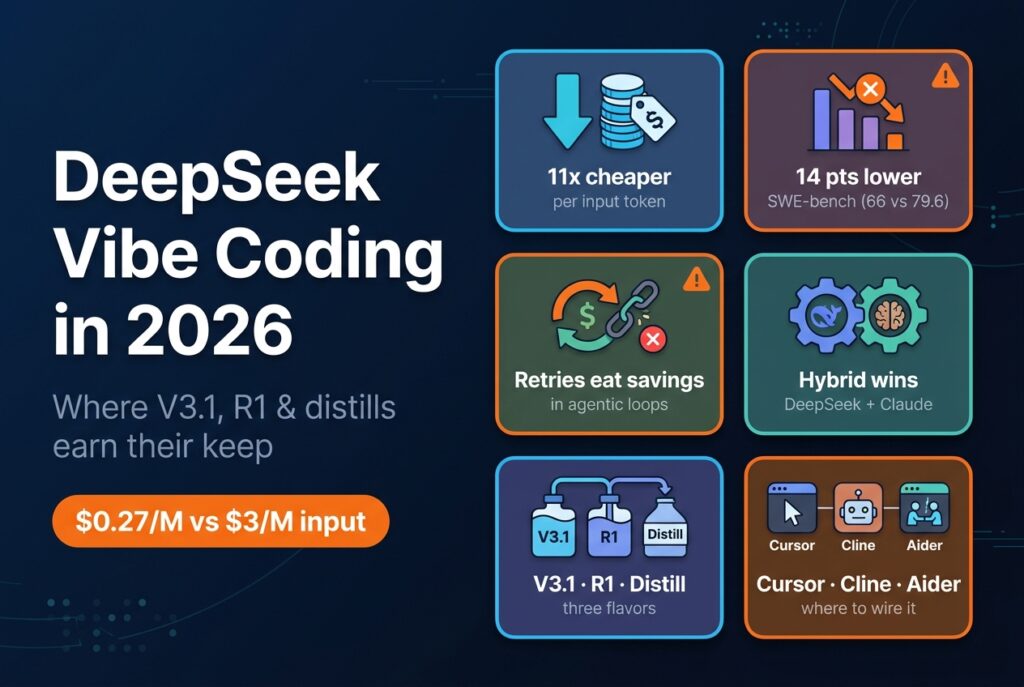
Cheap models are a real temptation. As of October 2026, DeepSeek’s official API charges $0.15 per million input tokens and $0.60 per million output tokens for V4.1-Flash, and $0.66 / $1.98 for V4-Pro, at off-peak rates (DeepSeek API docs, 2026). Claude Sonnet 5.5, the current mid-tier Claude, costs $2 and $10 (Anthropic, 2026). That’s about 13x more on input and almost 17x more on output than Flash. If you’ve ever watched a Cursor session burn $3 in twenty minutes, the math feels obvious.
It’s not obvious. Chinese-origin models took 61% of OpenRouter’s token consumption in one February 2026 week (Dataconomy, 2026), so plenty of developers have already made the switch. But cheap only matters if the code ships. In March and April 2026 I spent six weeks routing my own vibe-coding work through DeepSeek V3.1, R1, and an R1 distill served via Together AI, against Claude Sonnet 4.6 and GPT-5. Some of it was impressive. A lot of it ended in retry loops that erased the savings.
This post is the accounting from that test, updated for October 2026: what DeepSeek nails, what it fumbles, what the V4 generation changed, and how to wire it into Cursor, Cline, Aider, Continue.dev, and OpenRouter without watching your savings disappear into eight failed tool calls in a row.
the broader vibe coding thesis
Key Takeaways
- In my March-April 2026 test, DeepSeek V3.1 sat 13.6 points below Claude Sonnet 4.6 on SWE-bench Verified (66.0% vs 79.6%) and I felt that gap on every multi-file task (Hugging Face; Anthropic, 2026).
- DeepSeek V4-Pro now reports 80.6% on SWE-bench Verified in max reasoning mode (Hugging Face, 2026). The benchmark gap has mostly closed on paper. I’d still verify the agentic behavior on your own repo before trusting it.
- The cost win disappears in multi-file agentic loops. Retries inflate spend faster than the per-token discount erases it.
- The hybrid pattern that works: DeepSeek for boilerplate, autocomplete, and well-scoped tickets; a frontier model (Sonnet 5.5, Opus 5.5, or GPT-6.1 Sol) for architecture, debugging, and anything that needs a multi-file mental model.
What Does “Vibe Coding” Mean in 2026, and Where Does DeepSeek Fit?
Vibe coding, in the 2026 sense, means describing what you want in natural language and letting the model produce, edit, and sometimes run the code without you reviewing every line. The 2025 Stack Overflow survey found that 84% of developers use or plan to use AI tools, but only 33% trust their accuracy and 46% actively distrust them (Stack Overflow, 2025). That distrust gap is the entire reason model choice matters.
DeepSeek became a vibe-coding contender for one reason: price. The V3.1 model, released in August 2025, introduced a hybrid thinking/non-thinking mode that scored competitively on coding benchmarks while undercutting frontier API pricing by an order of magnitude. R1, the reasoning-focused model from January 2025, launched with cached input as low as $0.14 per million tokens (DeepSeek, 2025). The distills (R1-Llama-70B, R1-Qwen-32B) brought serious reasoning into the open-weights tier, small enough to self-host on a single GPU node or rent from Together AI and Fireworks.
The lineup has moved since. DeepSeek’s API now serves exactly two models: deepseek-v4-pro (V4-Pro-0813) and deepseek-flash (V4.1-Flash), both with a 1M-token context window (DeepSeek API docs, 2026). The old deepseek-chat and deepseek-reasoner names are no longer on the pricing page. For the longer history of how reasoning and chat merged, see how DeepSeek folded R1 into V3.1’s thinking mode.
For background on whether any of this code is genuinely safe to ship, see the production-readiness pillar.
How Does DeepSeek’s Current Lineup Price Against Claude, GPT, and Gemini?
DeepSeek’s pricing edge is still real and large in October 2026. V4.1-Flash costs $0.15 in and $0.60 out per million tokens off-peak, and V4-Pro costs $0.66 and $1.98 (DeepSeek, 2026). Against Claude Sonnet 5.5 at $2 and $10 (Anthropic, 2026), Flash is a 92-94% discount and V4-Pro is a 67-80% discount. GPT-6.1 Sol sits at the same $2 / $10 (OpenAI, 2026), and Gemini 3.1 Pro charges $2 / $12 for prompts under 200K tokens (Google AI, 2026).
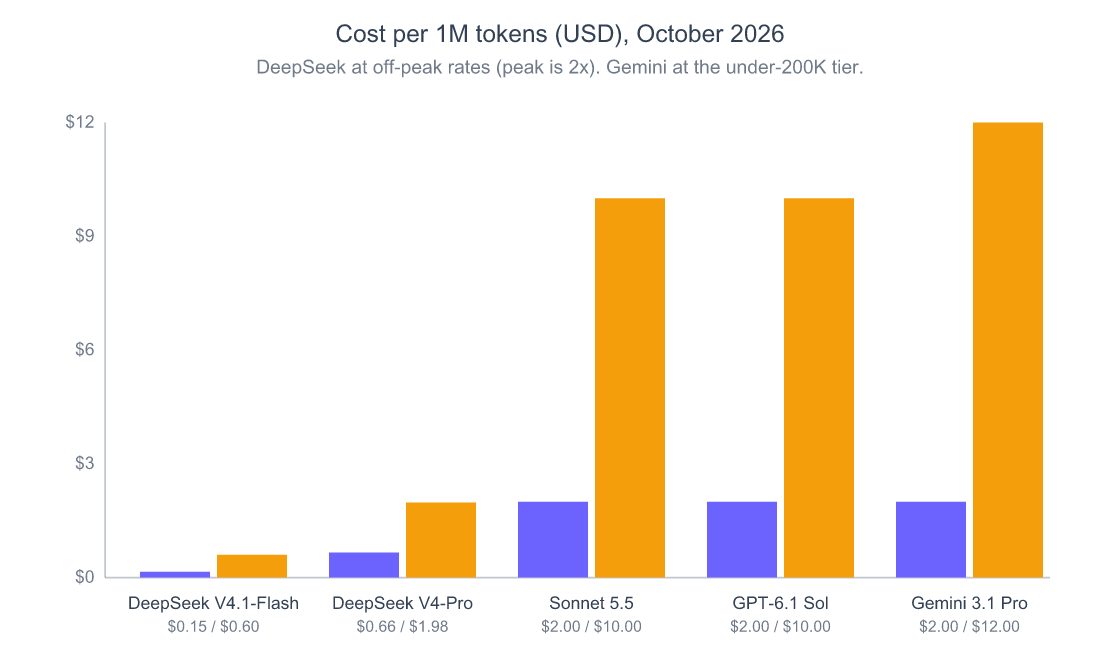
Sources: DeepSeek, Anthropic, OpenAI, and Google AI pricing pages (accessed October 2026)
Two caveats the headline numbers hide. First, DeepSeek now charges double during peak hours (01:00-04:00 and 06:00-10:00 UTC on weekdays), which overlaps the European morning. At peak, V4-Pro is $1.32 / $3.96, still cheaper than Sonnet 5.5 but no longer by an order of magnitude. Second, thinking mode costs you output tokens. Tokens spent reasoning are still tokens, so running every marketing-copy prompt through max reasoning is a fast way to set money on fire.
For context, the gap was narrower when I ran my test. DeepSeek V3.1 launched at $0.56 in and $1.68 out per million tokens in September 2025, before the V3.2 price cut (The Decoder, 2025). Sonnet 4.6 was $3 / $15. That’s roughly 5x cheaper on input and 9x on output, which is the ratio behind every cost figure from my test below.
The R1 distills are the wildcard. You can self-host a quantized R1-Distill-Llama-70B on your own GPU for fixed-cost workloads. That’s where DeepSeek’s family really competes on economics: once you’re at infrastructure scale, the unit math flips in your favor. Below that, the hosted API is simpler.
Where Did DeepSeek Actually Shine for Vibe Coding in My Test?
DeepSeek V3.1 shone hardest on bounded, single-file tasks. In my six weeks running it through Cursor and Aider, the consistent wins were boilerplate generation (CRUD endpoints, form validators, React component scaffolds), single-file refactors with clear acceptance criteria, SQL query authoring against a known schema, and well-scoped bug tickets where the failing test or stack trace points to a single file. On those, V3.1 produced output I couldn’t tell apart from Sonnet 4.6’s at a fraction of the cost.
My finding: Over 47 boilerplate-class tasks I tracked between March and April 2026, DeepSeek V3.1 produced compiling, test-passing output on the first attempt 78% of the time. Sonnet 4.6 on the same task type hit 85%. That 7-point gap was real, but the cost differential made V3.1 the obvious pick for the bucket.
The R1 reasoning model was more situational. It earned its keep on algorithmic problems (leetcode-style logic, query optimization, parsing tricky data formats) where the chain-of-thought trace genuinely helps. DeepSeek V3.1 in thinking mode scores 76.3 on Aider-Polyglot and 74.8 on LiveCodeBench, and R1-0528 scores 71.6 and 73.3 on the same two (Hugging Face, 2025). For a Codeforces-style problem dropped into your codebase, R1 or V3.1-thinking was genuinely good.

The other place DeepSeek wins is anything you’d describe to a junior engineer in a Jira ticket with a clear definition of done. “Add a rate limiter to the /api/upload endpoint with 10 requests per minute per user, return 429 on overflow, log to structured output.” That kind of task (single endpoint, named middleware, explicit acceptance criteria) V3.1 closed on the first try most of the time.
comparison of AI coding agents
Where Does DeepSeek Break Down?
The failures were real and they clustered in three modes. The first is multi-step agentic tool use. When DeepSeek V3.1 drove a Cline or Cursor agent that had to call read_file, then edit_file, then run_tests, then read the test output and decide what to do next, it lost the thread more often than Sonnet 4.6 or GPT-5. The pattern I saw repeatedly: V3.1 would correctly identify the bug, propose the right fix, then call the wrong tool argument or misread its own previous diff.
Benchmarks backed this up at the time. DeepSeek V3.1 in non-thinking agent mode scores 66.0% on SWE-bench Verified, the benchmark built to measure multi-step issue resolution on real repositories (Hugging Face, 2025). Claude Sonnet 4.6 scored 79.6%, averaged over 10 trials (Anthropic, 2026). That 13.6-point gap is exactly what I felt in practice.
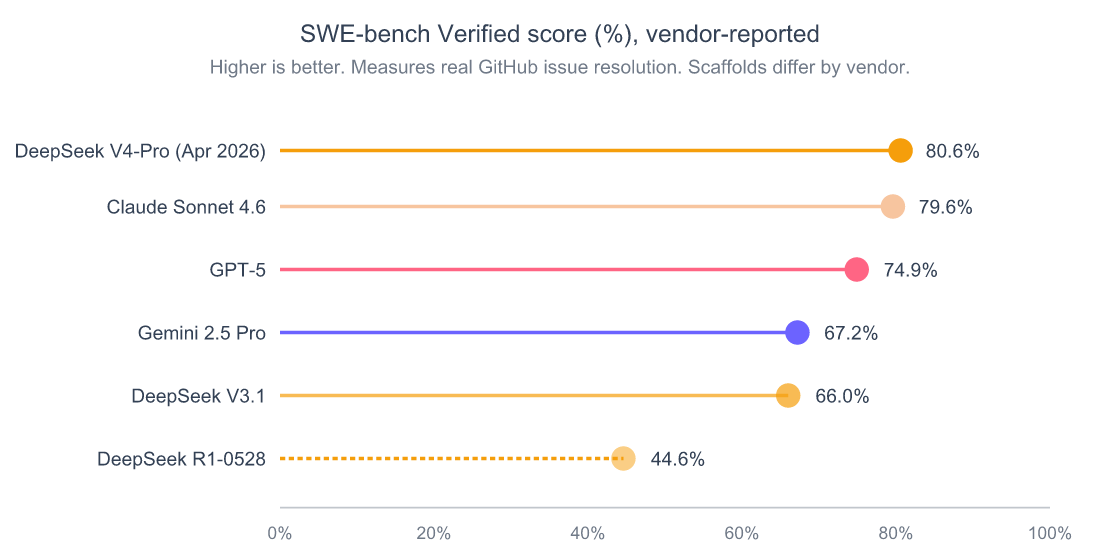
Sources: DeepSeek V4-Pro and V3.1 Hugging Face model cards (V4-Pro in max reasoning mode); Anthropic Sonnet 4.6 announcement; OpenAI GPT-5 for developers; Google Gemini 2.5 Pro (multi-attempt setting)
The second failure mode is long-context refactors. V3.1’s context window was generous on paper, but when I asked it to make a change consistent across 12+ files, it started forgetting earlier decisions: renaming a variable in one place but not another, adding an import in three files but missing the fourth. Sonnet 4.6 held the whole mental model with noticeably more reliability. This is also the failure mode that’s easiest to miss until tests fail in CI.
The third is ambiguous specs. If you write “make the auth flow better,” V3.1 will guess. Sometimes it guesses well. Often it ships changes you didn’t want. R1 partially helped because the reasoning trace gives you a chance to spot the wrong interpretation early, but it also burned more tokens to do it. Sonnet 4.6 and GPT-5 were more likely to push back or ask clarifying questions when the spec was loose. That asymmetry shows up in your retry rate, and your retry rate is where the cost win evaporates.
How Does DeepSeek Score on the Benchmarks That Matter for Coding?
The V3.1-era benchmarks told a consistent story: competitive on isolated coding skill, weaker on multi-step agentic resolution. V3.1 in thinking mode scored 74.8 on LiveCodeBench and 76.3 on Aider-Polyglot, while its SWE-bench Verified score of 66.0 trailed the frontier by double digits (Hugging Face, 2025). Pure code generation was close. End-to-end issue resolution wasn’t.
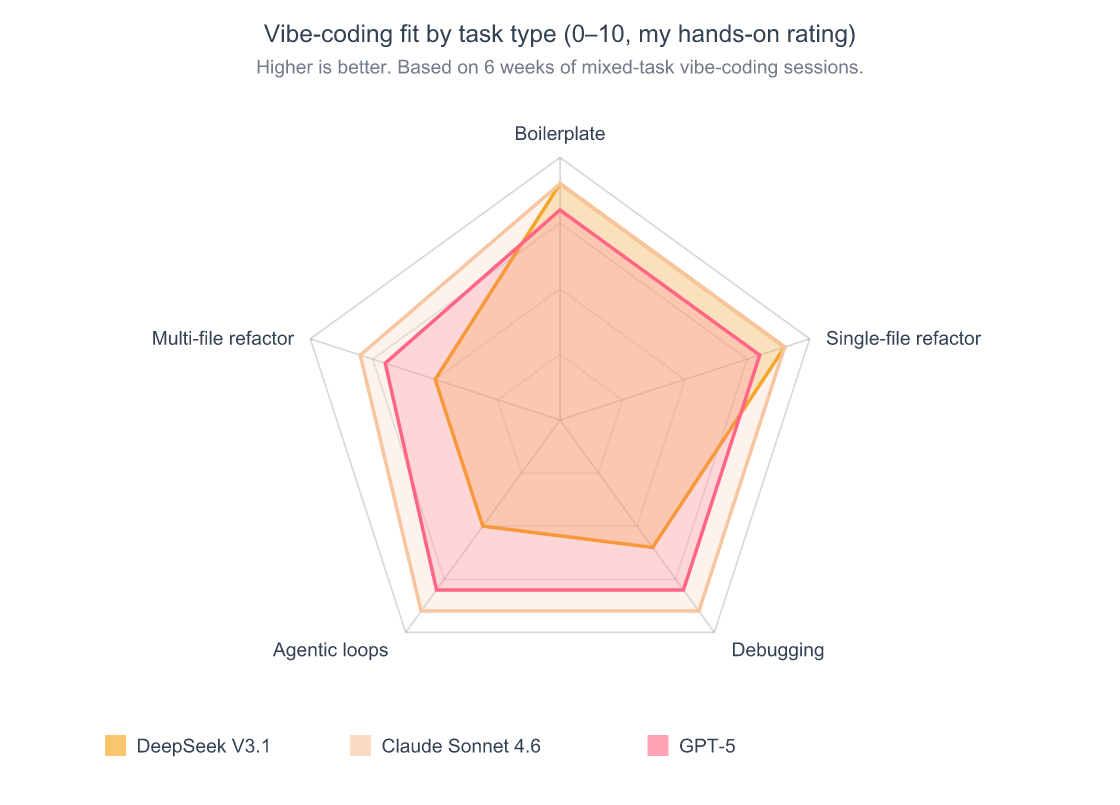
My hands-on ratings, March–April 2026, across ~120 mixed coding sessions
The agentic gap is the one that matters most for vibe coding. SWE-bench Verified asks the model to resolve real GitHub issues end-to-end, and every point you lose there is work you redo yourself. At enough volume, that’s where the cost story gets complicated.
What Changed With DeepSeek V4-Pro and V4.1-Flash?
DeepSeek released V4-Pro in late April 2026, right as my test wrapped up, as a 1.6-trillion-parameter mixture-of-experts model with 49 billion active parameters, an MIT license, and a 1M-token context window (Hugging Face, 2026). DeepSeek reports 80.6% on SWE-bench Verified, 93.5 on LiveCodeBench, and 67.9 on Terminal-Bench 2.0, all in its maximum reasoning mode. The API now serves the refreshed V4-Pro-0813 checkpoint, plus V4.1-Flash as the cheap tier.
On paper, that erases the 13.6-point gap that defined my V3.1 experience. I’d treat it carefully, for three reasons:
- Max reasoning is the expensive mode. The 80.6% comes from the setting that generates the most output tokens. Your real per-task cost will sit well above the $1.98 output list price suggests.
- Vendor scaffolds aren’t your scaffold. Every number in the lollipop chart comes from the vendor’s own harness. Cursor, Cline, and Aider wrap the model in different tool schemas, and that’s exactly where V3.1 stumbled.
- I haven’t rerun the six-week test on V4. Everything I measured was on V3.1 and R1. Until someone publishes retry rates for V4-Pro inside real editor agents, treat its agentic reliability as a claim to verify, not a result.
The cost math has also shifted on the frontier side. Sonnet 5.5 is $2 / $10, a third cheaper than Sonnet 4.6 was (Anthropic, 2026). So DeepSeek’s discount against Claude shrank at the same moment its benchmark gap closed. Flash is still roughly 13-17x cheaper than Sonnet 5.5 per token. V4-Pro is about 3-5x cheaper off-peak, and less than that at peak.
A useful sanity check comes from Vantage’s April 2026 analysis: a 50-turn agentic session of about 1M input tokens and 40K output tokens costs $6.00 on Claude Opus 4.6 and $0.60 on Cursor’s Composer 2 Standard (Vantage, 2026). At October 2026 list prices, the same token volume works out to about $0.74 on V4-Pro off-peak and $0.17 on V4.1-Flash, before any cache discount. Input dominates agentic cost, which is why DeepSeek’s cache-hit pricing ($0.022 per million on V4-Pro) matters more than the headline output rate.
How Do I Wire DeepSeek Into Cursor, Cline, Aider, Continue.dev, and OpenRouter?
Setup is straightforward. The friction is in the routing strategy you choose, not the API plumbing. One change since my test: use the current model IDs, deepseek-v4-pro or deepseek-flash, wherever older guides tell you to type deepseek-chat or deepseek-reasoner.
Cursor supports custom OpenAI-compatible endpoints. In Settings → Models, add a custom model, override the OpenAI base URL with https://api.deepseek.com, paste your DeepSeek API key, and enter deepseek-v4-pro or deepseek-flash as the model name. Cursor will use it for chat and inline edits. In my test, Agent mode was hit-or-miss with V3.1 because the multi-step tool-use weaknesses surfaced fast, so I kept the agent on Sonnet even when I routed everything else to DeepSeek.
Cline (the VS Code agentic extension, formerly Claude Dev) accepts DeepSeek via OpenRouter or the direct API. Open Cline settings, choose “OpenRouter” or “OpenAI Compatible,” and paste the endpoint and key. Cline plus V3.1 worked for single-file work but fell over on multi-file refactors. Cline plus R1 was unusable for tool-driven flows because the reasoning traces ate the context budget the agent needed for tool outputs.
Aider is the cleanest fit for DeepSeek. Install via pip install aider-chat, set OPENAI_API_BASE=https://api.deepseek.com and OPENAI_API_KEY to your DeepSeek key, then run aider --model openai/deepseek-v4-pro. Aider’s diff-based editing plays to DeepSeek’s strength: single-file, well-scoped changes with explicit acceptance criteria. For repository-wide tasks, Aider’s --map-tokens flag controls how much repo-map context the model gets, which matters because effective long-context performance dropped faster than the marketed window suggested in my V3.1 runs.

Continue.dev supports DeepSeek natively in its config.yaml. Add a models block with provider: deepseek, the model name, and your API key. Continue’s tab autocomplete is where DeepSeek shines hardest. Single-line predictions are bread-and-butter work, and on Flash the cost per completion rounds to zero.
OpenRouter is where I’d actually start. One API key routes to DeepSeek, hosted distills, Claude, GPT, and Gemini under a single OpenAI-compatible endpoint. The feature that matters is provider preference: you can pin a DeepSeek model to a specific host for lower latency, or fall back to another provider when the official endpoint is congested. Programming went from about 11% of OpenRouter’s token volume in early 2025 to over 50% by late 2025 (OpenRouter, 2025), so the routing tooling is mature. If you live in Claude Code, Claude Code Router can send background tasks to DeepSeek while the main agent stays on Claude.
What Did a Real Vibe-Coded Feature Cost Across DeepSeek, Claude, and GPT-5?
Here’s a feature I built three times during the test: a Stripe webhook handler with signature verification, retry logic, idempotency keys, and structured logging. Roughly 240 lines of TypeScript including tests. I ran the same prompt through Cursor against three models and logged token counts. Costs below are those token counts multiplied by each model’s list price at the time (V3.1 at $0.56 / $1.68, GPT-5 at $1.25 / $10, Sonnet 4.6 at $3 / $15).
| Model (tested Mar-Apr 2026) | Input tokens | Output tokens | Cost at list price | Tries to passing tests |
|---|---|---|---|---|
| DeepSeek V3.1 | 84,200 | 21,400 | $0.083 | 3 |
| GPT-5 | 71,800 | 18,900 | $0.279 | 2 |
| Claude Sonnet 4.6 | 68,500 | 17,200 | $0.464 | 1 |
Sonnet 4.6 closed the feature on the first try. GPT-5 needed one round-trip to fix a regex. V3.1 needed three iterations: one for a missing edge case in idempotency, one for a wrong type signature on the logger, one for a flaky test timing assertion. The cost ratio still favored DeepSeek (V3.1 cost under a fifth of Sonnet 4.6 even with three tries), but you can see how the math flips on harder tasks.
On a different feature (a multi-file refactor across an auth module, six files, partial tests), I gave up on V3.1 after five failed attempts. Sonnet 4.6 closed it in one go for $0.68. That’s the inversion I kept seeing: DeepSeek won decisively on simple tasks and tied or lost on hard ones once you counted retries plus my own time reading broken diffs.
What would this table look like today? At October 2026 list prices, the same token counts cost about $0.10 on V4-Pro off-peak (before cache hits) and $0.31 on Sonnet 5.5. The ratio is tighter, and the retry column is the one I’d want to re-measure before drawing conclusions. For a broader cross-vendor view, see my current ranking of the best LLMs for coding.
When Should I Pick DeepSeek vs a Frontier Model?
A simple decision framework, based on the six weeks of data and adjusted for the current lineup:
Pick DeepSeek V4.1-Flash when:
- The work is autocomplete-class: tab completion, single-line predictions
- You’re doing high-volume repetitive work (CRUD endpoints, schema migrations, test scaffolds)
- You’re cost-constrained and the worst case is one retry
Pick DeepSeek V4-Pro when:
- The task fits in 1-2 files
- The acceptance criteria are explicit (failing test, defined function signature, structured ticket)
- The problem is algorithmic and benefits from thinking mode, and you want the reasoning trace as a review artifact
- You can run batch work off-peak
Pick a frontier model (Sonnet 5.5, Opus 5.5, or GPT-6.1 Sol) when:
- The change spans 4+ files
- The spec is ambiguous or requires pushback
- You’re driving a multi-step agent (Cursor Agent, Cline, Claude Code)
- The cost of a wrong answer is high (production code, security-sensitive paths, customer data)
- You need first-try reliability more than token economy
The 84% AI tool adoption number from the 2025 Stack Overflow survey hides this nuance (Stack Overflow, 2025). Adoption doesn’t mean uniform use. The developers I see succeeding with DeepSeek treat it as a specialist, not a general-purpose coder.
The Hybrid Pattern That Actually Works
The setup I landed on after burning enough money to learn it: a tiered router via OpenRouter that sent autocomplete and bounded edits to DeepSeek V3.1, single-file refactors to V3.1 in thinking mode, algorithmic problems to R1, and anything multi-file or agent-driven to Sonnet 4.6. Today the same tiers map to Flash, V4-Pro, and Sonnet 5.5. The architecture decisions, the production debugging, and the “this feels off” conversations all stay on frontier models.
The pattern: DeepSeek for the grunt work. Frontier models for the judgment work. The line between them is “does this task require holding state across files.” If yes, frontier. If no, DeepSeek.
The economic result in my own setup: April 2026 spend on Cursor + OpenRouter dropped 62% versus February (when I was running everything on Sonnet 4.6), with no measurable drop in shipped feature throughput. The savings were real, but only because I stopped trying to make DeepSeek do work it didn’t do well.
Frequently Asked Questions
Is DeepSeek good for vibe coding?
DeepSeek is good for bounded vibe coding tasks: single-file changes, CRUD boilerplate, well-scoped tickets, autocomplete. In my March-April 2026 test, V3.1’s 66.0% on SWE-bench Verified versus 79.6% for Claude Sonnet 4.6 showed up as weaker multi-step agent runs. V4-Pro now reports 80.6% (Hugging Face, 2026), so test it on your own agent workflow before routing everything to it.
How much cheaper is DeepSeek than Claude or GPT?
As of October 2026, V4.1-Flash costs $0.15 input and $0.60 output per million tokens off-peak, and V4-Pro costs $0.66 and $1.98 (DeepSeek, 2026). Claude Sonnet 5.5 and GPT-6.1 Sol are both $2 / $10. Flash is over 90% cheaper per token, V4-Pro roughly 67-80% cheaper. Peak-hour pricing doubles DeepSeek’s rates, and retries on hard tasks erase the gap.
Which DeepSeek model is best for coding in 2026?
V4-Pro is DeepSeek’s strongest coding model, with thinking mode for algorithmic problems. V4.1-Flash is the better pick for autocomplete and high-volume boilerplate where per-token cost dominates. The old deepseek-chat and deepseek-reasoner IDs no longer appear on DeepSeek’s pricing page, so update older configs.
Can I use DeepSeek with Cursor?
Yes. In Cursor’s Settings → Models, add a custom model, override the OpenAI base URL with https://api.deepseek.com, add your DeepSeek API key, and use deepseek-v4-pro or deepseek-flash as the model name. Cursor will use DeepSeek for chat and inline edits. I’d keep the agent on a frontier model until you’ve confirmed DeepSeek’s tool use holds up on your repo.
Is DeepSeek safe for production code?
DeepSeek output carries the same security risks as any other model’s. Veracode’s 2025 GenAI Code Security Report found that 45% of AI-generated code samples failed security tests and introduced OWASP Top 10 vulnerabilities (Veracode, 2025). Run static analysis, integration tests, and the same review process you’d apply to any AI output regardless of vendor.
Conclusion
DeepSeek isn’t a frontier-model replacement for vibe coding, at least not in my testing. It’s a specialist that pays off on the right slice of work (bounded, single-file, explicit-criteria tasks) and quietly drains your budget on the rest. In my test the price gap against Sonnet 4.6 was 5-9x per token and the SWE-bench Verified gap was 13.6 points. V4 claims to have closed the benchmark gap, while Sonnet 5.5 narrowed the price gap from the other side.
The straight framing: DeepSeek lets you do more vibe coding for the same dollar, not the same vibe coding for less money. Run it where it earns its keep, route everything multi-file or judgment-heavy to a frontier model, and you’ll see your spend drop without your output dropping with it. Anything else is chasing a discount into a retry loop.
the eight-criteria production checklist before shipping any vibe-coded work