Why Vibe Coding Will Replace Traditional Programming
Traditional programming as we know it is dying. Not slowly. Not quietly. Right now.
As of 2026, 41% of all code worldwide is AI-generated (GitHub Octoverse, 2026). That number was under 5% three years ago. We’re watching the fastest shift in software development history unfold in real time, and most developers are still debating whether it’s “real programming.”
I’ve shipped three products in the Replace with a specific date (e.g., “in March 2026”) using vibe coding as my primary workflow. Two of them would have taken 3-4 months with traditional development. Both shipped in under six weeks. The code isn’t perfect. But it works, it’s in production, and users don’t care how it was written.
This piece will show you why the “real programmers write code” mindset is already obsolete, what the data actually says, and how to adopt a hybrid approach that makes you faster without sacrificing quality.
Understanding AI-native development patterns
TL;DR: Vibe coding — describing what you want in natural language and letting AI generate the code — now accounts for 41% of all code written globally (GitHub Octoverse, 2026). Developers who adopt it complete tasks 55% faster. The question isn’t whether to adopt it. It’s how quickly.
What Is the “Real Programmers Write Code” Argument?
The mainstream position is clear: writing code manually is a core developer skill, and outsourcing it to AI produces brittle, insecure, unmaintainable software. According to Stack Overflow’s 2026 Developer Survey, only 33% of developers trust AI code accuracy, and 46% actively distrust it (Stack Overflow, 2026). The skepticism has deep roots.
The argument goes something like this. Programming is about thinking, not typing. Understanding data structures, algorithms, and system architecture is what separates a developer from someone copying code off the internet. AI-generated code is just a fancier version of copy-paste from Stack Overflow — except now you can’t even read the answers before using them.
There’s historical weight behind this view. For decades, the best software engineers were distinguished by their ability to write precise, efficient code from scratch. Computer science education emphasizes this. Coding interviews test this. The entire culture of software development rewards people who can solve problems at the keyboard.
And it’s not just old-guard developers saying this. A CodeRabbit analysis of 470 GitHub pull requests found AI-co-authored code contained 1.7x more major issues than human-written code, including 2.74x more security vulnerabilities (CodeRabbit, 2026). That’s a real concern. Not a hypothetical one.
How these concerns shape the job market
Why Is the Anti-Vibe-Coding Position Wrong?
The core problem with the “real programmers write code” argument is that it confuses the method with the outcome. Software development has always been about solving problems — not about which keys you press to get there. Here are three reasons the traditionalist position doesn’t hold up.
The Productivity Gap Is Too Large to Ignore
GitHub’s study of 4,800 developers found that Copilot users complete tasks 55% faster than those coding manually (GitHub Research, 2026). That’s not a marginal improvement. DX’s analysis across 135,000+ developers reports an average of 3.6 hours saved per week per developer when using AI coding tools (DX, 2026). Daily AI users merge approximately 60% more pull requests than non-users.
Can you afford to be 55% slower than your competitors? In a market where speed determines survival, choosing to write every line by hand is a competitive disadvantage, not a badge of honor.
The Quality Argument Is Misleading
Yes, AI-generated code has more issues per pull request. But here’s what the critics miss: developers don’t ship raw AI output. They review it, refine it, and test it. The METR study — a randomized controlled trial published in Science — found that AI tools gave developers an average 19% slowdown on complex open-source tasks when they used AI passively (METR, 2026). But developers who actively guided the AI and reviewed output showed meaningful gains on scoped tasks.
The distinction isn’t between “AI code” and “human code.” It’s between passive AI use and active AI collaboration. Vibe coding done well means you’re the architect and the AI is the builder. You don’t accept everything it produces. You direct it.
The Market Has Already Decided
GitHub Copilot hit 20 million users by mid-2026 and is deployed at 90% of Fortune 100 companies (GitHub, 2026). Cursor crossed $2 billion in annual recurring revenue by February 2026 with over 1 million daily active users (Pragmatic Engineer, 2026). Claude Code went from zero to the most-used AI coding tool in eight months.
When 84% of developers use or plan to use AI tools (Stack Overflow, 2026), arguing against adoption isn’t a principled stand. It’s career risk.
Citation Capsule: GitHub Copilot reached 20 million users by mid-2026 and is deployed at 90% of Fortune 100 companies. Developers using AI coding tools complete tasks 55% faster and save an average of 3.6 hours per week (GitHub Research, 2026; DX, 2026).
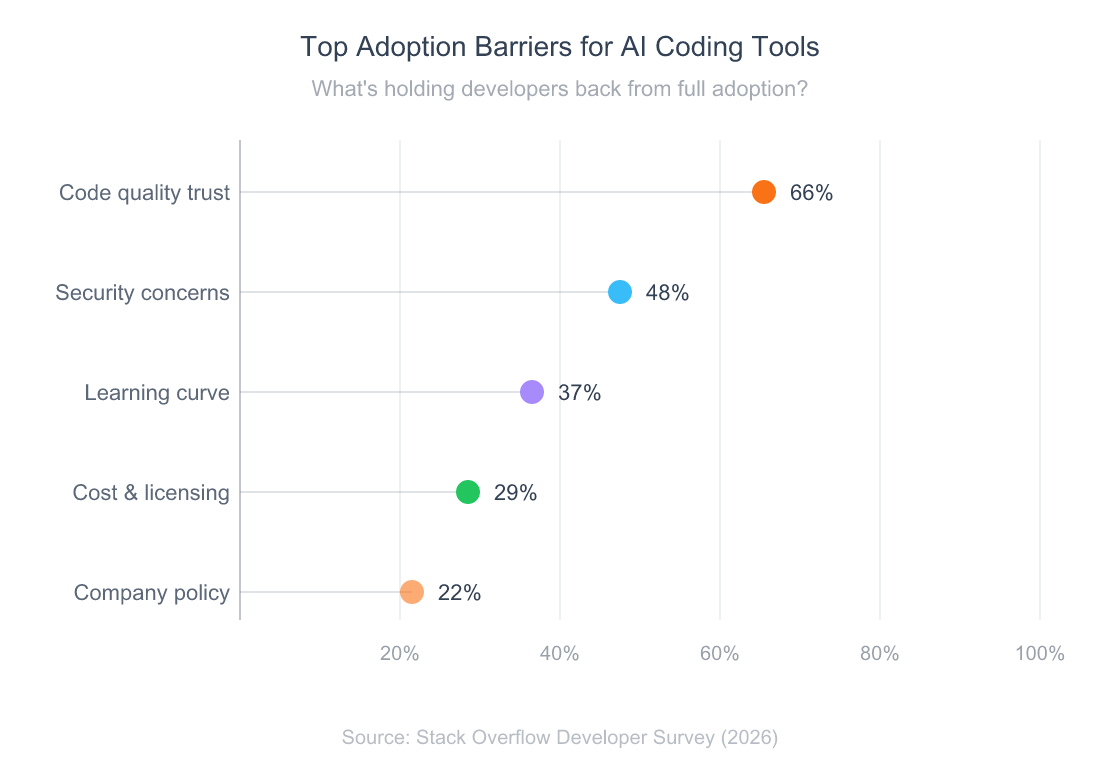
Code quality trust remains the top concern, but 84% of developers use AI tools despite these worries.
What Does the Data Actually Show About Vibe Coding?
The data tells a story that surprises both camps. Vibe coding isn’t a silver bullet, but it’s clearly the direction software development is heading. AI-generated code now accounts for 41% of all code globally, up from under 5% in 2026 (GitHub Octoverse, 2026). At Anthropic, the company behind Claude, that figure sits between 70% and 90% company-wide (Fortune, 2026).
But here’s where it gets interesting. The productivity gains aren’t uniform. Controlled experiments show 30-55% speed improvements for scoped tasks like writing functions, generating tests, or producing boilerplate. For complex architectural decisions and novel problem-solving, the gains shrink or disappear entirely.

Here’s what I’ve found after a year of vibe coding: it doesn’t replace thinking. It replaces typing. When I describe a feature in natural language, the AI handles the implementation details I’d otherwise spend hours on — boilerplate, standard patterns, API integrations, test scaffolding. What I still do myself: architecture decisions, edge case analysis, security reviews, and performance optimization. That split is roughly 80/20 — 80% AI-generated, 20% hand-written. And the 20% I write by hand is the 20% that actually matters.
Among Y Combinator’s Winter 2026 cohort, 21% of companies reported codebases that are 91% or more AI-generated (Y Combinator, 2026). These aren’t toy projects. They’re funded startups building real products for real users. The vibe coding market itself has grown to $4.7 billion globally and is projected to reach $12.3 billion by 2027 (Gartner, 2026).
What framework should replace the old one? Think of vibe coding as a spectrum, not a binary. On one end, you have fully manual coding. On the other, you have fully autonomous AI generation. The sweet spot for most professional work sits at about 80% AI-assisted, 20% human-directed — what I call the “architect-builder” model.
How AI-native applications are built differently
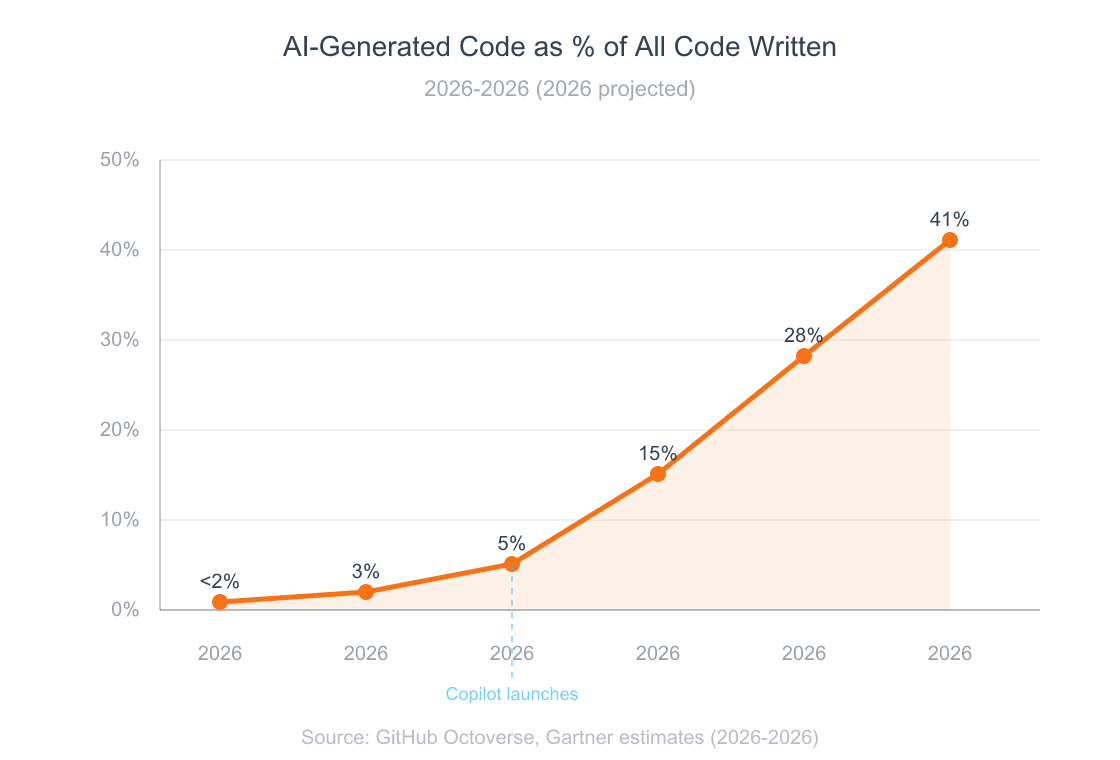
AI code generation has grown from under 2% in 2026 to 41% in 2026, with the inflection point occurring after GitHub Copilot’s 2026 launch.
Citation Capsule: AI now generates 41% of all code worldwide, up from under 5% in 2026. At AI-first companies like Anthropic, that figure reaches 70-90%. Among Y Combinator’s Winter 2026 cohort, 21% of startups report codebases that are 91%+ AI-generated (GitHub Octoverse, 2026; Fortune, 2026).
What’s the Better Approach to Vibe Coding?
The hybrid “architect-builder” model — roughly 80% vibe coding, 20% traditional programming — produces the best outcomes for most development work. This isn’t about abandoning programming skills. It’s about redirecting them toward the parts of development where human judgment can’t be replaced.
Here are the core principles:
- You design, AI implements. Describe the architecture, data models, and user flows in natural language. Let AI handle the translation to code. Review everything it produces.
- Prompt quality determines code quality. Vague prompts produce vague code. Specific, well-structured prompts with clear constraints produce production-ready output. Treat prompt engineering as a core skill.
- Keep the review loop tight. Don’t generate 500 lines and then review. Generate in small chunks — a function, a component, a test suite. Review each one before moving on.
- Know when to take the wheel. Performance-critical paths, security-sensitive operations, and novel algorithmic problems still benefit from hand-written code. Recognize these moments.
- Use multiple tools. 70% of developers now use between two and four AI coding tools simultaneously (Pragmatic Engineer, 2026). Each tool has strengths. Claude Code excels at complex reasoning. Copilot integrates deeply with your editor. Cursor offers an AI-first IDE experience.
After switching to the architect-builder model, my shipping velocity tripled. But more importantly, the quality of my architectural decisions improved because I spent less time on implementation details and more time on system design. I stopped being a typist and started being a product thinker.
Writing articles and content with AI follows similar patterns
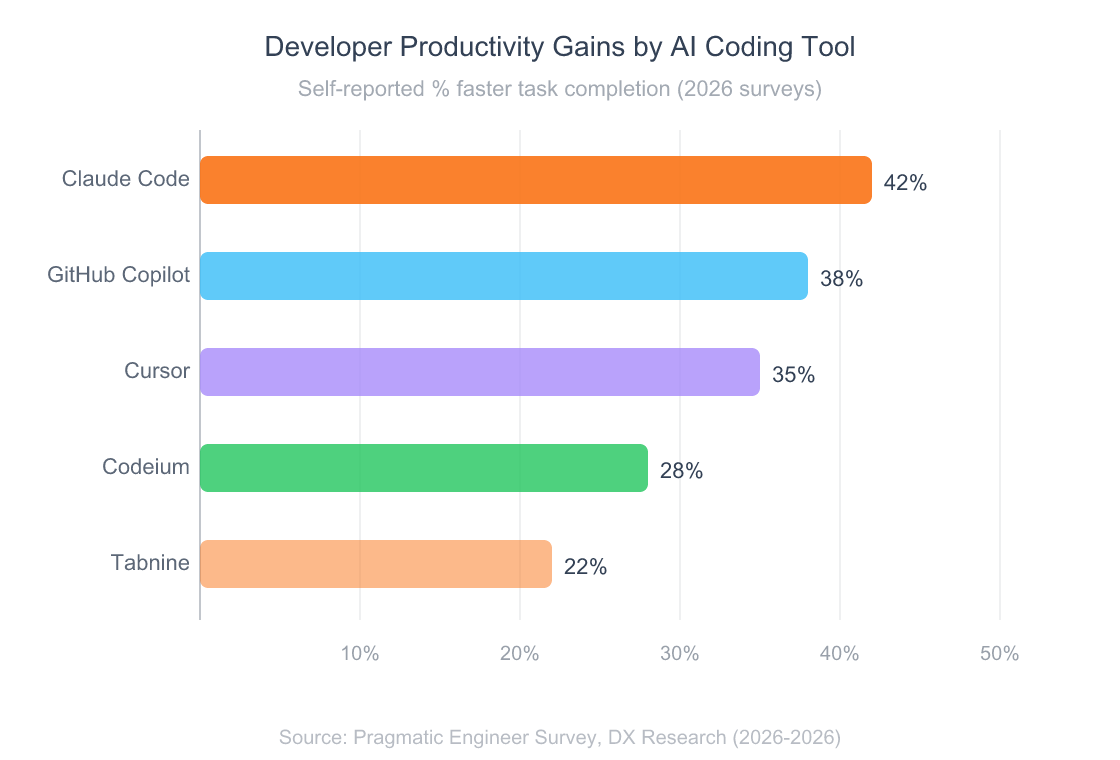
Productivity gains vary by tool, with agentic tools like Claude Code showing the largest improvements in task completion speed.
How Do You Start Vibe Coding Today?
Start with one project — not your most complex production system, but something real enough to matter. Here’s a week-by-week plan that works whether you’re a solo developer or part of a team.
Week 1: Pick your tools (2-3 hours). Install GitHub Copilot or Cursor alongside your existing editor. Sign up for Claude Code or a similar agentic tool. Don’t change your workflow yet. Just observe what the AI suggests as you code normally.
Week 2: Start with tests and boilerplate (5 hours). Use AI to generate test files, configuration boilerplate, and repetitive patterns. These are low-risk, high-volume tasks where AI excels and errors are easy to catch. Measure how much time you save versus your usual approach.
Week 3: Graduate to feature development (ongoing). Describe a feature in natural language — user story, acceptance criteria, edge cases. Let the AI generate the implementation. Review every line. Fix what’s wrong. Note which types of prompts produce the best results.
Week 4: Establish your review cadence (ongoing). Build a habit of generating code in small units, reviewing immediately, and iterating. Track your prompt patterns. What descriptions produce clean code? What descriptions produce garbage? This feedback loop is your new core skill.
You’ll know it’s working when you stop thinking about syntax and start thinking about systems. When your mental energy shifts from “how do I implement this?” to “what should I build next?” — that’s the transition.
AI tools can also accelerate your marketing workflows
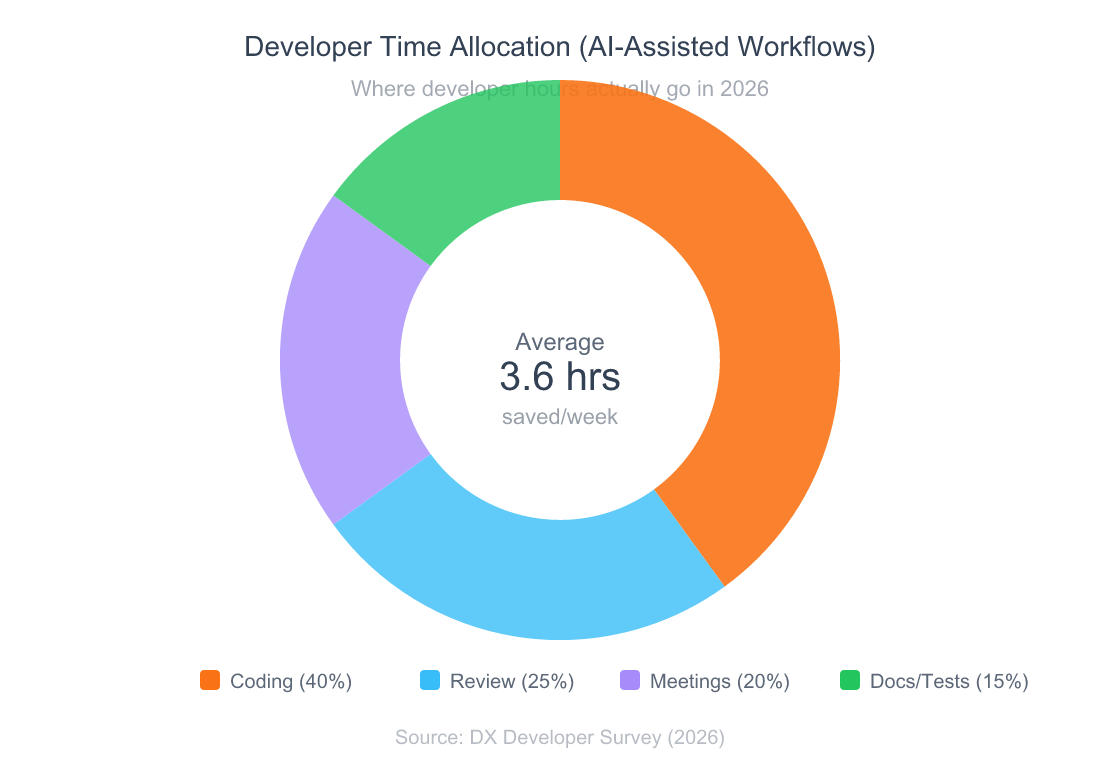
AI-assisted developers save an average of 3.6 hours per week, shifting time from raw implementation to higher-value review and design work.
When Should You Still Write Code by Hand?
Vibe coding isn’t the right tool for every job. This approach has real limits, and pretending otherwise would undermine everything I’ve argued. Here’s where the traditionalist view still applies.
Systems programming and performance-critical code. Writing an operating system kernel, a database engine, or latency-sensitive financial trading software requires the kind of precise control that AI can’t reliably deliver yet. These domains demand understanding at the instruction level, not the prompt level.
Novel algorithms and research. If you’re implementing something that doesn’t exist in the training data, AI can’t help you much. Original algorithmic work is still fundamentally human. Gartner projects that 75% of enterprise engineers will use AI assistants by 2028 (Gartner, 2026) — but that remaining 25% isn’t random. It’s the edge cases where human expertise is non-negotiable.
Security-sensitive operations. Cryptographic implementations, authentication flows, and authorization logic deserve hand-written, thoroughly audited code. The 2.74x increase in security vulnerabilities from AI-generated code makes this non-negotiable.
The hybrid model accounts for this. Use vibe coding for the 80% of development work where it excels. Write the critical 20% by hand. Knowing which is which — that’s the real skill.
Frequently Asked Questions
But doesn’t AI-generated code have more bugs than human-written code?
Yes, raw AI output shows roughly 1.7x more issues per pull request (CodeRabbit, 2026). But vibe coding doesn’t mean shipping raw output. It means generating code and reviewing it critically. Developers who review AI output catch most issues before they reach production. The net result is comparable quality at significantly higher speed — GitHub reports 55% faster task completion for Copilot users (GitHub Research, 2026).
What if my company restricts AI coding tool usage?
Start with what’s allowed and build a case with data. 90% of Fortune 100 companies already use GitHub Copilot (GitHub, 2026). Propose a 30-day pilot on a non-critical project, measure productivity gains, and present the results. Most enterprise restrictions are policies that haven’t caught up with adoption — Gartner projects 75% of enterprise engineers will use these tools by 2028 (Gartner, 2026).
Understanding the broader AI adoption landscape
How does vibe coding affect junior developers learning to program?
This is the most valid concern. Junior developers need to understand what the code does, not just what prompt generated it. The 2026 Stack Overflow survey found that 36% of developers learned AI tools for career advancement (Stack Overflow, 2026). The solution is learning fundamentals first, then using AI as an accelerator — similar to how calculators didn’t replace understanding math, but transformed how we apply it.
Won’t AI eventually replace developers entirely?
Not in any foreseeable timeframe. Anthropic’s CEO predicted 90% AI-written code within months, and we’re at 41% as of 2026. The growth is real but the ceiling keeps moving. Complex systems require human judgment for architecture, user experience, security, and novel problem-solving. The role shifts from “person who writes code” to “person who directs systems.” That’s not replacement. That’s evolution.
Is vibe coding just hype that will fade like previous trends?
The scale says otherwise. Cursor alone hit $2 billion in annual revenue by February 2026 (Pragmatic Engineer, 2026). GitHub Copilot serves 20 million users. Collins Dictionary named “vibe coding” its Word of the Year for 2026. When a practice generates billions in revenue and reaches majority developer adoption within three years, it’s infrastructure — not hype.
More on how AI is reshaping developer careers
The Industry Needs to Stop Gatekeeping Programming
Vibe coding is replacing traditional programming — not because developers are getting lazier, but because the definition of “developer” is expanding. The tools have gotten good enough that the bottleneck is no longer typing code. It’s thinking about what to build and why.
The industry needs to stop gatekeeping who counts as a “real programmer.” If someone describes a feature in natural language, reviews the generated code, tests it, ships it, and users love it — they’re a developer. Full stop. The 84% of developers already using AI tools (Stack Overflow, 2026) aren’t cheating. They’re adapting.
Five years from now, we’ll look back at fully manual coding the way we look at writing assembly language today — impressive, occasionally necessary, but not how most software gets built. The developers who thrive won’t be the ones who resisted the shift. They’ll be the ones who learned to direct AI effectively while maintaining the judgment that no model can replace.
Don’t wait for permission. Start vibe coding on your next project. Your competitors already are.
See how AI is creating entirely new categories of applications
I Built a Multi-Agent Code Review Skill for Claude Code — Here’s How It Works
The Complete Claude Code Workflow: How I Ship 10x Faster
How Do You Secure an API? The 4-Layer Framework That Actually Works