What Is a Moat? The Complete Guide to Competitive Moats in 2026
Every founder eventually asks the same question. “What stops a bigger, better-funded company from showing up next year and eating my lunch?” The answer (if you have one) is a moat.
Warren Buffett popularized the term in the 1990s, but the idea is older than business itself. A moat is a structural advantage that protects your profits from competition the way a castle’s water-filled trench protected its occupants from invaders. The key word is structural. A clever feature, a great team, a head start, those aren’t moats. They’re advantages that erode. A moat is the thing competitors can’t easily replicate, no matter how much capital they raise or how fast they ship.
Here’s what’s striking about 2026: only about 25% of the stocks Morningstar covers earn its “wide moat” rating, companies analysts believe can fend off competitors for at least 20 years (Morningstar, 2026). The other 75% are running on borrowed time. This guide breaks down what a moat actually is, the five types that exist, how to spot one, and why moats matter more, not less, in the AI era.
Why most AI SaaS startups have no real moat
Key Takeaways
- A moat is a structural competitive advantage that protects long-term profits, not a temporary feature lead or fundraising milestone.
- Only ~25% of Morningstar-covered stocks qualify as “wide moat” companies under its 20-year defensibility test (Morningstar, 2026).
- The five durable moat types are network effects, switching costs, cost advantages, intangible assets, and efficient scale.
- 42% of failed startups die because they had no real market need, meaning no defensible position to begin with (CB Insights, 2026).
- In SaaS, the median net dollar retention sits at 108%: a direct, measurable signal that switching costs are doing their job (Blossom Street Ventures, 2025).
What Is a Moat in Business?
A moat is a sustainable competitive advantage that lets a company earn returns above its cost of capital for an extended period (typically 10 to 20+ years) without being eroded by rivals. Buffett laid out the test plainly: “The most important thing to me is figuring out how big a moat there is around the business. What I love, of course, is a big castle and a big moat with piranhas and crocodiles” (Berkshire Hathaway annual meeting transcripts, 2000).
The metaphor matters because it forces precision. A castle without a moat looks impressive but falls in a single siege. A moat without a castle is just a hole in the ground. You need both, a profitable business plus a durable barrier that makes attacking it economically irrational. Most founders confuse “we’re growing fast” with “we have a moat.” Growth is the castle. The moat is something else entirely.
https://www.youtube.com/watch?v=eza5JajYjRI
The academic framing comes from Michael Porter’s 1985 work on competitive advantage, but it was Buffett and his protégé Charlie Munger who turned “moat” into the operating language of investors. Today, when an analyst at Morningstar, Goldman Sachs, or a venture firm asks “what’s the moat?”, they’re asking one specific question. Why will this company still earn outsize profits in ten years when better-resourced competitors will obviously try to take them?
If you can’t answer that question with a structural reason, not “we’re better” or “we’re first” but a reason rooted in how the business is built, you don’t have a moat. You have momentum. And momentum is rented, not owned.
Citation Capsule: Warren Buffett defined a moat as “the most important thing” he looks for in a business, a durable structural advantage that keeps competitors at bay for decades (Berkshire Hathaway letters, 2000). Morningstar formalized this into a quantitative test: a “wide moat” company must be able to fend off competitors for at least 20 years, a bar only ~25% of the stocks it covers meet (Morningstar, 2026).
Why Do Moats Matter More in 2026?
A McKinsey survey of senior executives in late 2026 found that one in three expect their company’s primary source of competitive advantage to change within five years: driven by AI, shifting customer expectations, and new entrants (McKinsey Global Survey, 2026). Translation: the half-life of advantages is collapsing. Moats that took decades to build are being tested in months.
Three forces are squeezing moats simultaneously. First, foundation models have collapsed the cost of building software, meaning a competitor can ship a credible alternative in weeks rather than years. Second, distribution is fragmenting, the old playbook of paying Google or Meta for traffic is breaking as AI search redirects intent. Third, customers expect more before they commit. Free trials, no-code switches, and APIs that abstract away vendor lock-in have lowered switching costs across most software categories.

I’ve watched this play out in my own work. A SaaS product I followed in 2026 had what looked like a “moat”: a deep integration with Slack, a polished UI, and a year-long head start. By 2026, three competitors had matched the features. By 2026, two of them had AI-generated equivalents that worked across Slack, Teams, and Discord. The “moat” was a feature checklist. Real moats don’t get checklist-cloned.
Andreessen Horowitz, whose partners have argued that AI applications can build moats through verticalized data and workflow integration, has also cautioned that so-called “data moats” are often overstated and slower to form than founders assume (a16z, The Empty Promise of Data Moats). When the smartest money in the room hedges, founders should listen.
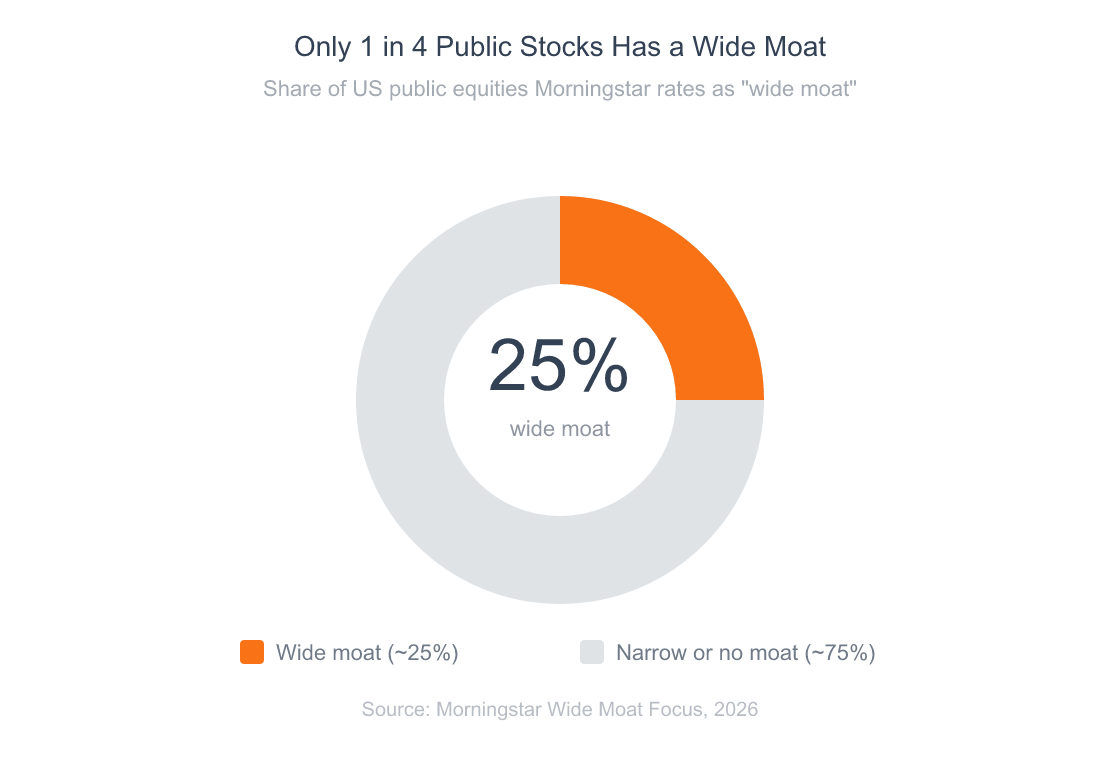
Three out of four public companies cannot meet the 20-year defensibility bar, yet most founders assume their startup is on the right side of that line.
If only one in four established public companies has a wide moat after years of refinement, what does that tell you about a two-year-old startup? Most don’t have one. They have product-market fit, which is necessary but not sufficient. The question is whether you’re building a moat in parallel with growth, or assuming growth itself is the moat.
Citation Capsule: McKinsey’s 2026 strategy survey found that 33% of senior executives expect their primary competitive advantage to fundamentally change within five years (McKinsey, 2026). Combined with Morningstar’s finding that only ~25% of US public stocks have wide moats, the data shows that durable defensibility is rare and getting rarer, making moat-building one of the highest-leverage strategic questions a founder can ask.
What Are the Five Types of Competitive Moats?
Strategy researcher Pat Dorsey, formerly Morningstar’s director of equity research, distilled durable moats into a framework that’s now standard reference: network effects, switching costs, cost advantages, intangible assets, and efficient scale (Pat Dorsey, The Little Book That Builds Wealth, 2008). Hamilton Helmer’s 7 Powers expanded the list, but the core five remain the most useful operating taxonomy.
https://www.youtube.com/watch?v=j7Vn7l8QtxU
Network Effects
A network effect exists when each additional user makes the product more valuable for existing users. Visa and Mastercard are the canonical example: together they hold 73.8% of US credit card transaction volume (Visa 52.2%, Mastercard 21.6%) because every new merchant accepting them increases the value of the cards already in cardholders’ wallets, and vice versa (The Motley Fool / Nilson Report, 2025). That’s a two-sided network with 70+ years of compounding.
Strong network effects are nearly impossible to dislodge. They don’t decay with technology shifts, they often strengthen. The hard part is reaching the critical mass where they kick in. Most products that claim network effects don’t actually have them. They have user growth.
Switching Costs
Switching costs are everything that makes it painful for a customer to leave. In SaaS, this shows up as data portability friction, integration depth, retraining effort, and contractual lock-in. The clearest measurable signal is net dollar retention: and the median public SaaS company posts 108% NDR, meaning existing customers expand spend faster than they churn (Blossom Street Ventures, 2025).
Healthcare records, financial systems, manufacturing ERP, and developer tools all have natural switching cost moats. The deeper the integration into core workflows, the higher the cost of leaving.
Cost Advantages
A cost advantage moat means you can profitably sell at prices competitors cannot match. Costco’s scale, GEICO’s direct-to-consumer model, and TSMC’s process-node leadership all qualify. TSMC alone holds approximately 70% of the global pure-play foundry market: a position so dominant that Apple, NVIDIA, and AMD all depend on a single supplier for their most advanced chips (Focus Taiwan / TrendForce, 2025).
Cost advantages erode if they’re based on temporary inputs (cheap labor, subsidies). They endure when they’re structural: geography, scale economics, or proprietary technology that competitors literally cannot replicate without billions in capex.
Intangible Assets (Brands, Patents, Licenses)
Intangible assets are the brand equity, patents, regulatory licenses, and proprietary data that competitors can’t easily acquire. Apple sits at the top of Interbrand’s 2026 ranking with a brand value of $470.9 billion, meaning the Apple logo alone is worth more than the entire market cap of all but a handful of public companies (Interbrand, 2026). That’s not a feature moat. That’s three decades of consistent design, marketing, and product compounding into something competitors can’t out-spend.
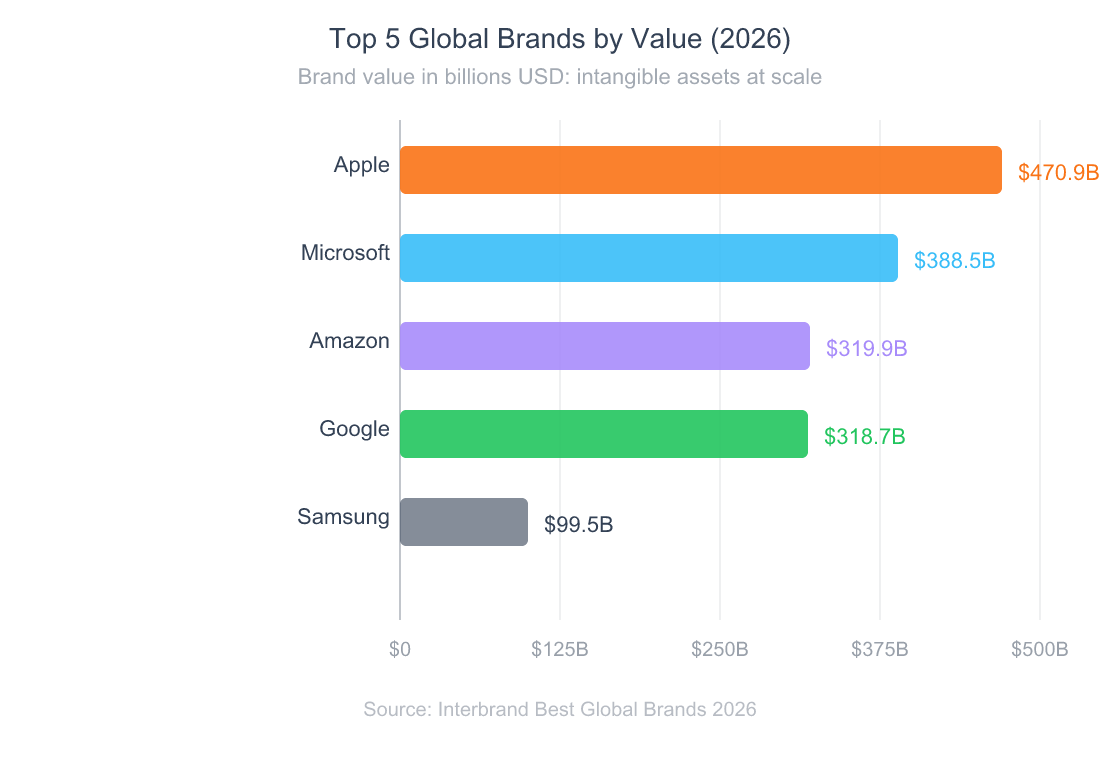
Apple’s $470.9B brand value is roughly 4.7x larger than Samsung’s, and brand strength compounds with every product cycle.
Patents and regulatory licenses work similarly. A pharmaceutical patent gives 20 years of exclusivity. An FDA-approved manufacturing facility takes years and tens of millions to replicate. These barriers aren’t elegant, they’re just expensive enough that competitors don’t bother.
Efficient Scale
Efficient scale is a niche moat: the market is just big enough for one or two profitable players, and any new entrant would split the pie too thin for anyone to make money. Pipeline operators, regional airports, and certain specialized B2B platforms fit this pattern. Google’s 89.62% global search market share creates something close to efficient scale, the cost of building a competing index plus the lack of room for a third player keeps the category structurally concentrated (Statcounter, 2026).
Citation Capsule: Pat Dorsey’s five-moat framework (network effects, switching costs, cost advantages, intangible assets, and efficient scale) remains the most-cited operating taxonomy of competitive moats (Morningstar, 2008). Real-world data validates each: Visa and Mastercard’s 73.8% combined US market share (network effects), median SaaS NDR of 108% (switching costs), TSMC’s ~70% foundry share (cost advantages), Apple’s $470.9B brand (intangibles), and Google’s 89.62% search share (efficient scale).
How Do You Identify a Moat?
The simplest test comes from Pat Dorsey: ask whether the company has earned consistently high returns on capital for at least a decade, and whether you can articulate a structural reason competitors haven’t caught up. If you can’t name the structural reason in one sentence, the moat probably isn’t real (Pat Dorsey at Talks at Google, 2008).
https://www.youtube.com/watch?v=YFS5JBgz1Xc
Three diagnostic questions help separate signal from noise. One: how long would it take a well-funded competitor to replicate this? If the answer is under 18 months, you don’t have a moat. Two: what gets stronger as you grow versus weaker? Network effects and brand strengthen with scale. Pricing-based advantages weaken. Three: what would a buyer actually keep paying for if the price doubled? That’s the moat, the rest is feature.
A useful internal exercise: list every competitive advantage you think you have, then mark each one as either replicable with capital or not. Customer support quality? Replicable. UI polish? Replicable. A 10x faster algorithm? Replicable in 6-12 months. A two-sided marketplace with both supply and demand already engaged? Not replicable without burning hundreds of millions and possibly still failing. The list of not replicable items is your actual moat. Most founders find that list shorter than they expected.
The Bain & Company / Reichheld research on retention provides a quantitative angle: a 5% increase in customer retention can lift profits by 25-95% depending on the industry (Bain & Company / Harvard Business Review, Reichheld, 1990, replicated multiple times since). If your retention curve is bending up over time and customers are expanding spend rather than churning, you have measurable evidence of switching costs, the most common moat type in software.
How Do Moats Work in SaaS Specifically?
In SaaS, moats compound through retention, expansion, and integration depth, and the cleanest signal is net dollar retention. The median public SaaS company posted 108% NDR in Q2 2025, with top-quartile performers above 120% (Blossom Street Ventures, 2025). That single number tells you whether existing customers are paying more over time without you acquiring new ones, the textbook definition of switching cost monetization.
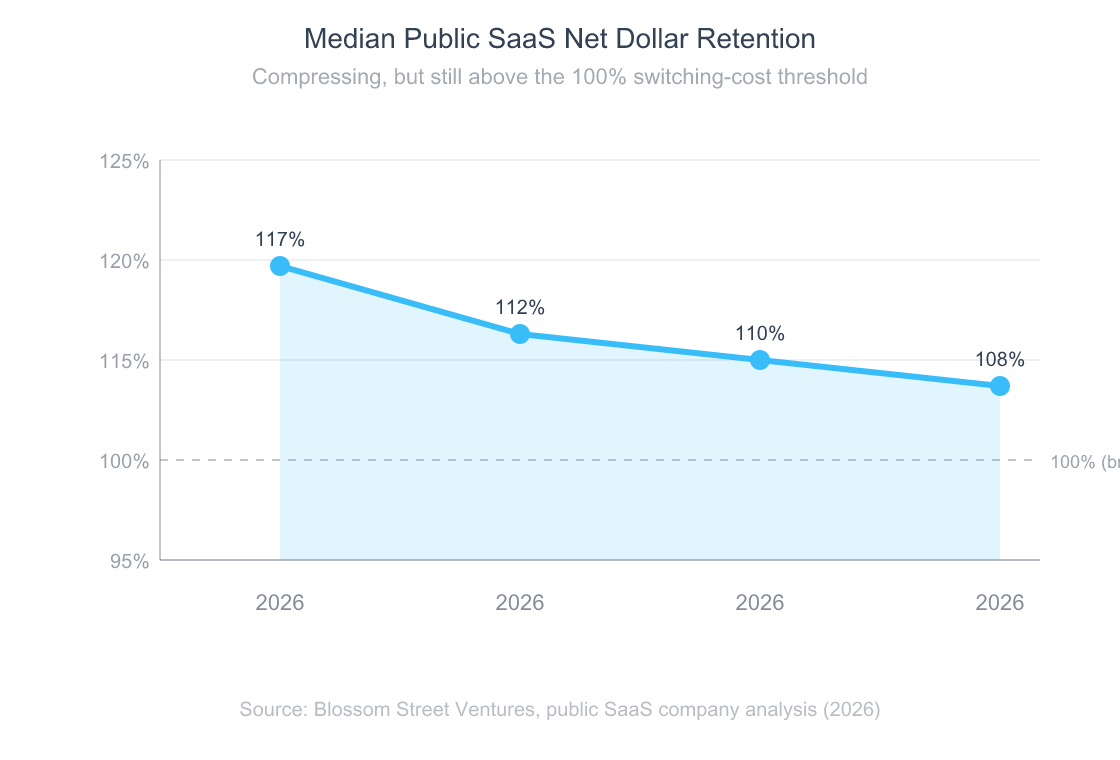
Median NDR has compressed nine points in three years, but staying above 100% means existing customers still pay more over time, the clearest measurable proof of switching costs.
The mechanics are simple. A new customer signs up at $500/month. They invite teammates. They integrate with your API. They pipe their data through your platform. By month 18, removing your product means rebuilding workflows, retraining staff, and migrating data, costs that often exceed two years of subscription fees. That’s not a feature moat. That’s accumulated organizational dependency.
The strongest SaaS moats stack three layers. Layer one is the daily-use workflow, the thing employees touch every day. Layer two is the data layer: historical data, custom configurations, audit trails competitors can’t backfill. Layer three is the integration layer: webhooks, APIs, single sign-on, and third-party ecosystem connections that compound with every new partnership. Stripe, Salesforce, and Snowflake all built moats by stacking these three layers, not by winning on features.
The Bain retention math compounds this: a 5% retention boost can drive 25-95% profit gains in subscription businesses (HBR / Reichheld, 1990). In SaaS terms, every point of churn you eliminate is worth multiples in lifetime value, which is why investors increasingly underwrite SaaS deals on retention metrics rather than top-of-funnel growth.
Why traditional SaaS moats are eroding faster in the AI era
Citation Capsule: The median public SaaS company posted 108% net dollar retention in Q2 2025, with top performers above 120% (Blossom Street Ventures, 2025). NDR above 100% is the mathematical proof that switching costs are functioning, existing customers are expanding spend faster than they churn, the clearest measurable signal of a real moat in software.
Are Moats Disappearing in the AI Era?
The honest answer: some moat types are eroding fast while others are getting stronger. Foundation models have collapsed the cost of building software, which weakens feature-based moats. But integration depth, proprietary data, regulatory licenses, and brand trust haven’t gotten easier to replicate: if anything, they’ve gotten harder, because the noise floor of new entrants is so much higher.
CB Insights’ analysis of post-mortems from failed startups found that 42% died from “no market need”, meaning they never had a defensible position to begin with (CB Insights, 2026). The other failure modes, running out of cash (29%), wrong team (23%), competition (19%), are downstream of that same root cause. Without a structural reason to exist, you’re racing competitors with no protective barrier when the headwinds arrive.

What changes in the AI era is which moats matter most. Hamilton Helmer’s framework, written in 2016, didn’t anticipate that the cheapest, most replicable layer of software would become the AI model itself. In 2026, building a “wrapper” around GPT or Claude is essentially building on rented foundations, the model provider can absorb your features at any time. The moats that survive are the ones AI providers can’t easily build themselves: regulated industries, proprietary first-party data, deep workflow integration, and trusted brand relationships.
I think the most underrated moat in 2026 is distribution. Owning the customer relationship (not the technology) is what makes Microsoft, Google, and Amazon nearly impossible to displace, even when their products lag on features. A weaker product with stronger distribution beats a better product with no distribution every single time. For founders, this means investing in audience, brand, and direct relationships from day one, not as a marketing tactic but as a moat strategy.
The takeaway isn’t “moats are dead.” It’s “the menu has shifted.” Network effects and switching costs still work. Cost advantages from scale still work. Brand still works: and may matter more, not less, in a world where AI commoditizes the underlying product. What doesn’t work is treating a clever feature, a head start, or a capital raise as a substitute for any of these.
How Does Buffett Use Moats in Investing?
Warren Buffett’s portfolio construction is the most public example of moat-based investing in practice. Berkshire Hathaway’s top five public holdings, Apple, American Express, Bank of America, Coca-Cola, and Chevron, accounted for roughly two-thirds of the firm’s equity portfolio at the end of Q3 2025 (Berkshire Hathaway Q3 2025 10-Q, 2025). Every single one is a wide-moat company by Morningstar’s framework.
The pattern isn’t subtle. Apple is a brand and ecosystem moat. American Express is switching costs and brand. Bank of America is scale and regulation. Coca-Cola is brand at extreme scale. Chevron is reserves, regulation, and capital intensity. None of these companies are growing 50% a year. All of them are protected from competition by structural barriers that have held for 30-100 years.
Buffett’s discipline isn’t about picking growth stocks. It’s about identifying companies whose moats are underestimated by the market and holding them for decades. The 70% concentration in his top five names is not a portfolio management quirk, it’s a deliberate expression of the principle that a small number of truly defensible businesses outperforms a large basket of mediocre ones over long horizons.
For founders, the lesson is asymmetric. You don’t need ten moats. You need one real one, deep enough to defend a meaningful market for a meaningful time. Berkshire’s portfolio is a 60-year demonstration that this works.
Frequently Asked Questions
What’s the difference between a moat and a competitive advantage?
A competitive advantage is anything that helps you win against rivals: better product, faster sales cycle, lower price. A moat is the structural, durable subset of competitive advantages that competitors can’t easily replicate even with significant capital and time. Most competitive advantages are temporary; only a few become moats. Morningstar’s wide-moat criteria require a 20-year defensibility horizon (Morningstar, 2026), which filters out short-lived advantages.
Can a startup have a moat from day one?
Rarely. Most moats (network effects, brand, switching costs, scale economics) require time and customers to build. What an early-stage startup can have is a credible path to a moat: a strategy where executing well today compounds into structural defensibility over 3-5 years. Founders who can’t articulate that path are usually competing on temporary advantages that 42% of failed startups also had (CB Insights, 2026). Even brand, the slowest-compounding moat, starts with a memorable, ownable name, which is exactly what the 2026 SaaS naming crisis makes harder than ever.
How do you measure if a moat is working?
The cleanest signals are sustained high returns on invested capital (ROIC), pricing power (ability to raise prices without losing customers), and retention metrics. In SaaS specifically, net dollar retention above 100% is the most direct measurement, the median public SaaS company posts 108% NDR (Blossom Street Ventures, 2025). For consumer brands, watch market share stability across multiple economic cycles.
Are network effects always a moat?
No. Many products claim network effects but don’t have them. A real network effect means each new user demonstrably increases value for existing users in a way that’s hard to replicate. Visa, Mastercard, LinkedIn, and dating apps qualify. Most marketplaces don’t, they have growth, not network effects. The test is whether unit economics improve as you scale, or just stay flat with more users.
Can AI startups build moats?
Yes, but not by wrapping foundation models. The defensible AI moats in 2026 are proprietary first-party data, regulated-industry positioning, deep workflow integration, and brand trust, none of which OpenAI or Anthropic can easily replicate. a16z’s own caution that “data moats” are often overstated confirms that simple model wrappers don’t qualify (a16z, The Empty Promise of Data Moats). For more on which AI moats survive, see the three AI SaaS moats that actually work.
The Bottom Line: Moats Are Earned, Not Assumed
A moat is the structural reason your business will still earn outsize profits in ten years when better-resourced competitors will obviously try to take them. Not a feature. Not a head start. Not a fundraising round. A structural reason: rooted in network effects, switching costs, cost advantages, intangible assets, or efficient scale.
The data from 2026-2026 makes the case starkly. Only 25% of public stocks meet the wide-moat bar. One-third of executives expect their advantages to change within five years. 42% of startup failures trace back to having no defensible position from the start. The companies with real moats (Apple, Visa, TSMC, Google, Costco) are the ones outperforming on every long-horizon metric that matters.
If you’re building a company in 2026, the most useful question to ask isn’t “are we growing?” It’s “are we earning a moat?” The two are different. The first is a metric. The second is the only thing that survives the next downturn, the next platform shift, and the next better-funded competitor with nothing to lose.
The AI SaaS Moat Is Drying Up: Why Most AI Startups Will Die