From 0 to $1K MRR: The Complete Playbook for Indian Solo Founders
India has produced over 1,600 funded SaaS companies (NASSCOM), yet most early-stage startups stall long before they cross $1K in monthly recurring revenue. The gap between “I have an idea” and “I have paying customers” is where most Indian solo founders get stuck. Not because of talent. Because of execution gaps nobody writes about.
This playbook exists because building from India is different. Stripe doesn’t fully work here. GST rules are confusing. Payment gateways eat your margins. And most “how to get your first $1K MRR” guides assume you’re in San Francisco with a US bank account. You’re not. So let’s fix that.
I’ve broken this into seven steps, each covering a specific phase of the journey from zero revenue to sustainable $1K MRR. Every section addresses the India-specific problems you’ll actually face.
marketing strategy guide for solo founders
TL;DR: Getting to $1K MRR from India requires a specific playbook: validate with 10 customer conversations, build an MVP in 4 weeks, set up Razorpay or Dodo Payments (not Stripe), price in USD for global buyers, and acquire your first 10 customers through personal outreach. Indian solo founders earning $1K MRR (~₹85,000/month) from tier-2 cities can live well while growing, since average monthly expenses there often run under ₹30,000.
Step 1: How Do You Validate Before You Build?
90% of startups fail, and the number one reason is building something nobody wants (CB Insights, 2026). For Indian solo founders with limited runway, validation isn’t optional, it’s survival. Spending four weeks talking to potential customers costs you nothing. Spending four months building the wrong product costs you everything.
Talk to 10 People Who Have the Problem
Don’t start with your solution. Start with the problem. Find 10 people who experience the pain you want to solve and have conversations: not surveys, not Google Forms, real conversations. Ask them three questions:
- How are you solving this problem today?
- What’s the most annoying part of your current solution?
- Would you pay for something that fixes this?
The last question is where most founders flinch. They don’t want to hear “no.” But a “no” at this stage saves you months of wasted work. If 7 out of 10 people say “yes, I’d pay for that,” you have something worth building.
The “Will They Pay?” Test
Validation isn’t just about interest. It’s about willingness to pay. The strongest signal is a pre-order or letter of intent. Ask potential customers to put down ₹500 or $10 as a deposit for early access. If they won’t commit ₹500, they won’t commit ₹5,000 later.
From experience: I’ve watched multiple Indian founders skip validation because they were excited about their tech stack. Every single one of them pivoted within six months. The founders who talked to customers first (even just 10 conversations over two weeks) built products people actually used. The correlation is almost perfect. The same founders also burn weeks bikeshedding a product name; if that’s you, read how the 2026 SaaS naming crisis is killing launches before you commit to a domain.
Where to Find Your First 10 Conversations
Indian founders often struggle with finding people to interview. Here’s what works:
- Twitter/X: Search for people complaining about the problem. DM them.
- Reddit and Quora: r/India, r/SaaS, and niche subreddits where your target audience hangs out.
- WhatsApp and Telegram groups: Industry-specific groups are goldmines in India.
- LinkedIn: Works better than you’d expect for B2B SaaS.
The key is speed. You should complete 10 conversations within two weeks. If you can’t find 10 people who have this problem, that itself is data, maybe the problem isn’t big enough.
defining your ICP with zero customers
Citation Capsule: According to CB Insights’ 2026 analysis, 90% of startups fail, with “no market need” being the top reason at 35%. Indian solo founders can de-risk their SaaS ventures by conducting just 10 customer conversations before writing any code, a validation step that costs zero rupees but statistically separates successful founders from the 90% who fail.
Step 2: How Do You Build Your MVP in 4 Weeks?
The median time to launch for successful indie SaaS products is 30 days (MicroConf, 2026). Four weeks. Not four months. Indian founders especially need to ship fast because your runway is measured in savings, not venture capital. Every extra week of development is a week of burn without revenue.
The Right Tech Stack for Indian Solo Founders
Pick boring, proven technology. This isn’t the time to learn Rust or experiment with bleeding-edge frameworks. Here’s what I’d recommend:
- Frontend: Next.js or plain React. You know it, it works, move on.
- Backend: Node.js with Express, or go full-stack with Next.js API routes.
- Database: PostgreSQL on Supabase (free tier is generous) or PlanetScale for MySQL.
- Auth: Supabase Auth, Clerk, or NextAuth.js. Don’t build auth yourself.
- Hosting: Vercel (free tier), Railway, or a ₹500/month VPS on DigitalOcean’s Bangalore region.
The total cost for this stack? Under ₹2,000/month, and often ₹0 on free tiers.
What to Include in Your MVP
Your MVP needs exactly three things:
- The core value loop, the one thing your product does that solves the pain.
- Payment integration: if people can’t pay you, it’s a project, not a product.
- Basic onboarding, a 30-second path from signup to “aha moment.”
That’s it. No admin dashboard, no analytics, no team features, no API, no mobile app. Ship the smallest thing that delivers value and collects money.
What to Skip (For Now)
- Custom email systems. Use Resend or Postmark’s free tier.
- Complex role-based permissions. You have 0 customers, you don’t need roles.
- Automated billing portals. Manually handle billing for your first 20 customers.
- Multi-tenancy architecture. Premature for pre-product-market-fit.
Worth noting: Indian founders tend to over-build MVPs because “jugaad engineering” culture makes us want to show technical sophistication. But the most successful Indian SaaS products, Zoho, Freshworks, Chargebee, all launched with embarrassingly simple v1 products. Your customers don’t care about your architecture. They care about whether their problem is gone.
Citation Capsule: MicroConf’s 2026 State of Indie SaaS report found that the median time to launch for successful indie products is 30 days. Solo founders who ship an MVP within 4 weeks using free-tier infrastructure (Vercel, Supabase, Resend) can start collecting revenue at near-zero operating cost, a significant advantage for bootstrapped Indian founders managing limited runway.
Step 3: How Do You Set Up Payments From India?
Payment processing is where building from India gets uniquely painful. Stripe launched in India but still operates with significant limitations for international transactions, and most global SaaS advice assumes you’re using Stripe. Indian founders need a different approach entirely, and the wrong choice can cost you 4-8% of every transaction in unnecessary fees (Razorpay, 2026).
Why Stripe Doesn’t Fully Work for Indian Founders
Stripe is available in India, but with restrictions that matter for SaaS:
- International payouts are delayed. Settlements for international payments can take 7-10 business days.
- Limited payment methods. Stripe India supports UPI and cards, but its international card acceptance rate is lower than Stripe US.
- Currency conversion fees. You’ll pay Stripe’s forex markup on top of gateway fees when receiving USD payments.
- Compliance overhead. RBI regulations require additional documentation for Stripe India to process international transactions.
For domestic-only SaaS, Stripe India works fine. For global SaaS (which is where the money is) you need alternatives.
Razorpay: The Default Indian Choice
Razorpay is the most widely used payment gateway in India, processing over $180 billion in transactions annually (Business Standard, 2025). Here’s what you need to know:
- Domestic fees: 2% per transaction for most payment methods.
- International fees: 3% per transaction + forex markup.
- Settlement time: T+2 for domestic, T+7 for international.
- Subscription billing: Built-in, works well for SaaS.
- GST invoice integration: Native, which saves you headaches.
Razorpay’s biggest advantage is ecosystem familiarity. Indian banks, UPI integrations, and compliance requirements are all handled natively.
Dodo Payments: The New Alternative Worth Watching
Dodo Payments is a newer player specifically built for Indian developers selling globally. Their pitch is simple: lower fees and faster international settlements.
- Domestic fees: 2% per transaction.
- International fees: 2.5% per transaction, notably lower than Razorpay’s 3%.
- Settlement time: T+3 for international.
- Built for developers: API-first, better docs, faster integration.
If you’re building a global SaaS product from India, Dodo Payments’ international fee structure can save you meaningful money at scale.
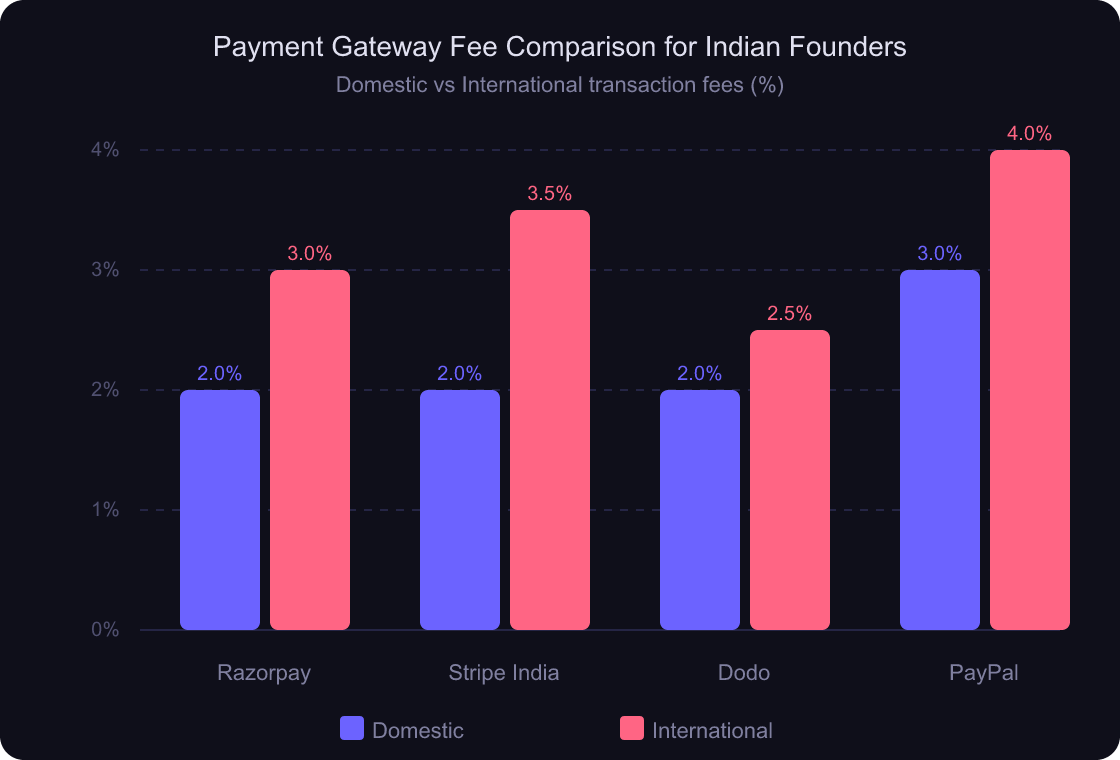
Fee comparison based on published pricing from Razorpay, Stripe, Dodo Payments, and PayPal as of March 2026. Excludes GST on fees.
The GST Nightmare (and How to Solve It)
Here’s where most Indian founders panic: GST compliance. Let me simplify it.
When you MUST register for GST:
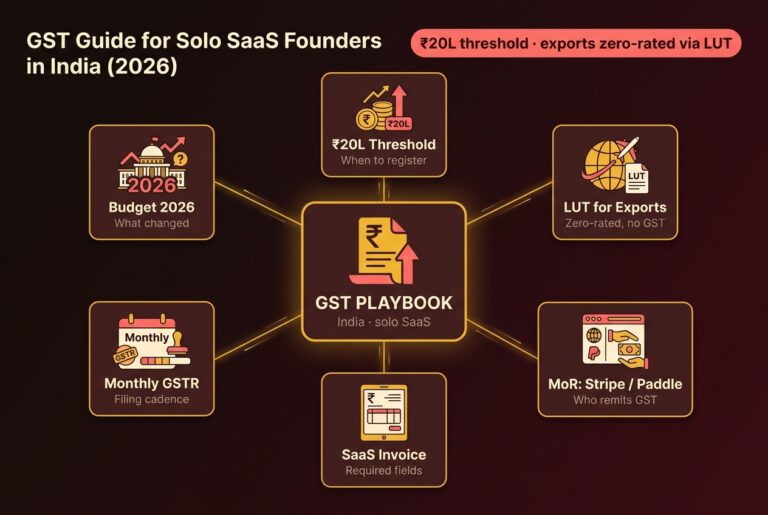
- If your aggregate turnover exceeds ₹20 lakh (₹10 lakh for special category states).
- If you sell to international customers, software exports require GST registration regardless of turnover.
LUT (Letter of Undertaking): Your Best Friend:
Once you have a GSTIN, file an LUT on the GST portal. This lets you export software services at zero GST, you don’t charge GST to international customers, and you don’t pay it either. Without an LUT, you’d need to charge 18% IGST and claim a refund later. Filing an LUT takes 15 minutes and saves you months of refund hassles.
Section 44ADA (The Tax Gift for Solo Founders):
If your gross receipts are under ₹75 lakh (increased from ₹50 lakh in 2026), you can opt for presumptive taxation under Section 44ADA. This means you declare 50% of your revenue as profit and pay tax only on that. No need to maintain detailed books of accounts. For a solo founder earning $1K MRR (~₹10.2 lakh annually), your taxable income would be just ₹5.1 lakh, which falls in the lowest tax bracket.
The math: At $1K MRR ($12K/year, ~₹10.2 lakh), under Section 44ADA, your presumptive profit is ₹5.1 lakh. Under the new tax regime, income up to ₹7 lakh is effectively tax-free (with rebate under Section 87A). So you’d pay approximately zero income tax on your first $1K MRR. This is a massive structural advantage of building from India.
Citation Capsule: Razorpay processes over $180 billion in annual transactions across India (Business Standard, 2025), charging 2% domestic and 3% international fees. For Indian solo founders selling SaaS globally, Dodo Payments offers a lower international fee of 2.5%, while filing an LUT under GST enables zero-rated exports, eliminating the 18% IGST that would otherwise destroy margins on every international sale.
Step 4: How Should You Price for Global Customers?
For Indian solo founders selling globally, currency is the single biggest pricing decision you’ll make. Price in rupees, and you anchor yourself to the Indian market where willingness to pay is lower. Price in USD, and the entire world of higher-paying buyers opens up.
USD Pricing From India: How It Actually Works
Pricing in USD doesn’t mean you need a US bank account. Your payment gateway handles the currency conversion. Here’s the flow:
- Customer pays $29/month in USD.
- Razorpay or Dodo Payments converts at market rate minus forex spread (typically 1-2%).
- You receive INR in your Indian bank account within T+2 to T+7 days.
- The transaction is classified as a software export under FEMA regulations.
The key requirement: you must have an FIRC (Foreign Inward Remittance Certificate) for each international transaction. Most payment gateways generate these automatically. Your CA will need them for tax filing.
The INR/USD Arbitrage Advantage
This is something nobody talks about enough. When you earn in USD and spend in INR, the exchange rate works massively in your favor.
The arbitrage math: At 1 USD = ₹85 (March 2026 rate), $1K MRR = ₹85,000/month. If you live in a tier-2 city like Pune, Jaipur, or Kochi, your total monthly expenses (rent, food, internet, coworking) can be under ₹25,000. That means $1K MRR gives you a 3.4x cushion over basic living costs. A US founder at $1K MRR in San Francisco? They’re still underwater on rent alone.
PPP (Purchasing Power Parity) Pricing
If you want Indian customers too, offer PPP discounts. But do it strategically:
- Default price: USD, aimed at global customers.
- PPP discount: 40-60% off for customers in India, Brazil, Southeast Asia, and similar markets.
- Implementation: Use Parity from Paddle, or detect country via IP and show adjusted pricing.
Don’t make PPP your primary pricing model. Make it a discount on your primary pricing. The distinction matters for positioning and perceived value.
Avoid Gumroad and LemonSqueezy (For Now)
Gumroad charges 10% of every transaction. LemonSqueezy acts as Merchant of Record but takes 5-8%. Both are popular in the indie hacker community, but they’re expensive for recurring SaaS billing. At $1K MRR, you’d pay $50-$100/month in fees, money better spent on infrastructure.
Use Razorpay Subscriptions or Dodo Payments for recurring billing. Pair it with a simple billing page built into your app. You don’t need a third-party checkout at this stage.
Citation Capsule: Pricing globally in USD rather than rupees lets Indian founders tap higher-willingness-to-pay markets instead of anchoring to local price sensitivity. Combined with tier-2 city living costs under ₹25,000/month, that creates a cushion at $1K MRR that US-based competitors simply don’t have.
Step 5: How Do You Get Your First 10 Customers?
The first 10 customers don’t come from marketing. According to a First Round Capital analysis, 70% of successful startups acquired their first customers through direct personal outreach: not ads, not content, not virality (First Round Review, 2026). Your first 10 customers are people you personally convince. Everything else scales later.
Your Personal Network (Don’t Skip This)
Start with people who already know and trust you. This doesn’t mean spamming your WhatsApp contacts with “check out my product!” It means identifying people in your network who have the exact problem you solve and offering them early access.
- Former colleagues who work in your target industry.
- Friends who run businesses with the pain point you address.
- Twitter/X mutuals who’ve talked about this problem publicly.
Offer them the product at a steep discount, or even free for the first month, in exchange for honest feedback. The goal isn’t revenue yet. It’s learning.
Building in Public on Twitter/X
India’s indie hacker community on Twitter/X has grown significantly. Building in public (sharing your progress, revenue numbers, lessons, and failures) is the most effective organic growth channel for Indian solo founders right now.
What to share:
- Weekly MRR updates (even if it’s $0, honesty builds trust).
- Technical decisions and why you made them.
- Customer conversations (anonymized).
- Revenue milestones, the Indian tech Twitter community celebrates these aggressively.
Consistency matters more than follower count. Tweeting daily for 90 days will build more distribution than any paid campaign.
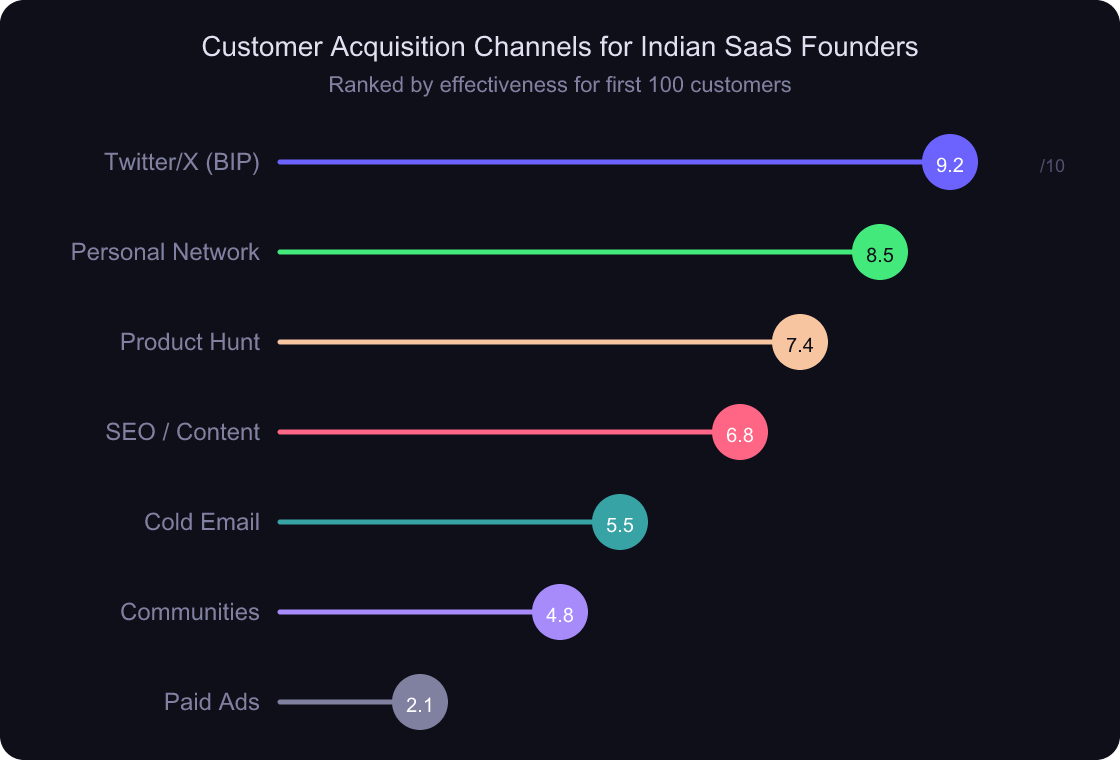
Effectiveness scores based on aggregated data from MicroConf 2026 Indie SaaS surveys, SaaSBoomi community reports, and founder interviews. Score = composite of cost-effectiveness, conversion rate, and time-to-first-customer.
Community Selling (Without Being Annoying)
Indian founders have access to some incredible communities:
- SaaSBoomi, India’s largest SaaS community. Attend their events, contribute in discussions.
- Indie Hackers, post honest updates, respond to others’ posts.
- Reddit: r/SaaS, r/IndieHackers, r/developersIndia.
- Discord servers: specific to your niche.
The rule: give 10x before you ask 1x. Help people, share knowledge, answer questions. When you eventually mention your product, people listen because you’ve earned credibility.
From experience: My first three paying customers came from Twitter. Not from a viral tweet: from consistent daily posts about what I was building, the problems I was solving, and the decisions I was making. It took 47 days of daily posting before someone DM’d me asking to try the product. Patience is the strategy.
why indie hackers fail at marketing
Citation Capsule: First Round Capital’s analysis shows that 70% of successful startups acquired their first customers through direct personal outreach, not marketing channels (First Round Review, 2026). For Indian solo founders, Twitter/X building-in-public combined with community participation in SaaSBoomi and Indie Hackers is the highest-ROI acquisition strategy for the first 10-50 customers.
Step 6: How Do You Scale From 10 to 100 Customers?
The jump from 10 to 100 customers requires a shift from personal selling to systems. Content marketing generates 3x more leads per dollar spent than paid advertising (HubSpot, 2026), making it the best channel for bootstrapped solo founders who have more time than money. This is where you start building assets that sell while you sleep.
Content Marketing That Actually Works
Blog posts, Twitter threads, and YouTube videos compound over time. But here’s what most founders get wrong: they write about their product instead of their customer’s problems.
The content framework that works:
- Bottom-of-funnel: “How to solve [specific problem your product solves]”, this captures people actively searching for solutions.
- Middle-of-funnel: “Best tools for [your category]”, include your product alongside competitors. Honesty builds trust.
- Top-of-funnel: Industry insights, tutorials, opinion pieces, these build authority.
Write one bottom-of-funnel article per week for 12 weeks. That’s 12 search-optimized pages working for you permanently.
SEO for Indian SaaS Founders
SEO is a long game, but it’s the most sustainable customer acquisition channel. Some India-specific tips:
- Target English keywords. Your SaaS is probably global. Write in English, target global search terms.
- Use programmatic SEO. Create template pages for use cases, integrations, and alternatives pages.
- Build backlinks through content. Guest posts on relevant blogs, HARO responses, and Product Hunt launches all generate domain authority.
The typical timeline: 3-6 months before SEO starts delivering consistent traffic (Ahrefs, 2026). Start in month one so it’s ready by month six.
Referral Programs
Your first 10 customers are your best salespeople. A simple referral program, “Give your friend 20% off, get 20% off your next month”, can accelerate growth without paid acquisition.
Keep it simple. Don’t build a complex referral tracking system. Use a Google Form or a simple spreadsheet until you have enough volume to justify software.
zero-dollar marketing stack
Citation Capsule: Content marketing generates 3x more leads per dollar than paid advertising (HubSpot, 2026), making it the most cost-effective growth channel for bootstrapped Indian solo founders scaling from 10 to 100 customers. SEO takes 3-6 months to deliver consistent traffic (Ahrefs, 2026), so start publishing bottom-of-funnel content in month one to compound results by month six.
Step 7: How Do You Hit and Sustain $1K MRR?
The median monthly churn rate for SMB SaaS products is 3-7% (Recurly, 2026). At 5% monthly churn, you lose half your customers every year. Hitting $1K MRR isn’t just about acquiring customers, it’s about keeping them. The math is unforgiving: if you add 10 customers per month but lose 5, you’re on a treadmill.
The Math of $1K MRR
Let’s break down what $1K MRR actually requires at different price points:
| Price Point | Customers Needed | Difficulty |
|---|---|---|
| $9/month | 112 customers | Hard, high volume needed |
| $19/month | 53 customers | Moderate, sweet spot for most indie SaaS |
| $29/month | 35 customers | Easier, fewer customers to support |
| $49/month | 21 customers | Best, if your product justifies it |
| $99/month | 11 customers | Ideal, but requires high perceived value |
The lesson? Price higher. Most Indian founders underprice because they anchor to their own willingness to pay (in INR). Your global customers think in USD. A $29/month product is a rounding error for a US business.
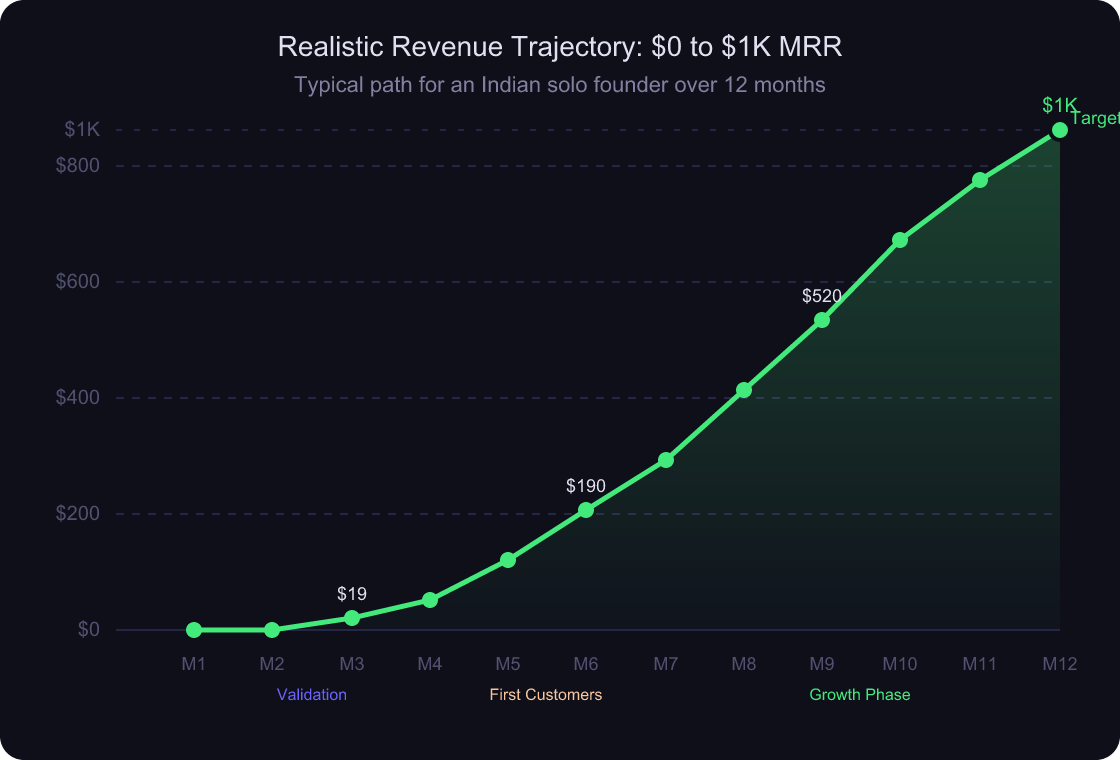
Realistic MRR trajectory based on median growth rates from MicroConf 2026 Indie SaaS Report. Most founders see $0 revenue for months 1-2 during validation and building.
Reducing Churn: The Hidden Key
Churn is the silent killer of MRR growth. Here’s what actually reduces churn for small SaaS products:
- Onboarding emails. Send a 5-email sequence in the first 7 days. Walk new users through the core value.
- Personal check-ins. At 10-50 customers, email each one personally. Ask how it’s going. This is your biggest advantage over larger competitors.
- Usage alerts. If a customer hasn’t logged in for 7 days, send a gentle nudge. Inactive users churn.
- Quick bug fixes. Nothing kills retention faster than unresolved bugs. Fix bugs the same day they’re reported.
Upselling: Growing Revenue Without Growing Customers
Once you have paying customers, upselling is cheaper than acquisition. Common upsell levers:
- Usage-based tiers. More API calls, more storage, more team members.
- Annual plans. Offer 2 months free for annual prepayment. This reduces churn and improves cash flow.
- Add-on features. Premium integrations, priority support, custom reports.
Even a modest 10% upsell across your customer base adds $100/month at $1K MRR. That’s $100 you didn’t need to acquire.
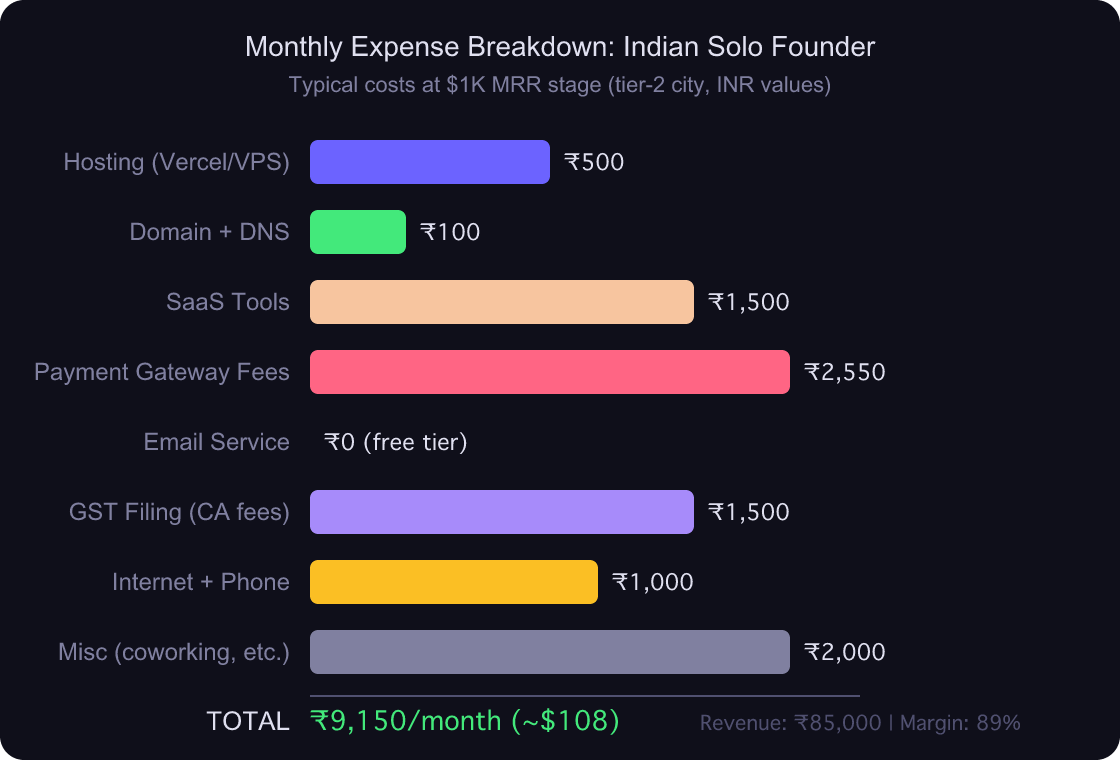
Expense breakdown for an Indian solo founder at $1K MRR. Payment gateway fees assume 3% average on ₹85,000 revenue. GST filing via CA at ₹1,500/month for quarterly returns. All figures in INR.
The bottom line: At $1K MRR, an Indian solo founder in a tier-2 city has business expenses of roughly ₹9,150/month ($108). That’s an 89% operating margin. Add personal living expenses of ~₹25,000/month, and your total burn rate is ₹34,150 ($402). You’re left with over ₹50,000 ($588) in monthly surplus. That’s reinvestment capital, or savings. Try finding that margin structure anywhere outside India.
Banking Tips for International Payments
Not all Indian banks handle international inward remittances well. From firsthand experience:
- HDFC and ICICI handle FIRC generation smoothly.
- State Bank of India works but is slower for forex settlements.
- Neo-banks like Jupiter and Fi don’t support business current accounts yet, stick with traditional banks for now.
- Open a current account, not savings. Business transactions in a savings account raise compliance red flags.
Citation Capsule: The median monthly churn rate for SMB SaaS is 3-7% (Recurly, 2026), meaning solo founders must focus on retention as much as acquisition to sustain $1K MRR. At an average price of $29/month, you need just 35 customers: and personal onboarding emails, same-day bug fixes, and weekly check-ins are the most effective churn-reduction tactics at this scale.
marketing strategy guide for solo founders
Frequently Asked Questions
How long does it realistically take to reach $1K MRR from India?
Based on MicroConf’s 2026 Indie SaaS data, the median time to $1K MRR for solo founders is 9-14 months from first line of code. Indian founders may take slightly longer (10-16 months) due to payment setup complexity and time zone differences affecting customer support. The fastest path is pricing at $29+/month and targeting global customers from day one.
Do I need to register a company before starting?
No. Start as a sole proprietor. You can operate under your PAN and register for GST when your turnover approaches ₹20 lakh. Register as an LLP or Private Limited only when you need to, typically when you cross ₹25 lakh revenue or want to raise investment. Premature incorporation costs ₹15,000-30,000 in setup and adds annual compliance overhead.
Which payment gateway should I pick: Razorpay or Dodo Payments?
If your customers are primarily Indian, use Razorpay: it has the widest payment method coverage including UPI, Netbanking, and all Indian cards. If you’re selling globally, compare Dodo Payments’ 2.5% international fee against Razorpay’s 3%. At $1K MRR with 80% international revenue, that 0.5% difference saves you ~$4/month, small now, but meaningful at scale. Start with whichever is faster to integrate and switch later if needed.
Is $1K MRR enough to go full-time in India?
It depends on your city. In a tier-2 city like Pune, Jaipur, or Chandigarh, $1K MRR (₹85,000/month) is enough to cover business expenses (₹9,000), personal expenses (~₹25,000), and have ₹50,000+ in monthly surplus. In Mumbai or Bangalore, you’d want ₹1.2-1.5 lakh/month before quitting your job. The rule of thumb: have 6 months of personal expenses saved and at least 3 months of consistent MRR before going full-time.
How do I handle currency conversion and taxes?
Your payment gateway converts USD to INR automatically. File for an LUT (Letter of Undertaking) to zero-rate GST on software exports, this takes 15 minutes on the GST portal. Use Section 44ADA for presumptive taxation if your receipts are under ₹75 lakh. At $1K MRR ($12K/year, ~₹10.2 lakh), your presumptive profit of ₹5.1 lakh falls under the tax-free threshold with Section 87A rebate. Hire a CA who understands software exports: expect ₹15,000-25,000/year for filing.
Conclusion
Getting to $1K MRR from India isn’t about having the best product or the most users. It’s about executing a specific sequence: validate with real conversations, build small, set up payments correctly, price in USD for global buyers, and acquire your first customers through personal outreach before scaling with content.
The structural advantage of building from India is real and underappreciated. Earning in dollars while spending in rupees gives you a 3.4x cost cushion that founders in expensive markets don’t have. Section 44ADA means your first $1K MRR is essentially tax-free. And living in a tier-2 city means ₹85,000/month puts you well ahead of the average tech salary.
Key takeaways from this playbook:
- Validate with 10 real conversations before writing code.
- Ship your MVP in 4 weeks, not 4 months.
- Use Razorpay or Dodo Payments (not Stripe) for international SaaS billing from India.
- File an LUT immediately after GST registration for zero-rated exports.
- Price in USD. Offer PPP discounts as secondary pricing.
- Get your first 10 customers through personal outreach and Twitter/X.
- Reduce churn with personal check-ins and fast bug fixes.
The hard truth? Most founders who start this journey won’t finish it. But the ones who follow a systematic playbook, stay patient through the zero-revenue months, and treat $1K MRR as a milestone (not the finish line), those are the ones who build real businesses.
Start today. Your first step is 10 conversations. Not code. Conversations.
marketing strategy guide for solo founders
Why Indian Developers Should Stop Freelancing and Start Building SaaS