Which International Payment Gateway Should Developers Choose in 2026?
Picking a payment gateway is one of those decisions that looks simple until you’re three months into an integration and realize your provider doesn’t support UPI in India or charges 4.4% on every European transaction. The cross-border payments market grew to $397 billion in 2026 (Fortune Business Insights, 2026). Developers building for international users can’t afford to get this wrong.
The problem isn’t a lack of options. It’s that every gateway looks identical on its marketing page. “135+ currencies!” and “Global coverage!” don’t tell you what happens when a Brazilian customer pays with Boleto, or how interchange++ pricing actually affects your margins at scale.
This guide compares the five gateways that matter most for developers shipping international products: Stripe, Adyen, PayPal/Braintree, Checkout.com, and Square. We’ll break down fees, currency support, API quality, and fraud tooling, with real numbers, not hand-waving.
API security fundamentals
TL;DR: For most developers, Stripe offers the best balance of API quality, currency support (135+), and documentation. Adyen wins on interchange++ pricing for high-volume merchants. PayPal reaches 200+ countries but only supports 25 currencies. Checkout.com leads with 150+ currencies. Cross-border payments hit $397 billion in 2026 (Fortune Business Insights), so choosing wrong costs real money.
How Big Is the International Payments Market Right Now?
Global digital payment transactions hit $26.89 trillion in 2026, with Mobile POS Payments alone accounting for $18.95 trillion (Statista, 2026). That’s not a rounding error. That’s the GDP of the United States flowing through payment processors every year, and it’s growing at 7.63% CAGR through 2030.
Cross-border specifically? The market reached $397.37 billion in 2026 and is projected to hit $727.74 billion by 2034 at a 7.9% CAGR (Fortune Business Insights, 2026). Every SaaS product, marketplace, and e-commerce platform expanding internationally feeds this growth.
Worth noting: Asia-Pacific captured 38.72% of global digital payments in 2026, with China alone projected at $10.96 trillion in 2026 (Statista, 2026). If your app doesn’t support Alipay and WeChat Pay, you’re ignoring the world’s largest digital payment market.
The mobile payment segment tells an even more aggressive story. It reached $4.97 trillion in 2026 and is projected to balloon to $46.62 trillion by 2034, a 28% CAGR (Fortune Business Insights, 2026). Digital wallet users hit 5.6 billion in 2026, roughly two-thirds of the world’s population (CoinLaw, 2026).
What does this mean for you as a developer? Your gateway choice determines whether you capture this growth or lose customers at checkout.
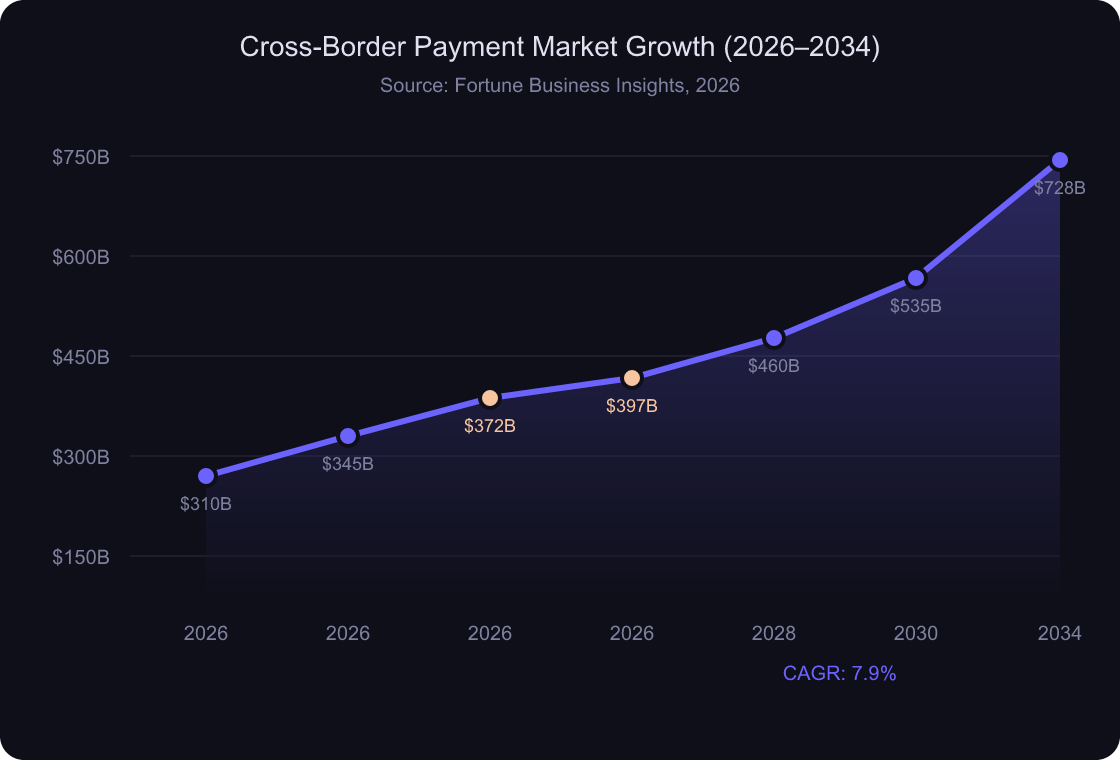
Source: Fortune Business Insights Cross Border Payments Market Report, 2026
building REST APIs
Which Gateways Actually Dominate the Market?
PayPal holds 43.4% of the global payment gateway market, followed by Stripe at 20.8–29% depending on how you measure it (Red Stag Fulfillment, 2026). Shopify Pay sits at 14.7%, Amazon Pay at 2.5%, and Square at roughly 2%. The top five processors handle about 48% of global transaction value.
That Stripe range deserves an explanation. BuiltWith’s technographic data (which scans website code to identify payment integrations) puts Stripe at 20.8% globally. But Stripe processes 45% of US online payments by volume. The difference comes down to measurement: website presence versus dollars processed.
For developers, market share matters because it signals ecosystem maturity. Stripe’s 1.31 million active websites means a deeper pool of Stack Overflow answers, open-source libraries, and community plugins. When you hit an edge case at 2 AM, that community is worth more than a 0.3% fee difference.
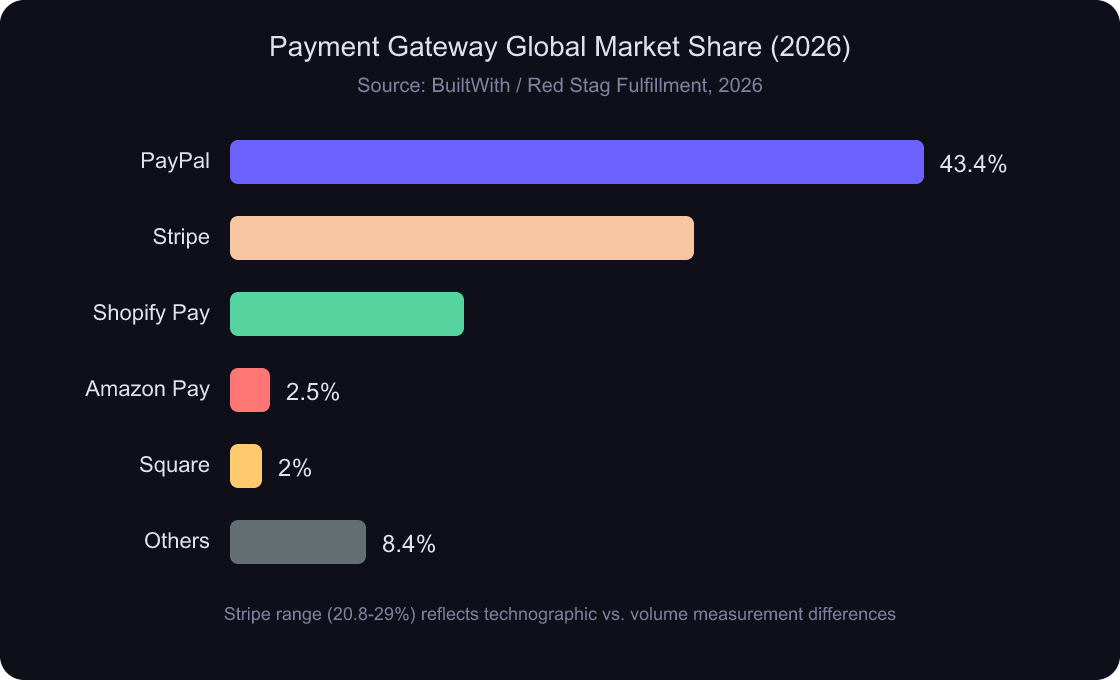
Source: BuiltWith technographic data / Red Stag Fulfillment analysis, 2026
1. Stripe: Best Developer Experience for International Payments

Stripe supports 135+ currencies across 46 countries with 100+ payment methods (Stripe, 2026). It’s used by 62% of Fortune 500 companies and 80% of the largest US software companies (Red Stag Fulfillment, 2026). For developers, that adoption isn’t an accident, it’s the direct result of API quality that competitors still haven’t matched.
What makes Stripe’s API stand out?
The documentation reads like a well-maintained open-source project. Every endpoint has working code samples in seven languages. The test mode uses real API calls against a sandbox, so your integration tests hit the same code paths as production. Webhooks arrive with retry logic and event ordering guarantees.
Stripe’s PaymentIntent API handles the entire international payment flow in a single object. Currency conversion, 3D Secure authentication, local payment method routing, it’s all abstracted behind one consistent interface. You don’t write separate logic for iDEAL in the Netherlands and PIX in Brazil.
Pricing
- Domestic: 2.9% + $0.30 per transaction
- International cards: 3.9% + $0.30 (1% surcharge for cross-border + 1% for currency conversion)
- Custom pricing: Available for businesses processing $80,000+/month
Best for
SaaS platforms, marketplaces (Stripe Connect), and any team that values developer velocity over per-transaction savings.
According to Capterra, Stripe holds a G2 rating of 4 out of 5 from 388 reviews, with developers consistently praising its documentation quality and API consistency (Capterra, 2026). For teams integrating their first international payment flow, that documentation advantage translates to weeks saved on implementation.
backend architecture patterns
2. Adyen (Best for High-Volume Enterprise Merchants)
Adyen supports approximately 144 currencies and 100+ local payment methods, with acquiring capabilities in over 50 countries (Adyen, 2026). Its interchange++ pricing model starts at just 0.60% + EUR 0.13 on top of actual interchange fees, significantly cheaper than flat-rate providers at scale.
Why do enterprises choose Adyen?
Interchange++ pricing means you pay what Visa and Mastercard actually charge, plus Adyen’s markup. For a European debit card, that could be 0.2% interchange + 0.60% Adyen fee = 0.80% total. Compare that to Stripe’s flat 2.9%. At $10 million in annual volume, that difference is hundreds of thousands of dollars.
The catch? Adyen’s API is more complex. There’s no equivalent to Stripe’s “copy this code block and it works” developer experience. The dashboard is enterprise-grade, powerful but intimidating for a two-person startup. And Adyen historically required a minimum monthly processing volume, though they’ve relaxed this with their newer “Adyen for Platforms” product.
Pricing
- Processing fee: 0.60% + EUR 0.13 per transaction (plus interchange)
- FX markup: 0.6–1.2% above market rate, depending on currency pair
- No monthly minimums on their platforms product (traditional acquiring still has minimums)
Best for
Enterprise SaaS, high-volume e-commerce, and businesses processing $1M+/year where interchange++ savings outweigh the steeper integration curve.
Our finding: Teams we’ve worked with consistently report that Adyen integration takes 2–3x longer than Stripe for the same payment flow, but the per-transaction savings compound quickly above $500K/year in volume.
3. PayPal / Braintree, Best for Maximum Geographic Reach

PayPal operates in 200+ countries, more than any other gateway on this list (PayPal, 2026). But here’s the number that surprises developers: PayPal only supports 25 currencies. That gap between geographic reach and currency support is the defining tension of the PayPal ecosystem.
When does PayPal make sense?
PayPal’s strength is consumer trust. In markets where credit card penetration is low, a PayPal button converts better than a generic card form. Braintree (PayPal’s developer-facing gateway) offers a cleaner API that supports Venmo, Apple Pay, Google Pay, and cards alongside PayPal.
The 200+ country reach matters most for digital products, ebooks, SaaS subscriptions, online courses, where you don’t need to ship physical goods. A customer in Kenya or Bangladesh can pay with their PayPal balance even if your gateway doesn’t support the Kenyan shilling directly.
Pricing
- Domestic: 2.9% + $0.30 per transaction
- International: 4.4% + $0.30 (1.5% cross-border fee)
- Currency conversion: Additional 3–4% if PayPal handles the conversion
Best for
Digital products sold globally, consumer-facing apps where PayPal brand recognition drives conversion, and businesses targeting emerging markets where PayPal has established trust.
Cross-border fraud is a real concern at PayPal’s scale. Merchants lost $52.84 billion to online payment fraud globally in 2026, with international orders facing a 3.0% fraud rate versus 2.6% for domestic (Visa/Merchant Risk Council, 2026). PayPal’s buyer protection program, while developer-unfriendly in dispute resolution, does reduce fraud exposure on the seller side.
securing payment webhooks
4. Checkout.com: Best for Currency Coverage and Custom Routing
Checkout.com supports 150+ currencies across 50+ countries, giving it the widest currency coverage of any gateway on this list (Checkout.com, 2026). Its interchange++ pricing and direct acquiring in multiple regions make it a strong contender for businesses that need granular control over payment routing.
What sets Checkout.com apart?
Intelligent payment routing. Checkout.com lets you define rules that route transactions through different acquiring banks based on card type, issuing country, or currency. A European card gets routed through a European acquirer (lower interchange), while a US card goes through a US acquirer. This optimization can reduce decline rates by 5–10% and cut costs simultaneously.
The API design sits between Stripe’s simplicity and Adyen’s enterprise complexity. Documentation is solid, SDKs exist for major languages, and the testing environment mirrors production. It’s not quite at Stripe’s level of polish, but it’s closer than most alternatives.
Pricing
- Processing fee: Interchange++ (custom per merchant, typically competitive with Adyen)
- FX markup: Custom, negotiable based on volume
- No publicly listed flat rate, all pricing is custom
Best for
Businesses processing across many currencies, travel and booking platforms, and teams that want interchange++ pricing without Adyen’s enterprise complexity.
How Do Transaction Fees Actually Compare?
Stripe charges a flat 2.9% + $0.30 domestically (3.9% + $0.30 for international cards), while Adyen’s interchange++ model starts at 0.60% + EUR 0.13 plus actual interchange (Chargeflow, 2026). That means the “cheaper” option depends entirely on your transaction volume, average order value, and customer geography.
Here’s what most comparison articles miss: flat-rate pricing (Stripe, PayPal, Square) bundles a known cost per transaction. Interchange++ pricing (Adyen, Checkout.com) passes through the actual card network fee, which varies by card type, issuing country, and whether the transaction is consumer or commercial.
The hidden variable: A US consumer Visa debit card has an interchange fee around 0.05% + $0.22. A UK commercial Amex card might be 2.5%. On Adyen’s interchange++, those two transactions cost wildly different amounts. On Stripe’s flat rate, they cost exactly the same. Your customer mix determines which model wins.
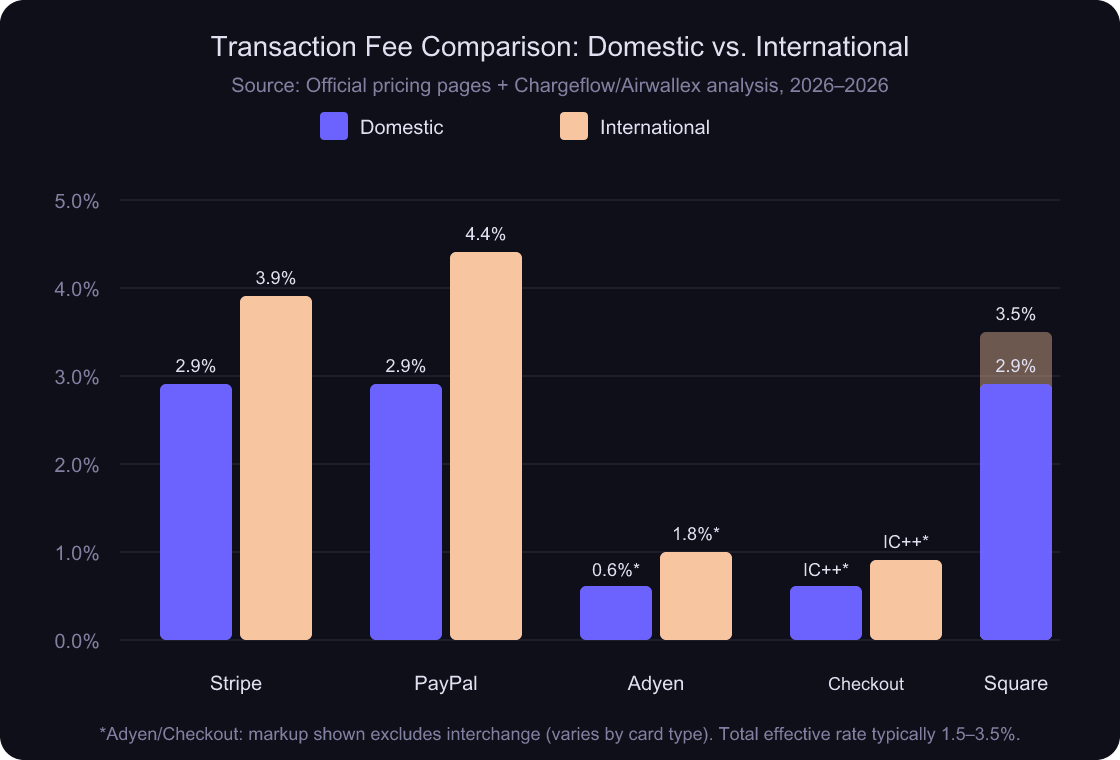
Source: Official pricing pages, Chargeflow, and Airwallex comparisons, 2026–2026
Are you processing under $500K/year? Stick with flat-rate pricing. The predictability is worth more than the theoretical savings. Above $1M/year? Interchange++ starts making serious financial sense, but budget for the added complexity.
5. Square, Best for Omnichannel (But Limited Internationally)

Square operates in just 8 countries and supports roughly 16 currencies, making it the least international gateway on this list. But if your business combines physical and online sales in supported markets, Square’s omnichannel tooling is hard to beat.
Where Square fits
Square’s POS hardware, inventory management, and online payment processing share a single backend. A sale at your physical store and a sale on your website hit the same transaction API. For developers building unified commerce experiences in the US, Canada, UK, Australia, Japan, Ireland, France, or Spain, that integration simplicity has real value.
Pricing
- Domestic online: 2.9% + $0.30 per transaction
- International: 3.5% + $0.30
- In-person: 2.6% + $0.10
Best for
Businesses with physical retail presence that need unified online/offline payments in Square’s supported markets. Not suitable for global-first SaaS or products targeting emerging markets.
How Should You Handle Fraud on International Transactions?
Merchants lost $52.84 billion to online payment fraud in 2026 (Visa/MRC, 2026). International orders face a 3.0% fraud rate compared to 2.6% for domestic, and Latin America sees the highest regional fraud loss at 4.6% of e-commerce revenue (DemandSage, 2026).
Every gateway on this list includes some fraud tooling. But the quality varies dramatically.
Fraud protection by gateway
- Stripe Radar: Machine learning trained on billions of transactions across Stripe’s network. Included free. Custom rules available on paid plans. The best out-of-the-box fraud prevention for most developers.
- Adyen RevenueProtect: Enterprise-grade risk engine with configurable rules. Strong for high-volume merchants who need granular control. Included in processing fees.
- PayPal/Braintree: PayPal’s buyer protection shifts fraud liability. Braintree includes basic fraud tools, with Kount integration for advanced detection.
- Checkout.com Fraud Detection Pro: ML-based, customizable, with real-time scoring. Competitive with Stripe Radar.
- Square: Basic fraud detection included. Less sophisticated than Stripe or Adyen for international transactions.
From experience: The single most effective fraud reduction strategy isn’t better ML models, it’s requiring 3D Secure 2.0 on international card payments. It shifts liability to the issuing bank and blocks a massive percentage of fraudulent transactions before they reach your fraud rules. Every gateway listed here supports it.
authentication best practices
What About Emerging Markets and Local Payment Methods?
India’s UPI processes over 18 billion transactions per month. Kenya leads digital payment adoption at 80% of the population. Half of mobile payment users in Latin America, Africa, and Southeast Asia don’t own a credit card (McKinsey, 2026).
If your app targets these regions, card-only gateways won’t cut it. Here’s how each gateway handles local methods:
| Gateway | Local Payment Methods | Emerging Market Strength |
|---|---|---|
| Stripe | 100+ (PIX, Boleto, iDEAL, Bancontact, SEPA, Alipay, WeChat Pay, GrabPay, Konbini) | Strong in LATAM, Europe, parts of APAC |
| Adyen | 100+ local methods, strong acquiring presence | Strongest in APAC and Europe; limited Africa |
| PayPal | PayPal wallet (accepted in 200+ countries) | Strongest pure reach, but limited local methods |
| Checkout.com | Major local methods, growing coverage | Growing in MENA and APAC |
| Square | Cards and Apple Pay/Google Pay only | Minimal, 8 countries, no local methods |
The key insight: “supports 200+ countries” doesn’t mean “supports the payment methods people actually use in those countries.” PayPal reaches Bangladesh, but a Bangladeshi customer paying with bKash (the dominant mobile wallet) needs a gateway that supports bKash directly, and that’s not PayPal.
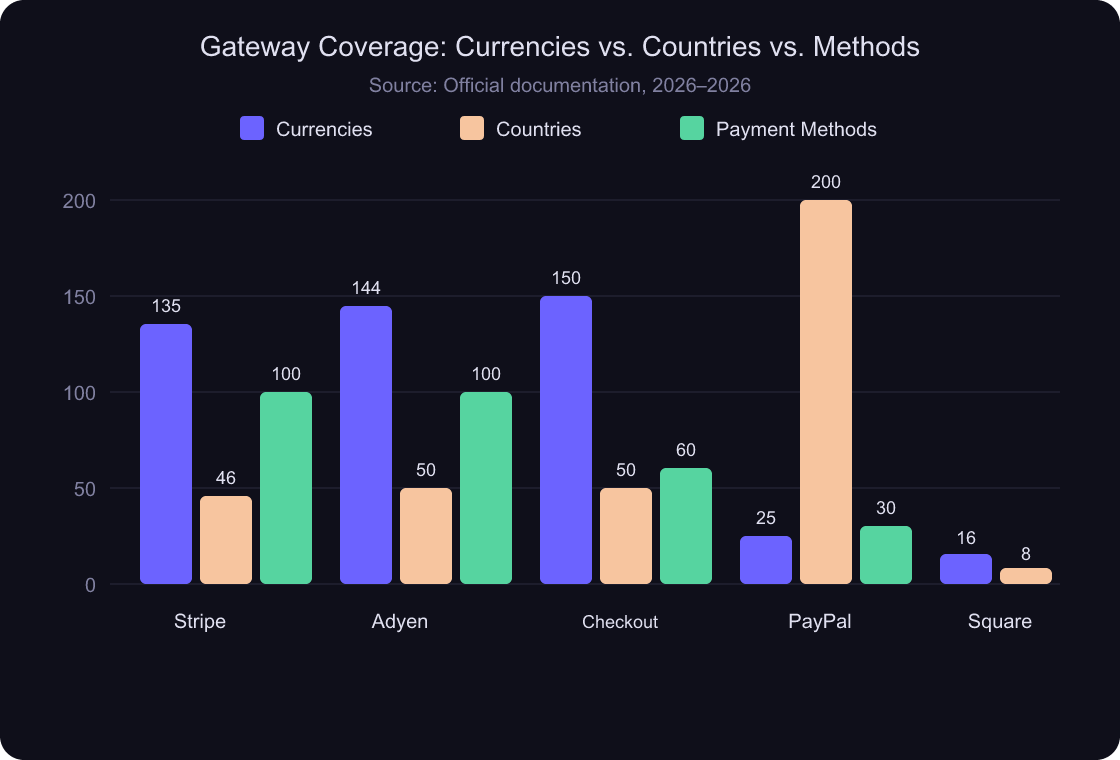
Source: Official Stripe, Adyen, Checkout.com, PayPal, and Square documentation, 2026–2026
How Do You Choose the Right Gateway for Your App?
The average cart abandonment rate is 70.22% (Baymard Institute, 2026). While only 10% of US shoppers abandon because of insufficient payment methods, that percentage climbs in markets where local payment methods dominate. Picking the right gateway is partly about fees and partly about not losing customers you’ve already acquired.
Here’s a decision framework:
Choose Stripe if:
- You’re a developer-led team that values API quality and documentation
- You need 135+ currencies and 100+ payment methods
- You process under $1M/year (flat-rate simplicity wins)
- You’re building a marketplace or platform (Stripe Connect)
Choose Adyen if:
- You process $1M+/year and want interchange++ savings
- You need deep local acquiring in Europe and APAC
- You have engineering capacity for a more complex integration
- You need a unified payment platform across online and in-store
Choose PayPal/Braintree if:
- You sell digital products globally and need the widest country reach
- Your customers expect PayPal as a payment option
- You want the simplest integration for basic card + PayPal
- Consumer trust matters more than per-transaction cost
Choose Checkout.com if:
- You need 150+ currencies, the most on this list
- You want interchange++ without Adyen’s enterprise overhead
- You need intelligent payment routing across acquiring banks
- You’re in travel, booking, or any high-volume cross-border vertical
Choose Square if:
- You need unified online + physical POS in supported markets
- You operate primarily in the US, UK, Canada, or Australia
- International transactions aren’t your primary volume
- You want the simplest possible setup for omnichannel
choosing a tech stack
Frequently Asked Questions
Which international payment gateway has the lowest fees?
Adyen typically offers the lowest effective fees for high-volume merchants through its interchange++ pricing model, starting at 0.60% + EUR 0.13 plus actual interchange costs (Chargeflow, 2026). For lower volumes, Stripe’s flat 2.9% + $0.30 is more predictable and often comparable when accounting for Adyen’s setup complexity.
How many currencies does Stripe support in 2026?
Stripe supports 135+ currencies across 46 countries with over 100 local payment methods (Stripe, 2026). This includes major local methods like iDEAL (Netherlands), PIX (Brazil), Alipay (China), and SEPA Direct Debit (Europe). Currency support continues to expand quarterly.
Is PayPal good for international payments?
PayPal reaches 200+ countries (more than any competitor) but only supports 25 currencies. Its 4.4% + $0.30 international transaction fee is also the highest among major gateways. PayPal works best when consumer trust drives conversion, particularly for digital products in emerging markets where credit card penetration is low.
What is interchange++ pricing and should developers care?
Interchange++ separates the card network fee (interchange), the scheme fee (Visa/Mastercard markup), and the processor fee. Adyen and Checkout.com use this model. For merchants processing over $1M/year, interchange++ typically saves 0.5–1.5% per transaction compared to flat-rate pricing (Airwallex, 2026).
Which gateway is best for mobile payments internationally?
Stripe and Adyen both support Apple Pay, Google Pay, and major regional wallets. With the global mobile payment market hitting $6.46 trillion in 2026 (Fortune Business Insights, 2026), mobile wallet support isn’t optional. Stripe’s pre-built mobile SDKs (iOS, Android, React Native) give it an edge for developer implementation speed.
Conclusion
No single gateway wins across every dimension. The right choice depends on three variables: your transaction volume, your target markets, and your team’s integration capacity.
Key takeaways:
- Stripe is the default choice for developer-led teams under $1M/year: 135+ currencies, best-in-class docs, and a flat-rate fee that’s predictable
- Adyen saves serious money above $1M/year with interchange++, but demands more engineering investment
- PayPal has unmatched geographic reach (200+ countries) but the highest international fees and narrowest currency support
- Checkout.com leads on currency coverage (150+) and offers intelligent payment routing for cross-border optimization
- Square is domestically excellent but internationally limited to 8 countries
Cross-border payments hit $397 billion in 2026 and are growing at 7.9% annually. Every month you delay optimizing your payment stack is revenue left on the table.
Start with one gateway. Measure decline rates, fees, and conversion by region. Then add a second gateway for the markets your primary provider handles poorly. That’s the pattern every successful international product follows.
building scalable backends
How Do You Secure an API? The 4-Layer Framework That Actually Works
Jira Customer-Facing Dashboard, 7 Alternatives That Actually Work