The Developer Job Market After AGI
The developer job market isn’t dying. It’s splitting in two.
One side grows faster than ever. The other side quietly disappears. The Bureau of Labor Statistics projects 15% growth in software developer roles through 2034 — much faster than the national average (BLS, 2026). Yet Goldman Sachs data shows employment among 22-to-25-year-olds in AI-exposed roles already fell 16% between late 2026 and mid-2026 (Goldman Sachs, 2026). Both things are true at the same time.
That contradiction tells you everything. AGI won’t eliminate developers. It’ll create a chasm between developers who adapt and those who don’t. This piece breaks down what the data actually shows, which roles are expanding, which are contracting, and how to position yourself on the right side of that divide.
what AGI means and how it differs from narrow AI
TL;DR: AGI won’t eliminate developer jobs — it’ll transform them. The BLS projects 15% growth for software developers through 2034, but roles are bifurcating: AI-fluent developers command a 12% salary premium while entry-level positions in AI-exposed categories have already declined 16% (Goldman Sachs, 2026). The playbook is AI fluency plus domain expertise.
What Are the Two Camps Saying About Developers and AGI?
The debate about AGI and developer careers has split into two loud, opposing camps — and both are wrong. Dario Amodei, CEO of Anthropic, predicts AGI by 2026, while Demis Hassabis of DeepMind gives it a 50% chance by 2030 (80,000 Hours, 2026). These timelines fuel wildly different career conclusions.
Camp one: total replacement. The doomsayers point to McKinsey’s late-2026 estimate that 57% of U.S. work hours are already automatable (McKinsey, 2026). Once AGI arrives, they argue, writing code becomes trivial. Why hire a $130,000-per-year engineer when AI does it for pennies? This view is popular on social media. It’s also historically illiterate.
Camp two: nothing changes. The dismissers argue automation-driven unemployment has been predicted for decades and never materializes. Developers are safe because software is eating the world. This camp cites BLS growth projections and leaves it there. This view is comforting. It’s also dangerously complacent.
Both camps make the same mistake: they treat the developer job market as one monolithic category. It isn’t. A frontend developer building marketing pages faces a different future than an ML engineer designing training pipelines. An agency developer cranking out WordPress sites faces different risks than a systems architect.
I’ve watched this pattern before. When cloud computing arrived, sysadmins who’d spent years manually provisioning servers didn’t all lose their jobs. Some became DevOps engineers and tripled their salaries. Others refused to adapt and slowly found their skills less valuable. The bifurcation was quiet, gradual, and brutal.

Why Are Both Sides Wrong About Developer Job Losses?
The binary framing — all jobs gone or nothing changes — misses the actual pattern automation follows. History shows that technology transforms job categories rather than eliminating them. When ATMs arrived, the number of tellers per branch fell from 20 to 13 between 1988 and 2004, but banks opened so many new branches that total teller employment actually rose (IMF Finance & Development, 2015).
Problem 1: The “57% automatable” stat is misleading
McKinsey’s figure refers to work hours that contain automatable tasks, not entire jobs being eliminated. A developer who spends 30% of their time writing boilerplate code might see that task automated. The other 70% — system design, stakeholder communication, debugging novel edge cases — remains human work. The job doesn’t vanish. It changes shape.
Problem 2: BLS projections don’t account for role-level shifts
The BLS projects 15% growth across “software developers, QA analysts, and testers” as a single bucket. That aggregation hides what’s happening underneath. AI-assisted coding tools already write 41% of all code in 2026 (Stack Overflow Developer Survey, 2026). The demand isn’t for more people who can write basic code. It’s for people who can architect, validate, and direct AI-generated systems.
Problem 3: Entry-level displacement is already measurable
Goldman Sachs found a 16% employment drop among 22-to-25-year-olds in AI-exposed roles from late 2026 to mid-2026, while experienced workers in those same fields stayed stable (Goldman Sachs, 2026). The displacement isn’t uniform. It hits the bottom of the experience ladder first and hardest.
What we’re seeing isn’t a jobs apocalypse or a nothingburger. It’s a compression of the junior developer pipeline. AI handles the tasks that used to be junior developer training grounds. That doesn’t mean fewer developer jobs total. It means the entry path is shifting — from “write code from scratch” to “orchestrate, validate, and extend AI-generated code.”
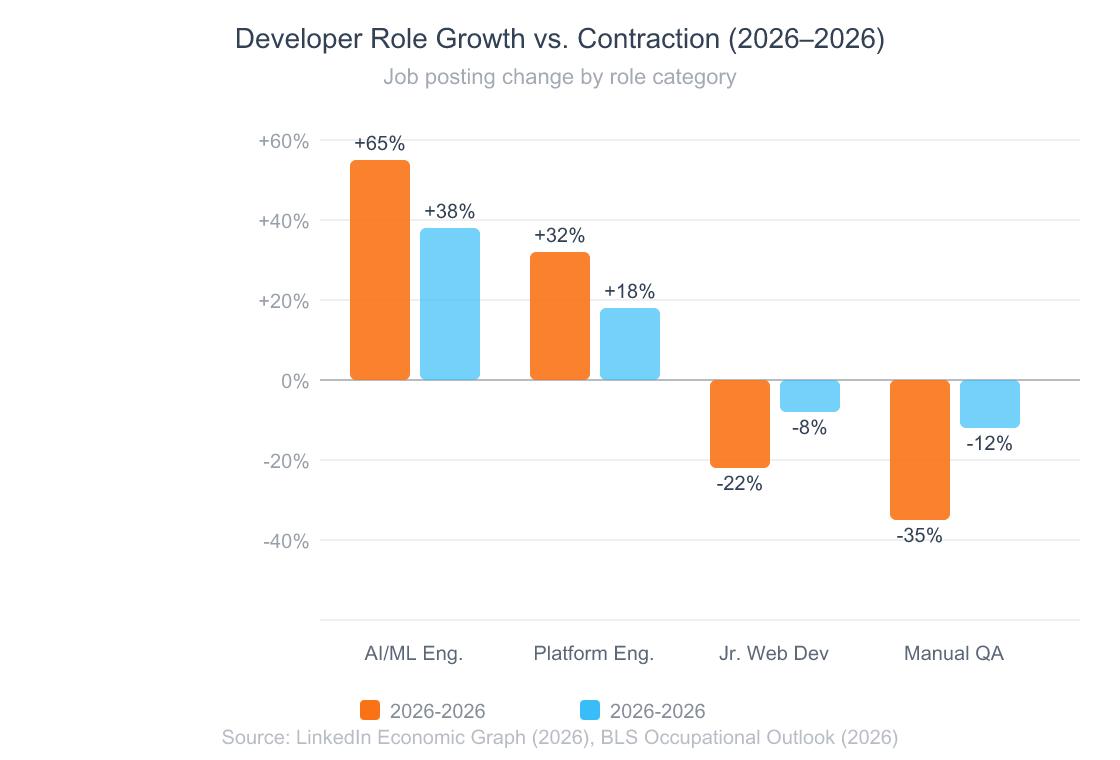
AI-adjacent developer roles are growing rapidly while routine coding and manual testing roles face accelerating contraction.
Citation Capsule: Developer job displacement isn’t uniform across roles. Goldman Sachs data shows a 16% employment drop among 22-to-25-year-olds in AI-exposed jobs since late 2026, while experienced workers remain stable (Goldman Sachs, 2026). The impact follows seniority, not occupation.
What Does the Employment Data Actually Show?
The BLS projects about 129,200 annual openings for software developers through 2034, with a median salary of $133,080 as of May 2026 (BLS, 2026). But the composition of those roles is shifting dramatically beneath the aggregate numbers.
The World Economic Forum’s Future of Jobs Report 2026 ranks software and application developers as the fourth fastest-growing role globally. But the three ahead of it — big data specialists, fintech engineers, and AI/ML specialists — are all roles that didn’t exist a decade ago (World Economic Forum, 2026). The market isn’t just growing. It’s mutating.
Here’s where it gets interesting. Prompt engineering roles grew 135.8% year-over-year, and LinkedIn tracked a 250% increase in prompt engineering job postings in a single year (Coursera, 2026). AI trainers earn $80,000 to $115,000. These roles didn’t exist three years ago.
Meanwhile, 84% of developers now use AI tools that write 41% of all code (Stack Overflow Developer Survey, 2026). You’re not just writing code anymore. You’re directing, reviewing, and integrating AI output. Does that sound like your job is disappearing — or evolving?
I call this the “AGI Exposure Framework.” Every developer role has three dimensions of AI exposure: task automation risk (how much of your daily work an AI handles today), value migration speed (how fast the valuable part of your role shifts), and adaptation runway (how much time before the shift becomes unavoidable). Template-based web development? High automation, fast migration, short runway — contracting now. Systems architecture? Moderate automation, slow migration — years of runway left.
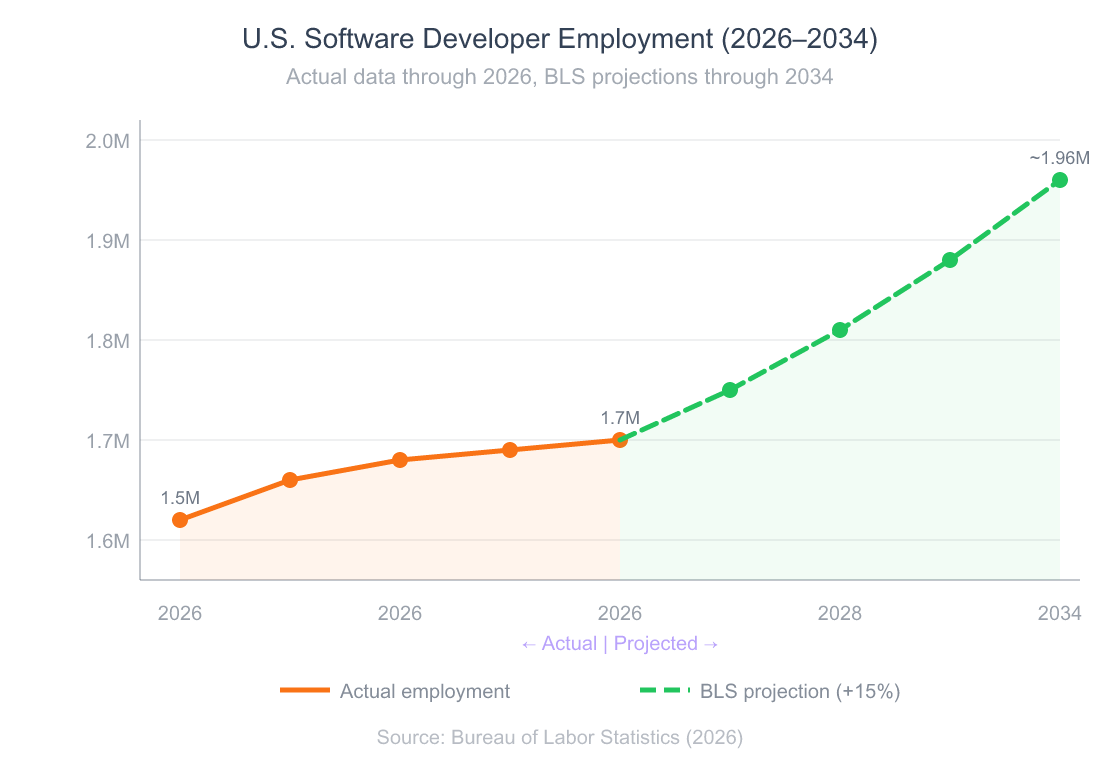
Despite AI anxiety, BLS projects steady 15% growth in software developer employment through 2034.
how vibe coding is reshaping the way developers build software
Citation Capsule: The World Economic Forum’s Future of Jobs Report 2026 ranks software developers as the fourth fastest-growing role globally, with 39% of all job skills expected to transform by 2030 (WEF, 2026). New categories like prompt engineering and AI training are growing at 135%+ annually.
What’s the Better Approach to Career-Proofing as a Developer?
The developers who’ll thrive after AGI are T-shaped: deep in one technical domain and fluent across AI tooling, system design, and a specific business vertical. Gartner predicts 80% of engineering teams will need to upskill specifically for AI collaboration by 2027 (Gartner, 2026). The upskilling isn’t optional. It’s table stakes.
Here are the core principles of an AGI-resilient career strategy:
- AI fluency over AI fear. You don’t need to build LLMs. You need to direct them, evaluate their output, and integrate them into production. Most developers can close this gap in 90 days.
- Domain expertise as a moat. AI writes generic CRUD apps. It can’t understand why a healthcare system needs specific audit trails or why a trading platform requires sub-millisecond latency. Industry knowledge is your differentiator.
- Systems thinking over code production. The value shifts from “can you write this function” to “can you design a system where AI agents, human reviewers, and automated tests work together.” Architecture compounds. Code production commoditizes.
- Portfolio of proof. Ship projects showing AI-augmented development. Build something where you orchestrated AI tools to solve a real problem. That’s worth more than a certification.
I’ve noticed that the developers who adapted fastest to AI tools weren’t the most technically brilliant. They were the most curious. They treated AI assistants like a new junior developer on the team — useful for drafts, unreliable for final decisions, and requiring constant review. That mental model made the transition natural rather than threatening.
AI-fluent engineers already command a 12% salary premium over their peers at the same experience level (Ravio, 2026). The premium is real and measurable. And it’s growing.
understanding how AI-native applications are reshaping software

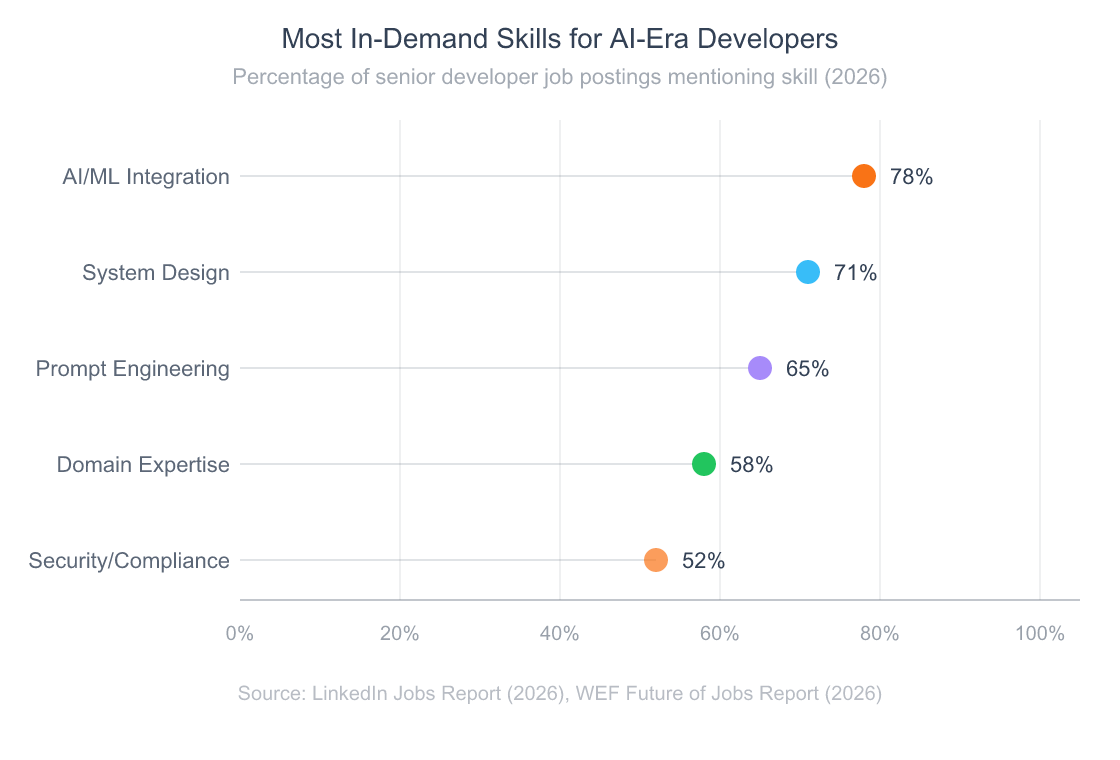
AI/ML integration and system design dominate hiring requirements, while prompt engineering has become a mainstream skill expectation.
How Should You Apply This to Your Career Right Now?
Start by auditing your current role against the AGI Exposure Framework this week. The 77% of employers planning to upskill staff for AI collaboration aren’t doing it out of charity — they’re doing it because the market demands it (WEF Future of Jobs Report, 2026). Here’s how to get ahead of that curve instead of behind it.
Step 1: Assess your task automation risk (1 hour)
List every task you do in a typical work week. Rate how well an AI tool handles each one today on a 1-5 scale. Anything rated 4 or 5? Start delegating it to AI now. Not because it’ll replace you — because it frees your time for higher-value work.
Step 2: Build one AI-augmented project (2-4 weeks)
Pick a project where you use AI tools end-to-end. Document your process: prompts used, output received, corrections made, final result. This becomes your portfolio’s strongest piece. Hiring managers want to see how you work with AI, not just how you code alone.
Step 3: Choose a domain vertical (ongoing)
Pick an industry — healthcare, fintech, logistics, energy. Learn its regulatory landscape, technical challenges, and business logic. Within six months, you’ll have domain knowledge no AI replicates from training data alone.
Step 4: Ship and share publicly (weekly)
Build in public. Share your AI-augmented workflows. The developers getting the best opportunities are the ones whose work is visible. Track GitHub contributions, blog traffic, and inbound recruiter messages. You’ll see movement within 90 days.
practical marketing approach for technical founders
When I started building AI into my daily workflows, the output felt wrong — good enough to ship but different from my style. Within two weeks, I’d developed a review-and-refine rhythm that increased my output. The key: treat AI-generated code like a pull request from a junior developer.
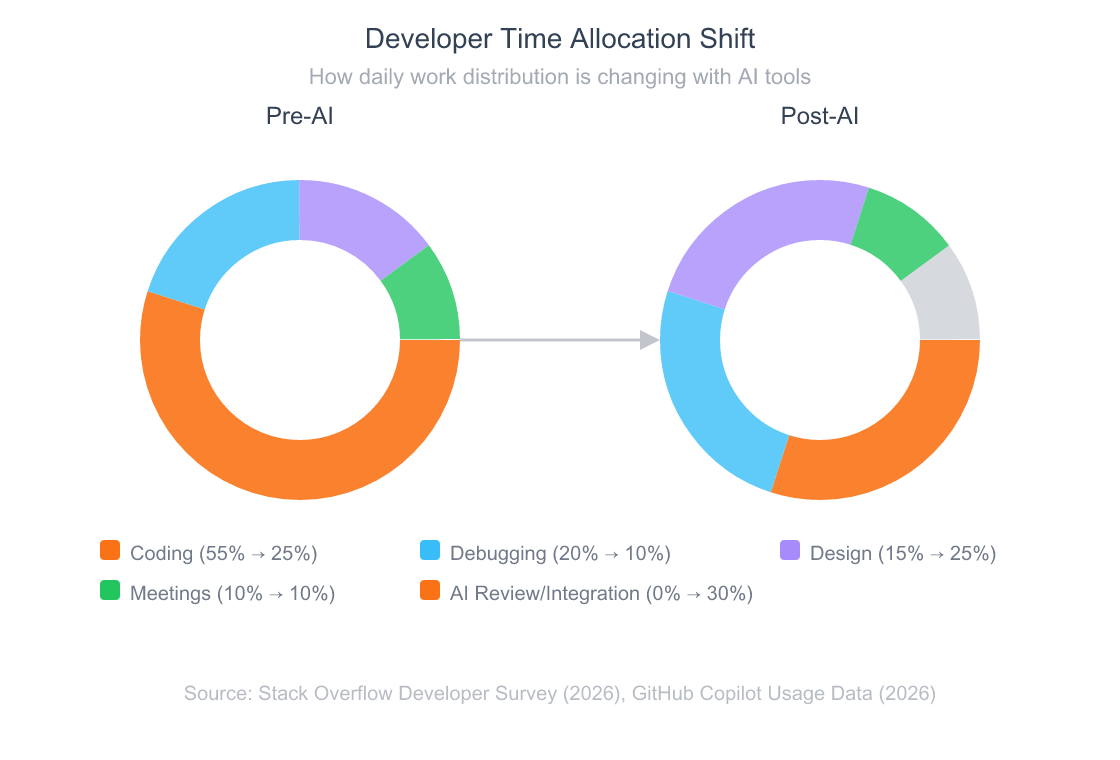
AI hasn’t reduced developer work — it’s shifted where the work happens, with AI review and system design replacing raw code production.
When Does This Analysis Fall Short?
The biggest caveat is timeline uncertainty. As of February 2026, forecasters put only a 25% chance on AGI arriving by 2029 and a 50% chance by 2033 (80,000 Hours, 2026). If AGI arrives sooner than expected — as some lab insiders suggest — the transformation could compress from a decade into a few years.
This analysis also assumes gradual adoption. If a breakthrough produces an AI that can genuinely replace a senior architect — not just write code but design systems and anticipate failure modes — the playbook changes entirely. We’re not there yet. We’ve also been wrong about timelines before.
There’s geographic and industry variance too. A developer at a well-funded San Francisco startup faces a different reality than one building internal tools at a mid-sized company in Ohio.
The core advice — build AI fluency, develop domain expertise, think at the systems level — holds regardless of timeline. It’s sound career strategy even if AGI never arrives.
Frequently Asked Questions
But won’t AGI make all programming skills obsolete eventually?
Even if AGI writes any code, someone defines what to build and validates that it works. Only 9% of developers believe AI code can ship without human oversight (BairesDev, 2026). The role shifts from writing code to directing and reviewing AI output — like how managers understand the work deeply without doing every task.
What if I’m a junior developer just starting my career?
The entry path is changing, not closing. Focus on system design, learn AI coding tools from day one, and pick a domain specialty early. The WEF ranks software developers as the fourth fastest-growing role globally (WEF, 2026). Demand exists — it’s for different skills than five years ago.
how AI-native applications are changing what developers build
How do I convince my employer to invest in AI upskilling?
Lead with data. AI tools now generate 41% of code, with productivity gains of 20-55% depending on the task (Stack Overflow Developer Survey, 2026). Frame it as competitive risk: 77% of employers globally already plan to upskill their teams. Being behind isn’t neutral — it’s a disadvantage.
Are AI-specific certifications worth it?
Certifications signal baseline knowledge but aren’t differentiators. A GitHub repo showing you orchestrated AI tools to build something real outweighs any certificate. The 12% AI salary premium applies to all AI-fluent engineers, certified or not (Ravio, 2026). Show your work instead.
Should I switch to an AI/ML specialization?
Not necessarily. The biggest opportunity is applying AI within your existing domain, not becoming an ML researcher. AI/ML roles grew 65%, but so did demand for developers who integrate AI into healthcare, finance, and logistics verticals (LinkedIn Economic Graph, 2026). Go deep where your experience already gives you an edge.
the AI marketing tools available for technical professionals
The Developer Career Isn’t Ending — It’s Forking
The developer job market after AGI isn’t extinction — it’s evolution. BLS projects 15% growth through 2034. Goldman Sachs shows displacement concentrated at the entry level. The WEF confirms skills are shifting, not disappearing.
What needs to change is how we talk about this. The doomsday headlines generate clicks but not clarity. The “nothing will change” reassurances generate comfort but not preparation. The truth is messier: your career will transform, the transformation is underway, and you have more control over which side you land on than you think.
The developers who’ll thrive aren’t the ones who ignore AI or fear it. They’re the ones who learn to work with it and bring human judgment where machines still fall short. That’s already happening.
Start building your AI fluency this week. Your future self will thank you.
practical guide to creating a marketing strategy as a solo technical founder
Quantum Computing for Web Developers: What You Need to Know in 2026
Your Personal AI Team: How Solo Founders Will Run Entire Businesses With AI Agents by 2028
The $0 Marketing Stack for Indie Hackers in 2026