

JavaScript vs TypeScript: Which Should You Actually Use in 2026?
The debate is over. Or at least, it should be. TypeScript became the number one language on GitHub by monthly contributors in August 2026, surpassing JavaScript, Python, and everything else (GitHub Octoverse, 2026). That’s 2.6 million developers choosing TypeScript every month — a 66% year-over-year jump.
But “TypeScript is popular” isn’t the same as “you should always use TypeScript.” I’ve shipped production code in both languages for years, and the honest answer is more nuanced than either camp wants to admit. So here’s the breakdown — what the data actually says, where TypeScript wins, and where plain JavaScript still makes sense.
What’s the Best Tech Stack for Micro SaaS in 2026?
Key Takeaways
- TypeScript is now the #1 language on GitHub with 2.6M monthly contributors and 66% YoY growth (GitHub Octoverse, 2026).
- Studies show TypeScript catches 15-38% of bugs before they reach production.
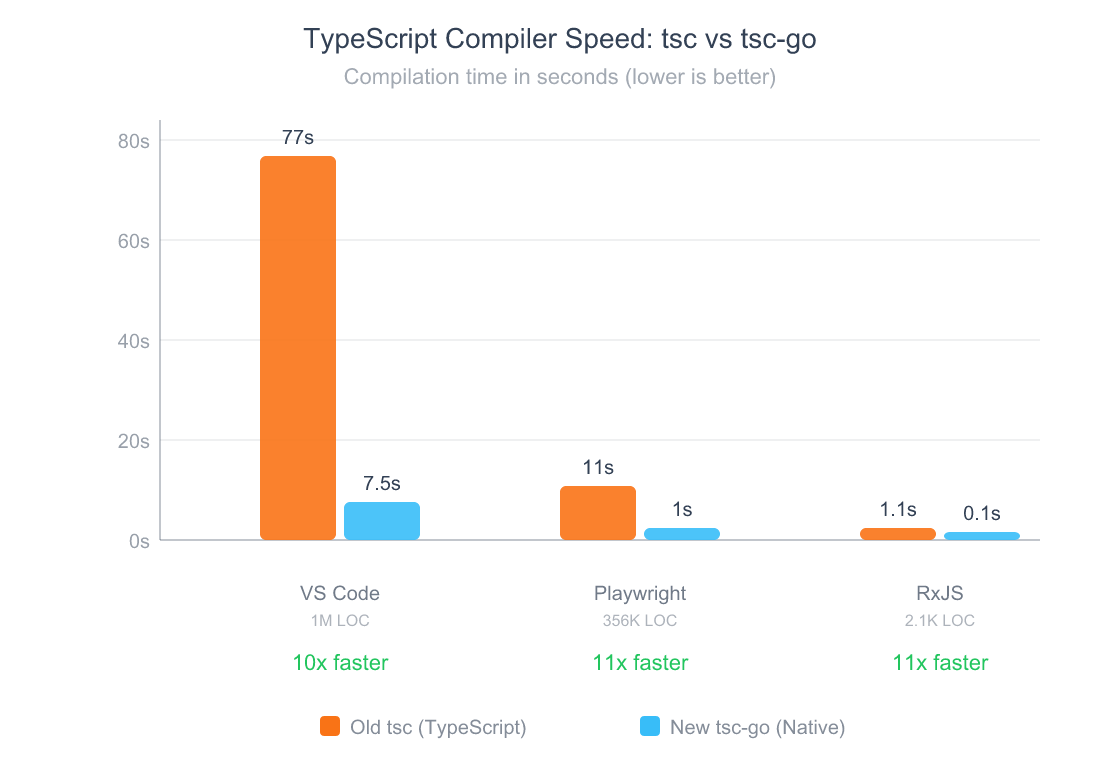
- The new tsc-go compiler delivers 10x faster builds, killing the compile-time objection.
- AI coding tools work dramatically better with typed codebases — 94% of LLM compilation errors are type-check failures.
- Plain JavaScript still wins for quick scripts, prototypes, and learning.
How Big Is TypeScript’s Adoption in 2026?
Forty percent of developers now write exclusively in TypeScript, up from 28% just three years ago — while only 6% stick to plain JavaScript alone (State of JavaScript 2026, 2026). That’s not a trend. That’s a migration.
The numbers stack up from every angle. Stack Overflow’s 2026 survey (49,000+ respondents across 177 countries) shows JavaScript at 66% overall usage versus TypeScript at 43.6% — but here’s what matters more: TypeScript’s “admired” rating sits at 72.4%, while JavaScript’s is just 58% (Stack Overflow, 2026). Developers who use TypeScript like it more than developers who use JavaScript like JavaScript.

JetBrains put TypeScript at the top of their Language Promise Index — a composite metric blending growth stability, adoption momentum, and user loyalty — alongside Rust and Go, based on a survey of 24,534 developers (JetBrains, 2026). TypeScript isn’t just growing. It’s growing in a way that suggests permanence.
What’s driving this? It isn’t hype. It’s pain avoidance. Every developer who’s spent four hours debugging a Cannot read property of undefined error understands the appeal of catching that at build time. And as codebases grow and teams scale, that appeal compounds.
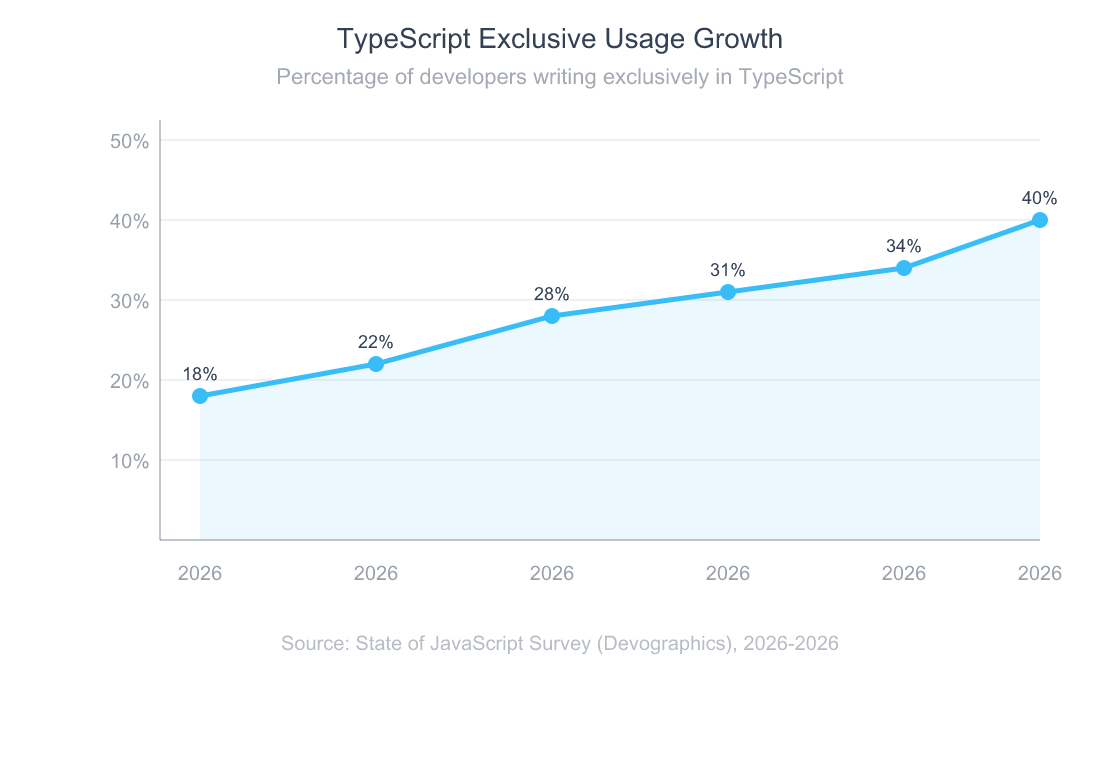
TypeScript exclusive usage more than doubled in five years, accelerating sharply from 2026 to 2026.
Citation Capsule: The State of JavaScript 2026 survey found that 40% of developers now write exclusively in TypeScript, up from 28% in 2026, while only 6% use plain JavaScript exclusively (Devographics, 2026). Combined with TypeScript reaching #1 on GitHub by monthly contributors, the data shows a language that’s moved from “nice to have” to industry default.
Does TypeScript Actually Prevent Bugs?
A peer-reviewed study examining 400 bugs across 389 public GitHub repositories found that 15% of JavaScript bugs could have been detected by TypeScript’s type system before the code ever ran (Gao, Bird & Barr, ICSE 2017). That’s one in seven bugs, caught for free at compile time.
And 15% is the conservative number. When Airbnb did a postmortem analysis of their own codebase, they found that 38% of production bugs were preventable with TypeScript (Brie Bunge, Airbnb/InfoQ, 2026). Not “could theoretically be caught.” Would have been caught. That’s the kind of math that makes engineering managers approve migration projects overnight.
I’ve seen this firsthand. In my own projects, the bugs TypeScript catches aren’t the dramatic ones — they’re the boring ones. Passing a string where a number was expected. Forgetting to handle a null return. Accessing a property that was renamed two sprints ago. These are the bugs that waste Tuesday afternoons. And TypeScript eliminates them before you even finish typing.
Here’s the thing skeptics miss: the 15-38% range understates the real impact. Those bugs don’t just cost time to fix. They cost time to find. A type error caught at compile time takes five seconds to resolve. The same bug discovered in production can burn hours of investigation. The ROI isn’t just about the bugs prevented — it’s about the debugging time you never have to spend.
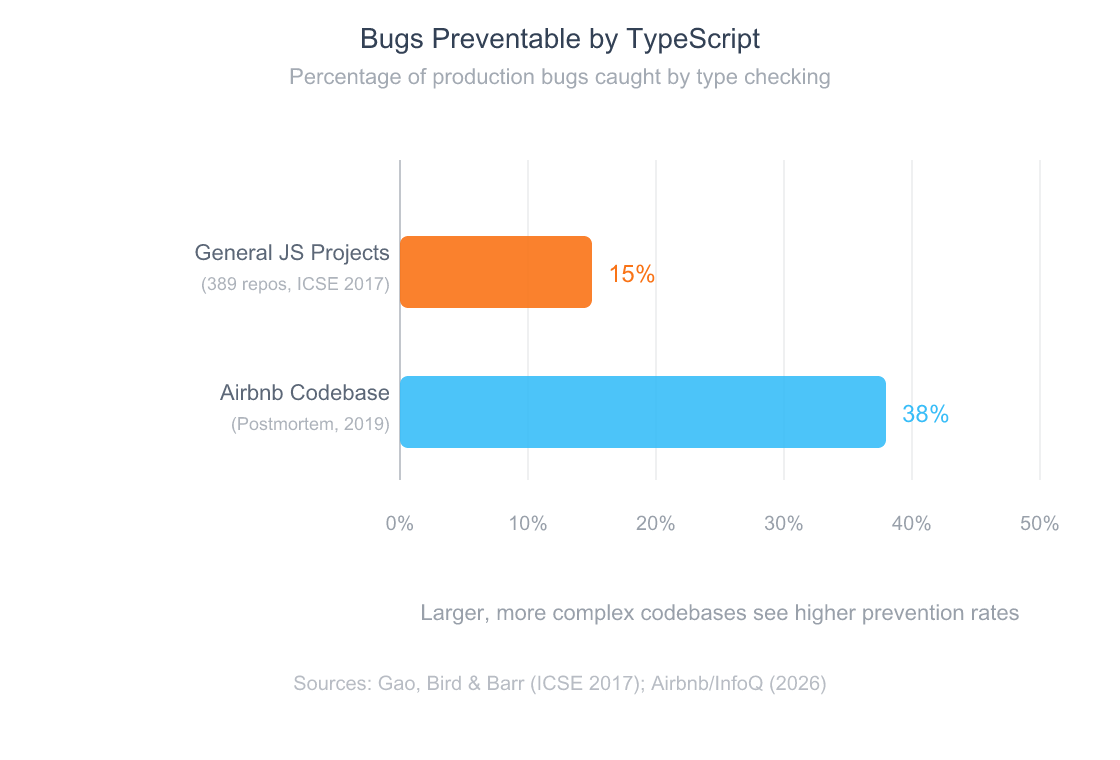
Airbnb’s real-world bug prevention rate was more than double the academic average, suggesting TypeScript’s value scales with codebase complexity.
Fireship’s 100-second overview of TypeScript — the fastest primer if you’re new to the language.
Citation Capsule: Microsoft’s native tsc-go compiler rewrites TypeScript compilation in Go, delivering 10x build speed improvements — reducing VS Code’s 1 million-line codebase from 77 seconds to 7.5 seconds (Microsoft/InfoQ, 2026). Combined with Node.js 23.6+ supporting native type stripping, the compile-time objection to TypeScript adoption is no longer credible.
Why Does TypeScript Win in the AI Era?
Here’s something almost nobody in the JavaScript-versus-TypeScript debate talks about: AI coding assistants work dramatically better with typed code. GitHub’s Octoverse 2026 report revealed that 94% of LLM-generated compilation errors are type-check failures (GitHub Octoverse, 2026). Think about what that means for a second.
When Copilot or Claude writes code for you, the overwhelming majority of errors it makes are exactly the kind TypeScript catches. Type mismatches. Wrong function signatures. Incorrect return types. In a JavaScript codebase, those errors slip through silently and explode at runtime — maybe in production, maybe at 2 a.m. In a TypeScript codebase, they get flagged immediately. Red squiggly line. Fix it. Move on.

Our finding: TypeScript’s value proposition has fundamentally shifted. It’s no longer just about protecting you from your own mistakes — it’s about protecting you from your AI assistant’s mistakes. As AI writes a growing share of production code, the type system becomes the safety net between generated code and production.
I’ve experienced this working with Claude Code daily. When I’m building in a TypeScript project, the AI’s suggestions are more accurate because the type context gives it better information about what’s expected. And when it does make mistakes, my editor catches them instantly. In JavaScript projects, I have to be much more vigilant reviewing AI output — there’s no compiler to watch my back.
This is arguably the strongest case for TypeScript in 2026. It isn’t just a developer productivity tool anymore. It’s an AI supervision tool. And as more code gets written by machines, that supervision layer only gets more valuable.
How I use Claude Code for AI-assisted TypeScript development
Citation Capsule: GitHub’s Octoverse 2026 report found that 94% of LLM-generated compilation errors are type-check failures (GitHub Octoverse, 2026). This makes TypeScript not just a developer productivity tool but an AI supervision tool — the type system catches the exact category of errors that AI coding assistants produce most frequently.
When Should You Still Use Plain JavaScript?
TypeScript isn’t always the right answer. I know — after four sections of glowing data, that might sound like a cop-out. But honesty matters more than advocacy.
Quick scripts and one-off automation. If you’re writing a 50-line Node script to rename files or process a CSV, adding TypeScript configuration is overhead you don’t need. Spin it up, run it, move on. Not everything needs to be production-grade.
Learning to code. If you’re just starting out, JavaScript has less friction. You don’t need to understand generics, union types, or tsconfig.json before writing your first for loop. Learn the language first. Add the type system when you start feeling the pain of not having it.
Rapid prototyping. When you’re validating an idea and plan to throw the code away, speed of iteration matters more than type safety. I’ve prototyped dozens of features in plain JavaScript before rebuilding the keepers in TypeScript.
Tiny projects you’ll never revisit. A personal blog, a weekend hack, a one-page site. If it’s under 500 lines and you’re the only one who’ll ever touch it, the overhead of TypeScript setup might not pay off.

The pattern is clear: JavaScript wins when code is short-lived, solo-authored, or experimental. The moment a project grows, gains collaborators, or heads toward production, TypeScript’s value starts compounding fast. The real question isn’t “JavaScript or TypeScript?” It’s “how long will this code live?”
Micro-SaaS Ideas That AI Can’t Replicate
Which Frameworks Default to TypeScript Now?
This is maybe the most telling signal of all. Every major web framework now scaffolds TypeScript by default (GitHub Octoverse, 2026). When you run npx create-next-app, you get TypeScript. When you start a new Angular project, TypeScript. When you scaffold SvelteKit, Astro, Qwik, SolidStart, or Remix — TypeScript. Every time.
| Framework | Default Language | TS Since |
|———–|—————–|———-|
| Next.js 16 | TypeScript | v13 (2026) |
| Angular 18 | TypeScript | v2 (2016) |
| SvelteKit 2 | TypeScript | v1 (2026) |
| Astro 3 | TypeScript | v1 (2026) |
| Qwik | TypeScript | v1 (2026) |
| SolidStart | TypeScript | v1 (2026) |
| Remix | TypeScript | v1 (2026) |
Framework authors don’t default to TypeScript for fun. They do it because their users file fewer bugs, their documentation becomes more precise, and the developer experience improves when types are present. It’s pragmatism, not tribalism.
TypeScript’s npm package now sees 55 million+ weekly downloads (npm, 2026). That’s not a language fighting for adoption. That’s infrastructure. When the tools you use assume TypeScript, opting out starts costing more than opting in.
Our finding: Every major JavaScript framework released since 2026 defaults to TypeScript scaffolding. The ecosystem has made its choice — the question for individual developers is whether to swim with the current or against it.
Frequently Asked Questions
Is TypeScript harder to learn than JavaScript?
TypeScript adds a learning curve, but it’s smaller than most people expect. You can start with basic type annotations and gradually adopt advanced features like generics and utility types. The 72.4% admiration rate in Stack Overflow’s 2026 survey suggests developers find it worthwhile once they invest the effort (Stack Overflow, 2026). Start with strict: false and turn on strictness incrementally.
Can I gradually migrate from JavaScript to TypeScript?
Yes — that’s actually the recommended path. TypeScript is a superset of JavaScript, so every .js file is valid TypeScript. Rename files to .ts one at a time, add types as you go, and increase compiler strictness over weeks. Airbnb migrated their entire codebase this way, eventually preventing 38% of production bugs (Airbnb/InfoQ, 2026).
Does TypeScript slow down runtime performance?
No. TypeScript compiles to plain JavaScript — the types are erased before execution, so there’s zero runtime overhead. With tsc-go delivering 10x compilation speedups and Node.js 23.6+ supporting native type stripping (Microsoft/InfoQ, 2026), even the build-time cost has become negligible.
Should I use TypeScript for a small personal project?
It depends on the project’s lifespan. For weekend hacks or throwaway prototypes, plain JavaScript is fine. But if there’s any chance the project will grow or you’ll revisit it in six months, TypeScript pays off quickly. The 40% of developers now using TypeScript exclusively aren’t doing it for big projects only (State of JavaScript 2026, 2026).
How does TypeScript work with AI coding assistants?
Exceptionally well. GitHub’s data shows 94% of LLM-generated compilation errors are type-check failures (GitHub Octoverse, 2026). TypeScript gives AI tools better context to generate accurate code, and when they make mistakes, the compiler catches them before you ship. It’s the best safety net for AI-assisted development.
How to set up Claude Code for TypeScript projects
The Verdict: TypeScript Is the Default, JavaScript Is the Exception
The data points in the same direction from every angle. TypeScript is the number one language on GitHub. It catches 15-38% of bugs automatically. The compile-time objection died with tsc-go’s 10x speedups. AI tools work better with it. Every major framework assumes it. And 40% of developers already use it exclusively.
Does that mean you should never write JavaScript again? No. Short scripts, learning projects, and quick prototypes are still valid JavaScript territory. But for anything that matters — anything with collaborators, production users, or a lifespan beyond next Tuesday — TypeScript isn’t just the better choice. It’s the obvious one.
My honest advice: if you’re starting any new project in 2026 and you’re asking “JavaScript or TypeScript?” — the answer is TypeScript unless you have a specific, concrete reason not to. The burden of proof has shifted. TypeScript is the default now. JavaScript is the exception.
What’s the Best Tech Stack for Micro SaaS in 2026?
The Developer Job Market After AGI
