
Fast and Slow Pointer Pattern: How to Recognize It and Use It in Interviews
AI changed the interview conversation, but it didn’t kill technical assessments. CoderPad reports that technical assessments on its platform grew 48% globally since mid-2026, while 53% of hiring leaders expect hiring-budget increases in 2026 (CoderPad, 2026). At the same time, HackerRank says 66% of developers prefer practical coding challenges over theoretical tests, yet algorithm-style screens still persist (HackerRank, 2025). That gap is exactly why pattern recognition matters.
The Fast and Slow Pointer pattern is one of the highest-leverage examples. Most people memorize it as Floyd’s cycle detection algorithm. That helps for one problem. It doesn’t help enough when the interviewer disguises the same structure inside an array, a number transformation, or a symmetry check. The real win is learning the trigger, not the trivia.
For a broader way to study recurring interview techniques, see our guide to recognizing algorithm patterns in interviews.
Key Takeaways
- Use Fast and Slow when the next state is deterministic and the reachable state space is finite.
- The speed gap guarantees a meeting if a cycle exists.
- The same pattern solves loop detection, duplicate-number problems, midpoint finding, and linked-list symmetry checks.
- CoderPad says technical assessments grew 48% globally since mid-2026, which is why reusable interview patterns still matter (CoderPad, 2026).
What Is the Fast and Slow Pointer Pattern?
Technical assessments are getting more AI-aware, not less frequent: CoderPad says 54% of developers would lose at least 10% productivity if AI disappeared tomorrow, yet assessment usage is still climbing (CoderPad, 2026). The practical implication is simple: interviewers still want proof that you can reason about structure even with tooling.
The Fast and Slow Pointer pattern uses two references moving through the same deterministic structure at different speeds. Slow moves one step. Fast moves two. If the structure eventually repeats a state, the faster pointer must eventually catch the slower one inside that repeated region.
That description is broader than “linked list cycle detection,” and that’s the important part. The structure can be a linked list, an array that behaves like a graph, or a repeated number transformation. If every state has one predictable next state, then you’re no longer dealing with random search. You’re dealing with a machine.
According to HackerRank, 96% of developers believe problem-solving should matter more than memorization in technical evaluations (HackerRank, 2025). The Fast and Slow Pointer pattern is valuable because it turns weird prompts into a recognizable machine: deterministic transitions, finite states, constant-space pressure.
Here’s the mental shift that makes the pattern stick: stop asking, “Is this a linked-list problem?” Start asking, “Does each state point to one next state, and am I trapped in a bounded system?” That question is what actually unlocks the pattern.
When Should You Use It?
HackerRank reports that 74% of developers still struggle to land roles despite improved demand, which means interview prep has to get more efficient, not more encyclopedic (HackerRank, 2025). Fast and Slow is useful because it compresses several common problems into one recognition rule.
Use the pattern when most of these are true:
- The next state is deterministic:
node.next,nums[i], or a transform like “sum of squared digits.” - The reachable state space is finite.
- The prompt nudges you toward O(1) extra space.
- The problem hints at repetition, a cycle, a duplicate, a midpoint, or symmetry.
Why does that combination matter? Because finite deterministic systems repeat. If you are not allowed to store visited states, then two-speed traversal is one of the cleanest ways to exploit repetition without using a hash set.
This is why the pattern shows up in:
- linked-list cycle detection
- middle-of-list problems
- palindrome linked lists
- find-the-duplicate-number
- happy number
According to CoderPad, 60% of hiring teams prioritize quality of hire over quantity in 2026 (CoderPad, 2026). In interviews, quality of reasoning often shows up as pattern selection: can you recognize the right abstraction quickly, or do you brute-force every prompt from zero?
For another way to build faster pattern recall, see our interview prep system for developers.
What Signals Should Trigger Fast and Slow?
CoderPad says the hiring conversation has shifted from “Should AI be allowed?” to “How do we assess real skill when AI can write code?” (CoderPad, 2026). That makes recognition signals even more valuable, because the interviewer is often measuring whether you see the shape of the problem before you touch syntax.
The clearest triggers are words like:
- cycle
- loop
- repeat
- duplicate
- do not modify input
But wording is only half the story. Structural signals matter more:
- values behave like pointers
- every state has one next hop
- you can model the prompt as
next = f(current) - the problem feels like a linked list even though it isn’t
That last one is the best shortcut. Find the Duplicate Number is the classic example. It looks like an array problem. Under the hood, it behaves like a linked structure where each value points to the next index. Once you notice that, Fast and Slow becomes natural.
According to HackerRank, 66% of developers prefer practical coding challenges, but outdated algorithmic tests still persist (HackerRank, 2025). In practice, that means you still need a shortlist of recognition triggers for the patterns interviewers keep reusing.
According to CoderPad’s 2026 hiring report, technical assessments are becoming more focused on authentic reasoning than raw memorization (CoderPad, 2026). When a prompt implies deterministic transitions, bounded states, and O(1) space, Fast and Slow is often the strongest first pattern to test.
Why Is Meeting Guaranteed?
Technical assessments grew 48% globally since mid-2026, according to CoderPad, which means you will keep seeing patterns that reward explanation under pressure, not just implementation speed (CoderPad, 2026). The guarantee behind Fast and Slow is one of those explanations interviewers love hearing clearly.
Once both pointers enter a cycle, the distance between them changes by one step per move. Slow gains one step. Fast gains two. Relative speed is one. Inside a loop, that means the gap shrinks modulo the cycle length until it becomes zero. Zero gap means collision.
You don’t need heavy notation to explain this well. Use the runner analogy. If two runners move on a circular track and one runner is faster, the faster runner eventually laps the slower one. A cycle is just a circular track made out of states instead of pavement.
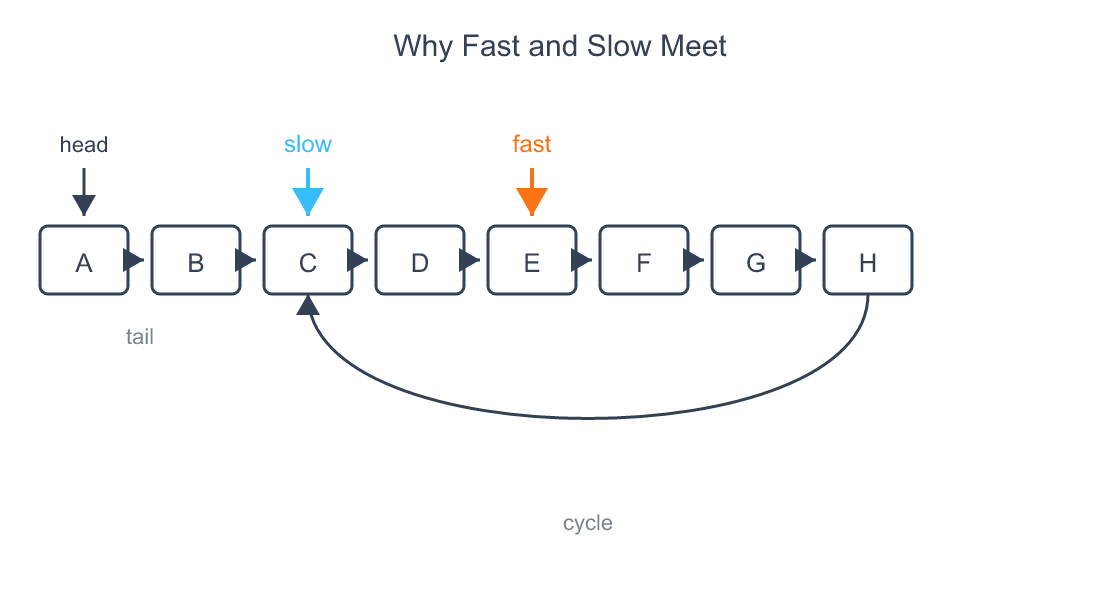
Snapshot the moment slow reaches the cycle entry (C). Fast, moving twice as fast, is already two nodes ahead (E). Each step, fast closes the gap by one. In three more steps, they land on the same node.
Here’s the invariant that matters: once both pointers are inside the same cycle, meeting is not a possibility. It’s a consequence.
How Does the Two-Phase Framework Work?
HackerRank says 96% of developers believe problem-solving should matter more than memorization, and this two-phase framework is the easiest way to show that you understand the pattern instead of reciting it (HackerRank, 2025). The framework has two jobs: detect repetition, then locate the structural meaning of that repetition.
Phase 1: Detect the Cycle
Move slow by one step and fast by two:
slow = head
fast = head

while fast and fast.next:
    slow = slow.next
    fast = fast.next.next
    if slow == fast:
        return True

return False
If fast reaches null, there is no cycle. If slow and fast meet, repetition exists.
Phase 2: Find the Entry
When the problem needs the cycle entry, reset one pointer to the start and move both one step at a time:
slow = head
fast = head

while fast and fast.next:
    slow = slow.next
    fast = fast.next.next
    if slow == fast:
        break

slow = head
while slow != fast:
    slow = slow.next
    fast = fast.next

return slow
Why does reset work? Because the distance from the head to the cycle entry matches the distance from the first meeting point to that same entry when both move at one step per turn. InterviewBit’s linked-list cycle explanations walk through the same intuition from the linked-list angle.
According to HackerRank’s 2025 report, developers are frustrated when assessments feel disconnected from real skill (HackerRank, 2025). Explaining the two-phase framework clearly is one of the fastest ways to demonstrate real understanding instead of memorized output.
For a companion pattern that also rewards clean phase-based thinking, see our binary search pattern guide.
What Does the Meeting Point Mean in Different Problems?
CoderPad reports that companies are increasingly looking for authentic signals of competence in technical assessments (CoderPad, 2026). One authentic signal is knowing that the same collision can mean different things depending on the structure you’re traversing.
| Context | Meaning of the meeting |
|---|---|
| Linked list | Both pointers are inside the loop |
| Array as graph | A duplicate value created the cycle |
| State machine | The process revisited a prior state |
| Number transform | The sequence is trapped in a non-terminating cycle |
This is where the pattern becomes powerful. You stop seeing “a list problem” or “an array problem.” You start seeing “a deterministic transition system.” That’s the generalization interviewers rarely say out loud, but they reward immediately when you use it.
According to HackerRank, 73% of developers think it is unfair to lose out to candidates who use AI to game tests (HackerRank, 2025). The easiest way to separate yourself from shallow answers is to explain what the meeting point represents in the current problem, not just how the pointer loop works.
This is the best compression rule I know for the pattern: the meeting point is never the final answer by default. It is evidence about the structure. Your real job is to interpret what that evidence means in context.
For another constant-space reasoning technique, see our in-place algorithm patterns.
What Else Can This Pattern Solve?
HackerRank says 66% of developers want practical challenges, yet algorithmic screens still show up often enough that you need a compact library of reusable moves (HackerRank, 2025). Fast and Slow earns its place because it solves more than one interview staple.
1. Linked List Cycle
The canonical use case. Detect whether a linked list loops back on itself.
2. Find the Duplicate Number
Treat each value as a pointer to the next index. That turns the array into an implicit graph with a duplicate-created cycle.
3. Happy Number
Repeatedly transform a number into the sum of the squares of its digits. If the process doesn’t reach 1, it eventually repeats a prior state and enters a cycle.
4. Middle of the Linked List
If fast moves twice as quickly and the structure has no cycle, fast hits the end while slow lands at the midpoint.
5. Palindrome Linked List
Use Fast and Slow to find the midpoint, reverse the second half, and compare both halves for symmetry.
InterviewBit’s linked-list question bank puts middle-node, cycle, and palindrome-style reasoning in the same family of recurring linked-list questions. That’s useful not because InterviewBit is the ultimate authority, but because it mirrors what many candidates actually practice against.
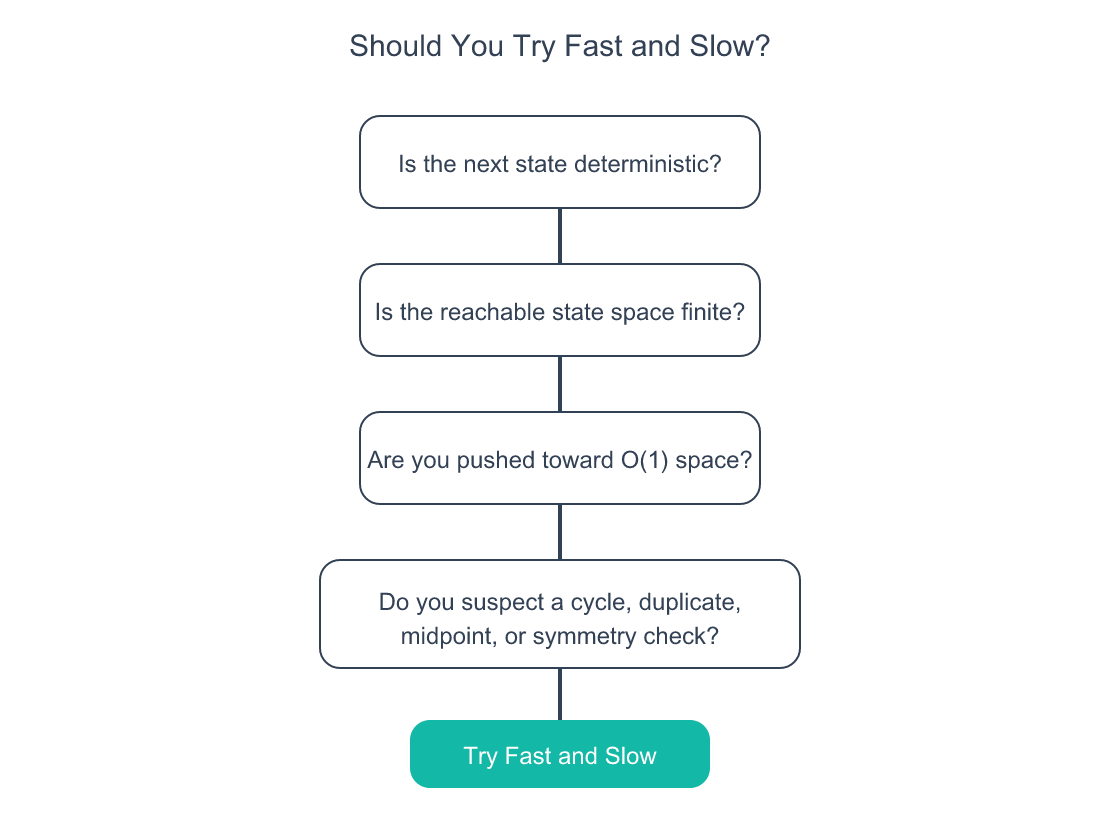
If those four answers trend yes, the pattern is usually worth testing first.
When Should You Avoid It?
Technical assessments may be evolving, but CoderPad still shows that teams are actively refining what “authentic skill” looks like in interviews (CoderPad, 2026). Knowing when not to use a pattern is part of that authenticity.
Fast and Slow is the wrong tool when:
- transitions are non-deterministic
- the reachable state space is not meaningfully bounded
- the prompt’s circular behavior depends on direction constraints your pointers can violate
- the structure is easier to reason about with explicit storage and the space limit is relaxed
Circular Array Loop is the classic trap. A naive two-pointer pass can miss the fact that movement direction matters. Single-element self-loops are another one. Some prompts count them as valid cycles. Others explicitly reject them.
According to HackerRank, 73% of developers worry about unfairness when hiring tests are gamed or poorly designed (HackerRank, 2025). In a real interview, one way to stand out is to flag the invalid cases before you start coding. It shows judgment, not just recall.
My rule here is simple: if the pattern needs too many caveats to stay correct, it probably isn’t the core pattern anymore. That’s usually your cue to step back and model the problem again.
Quick Interview Checklist
HackerRank reports that 96% of developers believe problem-solving should matter more than memorization, and this checklist is designed for exactly that pressure moment when you need a pattern fast (HackerRank, 2025). You don’t need a long theory dump. You need four sharp questions.
Ask these in under 30 seconds:
- Does every state point to one predictable next state?
- Is the reachable state space finite?
- Is O(1) extra space important here?
- Am I really being asked about a cycle, duplicate, midpoint, or symmetry check?
If the answer is mostly yes, try Fast and Slow before you reach for a hash set.
That one habit changes a lot. Instead of reacting to the surface wording, you start reacting to the structure underneath it. That’s what turns the pattern into a reflex.
For a deeper study sequence, continue with our future problem-solving hub page.
Frequently Asked Questions
Is Fast and Slow Pointer the same as Floyd’s Cycle Detection Algorithm?
Not exactly. Floyd’s algorithm is the most famous instance of the pattern, but the broader idea is two-speed traversal through a deterministic finite system. That framing helps you recognize more than one linked-list problem.
Why does resetting one pointer find the cycle entry?
Because after the first collision, the distance from the head to the cycle entry matches the distance from the collision point back to that same entry when both pointers move one step at a time. The next meeting is the entry.
When is a hash set better than Fast and Slow?
A hash set is better when the space limit is relaxed and clarity matters more than constant-space optimization. In interviews, though, an explicit O(1)-space constraint is often a strong hint that Fast and Slow is the intended direction.
Can Fast and Slow work on arrays?
Yes. Find the Duplicate Number is the best-known example. The array behaves like an implicit graph where each value points to the next position, which creates a cycle when a duplicate exists.
Is this pattern only for cycle problems?
No. It also helps with midpoint finding and linked-list symmetry checks. The common thread is not “cycle problem” as a label. It’s deterministic traversal with useful information encoded in relative speed.
Conclusion
Technical interviews are still alive, and pattern recognition is still one of the fastest ways to separate calm reasoning from brute-force trial and error. CoderPad says technical assessments have grown 48% globally since mid-2026, while HackerRank says 66% of developers still prefer practical coding challenges over theoretical tests (CoderPad, 2026; HackerRank, 2025). That means your best prep move is to learn the shapes interviewers keep reusing.
Fast and Slow Pointer is one of those shapes. If the problem gives you deterministic transitions, finite states, and pressure to stay in O(1) space, two pointers moving at different speeds should come to mind immediately.
Keep the recall line simple: if a problem feels like a linked list, but it isn’t, try Fast and Slow.
If you want to build a stronger interview toolbox from first principles, continue with future category hub for problem-solving articles.
