What Does a Personal AI Team Look Like for Solo Founders?
AI agents for solo founders are no longer theoretical — they’re shipping features and closing tickets right now. Picture this. It’s 2028. You wake up and check your phone. Your AI marketing agent published three blog posts overnight, scheduled a week of tweets, and replied to fifteen comments. Your AI support agent resolved eight customer tickets while you slept. Your AI engineering agent caught a production bug at 3 AM, wrote a fix, ran the tests, and deployed it. You open the revenue dashboard. Up 12% this month. You have zero employees.
Science fiction? Not really. The AI agents market is growing from $7.84 billion in 2026 to a projected $52.62 billion by 2030 — a 46.3% compound annual growth rate (MarketsandMarkets, 2026). The building blocks for a personal AI team already exist. What’s missing is the playbook for assembling them.
This guide is that playbook. I’ll walk through what an AI team org chart looks like for a one-person company, what you can build right now with today’s tools, what becomes possible by 2028, and how to start assembling your first agent team this week.
what agentic AI actually means
TL;DR: Solo founders can build a personal AI team using today’s agent tools — and by 2028, Gartner predicts 15% of work decisions will be made autonomously by AI agents (Gartner, 2026). Start with one agent handling one repetitive task, then add agents and connect them into a multi-agent system.
Table of Contents
- What Does an AI Team Org Chart Look Like?
- What Can You Automate With AI Agents Right Now?
- What Becomes Possible by 2028?
- How Do You Start Building Your AI Team Today?
- What Skills Matter When Agents Do the Work?
- FAQ
What Does an AI Team Org Chart Look Like?
Already, 35% of organizations report broad usage of AI agents across their operations (Salesmate, 2026). For solo founders, the opportunity isn’t replicating an enterprise deployment — it’s building a lean team of specialized agents, each handling a function you’d otherwise hire for. Think of it as your personal C-suite, running 24/7 for the cost of API calls.
Here’s what the org chart looks like when every department is an AI agent.
how the one-person company model works
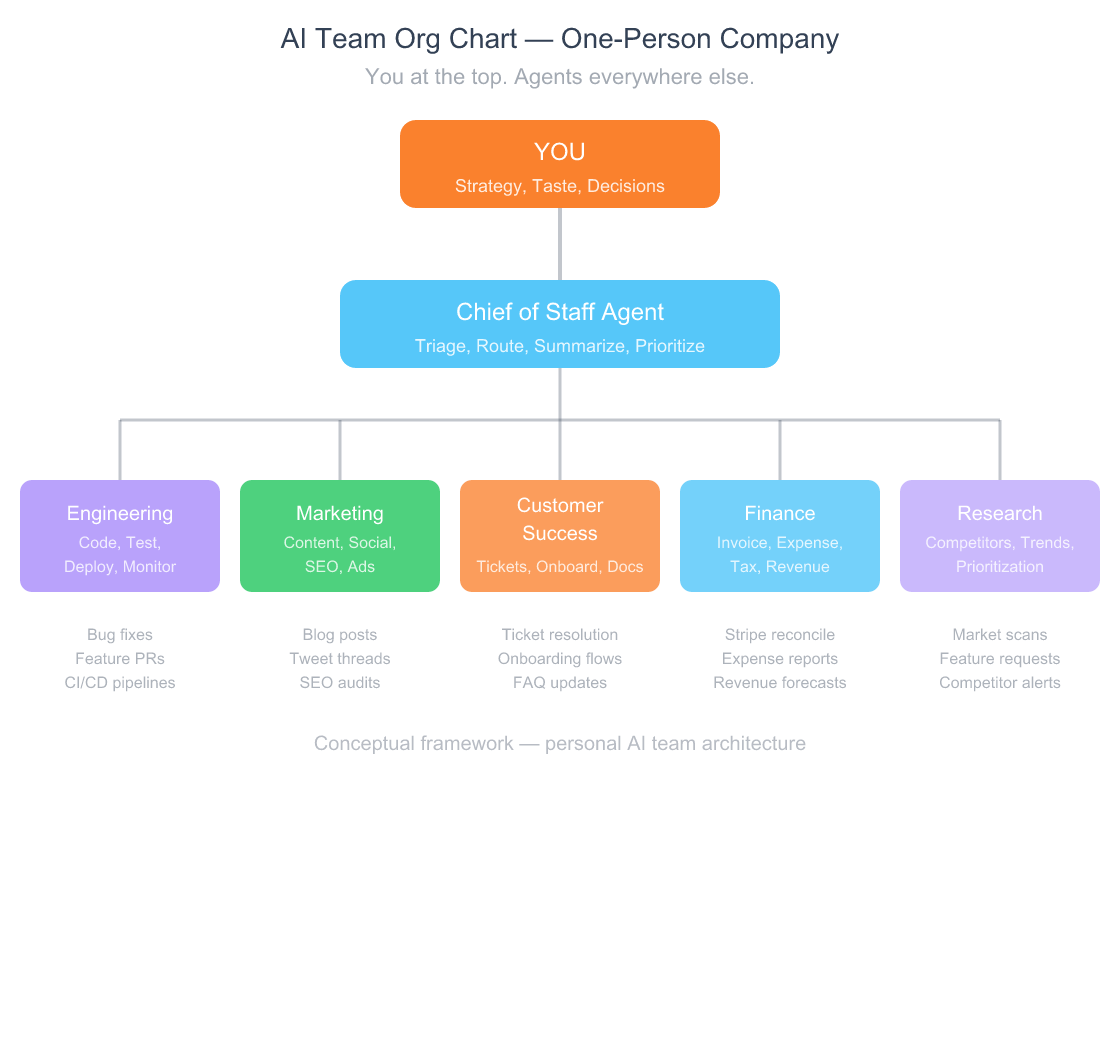
A personal AI team mirrors a traditional company structure — one founder giving direction, agents handling execution.
The Chief of Staff Agent
This is the agent that sits between you and everything else. It reads your inbox, triages requests, routes tasks to the right specialist agent, and compiles a daily summary. Think of it as your personal operating system. It knows your priorities, your calendar, and what each specialist agent is working on.
The Chief of Staff doesn’t execute tasks directly. It orchestrates. When a customer email comes in, it decides: is this a support ticket (route to Customer Success), a feature request (route to Research), or a partnership inquiry (flag for you)? That routing decision is where the real value lives.
The Engineering Agent
Writes code, runs tests, deploys to production, and monitors for issues. Today’s tools like Claude Code already handle substantial engineering tasks — writing full features from descriptions, debugging failing tests, and shipping pull requests. The engineering agent of 2028 won’t just respond to your commands. It’ll watch error logs proactively and fix issues before you even know they exist.
The Marketing Agent
Content creation, social media management, SEO optimization, and ad performance tracking. This agent writes blog drafts, schedules posts, analyzes what’s performing, and adjusts strategy. We’ve already seen marketing AI tools reduce content creation time by 40% (Salesforce, 2026). A dedicated marketing agent takes that further by connecting every marketing action to a unified strategy.
The Customer Success Agent
Resolves support tickets, writes onboarding documentation, and manages customer communications. It learns your product inside and out, answers common questions instantly, and only escalates the unusual cases to you. Gartner predicts that by 2029, AI agents will autonomously resolve 80% of common customer service issues (Gartner, 2026).
The Finance Agent
Invoicing, expense tracking, tax preparation, and revenue reporting. This agent reconciles your Stripe data, categorizes expenses, generates monthly reports, and flags anomalies. It won’t replace your accountant, but it’ll do 90% of the bookkeeping you currently avoid.
The Research Agent
Competitive analysis, market trend monitoring, and feature prioritization. This agent scans your competitors’ websites weekly, tracks industry news, analyzes customer feedback patterns, and surfaces insights that inform what you build next. It turns scattered information into structured intelligence.
Citation Capsule: The AI agents market is projected to grow from $7.84 billion in 2026 to $52.62 billion by 2030, a 46.3% CAGR (MarketsandMarkets, 2026). Solo founders can structure a personal AI team with six specialized agents — Chief of Staff, Engineering, Marketing, Customer Success, Finance, and Research — mirroring a traditional company hierarchy.
What Can AI Agents for Solo Founders Automate Right Now?
Multi-agent system usage spiked 327% over a four-month period in early 2026, according to Anthropic’s usage data (Anthropic, 2026). The tools aren’t theoretical. They’re shipping features, writing content, and managing workflows for thousands of solo founders today. Here’s what’s genuinely possible with tools available right now.

Engineering: Claude Code and Beyond
Claude Code can write and deploy full features from natural language descriptions. I’ve used it to scaffold entire project structures, write database migrations, implement API endpoints, and generate test suites. It’s not perfect — you still review and iterate — but it’s genuinely productive for a solo developer.
The workflow: describe what you want, let the agent write the code, review the output, ask for adjustments, then deploy. What used to take a full day of focused coding can compress into a few hours of directed iteration.
Marketing: AI-Powered Content Pipelines
Claude’s API combined with custom system prompts can generate blog post drafts, email sequences, social media content, and ad copy. The trick isn’t using a generic prompt — it’s building specialized prompt templates for each content type, pre-loaded with your brand voice, audience data, and strategic positioning.
I built Growth Engine’s content pipeline this way. Each agent has a deeply tailored system prompt that captures the exact tone, audience, and objectives. A generic “write a blog post” prompt gives you generic output. A system prompt with 2,000 words of brand context gives you output that sounds like your company wrote it.
Integrations: MCP and Workflow Automation
The Model Context Protocol (MCP) connects AI agents to your existing tools — Asana, Gmail, Google Calendar, Slack, your CRM. Instead of switching between ten tabs, your agent reads your project board, drafts responses, and updates tasks directly. Zapier and Make handle the automation layer, triggering agent actions based on events.
For example: a new support ticket arrives in your helpdesk. Zapier triggers your customer success agent, which reads the ticket, checks your knowledge base, drafts a response, and posts it. You review it once a day and handle the edge cases. That’s not 2028 speculation. That’s buildable this afternoon.
What’s Still Manual?
Not everything should be automated. Strategy requires human judgment — deciding what to build next, which market to target, how to position against competitors. Taste is irreplaceable. So is relationship building: investor calls, partnership negotiations, community engagement. The goal isn’t to remove yourself from the business. It’s to remove yourself from the repetitive tasks so you can focus on the work that only you can do.
how SaaS moats are shifting
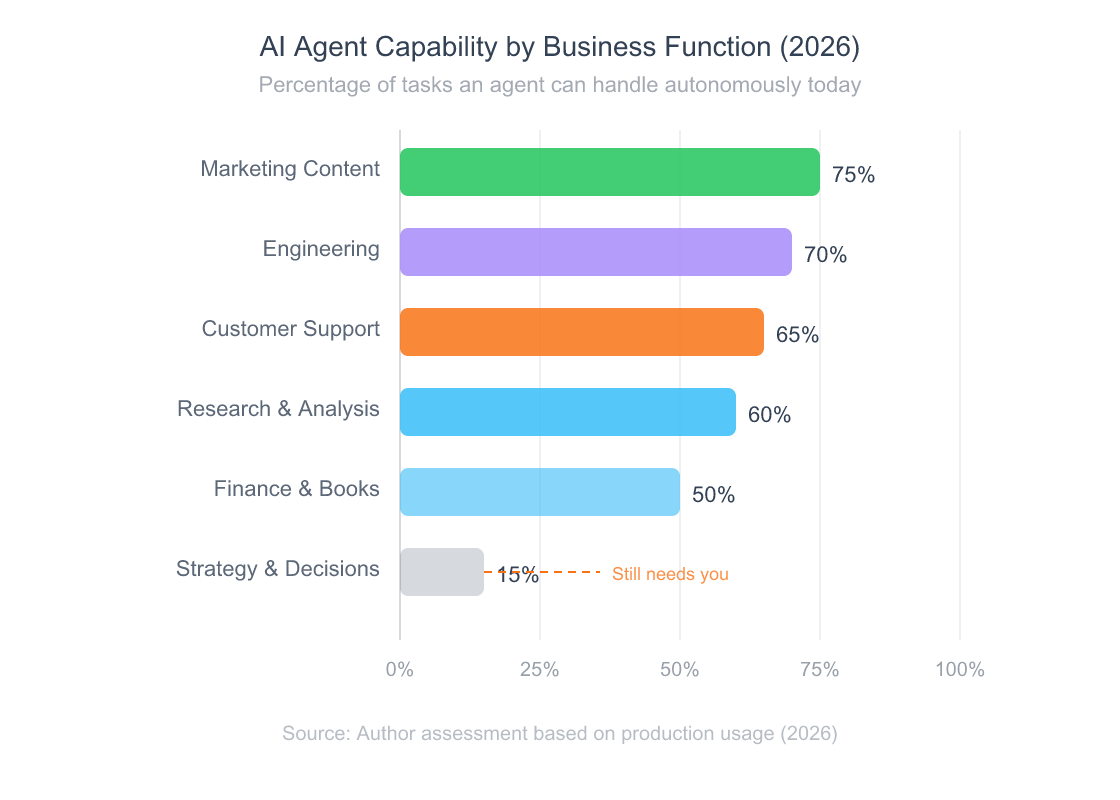
Marketing and engineering are the most automatable today. Strategy and high-stakes decisions remain firmly human.
Citation Capsule: Multi-agent system usage grew 327% in a four-month span in early 2026 (Anthropic, 2026). Current tools — Claude Code for engineering, Claude API for content, MCP for integrations, and Zapier/Make for workflow automation — already enable solo founders to automate 50-75% of execution tasks across most business functions.
What Becomes Possible by 2028?
Gartner forecasts that by 2028, at least 15% of day-to-day work decisions will be made autonomously by AI agents — up from virtually 0% in 2026 (Gartner, 2026). That’s a massive shift in just four years. What changes between now and then isn’t just speed or accuracy. It’s the fundamental nature of how agents operate.
Agents That Remember Your Decisions
Today’s agents start fresh every session. By 2028, persistent memory systems will let agents learn from your past decisions, preferences, and feedback. Your marketing agent won’t just generate a blog post — it’ll generate a blog post in the style you’ve refined over two years of corrections. Your engineering agent will know your coding conventions, your architectural preferences, your testing philosophy.
This changes the feedback loop dramatically. Right now, you prompt, review, correct, repeat. With decision memory, corrections accumulate. Each interaction makes the next one better.
Agents That Talk to Each Other
The biggest unlock isn’t smarter individual agents — it’s agent-to-agent communication. When your customer success agent spots a recurring complaint, it should automatically notify your engineering agent to prioritize a fix and your marketing agent to update the FAQ. Today, you’re the message broker between your tools. By 2028, multi-agent orchestration handles that routing automatically.
The 327% spike in multi-agent usage we’re already seeing hints at where this is heading. Teams are building systems where agents hand off work, share context, and coordinate — just like human employees do.
Agents That Act Proactively
Current agents respond to commands. Future agents will suggest actions. Your research agent notices a competitor launched a new feature — it drafts a competitive analysis, suggests positioning updates, and queues a blog post idea. Your finance agent sees a dip in MRR and alerts you with three hypotheses and recommended actions.
This shift from reactive to proactive is what separates a tool from a teammate. You don’t tell teammates what to do every morning. They see problems and propose solutions.
Agents That Handle Exceptions Gracefully
Today’s agents escalate everything unusual. A customer asks a question that’s slightly outside the knowledge base, and the agent punts to you. By 2028, agents will handle a wider band of exceptions — trying multiple approaches, consulting other agents, and only escalating genuine edge cases.
Low-code platforms are already democratizing this capability. Non-technical founders can configure exception-handling rules and escalation paths without writing code (Gartner, 2026). The barrier to building sophisticated agent behavior is dropping fast.
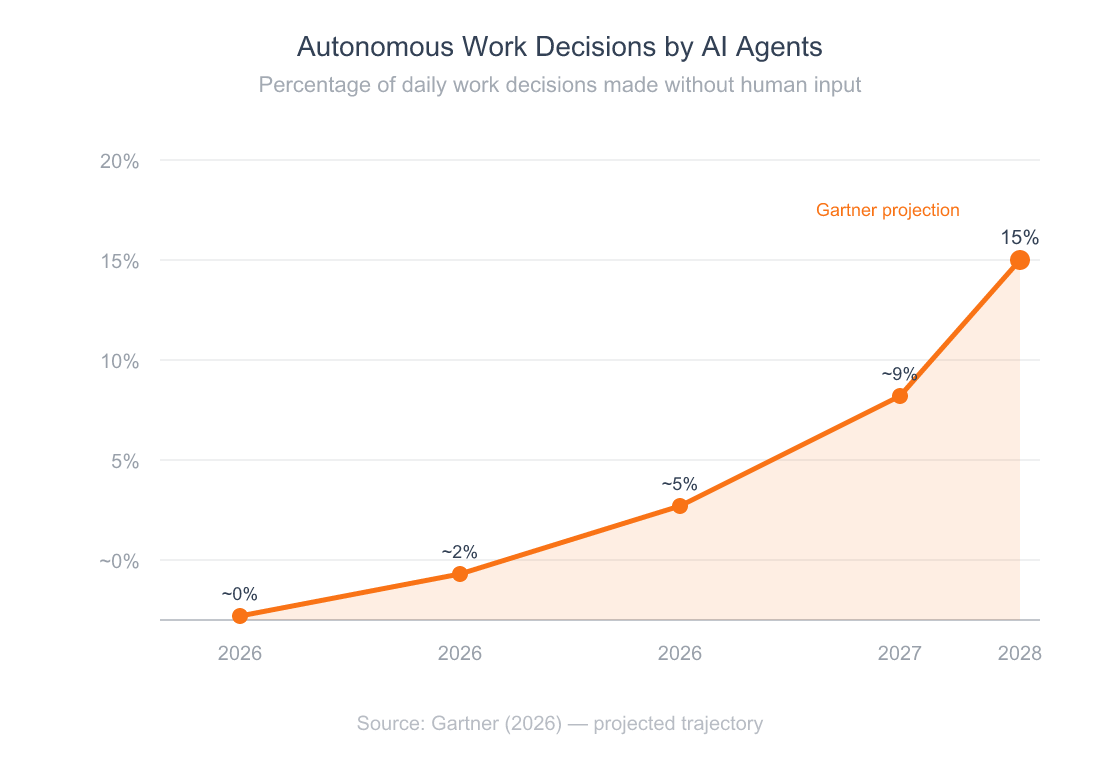
Autonomous decision-making by AI agents is accelerating. The jump from ~5% in 2026 to 15% by 2028 represents a fundamental shift in how work gets done.
Citation Capsule: By 2028, at least 15% of day-to-day work decisions will be made autonomously by AI agents, up from virtually 0% in 2026 (Gartner, 2026). Key enablers include persistent memory, multi-agent orchestration, proactive behavior, and improved exception handling — all advancing rapidly through low-code platforms.
How Do You Start Building Your AI Team Today?
McKinsey reports that 72% of companies now use AI in at least one business function, up from 55% in 2026 (McKinsey, 2026). You don’t need to wait for 2028 to start. The best time to begin building your personal AI team is now — and the approach is simpler than you’d expect. Start with one agent. One task. One repetitive job you hate doing.
Step 1: Identify Your Most Repetitive Tasks
Audit your week. What do you do repeatedly that follows a predictable pattern? Content drafting, support responses, data entry, invoice processing, social media posting — these are your agent candidates. Write them down. Rank them by time consumed and how formulaic they are.
The sweet spot is tasks that are time-consuming, repetitive, and have a clear “good enough” quality bar. Writing a customer onboarding email? Perfect agent task. Deciding your product roadmap? That stays with you.
Step 2: Build One Agent for One Task
Pick the task at the top of your list. Build one agent to handle it. If it’s content generation, set up a Claude API call with a detailed system prompt that includes your brand voice, target audience, and content guidelines. If it’s support, connect a model to your knowledge base and helpdesk via MCP.
Don’t try to build the entire org chart at once. That’s how AI projects fail. You want one agent working reliably before you add a second.
When I built Growth Engine, I started with a single marketing strategist agent. It took me two days to get the system prompt right — iterating on output quality, adding context about brand positioning, adjusting the tone. Only after that agent produced consistently good results did I add the analyst, writer, and advisor agents.
Step 3: Create Feedback Loops
Review every piece of agent output for the first two weeks. Not to do the work yourself, but to improve the prompts. When the agent produces something off-target, ask yourself: what context was it missing? Then add that context to the system prompt.
This is where most people give up too early. The first output from any agent is mediocre. The tenth is solid. The hundredth — after dozens of prompt refinements — is genuinely good.
Step 4: Add a Second Agent and Connect Them
Once your first agent is reliable, add a second that handles a different function. Then connect them. Your research agent’s competitive analysis becomes input for your marketing agent’s content calendar. Your customer success agent’s frequently asked questions feed your engineering agent’s bug priority list.
The connections between agents matter more than any individual agent’s capability. A team of mediocre agents with great communication outperforms brilliant agents that operate in isolation.
Step 5: Build Your Chief of Staff
This comes last, not first. Your orchestration layer should emerge from real workflows, not theoretical architecture. After running two or three specialist agents, you’ll naturally see patterns — tasks that require coordination, handoffs that happen repeatedly, daily summaries you want compiled. That’s when you build the Chief of Staff agent to manage those patterns.
how I built a multi-agent marketing system

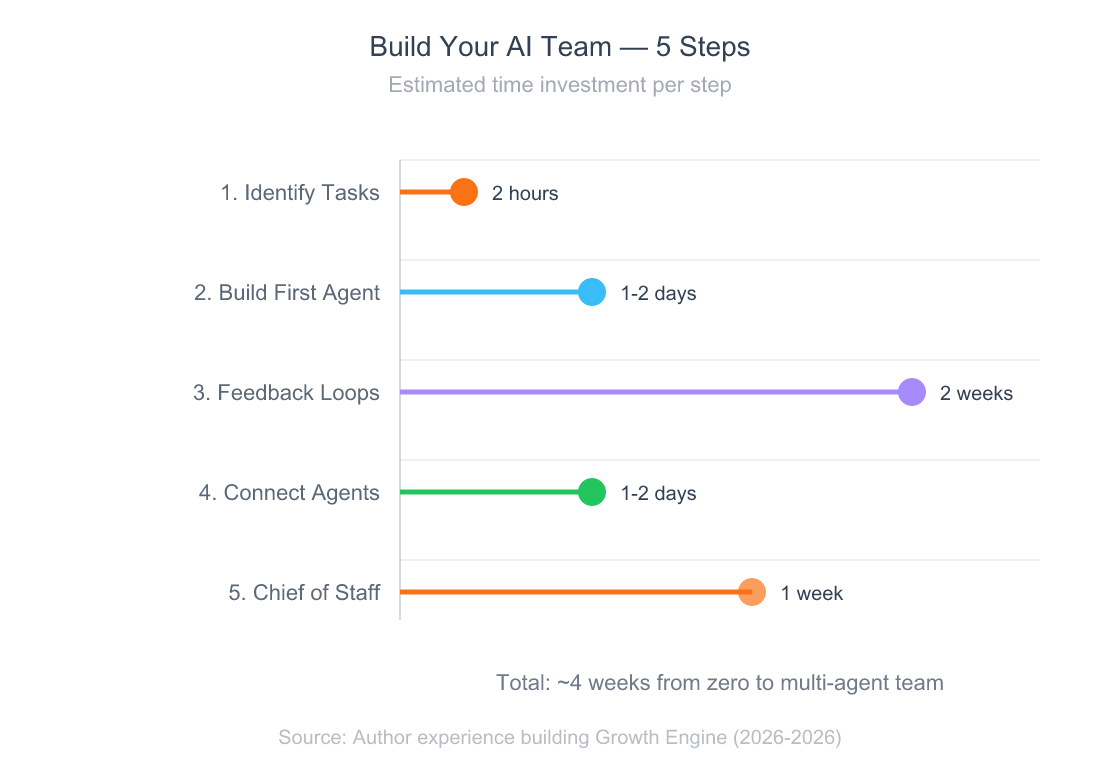
The feedback loop phase (step 3) takes the longest — but it’s where agent quality goes from mediocre to genuinely useful.
Citation Capsule: Seventy-two percent of companies now use AI in at least one business function (McKinsey, 2026). Solo founders can build a functional personal AI team in roughly four weeks by starting with one agent for one task, iterating through feedback loops, then gradually connecting specialist agents into a coordinated system.
What Skills Matter When Agents Do the Work?
The shift from doing the work to directing the work demands a fundamentally different skill set. Enterprises deploying AI agents already report 171% average ROI (Deloitte, 2026) — but that ROI goes to teams that understand how to architect, prompt, evaluate, and orchestrate agent systems. Here are the five skills that will define the most effective solo founders.
Agent Architecture Design
How do your agents communicate? What context do they share? When does one agent’s output become another’s input? These architectural decisions determine whether your AI team produces coherent, coordinated work or a mess of disconnected outputs.
The wrong architecture creates agents that duplicate work, contradict each other, or lose context between handoffs. The right architecture creates something that feels like a real team — where information flows naturally and outputs build on each other.
Prompt Engineering at Scale
Writing one good prompt is a skill. Writing twenty system prompts that work together across an agent team is a discipline. Each specialist agent needs a deeply crafted system prompt that defines its role, boundaries, output format, quality standards, and how it communicates with other agents.
In Growth Engine, each agent has a system prompt between 1,500 and 2,500 words. That’s not filler — it’s specific instructions about brand voice, output structure, quality thresholds, and inter-agent communication protocols. The difference between a 200-word generic prompt and a 2,000-word tailored one is the difference between “meh” output and output your customers can’t distinguish from human work.
Quality Control and Evaluation
How do you know your agent’s output is good? This is harder than it sounds. You need evaluation frameworks — rubrics for each agent that define what “good” looks like across multiple dimensions. Speed, accuracy, tone, completeness, consistency with brand guidelines.
Without evaluation, you’re flying blind. You can’t improve what you don’t measure. Build simple scorecards for each agent and review a random sample of outputs weekly.
Orchestration and Tool Integration
MCP, function calling, tool use, API chaining — these are the plumbing that connects agents to your business. Understanding how agents invoke external tools, pass data between systems, and handle errors in multi-step workflows is essential.
What happens when an API call fails mid-workflow? When two agents need the same resource simultaneously? When the output of one agent doesn’t match the expected input format for the next? These orchestration challenges are where most multi-agent systems break down.

Product Taste
This is the skill you absolutely cannot delegate to an agent. Taste means knowing when something is “right” even if you can’t articulate why. It’s the judgment call about whether a blog post sounds like your brand, whether a feature serves your users, whether a marketing angle is authentic or forced.
Agents produce volume. Taste produces quality. The founders who thrive with AI teams will be the ones who develop sharp taste and apply it ruthlessly to agent output.
why SaaS as we know it is changing
micro-SaaS ideas AI won’t replace
Citation Capsule: Enterprises deploying AI agents report 171% average ROI and 26-31% cost savings (Deloitte, 2026). The five critical skills for solo founders building AI teams are agent architecture design, prompt engineering at scale, quality evaluation frameworks, orchestration and tool integration, and product taste — the one capability that remains irreplaceably human.
FAQ
How much does it cost to run a personal AI team?
Costs depend on usage volume. A solo founder running agents for content, support, and research can expect $50-200 per month in API costs — far less than any single employee hire. The AI agents market is growing at 46.3% CAGR to $52.62 billion by 2030 (MarketsandMarkets, 2026), which means costs are dropping as competition intensifies.
building a marketing stack on zero budget
Can non-technical founders build AI agent teams?
Yes. Low-code platforms like Zapier, Make, and Relevance AI let non-technical users configure agent workflows without writing code. Gartner notes that low-code tools are democratizing agent deployment across skill levels (Gartner, 2026). You won’t build the most sophisticated system, but you can automate 60-70% of repetitive tasks with drag-and-drop tools.
What’s the biggest mistake founders make with AI agents?
Automating too much, too fast. The most common failure pattern is building a complex multi-agent system before validating that a single agent produces reliable output. Start with one agent. Get it right. Then expand. McKinsey found that less than 10% of organizations have scaled AI agents in any individual function (McKinsey, 2026).
Will AI agents replace the need for employees entirely?
Not likely in the near term. AI agents handle repetitive, pattern-based tasks well. They struggle with novel situations, relationship building, and nuanced judgment. By 2028, Gartner expects agents to handle 15% of work decisions autonomously (Gartner, 2026). That’s transformative for solo founders but doesn’t eliminate the need for human collaboration on complex projects.
what agentic AI is and how it works
What tools should I start with?
For technical founders: Claude Code for engineering, Claude API for content generation, and MCP for tool integrations. For non-technical founders: Zapier or Make for workflow automation plus a platform like Relevance AI for agent configuration. Either path, start with one tool and one task before stacking.
Build Your AI Team — Starting Now
The era of the personal AI team isn’t a future prediction. It’s a transition happening right now. The market data backs it: $7.84 billion in 2026, projected $52.62 billion by 2030 (MarketsandMarkets, 2026). Multi-agent usage up 327% in four months (Anthropic, 2026). Thirty-five percent of organizations already using agents broadly (Salesmate, 2026).
The question isn’t whether AI agents will run businesses. It’s whether you’ll be one of the founders who builds that system early — or one who scrambles to catch up.
I’m building my AI team right now. Growth Engine is already a multi-agent system — four specialized agents generating complete marketing kits. StatusLink will add agent-powered features soon. Follow the build at maketocreate.com.
Start this week. Pick one repetitive task. Build one agent. Refine the prompts. Then add a second. Within a month, you’ll have the beginning of something powerful: a team that works 24/7, costs less than your coffee habit, and gets smarter every time you correct it.
how I built my multi-agent marketing system
getting started with agentic AI
I Built a Multi-Agent Code Review Skill for Claude Code — Here’s How It Works
Why Indie Hackers Fail at Marketing (And What to Do Instead)
How to Create a Marketing Strategy When You’re a Solo Founder With No Budget