Should You Wait for the iPhone 18 Pro Max? Here’s What Apple Fans Need to Know
Apple’s September 2026 event is roughly six months away, and the rumor mill is already running hot. A 2nm chip. Variable aperture camera. The biggest iPhone battery ever. If you’re clutching an aging iPhone and wondering whether now’s the time — or whether patience pays off — you’re not alone.
42% of U.S. iPhone buyers in the year ending September 2026 replaced a device they’d owned for three or more years (CIRP, 2026). That’s up from 32% the year before — a massive spike that suggests millions of people are sitting on old hardware, waiting for the right moment to jump.
This guide breaks down every credible iPhone 18 Pro Max rumor, compares it directly against the current iPhone 17 Pro Max, and gives you a model-by-model verdict on whether to wait or buy now.
Apple ecosystem buying guide
TL;DR: The iPhone 18 Pro Max is expected in September 2026 with a 2nm A20 Pro chip (+15% performance, +30% efficiency), a first-ever variable aperture camera, and 45W wired charging. If you’re on an iPhone 13 or older, it’s worth the wait — CIRP data shows 42% of 2026 buyers upgraded from 3+ year-old devices. If you bought an iPhone 16 or newer, skip this generation entirely.
What’s Actually Rumored for the iPhone 18 Pro Max?
The A20 Pro chip, built on TSMC’s 2nm process, is expected to deliver roughly 15% faster performance and 30% better power efficiency compared to the 3nm A19 Pro (MacRumors, 2026). That’s not just a spec sheet flex — it means Apple Intelligence features will run faster on-device with less battery drain. For Apple fans who actually use writing tools, image generation, and Siri’s expanded capabilities daily, the 2nm jump matters.
But the real headline? The camera. Apple’s reportedly bringing a 48MP main sensor with variable aperture to the iPhone 18 Pro Max — a first for any iPhone (9to5Mac, 2026). Variable aperture (think f/1.4 to f/2.0) gives you DSLR-style depth-of-field control without relying entirely on computational photography. Shallow background blur for portraits. Sharper landscapes when you stop down. It’s the kind of hardware leap that software updates can’t replicate.
Here’s what else is on the table:
- Battery: 5,100-5,200 mAh — the largest ever in an iPhone, up from 5,088 mAh on the 17 Pro Max
- Charging: 45W wired (+50% over iPhone 17 PM’s 30W) and 25W MagSafe (+67%)
- Front camera: 24MP, a 33% jump from the 17 Pro Max’s 18MP selfie shooter
- Dynamic Island: Shrinking roughly 35% thanks to under-display Face ID components
- Display: Peak brightness bumped to an estimated 3,200 nits
- Price: Expected to hold at $1,199, matching the iPhone 17 Pro Max
According to Apple Insider, the A20 Pro built on TSMC’s 2nm node will use wafer-level multi-chip module (WMCM) packaging to integrate RAM directly, delivering 30% better power efficiency than the 3nm A19 Pro (Apple Insider, 2026). This architectural shift means thinner devices that run cooler under sustained AI workloads.
How Does the iPhone 18 Pro Max Stack Up Against the 17 Pro Max?
The iPhone 17 Pro Max outsold the iPhone 16 lineup by 14% in its first 10 days on sale in the U.S. and China (Counterpoint Research via MacRumors, 2026). It’s a strong phone. So what does the 18 Pro Max actually improve?
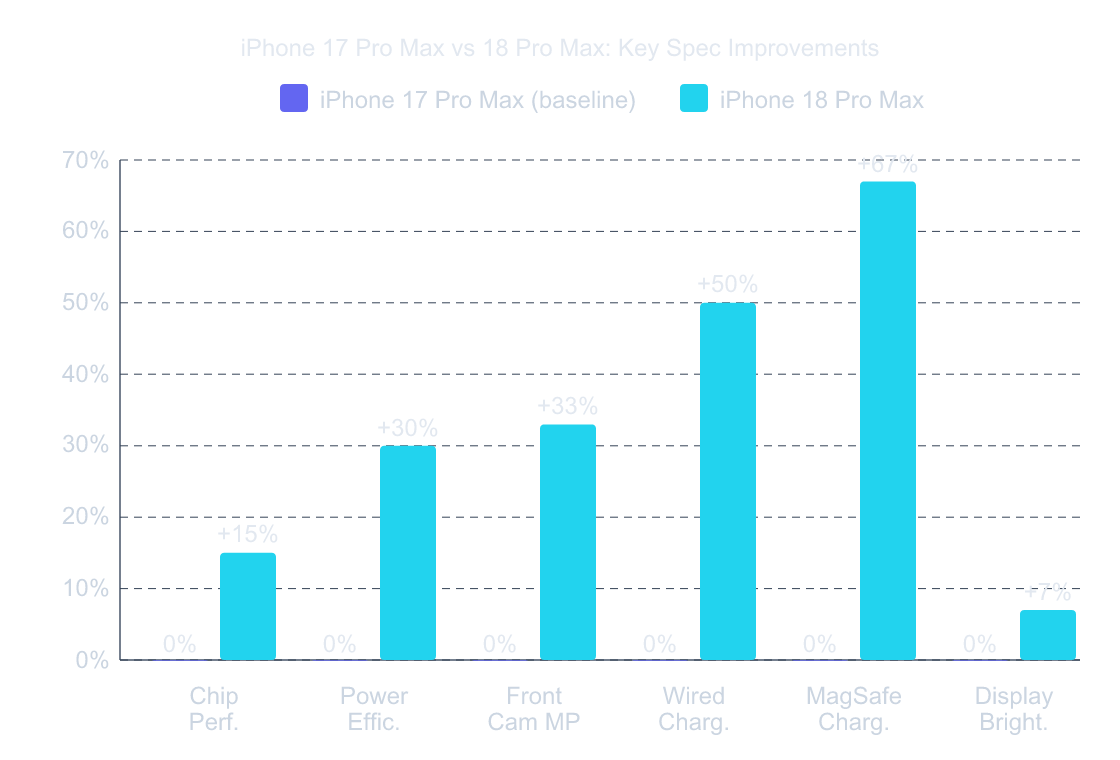
Source: MacRumors, Apple Insider (2026-2026). Percentage improvements calculated from iPhone 17 Pro Max baseline specs.
The biggest jumps are in charging speed and power efficiency — not raw performance. That’s a pattern Apple’s been leaning into since the A16. Each year, the chip gets meaningfully more efficient, while raw speed gains shrink. What does that mean practically? Your phone dies slower, charges faster, and runs AI features without turning into a hand warmer.
The variable aperture camera is the wildcard. Fixed-aperture phones rely on computational bokeh — software guessing what should be blurry. Variable aperture gives you optical control. If you shoot in ProRAW or care about night photography, that’s a genuine reason to wait. If you mostly point and shoot? The iPhone 17 Pro Max’s camera is already excellent.
The iPhone 18 Pro Max’s variable aperture (f/1.4-2.0) marks the first time an iPhone has offered optical depth-of-field control, eliminating the need for computational bokeh in portrait photography (MacRumors, 2026). This hardware-level camera upgrade can’t be replicated via software updates on older models.
smartphone photography tips
Which iPhone Do Most People Actually Use Right Now?
The iPhone 13 — a phone released in September 2026 — is still the single most-used iPhone model at 14.59% share, according to telemetry data from roughly 16 million monthly active users (TelemetryDeck, February 2026). The iPhone 16 Pro sits at 11.60%, and the iPhone 15 at 11.58%. In other words, the installed base is fragmented, and a huge chunk of Apple’s audience is sitting on hardware that’s three to five years old.
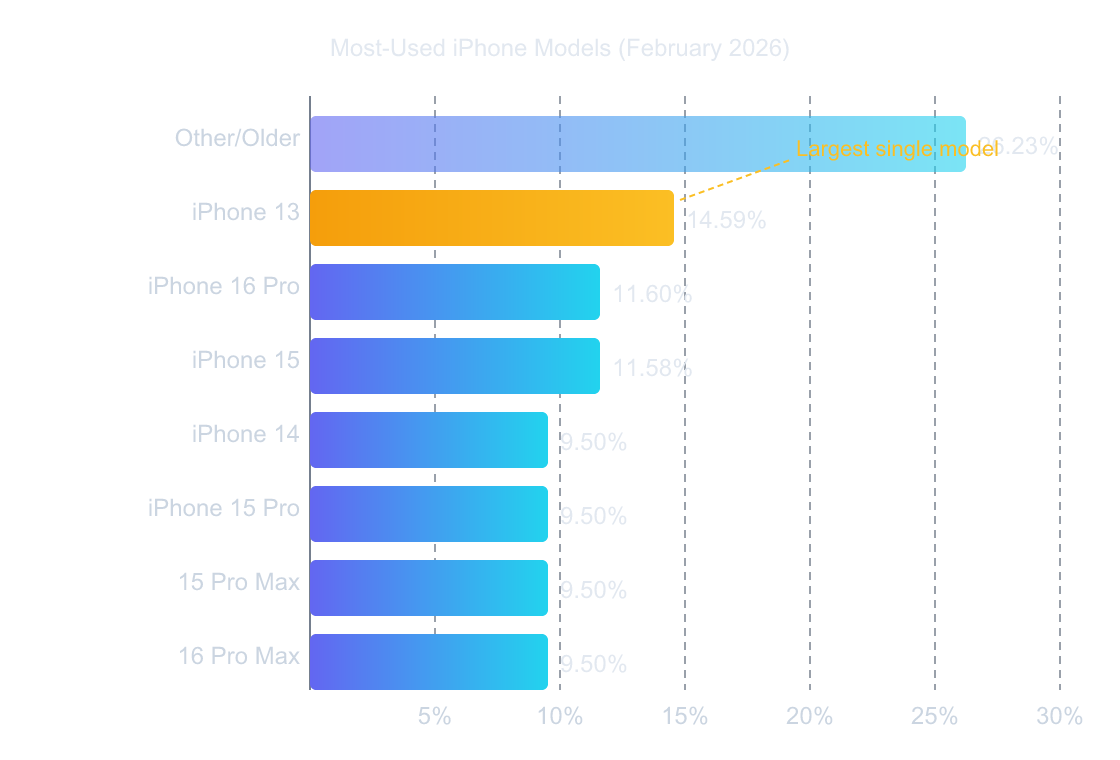
Source: TelemetryDeck, February 2026. iPhone 13 highlighted as the single most-used model despite being 4+ years old.
Why does this matter for the upgrade decision? Because the average U.S. iPhone upgrade cycle has stretched to 3.84 years (CIRP, 2026). If you’re on an iPhone 13 or 14, you’re squarely in that window. You’ve ridden the depreciation curve about as far as it goes — trade-in values drop sharply after the four-year mark.
And what’s actually pushing people to finally upgrade? Battery degradation, by a landslide. A SellCell survey of 19,217 respondents found that 75% cite battery health as their primary reason for switching phones (SellCell, 2026). Not new features. Not a better camera. The phone just doesn’t last through the day anymore.
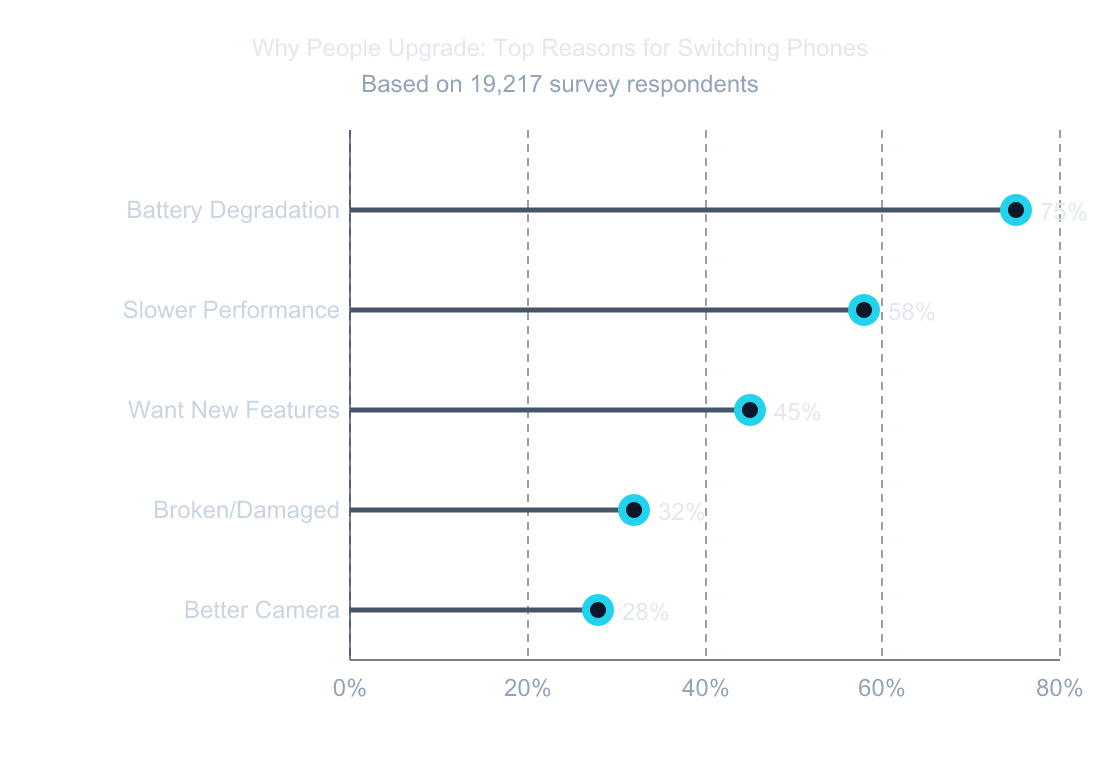
Source: SellCell Survey (19,217 respondents), 2026. Battery degradation and performance slowdowns drive the majority of upgrade decisions.
TelemetryDeck’s February 2026 data, drawn from 16 million monthly active users across approximately 8,000 apps, reveals that the iPhone 13 still holds 14.59% usage share — making it the single most popular active iPhone model (TelemetryDeck, 2026). This concentration of users on 4+ year-old hardware suggests a massive pending upgrade wave.
Should You Wait or Upgrade Now? A Model-by-Model Breakdown
This is where it gets personal. The right answer depends entirely on what you’re holding right now. Here’s the honest breakdown — no hedging.
Our take: The upgrade decision isn’t about whether the iPhone 18 Pro Max is “good enough.” Every iPhone since the 14 has been good enough. It’s about whether your current phone’s pain points align with what the 18 Pro Max specifically fixes.
iPhone 12 or Older: Upgrade Now — Don’t Wait
Your phone doesn’t support Apple Intelligence at all. You’re missing out on the single biggest software shift Apple has made since the App Store. Battery health is almost certainly below 80%. Trade-in value is approaching zero. Buy the iPhone 17 Pro Max today, or wait for the 18 — but don’t sit on a phone that’s functionally end-of-life.
iPhone 13: Wait for the iPhone 18 Pro Max
You’re the single largest cohort of active iPhone users at 14.59% (TelemetryDeck, 2026). Your battery is probably struggling after four years. You have limited Apple Intelligence support. The jump from A15 to A20 Pro will be night-and-day — five chip generations in one upgrade. Wait six more months. It’s worth it.
iPhone 14 / 14 Pro: Wait If the Camera Matters
You’ve got basic Apple Intelligence, but the A16 chip limits what it can do. If you’re frustrated by camera performance in low light or want variable aperture control, the iPhone 18 Pro Max is your play. If you’re mostly happy and just want a speed bump, the iPhone 17 Pro Max at a discount (once the 18 launches) might be the smarter buy.
iPhone 15 / 15 Pro: Marginal Gains — Wait Unless Battery Is Dying
The A17 Pro is still plenty fast. You’ve got USB-C, the Dynamic Island, and solid Apple Intelligence support. The iPhone 18 Pro Max’s improvements — variable aperture, faster charging, slightly better efficiency — are nice-to-haves, not must-haves. Unless your battery health has tanked below 80%, you’re fine to hold another year.
iPhone 16 / 16 Pro: Skip This Generation Entirely
You’ve got the A18 Pro, a 48MP main camera (without variable aperture), and full Apple Intelligence. The jump to the iPhone 18 Pro Max is incremental at best. Wait for the iPhone 19 or even the 20 — the 2nm efficiency gains won’t feel dramatic when you’re only one generation behind.
iPhone 17 Pro Max: Do Not Upgrade
You bought the best iPhone available six months ago. Enjoy it. The 18 Pro Max’s improvements don’t justify the cost delta for anyone on Replace with a specific date (e.g., “in March 2026”)’s flagship.
CIRP research shows that 42% of U.S. iPhone buyers in the year ending September 2026 were replacing devices owned for three or more years — up from 32% the prior year, marking the sharpest single-year jump in upgrade cycle data (CIRP, 2026). This surge indicates a growing pool of long-holdout users ready for a generational leap.
What About the Foldable iPhone?
Here’s the wildcard nobody’s talking about enough. Apple is expected to announce its first foldable iPhone alongside the iPhone 18 lineup in September 2026, with analyst Ming-Chi Kuo estimating a price range of $2,000-$2,500 (MacRumors, 2026). That’s nearly double the Pro Max.
The rumored specs are impressive: a 7.76-inch inner display, 5.49-inch outer screen, and a crease depth under 0.15mm — which would make it virtually invisible. It’ll run the same A20 Pro chip as the iPhone 18 Pro Max.
But should you wait for the Fold instead of the Pro Max? For most people, no. The foldable is a first-generation product at a premium price. The iPhone 18 Pro Max will give you the same chip, a better camera (variable aperture likely won’t make the Fold’s first generation), and a proven form factor at half the cost. The Fold is for early adopters with deep pockets and a high tolerance for first-gen quirks.
If portability and screen real estate matter more to you than camera quality, the Fold could be compelling. Everyone else should stick with the Pro Max.
foldable phone comparison
When Will the iPhone 18 Pro Max Launch, and What Will It Cost?
Apple shipped a record 247.8 million iPhones in 2026 and captured roughly 20% of the global smartphone market — up from 18% in 2026 (IDC/Counterpoint Research via Apple Insider, 2026). Demand isn’t slowing. If anything, Apple’s installed base of over 2.5 billion active devices means the upgrade addressable market keeps growing.
The iPhone 18 Pro Max is expected to follow Apple’s consistent September launch cadence:
- Announcement: Mid-September 2026 (likely Tuesday, September 8 or 15)
- Pre-orders: Friday following the announcement
- In-store availability: One week after pre-orders
- Starting price: $1,199 (matching iPhone 17 Pro Max)
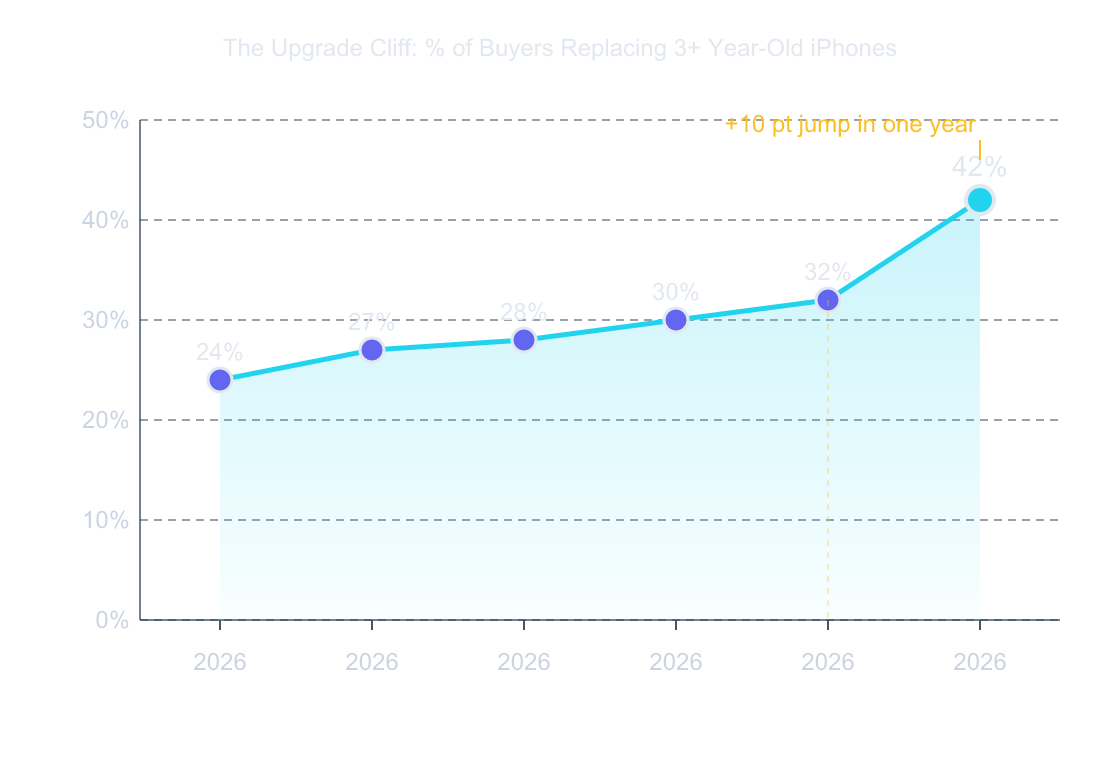
Source: CIRP (via Secondary Market News), 2026. The sharp 2026 spike suggests a wave of delayed upgraders entering the market.
Pro tip for trade-ins: If you’re planning to wait, don’t trade in your current phone too early. Apple and carrier trade-in programs offer the best values during launch week. Hold your current phone until September, trade it during the pre-order window, and maximize your credit.
Worth noting: Carrier promotions typically spike during iPhone launch windows. In 2026, major U.S. carriers increased maximum iPhone subsidies by roughly $100 compared to the prior year, which helped drive the iPhone 17 lineup’s 14% sales jump over iPhone 16 in the first 10 days.
Apple’s Q1 FY2026 earnings revealed record iPhone revenue of $85.27 billion — a 23% year-over-year increase — while the company’s total installed base exceeded 2.5 billion active devices (Apple Newsroom, 2026). This financial momentum suggests Apple has no reason to deviate from its annual September launch cadence or current pricing structure.
Frequently Asked Questions
Is the iPhone 18 Pro Max worth waiting for?
It depends on your current phone. If you’re on an iPhone 13 or older, absolutely — you’ll get five generations of chip improvements, variable aperture photography, and a 5,200 mAh battery. The average U.S. iPhone upgrade cycle is now 3.84 years (CIRP, 2026), so waiting six more months from an already-aging device makes sense. If you’re on an iPhone 16 or newer, skip it.
What chip will the iPhone 18 Pro Max have?
The A20 Pro, built on TSMC’s 2nm process node. It’s expected to deliver 15% faster CPU performance and 30% better power efficiency compared to the iPhone 17 Pro Max’s 3nm A19 Pro (MacRumors, 2026). The efficiency gains matter most — they’ll extend battery life and keep the phone cooler during Apple Intelligence tasks.
How much will the iPhone 18 Pro Max cost?
The starting price is expected to hold at $1,199, matching the iPhone 17 Pro Max. Apple hasn’t raised Pro Max pricing since the iPhone 15 Pro Max, and with record iPhone revenue of $85.27 billion in Q1 FY2026 (Apple Newsroom, 2026), there’s no financial pressure to increase prices.
Should I buy the iPhone 17 Pro Max now or wait for the 18?
If your current phone is functional and the battery lasts through your day, wait. The variable aperture camera and 2nm chip are meaningful upgrades. But if your phone is dying by 2 PM or you’re on an iPhone 12 that doesn’t support Apple Intelligence at all, don’t suffer through six more months — the iPhone 17 Pro Max is an excellent phone today.
Will the iPhone 18 Pro Max have a better camera?
Yes — significantly. The 48MP main sensor gains variable aperture (f/1.4-2.0), giving you optical depth-of-field control for the first time on an iPhone (9to5Mac, 2026). The front camera jumps from 18MP to 24MP. These are hardware improvements that can’t be replicated via iOS software updates.
The Bottom Line
The iPhone 18 Pro Max looks like a genuine generational upgrade — not a spec-bump year. Variable aperture photography, a 2nm chip, and the fastest charging Apple has ever shipped make it worth waiting for if your current phone is showing its age. Here’s the quick decision guide:
- Upgrade now (don’t wait): iPhone 12 or older — you’re missing Apple Intelligence entirely
- Wait for iPhone 18 Pro Max: iPhone 13, iPhone 14 — the biggest jump in years
- Wait, but it’s optional: iPhone 15/15 Pro — solid gains if battery is your pain point
- Skip entirely: iPhone 16 or newer — the improvements are incremental for you
Apple’s iPhone retention rate sits at roughly 92% (DemandSage, 2026), which means most of you reading this aren’t switching to Android. The real question isn’t if you’ll upgrade — it’s when. For iPhone 13 and 14 owners, September 2026 is looking like the right answer.
best iPhone accessories
