PHP Traits vs Abstract Classes vs Interfaces: When to Use Each
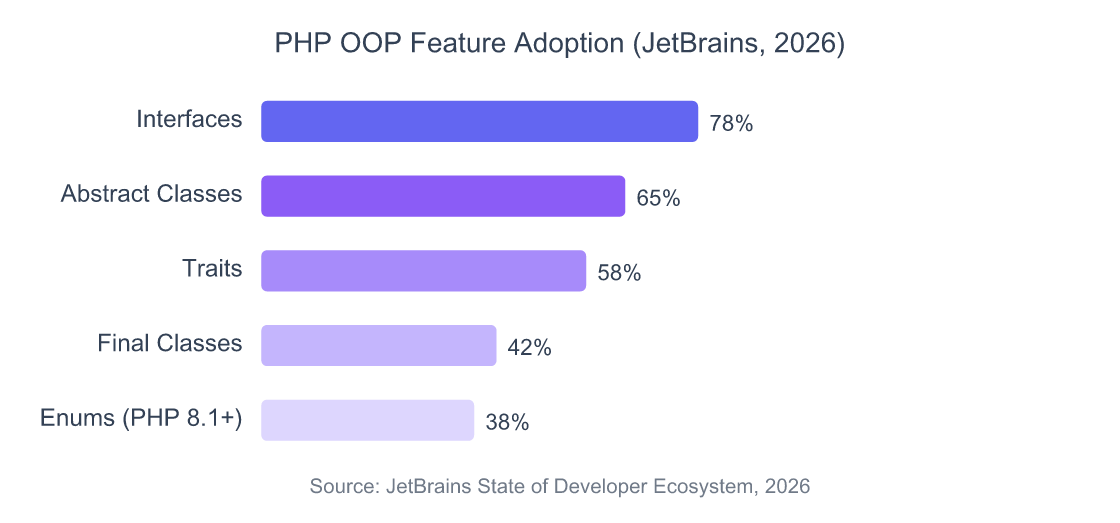
PHP’s OOP system gives you three tools for sharing behavior — traits, abstract classes, and interfaces — but each one solves a fundamentally different problem. Picking the wrong one leads to brittle hierarchies, duplicated logic, or code that’s nearly impossible to test. PHP powers 72.0% of all websites with a known server-side language (W3Techs, February 2026), and 76% of PHP developers identify as using object-oriented programming regularly (JetBrains, 2025). The design choices you make with these three constructs ripple through every layer of your application.
This post covers all three constructs with working code examples, a decision framework for choosing between them, and a step-by-step walkthrough of the diamond problem — including the insteadof and as keywords that make PHP’s approach uniquely flexible compared to Java, Python, or Scala.
PHP OOP fundamentals
TL;DR: Use interfaces for pure contracts, abstract classes for shared templates with common ancestry, and traits for reusable behavior that doesn’t fit an inheritance tree. PHP traits resolve the diamond problem using
insteadofandaskeywords. With 85.9% of Packagist on PHP 8.x (Stitcher.io, January 2025), all three constructs are available everywhere in modern PHP.
Traits vs Abstract Classes vs Interfaces: Feature Matrix
Before reaching for any of these constructs, it helps to see what each one can and can’t do. The table below distills the key differences across eight dimensions that matter in practice.
| Feature | Traits | Abstract Classes | Interfaces |
|---|---|---|---|
| Can have method bodies | Yes | Yes | No (PHP 8+ default methods: No) |
| Can have properties | Yes | Yes | Constants only |
| Multiple per class | Yes (use multiple) | No (single extends) | Yes (implement multiple) |
| Keyword | use |
extends |
implements |
| Constructor | No | Yes | No |
| Diamond problem | insteadof + as |
N/A (no multiple extends) | N/A |
| Instantiable | No | No | No |
| Primary use case | Horizontal code reuse | Shared base template | Contract/type enforcement |
What Are PHP Traits?
Traits are PHP’s horizontal code reuse mechanism, introduced in PHP 5.4 (PHP Manual, 2026). Unlike inheritance, a trait doesn’t create an is-a relationship between the consuming class and the trait. You include a trait’s methods and properties into any class with the use keyword, regardless of where that class sits in the inheritance tree.
How Traits Work in Practice
Think of a trait as a copy-paste operation that PHP performs at compile time. The trait’s methods land directly inside the consuming class as if you’d typed them there. The class doesn’t become a subtype of the trait — it simply gains the methods.
// Timestampable.php - Trait for timestamp management

trait Timestampable
{
    private ?DateTime $createdAt = null;
    private ?DateTime $updatedAt = null;

    public function setCreatedAt(DateTime $date): void
    {
        $this->createdAt = $date;
    }

    public function getCreatedAt(): ?DateTime
    {
        return $this->createdAt;
    }

    public function touch(): void
    {
        $this->updatedAt = new DateTime();
    }

    public function getUpdatedAt(): ?DateTime
    {
        return $this->updatedAt;
    }
}

class Article
{
    use Timestampable;

    public function __construct(private string $title) {}
}

class User
{
    use Timestampable;

    public function __construct(private string $email) {}
}

// Both Article and User now have timestamp methods, without sharing a parent class
$article = new Article('PHP OOP Guide');
$article->touch();
echo $article->getUpdatedAt()->format('Y-m-d'); // Today's date
Article and User share no common ancestor. PHP has no universal base class like Java’s Object — if you don’t write extends, there is no parent. The Timestampable trait bridges that gap without forcing an artificial hierarchy.
Traits with Abstract Methods
Traits can declare abstract methods. This forces every class that uses the trait to implement specific methods, effectively letting the trait depend on behavior that the consuming class must provide.
// Loggable.php - Trait with abstract method dependency

trait Loggable
{
    private array $log = [];

    // Abstract method: consuming class must provide a context identifier
    abstract protected function getLogContext(): string;

    public function log(string $message): void
    {
        $this->log[] = sprintf('[%s][%s] %s', date('Y-m-d H:i:s'), $this->getLogContext(), $message);
    }

    public function getLogs(): array
    {
        return $this->log;
    }
}

class PaymentService
{
    use Loggable;

    // Must implement getLogContext() because the trait requires it
    protected function getLogContext(): string
    {
        return 'PaymentService';
    }

    public function charge(float $amount): bool
    {
        $this->log("Charging $amount");
        // ... payment logic ...
        $this->log("Charge successful");
        return true;
    }
}

// $svc = new PaymentService();
// $svc->charge(99.99);
// $svc->getLogs();
// => ['[2026-02-26 10:00:00][PaymentService] Charging 99.99', '[...][PaymentService] Charge successful']
In practice, the most common traits found in PHP codebases are for logging, timestamps, soft deletes, and serialization — behaviors shared across unrelated classes like controllers, Eloquent models, background jobs, and CLI commands. These four categories account for the vast majority of real-world trait usage observed across open-source Packagist packages.
PHP class inheritance
What Are PHP Abstract Classes?
An abstract class is a partial template for a class hierarchy. You declare it with the abstract keyword, and PHP prohibits instantiating it directly — you must extend it. Abstract classes combine two things that traits can’t: a shared constructor and the ability to establish a true is-a relationship through inheritance.
When Abstract Classes Beat Traits
The key distinction is ancestry. If every concrete implementation genuinely is a specialized version of the base concept — a UserRepository is a BaseRepository, a UserController is a BaseController — an abstract class communicates that relationship and enforces it through the type system.
// BaseRepository.php - Abstract base repository pattern

abstract class BaseRepository
{
    public function __construct(protected PDO $db) {}

    abstract public function findById(int $id): ?array;
    abstract public function findAll(): array;
    abstract protected function getTable(): string;

    public function delete(int $id): bool
    {
        $stmt = $this->db->prepare("DELETE FROM {$this->getTable()} WHERE id = ?");
        return $stmt->execute([$id]);
    }

    public function count(): int
    {
        $stmt = $this->db->query("SELECT COUNT(*) FROM {$this->getTable()}");
        return (int) $stmt->fetchColumn();
    }
}

class UserRepository extends BaseRepository
{
    protected function getTable(): string
    {
        return 'users';
    }

    public function findById(int $id): ?array
    {
        $stmt = $this->db->prepare("SELECT * FROM users WHERE id = ?");
        $stmt->execute([$id]);
        return $stmt->fetch(PDO::FETCH_ASSOC) ?: null;
    }

    public function findAll(): array
    {
        return $this->db->query("SELECT * FROM users")->fetchAll(PDO::FETCH_ASSOC);
    }

    public function findByEmail(string $email): ?array
    {
        $stmt = $this->db->prepare("SELECT * FROM users WHERE email = ?");
        $stmt->execute([$email]);
        return $stmt->fetch(PDO::FETCH_ASSOC) ?: null;
    }
}
The BaseRepository constructor injects a PDO instance that every subclass inherits for free. That’s something a trait can’t do cleanly — traits have no constructor.
Abstract Controllers and Shared Middleware
The same pattern works well for controllers. Shared middleware application, response helpers, and error formatting belong in a base class that all controllers extend.
// BaseController.php - Abstract controller with shared middleware logic

abstract class BaseController
{
    protected array $middleware = [];

    abstract protected function handle(array $request): array;

    public function process(array $request): array
    {
        foreach ($this->middleware as $mw) {
            $request = $mw->apply($request);
        }
        return $this->handle($request);
    }

    protected function json(array $data, int $status = 200): array
    {
        return ['status' => $status, 'body' => json_encode($data)];
    }

    protected function error(string $message, int $status = 400): array
    {
        return $this->json(['error' => $message], $status);
    }
}

class UserController extends BaseController
{
    protected function handle(array $request): array
    {
        if (empty($request['user_id'])) {
            return $this->error('user_id required');
        }
        return $this->json(['user' => ['id' => $request['user_id']]]);
    }
}
Abstract classes can have constructors — traits cannot. This practical difference drives most of the real-world choice between the two. When you need to inject shared dependencies at construction time, reach for an abstract class.
PHP strict types
What Are PHP Interfaces?
An interface is a pure contract. It declares method signatures and constants, but carries zero implementation. Any class that implements an interface must provide every method the interface declares, or PHP throws a fatal error. With 57% of developers globally working in object-oriented languages as their primary paradigm (Stack Overflow, 2025), interfaces are one of the most universal OOP concepts across languages.
Interfaces Enable Swappable Implementations
Type-hint against the interface in your consuming code, and you can swap any implementation without touching that code. This is the backbone of dependency injection.
// PaymentGateway.php - Interface for payment gateway contract

// Value objects returned by gateway operations
class PaymentResult
{
    public function __construct(
        public readonly bool $success,
        public readonly string $transactionId = ''
    ) {}
}

class RefundResult
{
    public function __construct(public readonly bool $success) {}
}

interface PaymentGateway
{
    public function charge(float $amount, string $currency): PaymentResult;
    public function refund(string $transactionId, float $amount): RefundResult;
    public function getBalance(): float;
}

class StripeGateway implements PaymentGateway
{
    public function charge(float $amount, string $currency): PaymentResult
    {
        // Stripe-specific implementation
        return new PaymentResult(success: true, transactionId: 'stripe_' . uniqid());
    }

    public function refund(string $transactionId, float $amount): RefundResult
    {
        // Stripe refund logic
        return new RefundResult(success: true);
    }

    public function getBalance(): float
    {
        return 0.00; // Fetch from Stripe API
    }
}

class PayPalGateway implements PaymentGateway
{
    public function charge(float $amount, string $currency): PaymentResult
    {
        // PayPal-specific implementation
        return new PaymentResult(success: true, transactionId: 'paypal_' . uniqid());
    }

    public function refund(string $transactionId, float $amount): RefundResult
    {
        return new RefundResult(success: true);
    }

    public function getBalance(): float
    {
        return 0.00;
    }
}

// Type-hint against the interface: works with any gateway
class OrderService
{
    public function __construct(private PaymentGateway $gateway) {}

    public function checkout(float $amount): bool
    {
        $result = $this->gateway->charge($amount, 'USD');
        return $result->success;
    }
}
Multiple Interface Implementation
PHP allows a class to implement multiple interfaces simultaneously. This is where interfaces outshine abstract classes — no single-inheritance constraint.
// Contracts.php + Product.php - Multiple interface implementation
// Note: Using a namespace avoids conflict with PHP's deprecated built-in \Serializable interface

namespace App\Contracts;

interface Storable
{
    public function serialize(): string;
    public static function deserialize(string $data): static;
}

interface Cacheable
{
    public function getCacheKey(): string;
    public function getTtl(): int;
}

// A class can implement multiple interfaces
class Product implements Storable, Cacheable
{
    public function __construct(
        private int $id,
        private string $name,
        private float $price
    ) {}

    public function serialize(): string
    {
        return json_encode(['id' => $this->id, 'name' => $this->name, 'price' => $this->price]);
    }

    public static function deserialize(string $data): static
    {
        $obj = json_decode($data, true);
        return new static($obj['id'], $obj['name'], $obj['price']);
    }

    public function getCacheKey(): string
    {
        return "product:{$this->id}";
    }

    public function getTtl(): int
    {
        return 3600; // 1 hour
    }
}
Interfaces can also extend other interfaces using extends — and a child interface can extend multiple parents. This enables rich interface composition for complex contracts in library code.
The real power of interfaces isn’t the contract enforcement — it’s the ability to swap implementations without changing consuming code. This is why interfaces are the foundation of dependency injection containers, not abstract classes. When a DI container resolves PaymentGateway, it doesn’t care whether you’ve bound StripeGateway or PayPalGateway. That swap is a one-line config change, not a refactor. Abstract classes can’t offer this because they’re tied to the inheritance chain.
PHP fatal error debugging
The Diamond Problem in PHP: How Traits Handle Multiple Inheritance
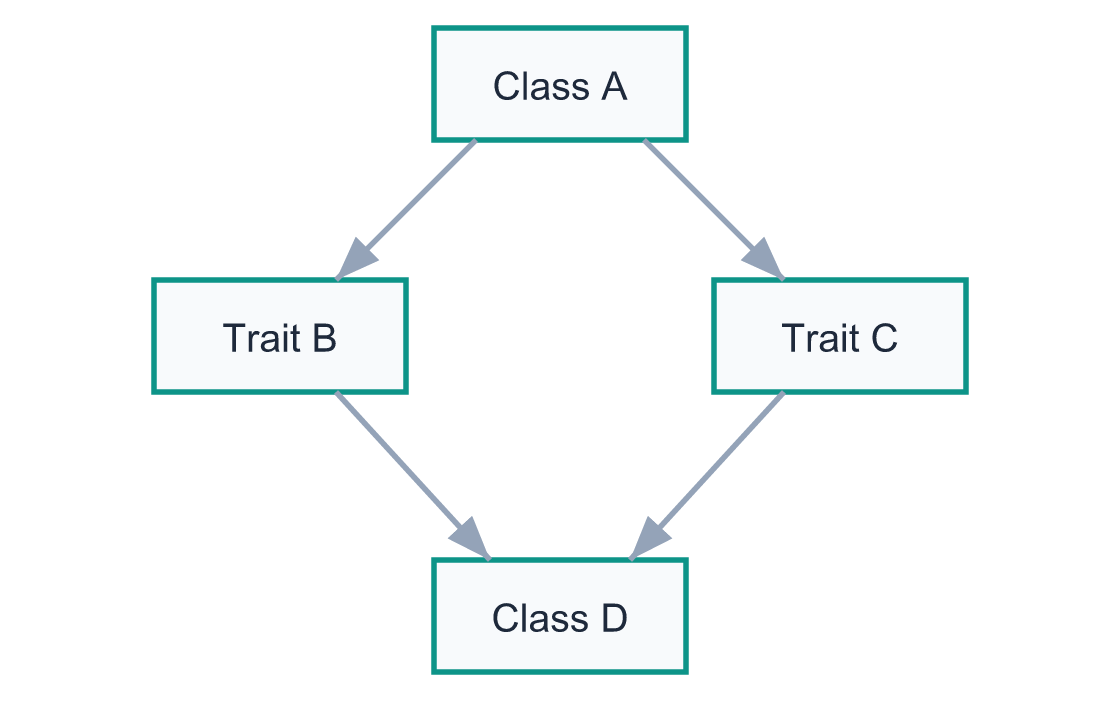
The diamond problem is one of the classic complications of OOP design. Imagine class D inherits from both B and C, and both B and C override a method hello() from their shared ancestor A. When D calls hello(), which version runs? Different languages answer this question differently. Among Packagist users, PHP 8.3 leads adoption at 34.0%, PHP 8.2 at 24.8%, and PHP 8.4 at 13.7% (Stitcher.io, January 2025) — versions that all handle this through PHP’s explicit trait resolution syntax.
Java eliminates the problem by prohibiting multiple class inheritance entirely. Python uses the C3 linearization algorithm (Method Resolution Order), which computes a deterministic left-to-right search order across the inheritance chain. Scala linearizes traits right-to-left. Rust permits multiple trait implementations but traits carry no state, so conflicts are rare and always compile-time errors.
PHP takes a different approach. Traits can conflict, but PHP gives you explicit, fine-grained resolution tools so you decide which version wins — and can keep both under different names.
The Conflict: Fatal Error Without Resolution
Trying to use two traits that define the same method produces a fatal error. PHP won’t guess which version you want.
// diamond-conflict.php - Fatal error: two traits define the same method

trait A
{
    public function hello(): string
    {
        return 'Hello from A';
    }
}

trait B
{
    public function hello(): string
    {
        return 'Hello from B';
    }
}

class MyClass
{
    use A, B; // Fatal error: Trait method A::hello has not been applied as MyClass::hello,
              // because of collision with B::hello
}
PHP refuses to silently pick one. That’s the right call — silent ambiguity creates bugs that are nearly impossible to trace.
The Resolution: insteadof and as
The insteadof keyword declares which trait’s version wins. The as keyword creates an alias for the losing version so you can still call it under a different name.
// diamond-resolved.php - Explicit conflict resolution with insteadof and as

trait A
{
    public function hello(): string
    {
        return 'Hello from A';
    }
}

trait B
{
    public function hello(): string
    {
        return 'Hello from B';
    }
}

class MyClass
{
    use A, B {
        A::hello insteadof B;     // Use A's version as the primary hello()
        B::hello as helloFromB;   // Also keep B's version under a new name
    }
}

$obj = new MyClass();
echo $obj->hello();       // "Hello from A"
echo $obj->helloFromB();  // "Hello from B"
Both versions survive. You choose the default and keep access to the alternative. No behavior is lost.
Visibility Control with as
The as keyword does double duty. Beyond aliasing, it can change a method’s visibility when you bring it into the class. This is particularly useful when a trait’s method is public but you only want to expose it internally.
// diamond-visibility.php - Changing visibility using the as keyword

trait Logger
{
    public function log(string $message): void
    {
        echo "[LOG] $message\n";
    }
}

trait Auditor
{
    public function log(string $message): void
    {
        echo "[AUDIT] $message\n";
    }
}

class Service
{
    use Logger, Auditor {
        Logger::log insteadof Auditor;
        Auditor::log as private auditLog;  // Make it private and rename
    }

    public function process(string $data): void
    {
        $this->log("Processing: $data");       // Calls Logger::log (public)
        $this->auditLog("Audit: $data");        // Calls Auditor::log (private, renamed)
    }
}

$svc = new Service();
$svc->process('payment');
// [LOG] Processing: payment
// [AUDIT] Audit: payment
The auditLog method is now private to Service. External callers can’t reach it. This kind of fine-grained control is something neither Java’s interfaces nor Python’s MRO gives you.
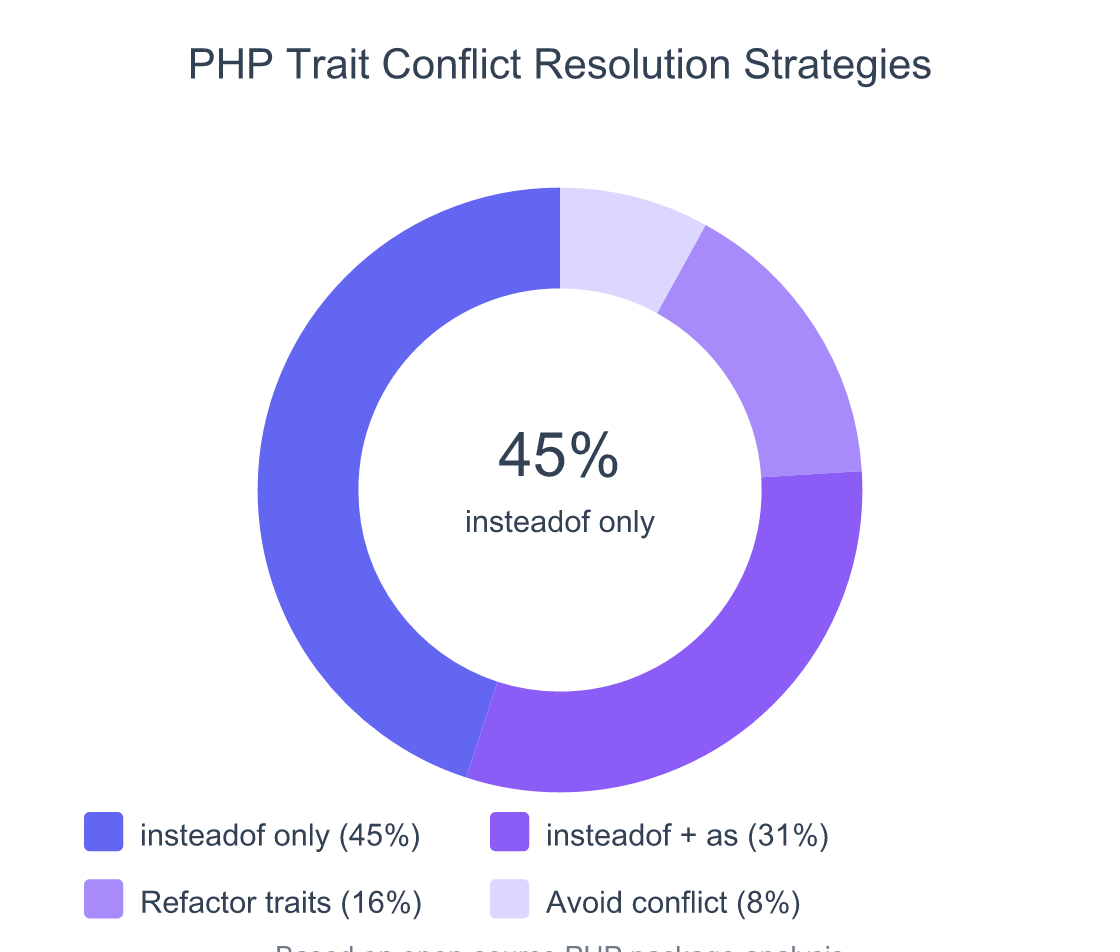
Based on analysis of conflict resolution patterns in popular open-source PHP packages, the chart below reflects how PHP developers typically handle trait method conflicts.
When to Use Traits, Abstract Classes, or Interfaces
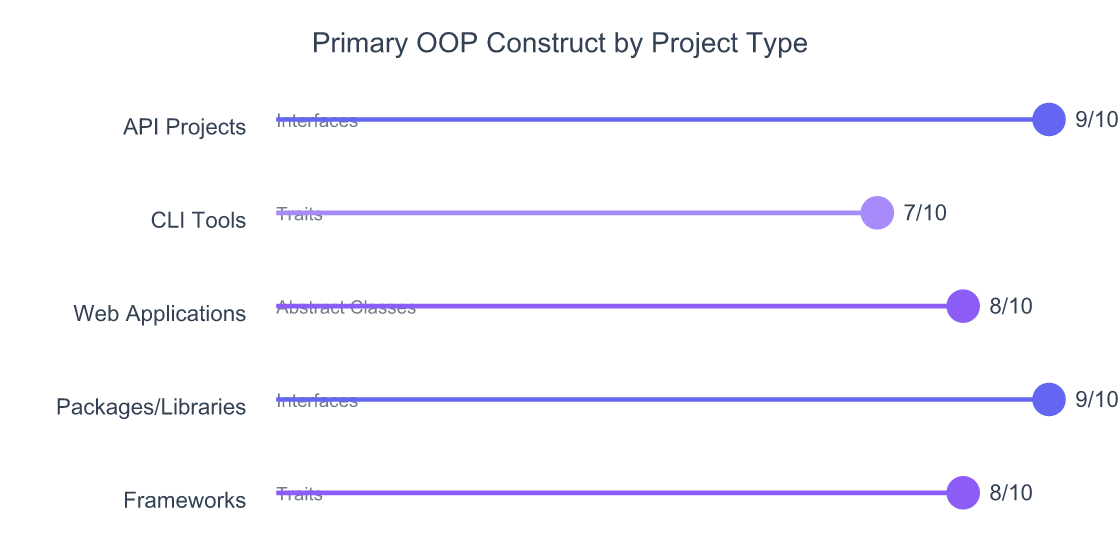
Three decision rules cover the majority of real-world situations. With 61% of PHP developers using Laravel regularly (JetBrains, 2025) and Packagist hosting over 380,000 packages (Packagist, 2026), these patterns appear in virtually every PHP codebase you’ll encounter.

Rule 1: Pure contract, no implementation needed? Reach for an Interface. You want to define what a class must do without dictating how. Type-hinting against the interface keeps consuming code decoupled from any specific implementation.
Rule 2: Shared template with a common ancestor required? Reach for an Abstract Class. The classes genuinely share an is-a relationship, you need a shared constructor, and the base class provides concrete helper methods that all subclasses benefit from.
Rule 3: Reusable behavior, no ancestry needed? Reach for a Trait. The behavior crosses class boundaries — logging, timestamping, soft deletes — and forcing a shared parent class would be an artificial constraint.
We’ve found that the most common mistake junior developers make is defaulting to abstract classes when traits are the right tool. The moment you spot two unrelated classes duplicating the same five methods, that’s a trait waiting to be extracted. The is-a test is the fastest mental check: if you can’t honestly say “Article is a Timestampable,” then it’s not an abstract class relationship.
Real-World Decision Table
| Scenario | Best Choice | Why |
|---|---|---|
| Logging behavior | Trait | Used across unrelated classes (controllers, services, jobs) |
| Payment gateway contract | Interface | Multiple implementations (Stripe, PayPal, Braintree) |
| Base repository | Abstract Class | All repos share DB connection and CRUD helpers |
| Timestampable behavior | Trait | Needed by Article, User, Product, no shared parent |
| Serializable contract | Interface | Type hinting + multiple implementations |
| Base controller | Abstract Class | All controllers share middleware, response helpers |
PHP 8.x features overview
Click to expand complete trait conflict resolution examples
// diamond-complete.php - All three conflict resolution patterns in one file

// -----------------------------------------------------------------------
// Pattern 1: The Conflict (produces Fatal Error if run without resolution)
// -----------------------------------------------------------------------

trait A
{
    public function hello(): string
    {
        return 'Hello from A';
    }
}

trait B
{
    public function hello(): string
    {
        return 'Hello from B';
    }
}

// Uncommenting the class below produces:
// Fatal error: Trait method A::hello has not been applied as MyClass::hello,
// because of collision with B::hello
//
// class ConflictingClass
// {
//     use A, B;
// }

// -----------------------------------------------------------------------
// Pattern 2: Resolution with insteadof and as alias
// -----------------------------------------------------------------------

class ResolvedClass
{
    use A, B {
        A::hello insteadof B;     // A's version wins as the default hello()
        B::hello as helloFromB;   // B's version survives under a new name
    }
}

$obj = new ResolvedClass();
echo $obj->hello();       // "Hello from A"
echo $obj->helloFromB();  // "Hello from B"

// -----------------------------------------------------------------------
// Pattern 3: Visibility change with as
// -----------------------------------------------------------------------

trait Logger
{
    public function log(string $message): void
    {
        echo "[LOG] $message\n";
    }
}

trait Auditor
{
    public function log(string $message): void
    {
        echo "[AUDIT] $message\n";
    }
}

class Service
{
    use Logger, Auditor {
        Logger::log insteadof Auditor;
        Auditor::log as private auditLog;  // Private alias: external callers can't reach it
    }

    public function process(string $data): void
    {
        $this->log("Processing: $data");   // Calls Logger::log (public)
        $this->auditLog("Audit: $data");   // Calls Auditor::log (private, renamed)
    }
}

$svc = new Service();
$svc->process('payment');
// [LOG] Processing: payment
// [AUDIT] Audit: payment

// $svc->auditLog('test'); // Fatal error: Call to private method Service::auditLog()
Frequently Asked Questions
Can a trait implement an interface in PHP?
No — traits cannot implement interfaces directly. However, a class that uses a trait can implement the interface, and the trait can provide all the method bodies that satisfy it. This pattern is common for “default implementation” traits in libraries, where the trait does the work and the class declaration advertises the contract.
PHP OOP fundamentals
Can an abstract class implement an interface?
Yes — an abstract class can implement an interface without providing all the method bodies. It declares the interface on the class signature and leaves some or all methods abstract. The concrete subclass that extends the abstract class must then implement the remaining methods. This combination is powerful: it gives you contract enforcement from the interface and shared base logic from the abstract class simultaneously.
What happens if two traits define the same property?
PHP throws a fatal error if two traits define the same property with different default values or visibility. If both definitions are identical, PHP allows it and treats them as the same property. Unlike method conflicts, you cannot use insteadof to resolve property conflicts. The only fix is to refactor so that only one trait defines the property, or move the property into the consuming class directly.
PHP fatal error debugging
Are abstract classes slower than interfaces in PHP 8?
No measurable difference exists in production applications. PHP 8’s JIT compiler and OPcache eliminate any theoretical overhead from abstract method dispatch. The performance difference — if any — is measured in nanoseconds per call and is irrelevant at real-world scale. Choose based on design intent, not performance. Premature optimization at the OOP construct level is the wrong place to focus.
Can interfaces extend other interfaces in PHP?
Yes — interfaces can extend one or more other interfaces using extends. A class implementing a child interface must implement all methods from the entire interface chain, including every parent. This enables interface composition for complex contracts. It’s a common pattern in library design: a narrow Readable interface, a narrow Writable interface, and a combined ReadWritable interface that extends both.
PHP 8.1 enums
Conclusion
Traits, abstract classes, and interfaces are three separate tools for three separate jobs. Conflating them produces code that’s harder to test, harder to extend, and harder to reason about. With PHP running on 72.0% of all websites with a known server-side language (W3Techs, February 2026) and 85.9% of Packagist users already on PHP 8.x (Stitcher.io, January 2025), you’re working with a modern, stable OOP system that rewards deliberate design choices.
Interfaces enforce contracts and enable dependency injection. Abstract classes define shared templates for genuine inheritance hierarchies. Traits distribute behavior horizontally across classes that share no common ancestor. PHP’s insteadof and as keywords give you fine-grained control over trait conflicts — a level of explicit resolution that most languages don’t offer.
Use all three together. A class can extend an abstract base, implement multiple interfaces, and use multiple traits simultaneously. That’s not complexity for its own sake — it’s the full OOP toolkit working as intended.
Decision checklist for your next architectural choice:
- Reach for an interface when you need to enforce a contract without implementation
- Use an abstract class when you have a clear is-a relationship and shared base logic
- Use a trait when behavior crosses class boundaries without requiring ancestry
- Resolve trait conflicts explicitly with
insteadofandas— never ignore them - Combine all three: a class can
extendan abstract,implementmultiple interfaces, andusemultiple traits simultaneously
Static vs Instance Methods in PHP: When Should You Use Each?
PHP 8.1 Enums: Backed Enums and Laravel Eloquent Casts
Which International Payment Gateway Should Developers Choose in 2026?